Remembering Freedom
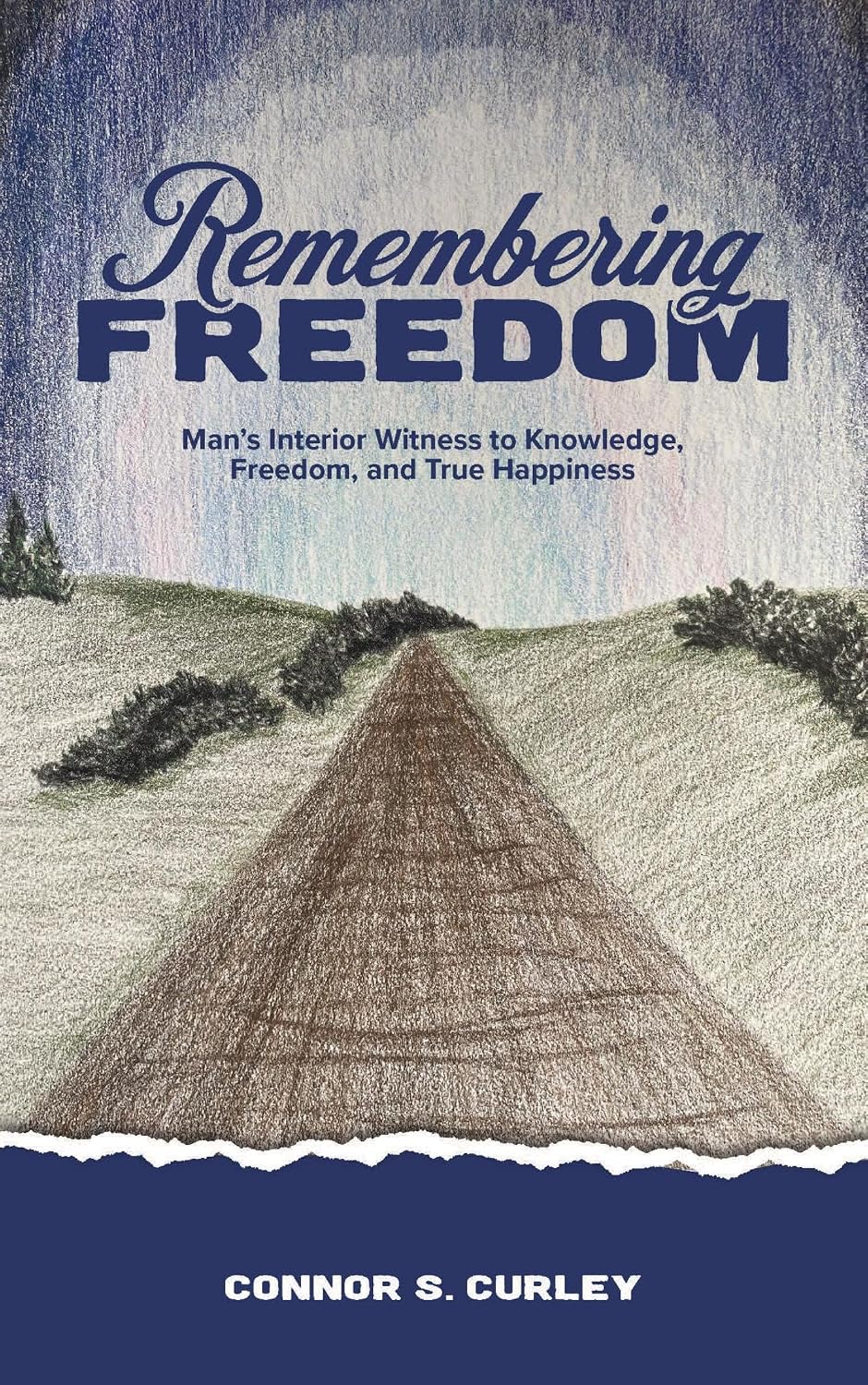

In Remembering Freedom, Connor S. Curley takes on a question that shapes nearly every part of our lives: What does it actually mean to be free? His answer begins with an exploration of how we know what’s true, moves through an examination of human nature, and eventually arrives at the relationship between freedom, conscience, and happiness. Drawing heavily on Catholic intellectual tradition, particularly Thomas Aquinas, Karol Wojtyła (Pope John Paul II), and Joseph Ratzinger (Pope Benedict XVI), Curley argues that genuine freedom is rooted in our ability to recognize and pursue what is good. At the center of his argument is the conviction that truth is objective and ultimately personal, because truth finds its fullest expression in God. It’s an ambitious philosophical project that invites readers to reconsider some of their most basic assumptions about knowledge, personal autonomy, and the purpose of human life.
One of the book’s most interesting features is how Curley connects ideas that we often consider separately. His discussion of knowledge establishes the groundwork for understanding the human person as a union of body and soul, while his examination of conscience introduces the idea of anamnesis, an interior recognition of goodness that directs us toward truth. These concepts come together in his treatment of freedom, where he distinguishes the classical understanding of freedom as the pursuit of the good from the modern emphasis on unrestricted choice. Curley draws on an impressive range of philosophical and theological sources, moving between Plato, Aristotle, Aquinas, Descartes, and more recent Catholic thinkers. His use of stories and practical examples, from the tragedy of Oedipus to a soldier’s encounter with a rattlesnake, helps bring abstract philosophical concepts into everyday experience. These moments are especially engaging because they allow readers to see how the questions he’s exploring play out in actual human decisions.
Curley’s writing has the unmistakable personality of someone who genuinely enjoys a spirited intellectual conversation. He’s comfortable challenging prevailing assumptions, questioning established arguments, and occasionally wandering down an interesting philosophical side road. That conversational energy gives the book a distinctive voice, although the arguments themselves can become quite dense. Readers will encounter substantial discussions of epistemology, teleology, natural law, and the operations of the soul, often supported by extended quotations from other thinkers. Curley’s interpretation of modern philosophy is particularly sweeping, and his account of its relationship to contemporary understandings of freedom invites further debate. He also makes clear that his argument proceeds from a Christian understanding of God, an important consideration when evaluating his conclusions. Perhaps the book’s most compelling thread is its insistence that human beings are fundamentally relational. Our freedom, dignity, and happiness are intimately connected to our relationships with God and one another, a theme that gives the more technical philosophical discussions a meaningful human dimension.
Remembering Freedom will likely appeal most to intellectually curious Catholics and other Christians who want to explore the philosophical foundations of their beliefs, especially those interested in Thomism, personalism, and the relationship between faith and reason. Readers who enjoy G. K. Chesterton, Josef Pieper, or John Paul II will find familiar ideas developed and connected in interesting ways. It would also make a worthwhile choice for a philosophy reading group, particularly one whose members enjoy wrestling with challenging ideas and discussing them together. Some familiarity with classical philosophy or Catholic theology will certainly help, and readers approaching these subjects for the first time may want to take the book slowly. Curley’s concluding reflections on intellectual humility and the importance of genuine dialogue offer a fitting destination for the journey. His larger invitation is to approach knowledge as an encounter with reality and with other persons, and to understand freedom as something that develops through the pursuit of truth and goodness. The book is particularly suited to readers who enjoy conversations that continue long after they’ve turned the final page.
Pages: 237 | ASIN : B0GX35TDFW


Posted on September 30, 2026, in Book Reviews, Five Stars and tagged Catholic theology, christian living, Epistemology, ethics, morality, nonfiction, philosophy, Remembering Freedom. Bookmark the permalink. Leave a comment.



Leave a comment
Comments 0