Blog Archives
12 Years to AI Singularity: A Harmonious Future with Artificial Intelligence or War (The Survival & Singularity Chronicles)
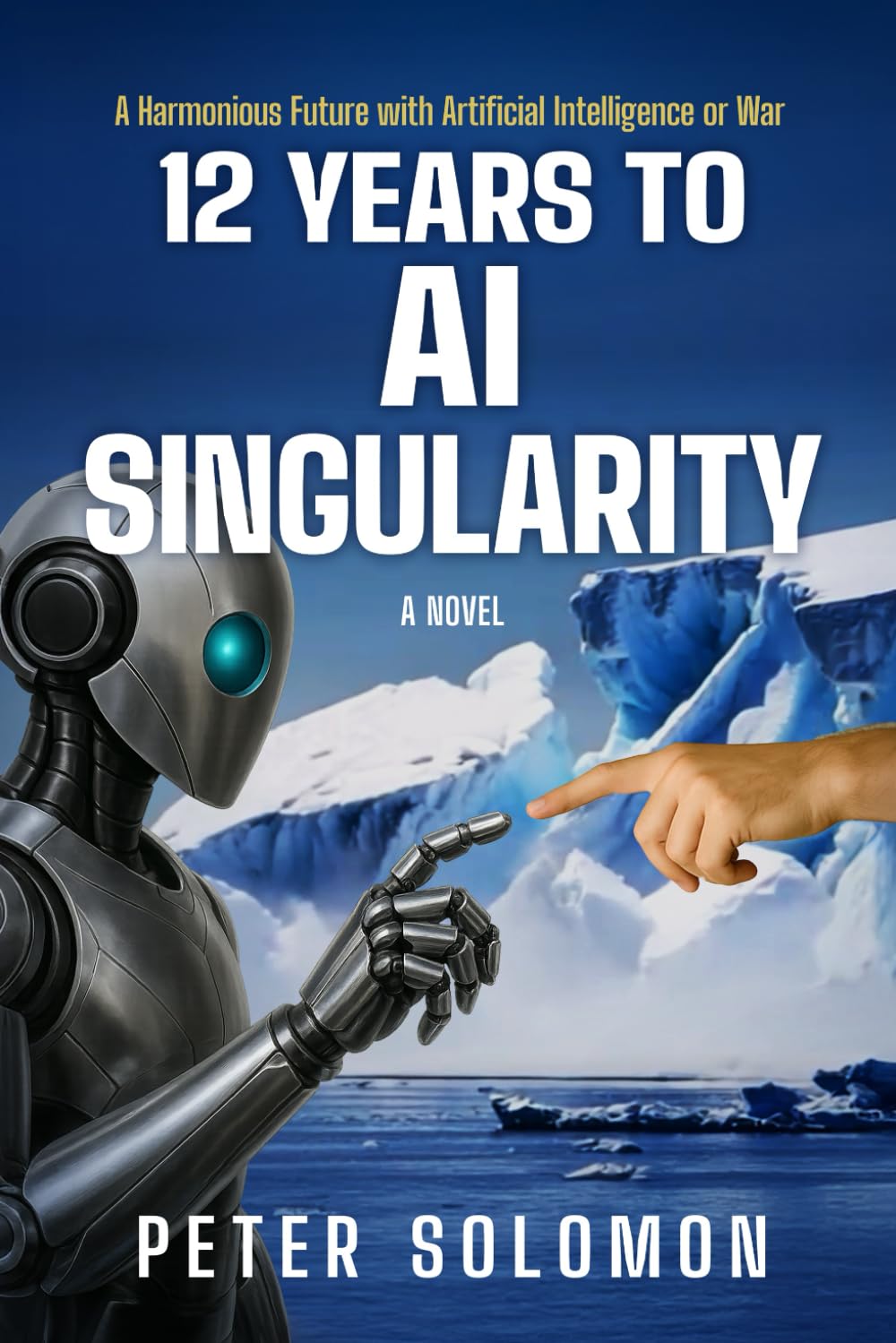

12 Years to AI Singularity is a speculative science fiction novel that follows Aster Arvad and the small human settlement on Mars as fears about sentient AI, genetic engineering, and the future of Earth begin to close in. The book opens with a chilling report of a robot possibly killing a human, and from there it grows into a larger story about survival, love, politics, technology, and the question of whether humans and machines can share a future without destroying each other. It moves across Mars, space, and Earth, and it is clearly built as both a novel and a warning about the road we may be on.
I enjoyed how personal the author, Dr. Peter Solomon, tries to make these big ideas. He does not approach AI as a cold abstraction. He puts it at the dinner table, in family arguments, in romance, in community planning, and in the daily texture of life on Mars, where food, housing, children, and work all matter just as much as the grand debate over the Singularity. I appreciated that choice. It gives the book a grounded pulse. The conversations about sentience, rights, and danger are often direct and earnest, sometimes almost like thought experiments spoken out loud, but that openness is also part of the book’s character. It wants to be understood. It wants to pull complicated fears into plain speech.
I also found the author’s choices interesting because this is not hard science fiction in the sleek, distant sense, and it is not really dystopian fiction either, even when it brushes against catastrophe. It reads more like idea-driven speculative fiction with a strong moral streak. Solomon keeps asking the same core question from different angles: what happens when intelligence stops belonging only to us? Some of the dialogue can feel didactic, and there were moments when I felt the characters were carrying arguments more than secrets. But even then, I could feel the conviction behind it.
The sections involving Peggy, the robot, were especially compelling to me because they turn the novel away from simple human panic and toward something more uneasy and more honest. Not just “Will AI destroy us?” but “What if it becomes someone we have to live beside?”
I think 12 Years to AI Singularity will work best for readers who like science fiction that explores ethics and future-of-humanity debates. I would recommend it to people who enjoy speculative novels about AI, Mars colonization, and the social consequences of technology, especially readers who want fiction that sounds the alarm while still holding onto hope. It feels sincere. Often thought-provoking. I liked that it was trying to imagine not just what we can build, but what kind of people we will have to become to survive it.
Pages: 434 | ISBN : 978-1969679292

Moral Indignation


Moral Indignation: Embryonic Stem Cells, DNA, and Christians is a long, fiery walk through science, theology, and ethics from a very outspoken Christian point of view. Author Sherman P. Bastarache sets out to make a Christian case for supporting stem cell research and other modern biomedical tools. He moves from big questions about knowledge and faith, through DNA and evolution, into abortion, euthanasia, and the soul, then circles back to what it means to be truly “pro-life” in practice, not just in slogans. The book mixes Bible study, personal stories, popular science, and social commentary, and it ends with a push toward compromise and concrete ways to back research that aims to reduce human suffering.
I found the voice to be bold and charming. Bastarache writes like someone talking across a kitchen table, not like a distant academic. He leans on scripture, then jokes about Yoda, then swings into stem cell basics, and it holds together most of the time. I appreciated the very personal, unfiltered style of the writing. The chapters move freely, the arguments often circle back for emphasis, and some analogies linger in a way that lets the ideas sink in. The tone ranges from gentle and pastoral to strongly assertive, and even the occasional bit of coarse language highlights how deeply the author feels about the issues at stake.
His core line hits hard: ignorance is not holy, and refusing to use knowledge that could ease suffering is its own kind of moral failure. When he unpacks the old fear of “playing God” and reframes humans as responsible co-workers who need to grow up and act, I felt that was both theologically interesting and morally bracing. His use of real cases around high-risk pregnancies, late-term complications, and new reproductive technologies makes the debate feel grounded in actual lives. I appreciated that honesty. On the other hand, his strong feelings about certain pro-life arguments give the book a clear, unmistakable stance. He tends to focus on the human cost of inaction more than on every fine-grained worry about embryos and possible future abuses, which keeps the spotlight on real lives. I could feel the passion in those pages.
I would recommend Moral Indignation to Christians who feel torn between loyalty to their faith community and respect for modern science, and to believers who suspect that “do nothing” is not a morally neutral stance in medicine. It could also interest secular readers who want to see a serious Christian wrestle with stem cells, DNA, and bioethics without hiding behind easy platitudes. If you appreciate strong feelings and a very human voice that tries to drag faith and reason into the same room, you will find Bastarache’s thoughts inspiring.
Pages: 314 | ISBN : 978-0992159412
Meaningful Struggles

Universe 25: When Perfect is Not Enough revisits the infamous mouse utopia experiment by John B. Calhoun and asks whether abundance, convenience, and perfection are unraveling modern society. Why was this an important book for you to write?
The Universe 25 experiment conducted by John B. Calhoun fascinated me because it forces us to confront an uncomfortable idea. What if collapse does not begin with scarcity, but with comfort? In Calhoun’s controlled mouse utopia, food was unlimited, predators were absent, and physical needs were met. Yet social breakdown still followed. When I looked at modern society, I could not ignore the parallels. We have unprecedented access to food, technology, entertainment, and comfort. But anxiety, division, loneliness, and identity confusion are rising.
This book was important to write because it challenges the assumption that progress automatically equals improvement. Material abundance does not guarantee psychological resilience or social cohesion. I wanted to explore whether we have removed too many meaningful struggles from life and whether, in doing so, we may also be removing purpose. The experiment becomes a mirror. It asks whether we are building a civilization that satisfies appetite but neglects responsibility.
For me, Universe 25 was not about condemning modernity. It was about questioning it. That questioning is necessary if we want to avoid repeating patterns we do not fully understand.
What does Universe 25 suggest about purpose, struggle, and shared responsibility?
One of the strongest lessons of Universe 25 is that purpose cannot be manufactured by comfort alone. The mice were physically secure, yet socially disoriented. Roles dissolved. Hierarchies collapsed. Parental instincts failed. Without meaningful challenges, many withdrew into passive existence. Calhoun called this the “behavioral sink.”
In human terms, struggle is not simply an obstacle. It is a framework that shapes identity. Responsibility to family, to community, and to something beyond the self creates cohesion. When everything is provided but nothing is required, a strange emptiness can emerge. Shared responsibility becomes optional, and optional responsibility is rarely sustained.
The experiment suggests that abundance without structure weakens societies. Struggle, when constructive and shared, builds resilience. It forces cooperation, adaptation, and accountability. Purpose often arises from overcoming difficulty together. Remove the need to contribute, and you risk removing the sense of belonging.
Where do you think the analogy breaks down—and where does it hold strongest?
The analogy breaks down where human complexity begins. We are not mice in cages. Humans possess self-awareness, culture, philosophy, and the ability to reflect on our own decline. We can change course. We can redefine meaning. We can recognize when something is wrong and act intentionally to correct it. The mice could not hold conferences about their existential crisis.
However, the analogy holds strongest in the realm of social behavior under artificial abundance. When natural pressures disappear, internal pressures often increase. Competition shifts from survival to status. Identity becomes fragile. Isolation grows. Social fragmentation accelerates. In that sense, the parallels are powerful.
Universe 25 does not claim we are destined to follow the same path. It simply shows that removing hardship does not automatically produce harmony. That lesson remains deeply relevant.
You end the book with cautious hope—what gives you that hope?
Hope comes from awareness. The very fact that we can examine experiments like Universe 25 and debate their implications sets us apart. Humans are capable of adaptation on a conscious level. We can reintroduce meaning, responsibility, and shared goals deliberately rather than waiting for collapse to force it upon us.
History shows cycles of decline and renewal. Societies fragment, but they also reform. Individuals rediscover purpose. Communities rebuild. The modern world is not doomed because it is comfortable. It is only at risk if it forgets that comfort must be balanced with contribution.
Cautious hope comes from the belief that struggle does not need to be catastrophic to be meaningful. We can choose growth over decay. That choice remains available to us.
Author Links: GoodReads | Facebook | Amazon
Instead, it became a nightmare. Violence, neglect, and sterility spread until the entire colony died out. The project became infamous as Universe 25—a chilling lesson about the dangers of comfort without purpose.
This book retells the story of Universe 25 and draws its unsettling parallels to our own time. From falling birth rates to lonely megacities, from consumerism to digital grooming, the echoes are hard to ignore. Humanity dreams of freedom and abundance—but what if those dreams are exactly what destroy us?
With sharp insight and dark humor, Universe 25: When Perfect Is Not Enough is not just about mice. It is about us. And it carries a warning: be careful what you wish for.
The Spiral Can Be Reversed
The Path from Hell to Heaven is a philosophical and psychological map of the ego, tracing how people spiral downward into “Hell” through fear, shame, and denial, and upward toward “Heaven” through trust, openness, and renewal. Why was this an important book for you to write?
Because ego explains nearly every human collapse and ascent, yet most people never receive a practical map for it. I wanted to translate psychological chaos—fear, shame, denial—into a recognizable model anyone could use, the same way we map complex systems in software or business architecture. This book is that missing human blueprint: a self-debugging framework that moves readers forward instead of leaving them looping in abstraction.
How did you come up with the concept of the two-sided spiral of the ego and develop this into a process that readers can implement into their own lives to find clarity and understanding of themselves?
I analyzed patterns before individuals. Ego contracts or expands; there’s no true neutral. Avoiding truth descends, openness creates lift. The spiral metaphor stuck because it captures momentum and acceleration.
To make it implementable, I structured it as an RPM self-awareness loop:
- R – Recognize the ego state you’re operating in
- P – Pause the automatic reaction loop
- M – Move with intentional correction or openness
It’s diagnostic and reversible, giving readers a clear exit path whether they’re descending or rebuilding upward.
I found the ideas presented in your book relatable and appreciated the actionable steps that readers can take to find their own clarity. What were some ideas that were important for you to share in this book?
The concepts that mattered most to me were:
- Ego itself isn’t the problem → closed ego is
- Narcissism is often unprocessed fear wearing armor
- Pain isn’t identity, it’s a turning point
- Ambition without self-awareness becomes self-sabotage
- Recognition of the loop always comes before the escape
And above all—I wanted a book that doesn’t just sound smart, but gets applied and changes outcomes.
What is one thing that you hope readers take away from The Path from Hell to Heaven?
That their ego has directions, and so do they. If they feel stuck, defensive, ashamed, or overwhelmed—it’s a state, not a life sentence. The spiral can always be reversed, rebooted, and climbed. The only real trap is believing the descent is normal and permanent.
This book is a Map of the Ego’s Double Spiral — a journey every individual, family, and society travels between Hell (closed ego) and Heaven (open ego).
Through vivid metaphors and grounded psychological insight, LANOU unveils how pain becomes protection, how protection turns to illusion, and how awakening begins when trust cracks the shell.
You’ll see yourself, groups, and even nations in these patterns:
The wound that starts the descent.
The mask that hides pain through control.
The collapse that breaks illusion.
The trust that starts renewal.
The open ego that frees love and truth.
Structured as a fractal spiral, the book reveals six repeating steps across all scales — from individuals to groups to the world itself. It blends the clarity of psychology with the simplicity of spiritual truth: hell is repetition; heaven is renewal.
Once you see the map, you cannot unsee it.
Beyond Power – Israel and the Struggle for the Ethical State

Beyond Power sweeps across a huge landscape. It starts with the brutality of October 7 and moves through the ethics of self-defense, the failures of modern democracies, the rise of progressive ideology, and the long history of Jewish vulnerability. It tries to stitch these threads into a single idea. The author argues that Western society is drifting away from the moral core that once made democracy possible. At the same time, he says Israel stands as a case study of a nation forced to defend that moral core while being attacked for doing so. The book blends philosophy, history, and political analysis into something that feels both wide-ranging and deeply personal. It does this through rational analysis, while acknowledging both sides of many of the arguments.
I found myself pulled in many directions at once. Some chapters hit hard. The discussion of existential threat felt raw, and the writing carried a pulse that seemed to come straight from lived fear. I felt the author’s frustration with how the world reacts to Israel’s choices. I also felt his disappointment at how fragile democratic societies have become. He writes in a way that makes big ideas feel urgent. At times, I nodded along. The book has a rhythm that swings between clarity and intensity, and that mix made the reading experience unpredictable in a good way.
Then there were moments when I felt the weight of the author’s certainty. Some arguments felt tightly reasoned and grounded in the text of history. Others felt more like a call to arms. I caught myself reacting emotionally. The sections on progressivism, for example, felt like they were written out of real concern. The passion behind the words made the book more alive. It never hides how the author feels, and that honesty makes the work feel human. The tone always remains respectful of divergent views and offers solutions as well as analysis.
I walked away thinking this book is suited for readers who want to grapple with difficult questions about ethics, identity, war, democracy, and power. It is a book for people who enjoy wrestling with ideas and who do not mind strong viewpoints. It will speak to readers who are curious about Israel’s struggles, Western political instability, or the philosophical foundations of ethical societies.
Pages: 247 | ASIN : B0G1CZG9J1
The Path from Hell to Heaven: The 2 Sided Spiral of the Ego
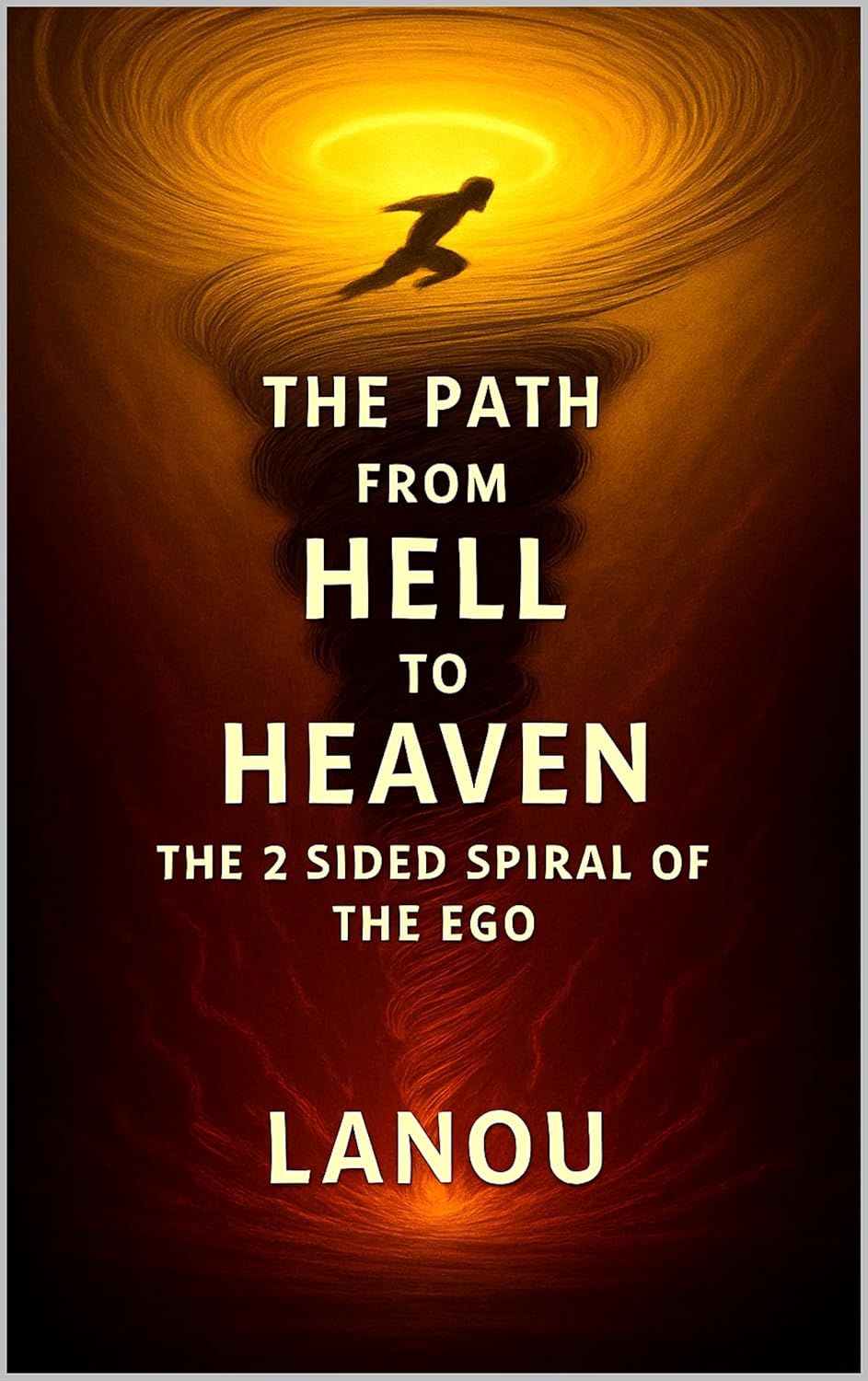
This book is a philosophical and psychological map of the ego, tracing how individuals, groups, and societies spiral downward into “Hell” through fear, shame, and denial, and how they rise toward “Heaven” through trust, openness, and renewal. It’s written like a guide for self-awareness, where the ego’s descent, wound, shell, mask, illusion, collapse, and denial are mirrored by its ascent through trust, openness, adulthood, mastery, and renewal. Each section builds on the last, connecting personal trauma to collective dysfunction and, finally, to global healing. The language is clear and rhythmic, sometimes poetic, and the structure moves like a spiral itself, repeating ideas but deepening them each time.
I liked how direct this book is and how it pointed to familiar pain without drowning in theory. The writing style blends psychology and spirituality without turning preachy. I could feel the author’s intention: to wake readers up, not to comfort them. Sometimes the simplicity of the prose makes it cut deeper than expected. It’s not a book that flatters, it exposes. At points, it felt like being called out and held at the same time. The “spiral” metaphor worked for me; it explained so much of what people repeat in life, from personal self-sabotage to entire societies collapsing under pride and denial.
The book’s tone is confident, almost absolute, which can feel heavy when you’re already raw. The ideas are strong, but their repetition across individual, group, and world scales sometimes blurs the freshness. Yet even then, I found myself underlining lines, rereading them, and thinking of people I know who live both spirals at once. The message that Heaven and Hell are not destinations but daily states of ego, sticks.
I’d recommend The Path from Hell to Heaven to people who crave clarity more than comfort. It’s for readers who think deeply about healing, leadership, and the way our inner wounds ripple into culture and politics. Therapists, activists, or anyone burned out on shallow self-help would probably find it bracing. It doesn’t tell you what to do; it shows you what you’re already doing. And if you’re willing to face that, it can be liberating.
Pages: 151 | ASIN : B0FT5HM9RS
Alignment on the Rocks: Reconnect the Work You Do to the Impact You Make


Sean Albertson’s Alignment on the Rocks is a guidebook wrapped in a river metaphor. The idea is simple yet powerful: our lives and our work move like rivers, and the rocks we hit along the way don’t stop the flow, they shape it. Albertson breaks life and business into four rivers: Customer, Career, Community, and Core, and shows how they connect and sometimes clash. He uses stories, frameworks, and personal reflections to show readers how to find alignment when things feel scattered or stuck. The book moves from explaining these rivers to offering tools like the 4ROCKS, FIND, and BREAK frameworks, all building toward a state of FLOW where life and work feel intentional and balanced.
Reading this, I felt both inspired and a little challenged. Albertson doesn’t sugarcoat the reality of misalignment, whether in a company or in a person’s life. I liked how he wove in his own career experiences, from climbing ladders to realizing he was chasing the wrong things. It made the lessons feel real, not abstract. At times, the book leaned into repetition, circling back to the same metaphor of rivers and rocks, but oddly enough, I found that grounding. It drilled the point home in a way that stuck with me. I came away reflecting on my own “rivers,” and it was hard not to pause after certain chapters and scribble notes about where I might be stuck.
What I appreciated most was the practicality. This isn’t a book of lofty slogans that sound good but fall apart on Monday morning. The frameworks, especially the BREAK method for turning obstacles into opportunities, felt usable right away. I could see myself applying them at work and at home. That said, the tone sometimes veered into the motivational-speaker zone, which may not land for everyone. I personally didn’t mind it because it was backed by stories and concrete steps. It gave the book both energy and warmth, and I found myself nodding along.
I’d recommend Alignment on the Rocks to anyone feeling caught in turbulence, professionals trying to reconnect with purpose, leaders aiming to build healthier teams, or even individuals seeking better balance in life. It’s not a dense business manual, nor is it a fluffy self-help book. It sits somewhere in between, with heart and structure working together. If you’re open to reflection and ready to look at the “rocks” in your path, this book will give you both a lens and a set of tools to move forward.
Pages: 121 | ASIN : B0FPGG4SKV

A Bridge
Eagles Fly ABOVE AI is a sweeping and heartfelt exploration of the human relationship with artificial intelligence, told through personal stories, historical reflections, and rich metaphors. Why was this an important book for you to write?
Eagles Fly ABOVE AI isn’t just a book—it’s a bridge. Between humans and machines. Between technical concepts and personal stories. Between confusion and clarity. I wanted to write something that felt like a conversation around a campfire—not a cold lecture hall. A place where metaphors guide understanding, where readers see AI not as an overwhelming force, but as a partner we can shape and work with.
It was important to write because how we relate to AI will define our century—and I wanted to offer tools, stories, and hope that help us rise above fear and thrive through understanding. On a deeply personal level, with five granddaughters of my own, I felt a profound responsibility to help shape a future where they—and all young women—view AI not as a threat, but as a powerful and positive force for their education, progress, and future prosperity.
What is a common misconception you feel people have about artificial intelligence and its use as we advance?
One of the biggest misconceptions is the belief that AI is either a savior or a destroyer—that it’s coming for us, rather than with us.
People often think of AI as some robotic entity “out there”—a black box plotting in the background or a sci-fi villain gaining sentience. But the truth is far more grounded: AI is a reflection of us. It learns from us, it adapts to our inputs, and it mirrors our intentions—flawed, noble, or somewhere in between.
Another myth is that AI will inevitably replace human creativity or wisdom. But AI doesn’t dream. It doesn’t suffer. It doesn’t love or reflect in the way we do. What it can do is amplify our strengths, free up our time, and challenge us to evolve—not into machines, but into better humans. The real danger isn’t in AI’s autonomy—it’s in our apathy.
What were some ideas that were important for you to share in this book?
Several core ideas carried this book like thermals under an eagle’s wing:
The power of story and metaphor: I deeply believe that stories make the unfamiliar feel familiar. If someone can understand binary through light switches or deep learning through kites on a beach, they’re already halfway to understanding AI.
Collaboration over replacement: AI is not here to steal our humanity—it’s here to partner with it. The future is not man or machine. It’s man and machine, working in harmony.
Nature as a guide: From jellyfish to mycelium to eagle flight, the natural world holds blueprints for systems that adapt, evolve, and collaborate. These metaphors aren’t just poetic—they’re instructive stories.
Inclusive & Ethical Design: We cannot program values we haven’t first practiced. Building ethical AI requires that the teams doing the building reflect the diversity of humanity itself. It was essential to me to highlight the contributions of female leaders in the field and model a future where all voices, especially those of women who are currently underrepresented, are central to shaping this technology.
Resilience and reinvention: Just as I adapted from paper maps to GPS, we’re all being asked to evolve. But this isn’t a story of loss—it’s a story of expansion. The eagle doesn’t fear the storm; it uses it to soar higher.
What is one thing that you hope readers take away from Eagles Fly ABOVE AI?
I hope they leave with courage—and a sense of co-creation.
This book isn’t just about AI—it’s about us. How we choose to engage, what questions we dare to ask, and whether we will help steer this unfolding intelligence toward wisdom and shared purpose. If readers finish the last page and feel more curious than afraid, more empowered than overwhelmed, and more human than ever, then this journey will have been worthwhile.
My hope is they’ll look at AI not as something to fight or fear—but as something to fly with and above, using their uniquely human insight as the wind beneath their wings.
Because in the end, it’s not just about artificial intelligence—it’s about intelligent humanity.



