Blog Archives
Choosing Well In All Of Our Tasks

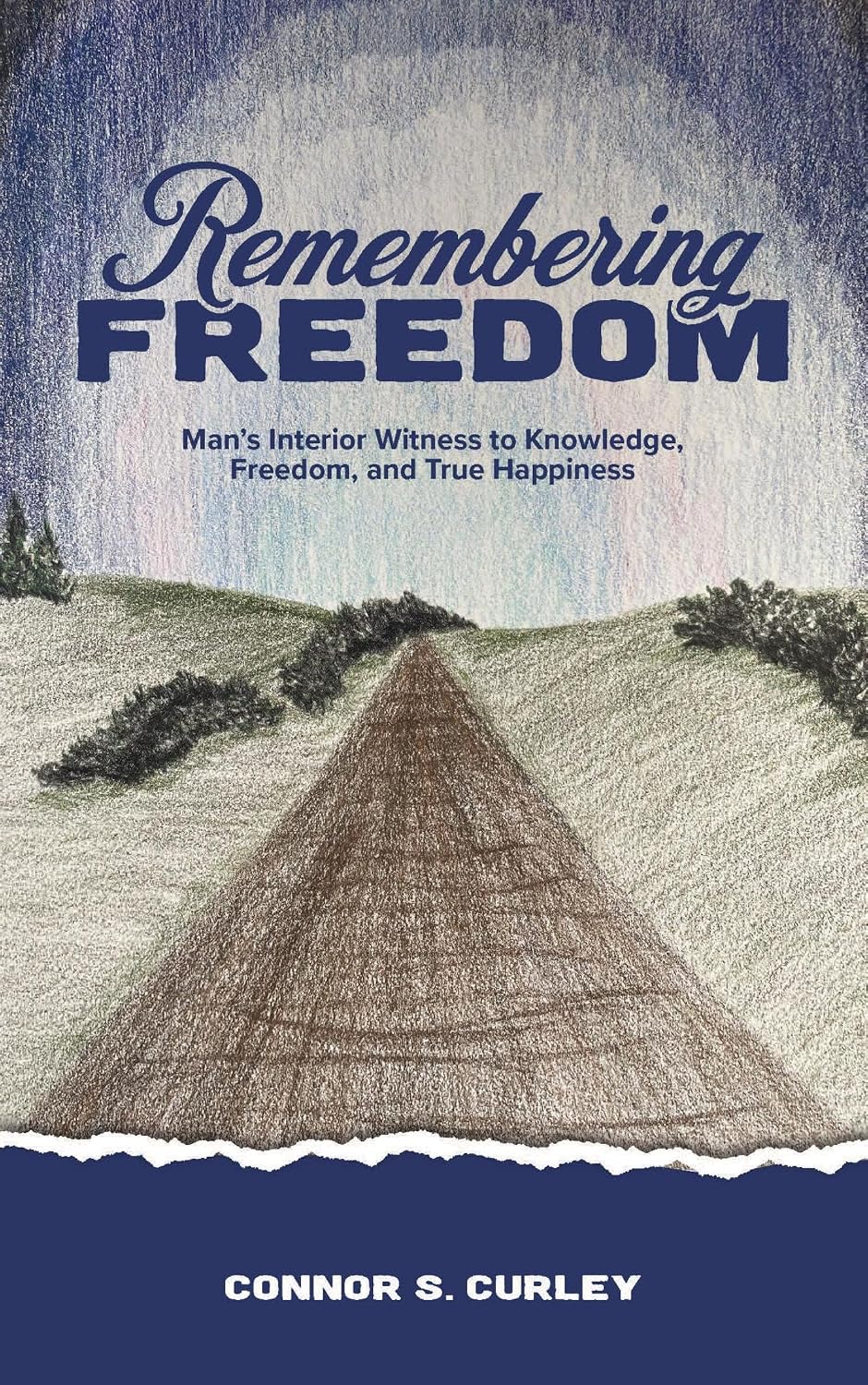
Remembering Freedom invites intellectually curious Christians and philosophy readers into a conversation about truth, conscience, relationships, happiness, and what it means to exercise freedom well. What do you believe the classical philosophical tradition can contribute to contemporary conversations about human nature?
Philosophy used to progress in more or less a linear fashion. Someone would wonder something about the physical world, come up with a theory which best described what was observed, and develop ideas surrounding this theory. Others in the line of tradition would, in turn, read these theories, accept or reject them for any number of rational or pragmatic reasons, and develop their own theories to correct their predecessor’s which better explained what we could observe. Take for example the notion of a “person” as an individual subject with agency, autonomy, etc. The notion of person we hold today is actually absent from much of classical philosophy; it is a Christian injection in order to explain the Trinity. So, for early Christianity, Plato and Aristotle’s work might have been valuable, but wrong and lacking some key elements that would only be developed later on in light of a new factor (how there could be three distinct Persons within one Being). In this, classical philosophy actually fits the strictest definition of a “science:” humans developing theories to best determine what is observed. Sometimes what is observed changes through better tools, revelation, etc; sometimes what best explains that data changes.
So it progressed from age to age, each generation in conversation with those who had come before – almost never simply accepting but always revising. This tradition of building upon the shoulders of those who came before continued until, in the grand scheme of things, very recently.
In Remembering Freedom, I talk about Descartes and his novel idea to reject everything that had come before so as to somehow establish a mathematically certain base upon which he could really know things. Now, it’s not fair to Descartes to suppose he came up with his novel theory in a vacuum by himself. This idea was already growing and festering among the leading academics and scientists of his day. Descartes is merely the first operable articulation of an idea he himself inherited from his own surroundings. This being said, the skepticism he introduced as the platform from which we are supposed to build is pretty radical – and has remained influential throughout the ages. His Meditations presents something new in several ways. From changing what kind of knowledge do humans consider “real” to how do we get to that knowledge, everything to how we interact with our predecessors was changed, called into question, and, over the course of several years, ultimately rejected for this new position.
Here’s the irony, though. Descartes’ position is that you begin from a place of complete and utter rejection, to come to each fact on your own verification in order to see whether it’s true. His successors, however, don’t largely follow his starting point. They actually enter into conversation with Descartes, begin building upon his deficiencies, and, essentially, “do philosophy” pretty much the same way humans always have done philosophy. The difference between classical and modern philosophy, then, isn’t so much how we do philosophy; the difference is in the underlying premises surrounding epistemology.
Modern philosophy brings up existential questions about human nature that are, in short, absurd – but because of their underlying premises, are difficult to refute. Because of this, allowing the Classical Philosophical Tradition a seat at the table does more than merely provide historical context to philosophy; it allows this school to actually be part of the conversation again. And conversation with those who have come before is pretty universal when it comes to philosophy, classical or otherwise. Classical philosophy challenges the premises prevalent today, and asks questions which avoid the absurdist/invincible pitfall much of philosophy post Descartes has fallen into.
Classical philosophy is not the ultimate gem of answers. It got many things wrong. Descartes and his successors have in fact brought up many valid and legitimate things problematic in classical philosophy, particularly surrounding the subjectivity of human senses and experience. But that doesn’t make Plato and Aristotle irrelevant. Rather than throwing them out, perhaps we should do what humans have always done – revise, add, and cautiously reject. Phenomenology is one such study that has begun to do this, and I look forward to it gaining more traction as the academic world moves forward.
Anamnesis is an important concept in your discussion of conscience. How would you introduce that idea to a reader encountering it for the first time?
Anamnesis is a very technical philosophical term in the Christian tradition, so I think this question is really valid. It is, as you said, important in Remembering Freedom’s discussion on conscience. In fact, it’s such a crucial point in the book that the remembering part of the title is a direct reference to anamnesis, borrowed from the Platonic idea that all knowledge is really a remembering of sorts. Though I like to think of it more as a re-cognating (recognition).
Many people might equate “anamnesis” with “conscience;” and we could forgive those who, in the interest of simplification, try to do so. In fact, for a very first-time encounter with the word, it’s not a bad stab at it: anamnesis is a function of our soul which helps us recognize what is good, and call evil what it is. Sounds a lot like the conscience, when described like that!
The key difference is that word “recognize,” and that’s where conscience and anamnesis take almost parallel roads. Conscience, strictly speaking, is tied to the will. It is what causes me to actively choose the good thing, since conscience seeks to understand the good. Anamnesis, on the other hand, is a recognition and a resonance with the good when I encounter it, as if it were already written upon my soul. In Remembering Freedom, I used the example of buying my Father a Father’s Day card. The conscience tells me it is good to honor my Father on that day (in this case that honor looks like getting him a card), but anamnesis tells me to get this particular card, because in this card I recognize (or realize, or fulfill) my relationship with him. I am simply more myself and can recognize myself as more fully me by doing this good thing – a good thing which is only good because God has ordained it to be so. As I put it in the book, “whereas conscience would have me seek to honor [my father], anamnesis would cause me to honor him according to my personality, which is precaused by the way in which I recognize what is legitimately good.” Conscience does the good, but anamnesis recognizes and encounters it on a deeply personal level.
I do not think that, truly, anamnesis and conscience can be ever fully separated. It’s not really possible to comprehend or talk about one without the other; the difference is subtle – but important. For Remembering Freedom, knowing the good and recognizing it is prior to actually doing it. And knowledge is a deeply personal activity: it is me, a person, getting to know and recognizing another Person, who is God. I do really think that without the Christian element, the distinction between conscience and anamnesis is negligible and perhaps even nonexistent. For my book, it is primarily a recognition of God, the prime good that we all desire in one way or another. And so, even though we see concepts about knowledge and memory as far back as Plato (a pagan), how we deal with it here in this book is something related, but different – and definitively Christian. I think anamnesis is the discussion in the book which comes closest to what some would class theology rather than philosophy.
In the years to come, more work needs to be done to formalize and clarify the distinction between the two and the operation of anamnesis as a function of the intellect as opposed to conscience which is a function of the will.
How can readers move from intellectually understanding these ideas to applying them in everyday decisions?
To start, one might say that there is a danger in intellectually understanding anything. Because humans are both physical and intellectual, we can sometimes suppose that just because we understand something we therefore have risen above the physical reality of that thing. Just because I know that Luke Comb’s song, Ain’t No Love in Oklahoma, for example, gives me a rush of adrenaline, and just because I know the reason for this adrenaline is because it reminds me of the thrill I used to get during rodeo season, that doesn’t therefore mean that I can expect to listen to the song and not feel that adrenaline rush. We could even go into depth about what adrenaline is, what causes it, its affects on the brain, and, through self knowledge, the relative good or bad decisions I personally make when under an adrenaline high. From this I would even know what it means for my mood the rest of the day, whether I should listen to it as a warm up before having a sensitive conversation, winding down for the night, etc.
None of this knowledge, though, makes me immune to the adrenaline rush. Though I might understand what will, could, does, or is happening, the thing itself is still happening around or to me. So it is with more chemical, instinctive realities such as adrenaline; so it is with more anthropological realities such as, you know, having a body. So this is the first point of moving from an intellectual understanding to an application in real life: these intellectually understood realities are not abstract things. They exist here and now, in the life around you, whether you understand them or not. And merely talking about them does not then mean that the intellectual has risen above the physical. The physical reality and consequences of objective reality exist and apply.
I think that word of caution really sums up the mechanism by which readers move from intellectual reading philosophy to “applying” them in real life, too: these ideas are in the here, not the abstract out there. Understanding these things allows us to know what we are looking for here in the real world, and equips us to really recognize what is truly happening.
For readers of Remembering Freedom specifically, remember that this book is constructed around a simple syllogistic premise: a) you are most happy when you choose to do what really makes you happy, b) in order to do that you must be free to actually choose that thing, therefore, c) in order to be free, you must first know (or recognize) what really makes you happy. It might seem like humans are creatures with infinite choices, each with the potential to make them happy; really, though, that’s not the case. It might seem like pleasure is a source of happiness, and indeed pleasure is in itself good; but often pleasure is merely a lesser good, not the real thing your heart was yearning for (that yearning would be, in a sense, anamnesis which recognizes and finds fulfillment when correctly addressed.) While you are shopping and feel the urge to buy all the carbohydrates in sight, are you really wanting carbs? Or are you hungry, and the choice that would make you truly happy is grabbing a small snack to raise your blood sugar and continuing with your predetermined list? Either way, just because you might recognize the reality of what is happening, that doesn’t therefore mean you’re immune to the chemical and physical things influencing your desires in that moment. You can’t understand your way out of reality.
You might think that the questions about happiness in Remembering Freedom are bigger questions than low blood sugar and grocery shopping, but the principles are exactly the same: choosing well in all of our tasks allows us to live as authentically ourselves, unique as we are. “How do I know things?”, “What do I truly want in life?”, and “What inhibits my ability to choose that thing?”, are everyday questions that can apply to our thoughts and actions, big or small. To recognize and apply the intellectual ideas of Remembering Freedom in the outside world, start there.
Author Links: GoodReads | X | Facebook | Website
Remembering Freedom is designed to be both engaging and practical, articulating abstract concepts through real-life stories from marriage, military deployments, and more to show how “abstract” things look in the real world. If you are looking to enter into discussions, or if you find yourself wondering how on earth we got to the point we are at now, Remembering Freedom is the book for you.
God Theories


In God Theories, Ken Ungerecht offers a thought-provoking examination of existence, consciousness, and humanity’s relationship with the divine. Drawing on his background in science education and engineering, Ungerecht approaches spiritual questions through a combination of scientific reasoning, mathematical probability, philosophical inquiry, and personal reflection. His central argument is that human existence involves more than physical processes and that consciousness may be a fundamental aspect of reality. The book also reflects his decades-long exploration of spirituality, which began with a shift from agnosticism toward a conviction that a greater intelligence influences the universe. With an accessible, conversational voice, Ungerecht invites readers to reconsider familiar assumptions about life, identity, and the nature of existence. His perspective is captured in one particularly direct statement: “You are not here by accident, you are here for reasons.” This conviction provides the foundation for an ambitious discussion of science and spirituality.
One of the book’s most distinctive features is its use of mathematical probability to examine the circumstances surrounding an individual’s existence. Ungerecht considers the extraordinary number of possible genetic combinations across generations, arguing that the improbability of any particular person being born points toward conscious involvement beyond the physical world. From this foundation, he explores the anthropic principle, quantum physics, matter, energy, thermodynamics, and the origins of consciousness. These discussions build toward his proposal that consciousness exists independently of the human brain and participates in the development of physical reality. His explanations frequently employ everyday comparisons, including lotteries, playing cards, and familiar mechanical processes, to make complicated concepts easier to follow. Although his interpretation of probability and certain scientific principles invites scrutiny, his effort to connect these subjects gives the book a consistent intellectual direction. Readers interested in the relationship between scientific discoveries and metaphysical possibilities will find considerable material to consider.
Ungerecht broadens his examination by comparing classical evolution, intelligent design, and his own proposed model of instinctively directed and consciously driven evolution. He also discusses near-death experiences, reincarnation, psychic phenomena, and the possibility that physical reality operates through processes resembling holographic projection. The revised edition includes a chapter titled “Physical Illusions,” which extends his discussion of matter into questions about the nature of perceived reality. Throughout these sections, Ungerecht draws on scientific figures, spiritual thinkers, and metaphysical writings, creating an interdisciplinary discussion with an unmistakably personal viewpoint. His treatment of these sources occasionally places speculative interpretations alongside established scientific ideas, making careful distinctions important for readers assessing the arguments. Still, the range of material demonstrates the breadth of his curiosity and his determination to explore questions that have occupied philosophers, scientists, and religious thinkers for centuries.
Beyond its scientific and philosophical arguments, God Theories carries a strong ethical message about personal responsibility, compassion, and the importance of examining deeply held beliefs. Ungerecht considers how religious divisions, rigid convictions, and competing interpretations of truth contribute to social conflict. He encourages intellectual openness while emphasizing the value of spirituality in developing a more constructive relationship with others and the world. His belief that “The most fundamental truth we can come to know is that we are eternal” informs his reflections on human purpose and the choices people make throughout their lives. The book’s strength lies in the sincerity of its inquiry and its willingness to engage with consequential questions across several disciplines. Its conclusions will inspire agreement, skepticism, and further investigation depending on the reader’s perspective. For those drawn to philosophical discussions of consciousness, spiritual identity, and the intersections of science and faith, God Theories offers a passionate and wide-ranging exploration of what it means to exist.
Pages: 96 | ASIN: B0793SYYBW

Literary Titan Gold Book Award: Nonfiction

The Literary Titan Book Award recognizes outstanding nonfiction books that demonstrate exceptional quality in writing, research, and presentation. This award is dedicated to authors who excel in creating informative, enlightening, and engaging works that offer valuable insights. Recipients of this award are commended for their ability to transform complex topics into accessible and compelling narratives that captivate readers and enhance our understanding.
Award Recipients






Visit the Literary Titan Book Awards page to see award information.
Remembering Freedom

In Remembering Freedom, Connor S. Curley takes on a question that shapes nearly every part of our lives: What does it actually mean to be free? His answer begins with an exploration of how we know what’s true, moves through an examination of human nature, and eventually arrives at the relationship between freedom, conscience, and happiness. Drawing heavily on Catholic intellectual tradition, particularly Thomas Aquinas, Karol Wojtyła (Pope John Paul II), and Joseph Ratzinger (Pope Benedict XVI), Curley argues that genuine freedom is rooted in our ability to recognize and pursue what is good. At the center of his argument is the conviction that truth is objective and ultimately personal, because truth finds its fullest expression in God. It’s an ambitious philosophical project that invites readers to reconsider some of their most basic assumptions about knowledge, personal autonomy, and the purpose of human life.
One of the book’s most interesting features is how Curley connects ideas that we often consider separately. His discussion of knowledge establishes the groundwork for understanding the human person as a union of body and soul, while his examination of conscience introduces the idea of anamnesis, an interior recognition of goodness that directs us toward truth. These concepts come together in his treatment of freedom, where he distinguishes the classical understanding of freedom as the pursuit of the good from the modern emphasis on unrestricted choice. Curley draws on an impressive range of philosophical and theological sources, moving between Plato, Aristotle, Aquinas, Descartes, and more recent Catholic thinkers. His use of stories and practical examples, from the tragedy of Oedipus to a soldier’s encounter with a rattlesnake, helps bring abstract philosophical concepts into everyday experience. These moments are especially engaging because they allow readers to see how the questions he’s exploring play out in actual human decisions.
Curley’s writing has the unmistakable personality of someone who genuinely enjoys a spirited intellectual conversation. He’s comfortable challenging prevailing assumptions, questioning established arguments, and occasionally wandering down an interesting philosophical side road. That conversational energy gives the book a distinctive voice, although the arguments themselves can become quite dense. Readers will encounter substantial discussions of epistemology, teleology, natural law, and the operations of the soul, often supported by extended quotations from other thinkers. Curley’s interpretation of modern philosophy is particularly sweeping, and his account of its relationship to contemporary understandings of freedom invites further debate. He also makes clear that his argument proceeds from a Christian understanding of God, an important consideration when evaluating his conclusions. Perhaps the book’s most compelling thread is its insistence that human beings are fundamentally relational. Our freedom, dignity, and happiness are intimately connected to our relationships with God and one another, a theme that gives the more technical philosophical discussions a meaningful human dimension.
Remembering Freedom will likely appeal most to intellectually curious Catholics and other Christians who want to explore the philosophical foundations of their beliefs, especially those interested in Thomism, personalism, and the relationship between faith and reason. Readers who enjoy G. K. Chesterton, Josef Pieper, or John Paul II will find familiar ideas developed and connected in interesting ways. It would also make a worthwhile choice for a philosophy reading group, particularly one whose members enjoy wrestling with challenging ideas and discussing them together. Some familiarity with classical philosophy or Catholic theology will certainly help, and readers approaching these subjects for the first time may want to take the book slowly. Curley’s concluding reflections on intellectual humility and the importance of genuine dialogue offer a fitting destination for the journey. His larger invitation is to approach knowledge as an encounter with reality and with other persons, and to understand freedom as something that develops through the pursuit of truth and goodness. The book is particularly suited to readers who enjoy conversations that continue long after they’ve turned the final page.
Pages: 237 | ASIN : B0GX35TDFW
To Find Meaning In Our Existence

A Clockwork Universe takes readers on a journey through metaphysics, physics, and cosmology, challenging conventional ideas about space, time, and gravity while exploring a universe defined by rotation, motion, and observable relationships. Why was this an important book for you to write?
I am a metaphysicist, which is a person who studies and researches phenomenon that cannot be directly tested like consciousness, the mind, reality, existence, the origins of the universe, space, and time. Metaphysics is a branch of philosophy that sometimes intersects with the sciences. My first treatise on time was published eighteen or nineteen years ago in 2008, followed by a treatise on time in 2022, and subsequent treatises on consciousness, reality, and the universe in recent years. I want to understand more about our universe. Through my research I ultimately hope to find meaning in our existence. I hope to make sense of the good, the bad, joy and suffering.
What is URUT, and how does it differ from conventional cosmological theories?
Unified Rotating Universe Theory proposes, based on research and other data, that we live in a slowly rotating universe. This hypothesis dates back as far as 300 years to Wilhelm Gottfried Leibniz and more recently to philosopher Kurt Gödel, who wrote the first big equation for a rotating universe as a gift to his friend, Albert Einstein in the 1950s. The model is also being explored by new contemporary thinkers and scientists interested in rotating models of the universe. Conventional cosmological theories suggests a flat open universe that expands infinitely. A rotating universe is generally closed, meaning if you start at one point, you’ll eventually end where you started, as if traveling along the curve of a sphere. We live in a closed, yet unbounded universe.
Why is it important to distinguish mathematical models from physical reality?
The demand for equations to describe (and even validate) philosophical and scientific phenomenon is a “requirement” that emerged in the past 100 years. It’s not really necessary to use equations to describe everything since there are other tools available to us as supporting evidence. Empirical and observation-driven data is equally important. The reification of equations, which treats abstract equations like tangible or real phenomenon, creates a version of reality and the universe that often feels abstract and exotic, like something out of a science fiction novel. What I proposed with this book, is rather than devise an hypothesis, write an equation, then spend decades researching the conclusion to prove that the equation as a conceptual framework is valid or real, I wanted to ground the universe in an intuitive, realistic, mechanical framework.
What is the one assumption about the universe you hope readers will reconsider?
My goal is not to replace current models, but to give readers a different way of looking at the universe. I hope to extend or add some texture to what we already know.
Author Links: Amazon | Website
A Clockwork Universe: URUT explores the possibility of a rotating universe, challenging modern narratives on dark matter, dark energy, and the Big Bang from a historical and philosophical perspective.
Drawing from recent and historical data, URUT establishes a rotational cosmological framework, taking a dialectical approach to Einstein’s Relativity, Gödel’s Rotating Universe, and Newton’s Mechanical Universe. URUT offers a tangible, mechanical view of the cosmos that doesn’t build its premise from abstract mathematical principles, but natural phenomenon and evidence-supported observation that will challenge our current understanding of the cosmos.
What is wave-time?
Can we unify physics and general relativity? What is space?
Was there really a “Big Bang?”
Learn more about the Unified Rotating Universe Theory.
See the Literary Titan book reivew of “A Clockwork Universe” here.
The Proxy Condition
Harrison Rose Tate’s The Proxy Condition is an ambitious work of cultural criticism about what happens when a person exists simultaneously in physical life and in the networked systems that represent, predict, and sometimes act for them. Tate calls that second presence the “proxy self,” arguing that it’s more than an online persona. It can keep operating when we’re absent, influencing recommendations, transactions, rankings, automated decisions, and other systems built from traces of our behavior. The book develops this idea through philosophy, sociology, neuroscience, technology history, personal observation, and examples ranging from social media feeds and banking systems to smart homes and AI. Its central claim is surprisingly easy to recognize once Tate has named it: we’re “living once, but existing twice,” and the strain people often experience around digital life may come partly from trying to manage those two forms of presence as though they were one.
One of the book’s strongest qualities is the seriousness with which it treats that idea. Tate doesn’t leave “proxy” as a clever metaphor. She builds a vocabulary around it, including ontological presence, fidelity, recursivity, choice conditioning, temporal jet lag, and eventually “infusus,” her term for maintaining coherence between digital and physical selves. The philosophical sections pull from thinkers such as Heidegger, Deleuze, McLuhan, Postman, and Stiegler, while later chapters move into attention, neurological reward, changing ideas of authority, digital time, and the hidden behavioral costs of supposedly free platforms. The historical timeline is especially useful because it shows the proxy condition developing gradually through email, search, social media, smartphones, personalization, surveillance, and generative AI. Tate’s recurring examples also keep some of the denser material grounded. A dormant bank account influencing an automated decision, an Amazon system deciding how to resolve a failed delivery, or a person documenting a family moment so intensely that the documentation replaces the experience all make the theory concrete.
The book is at its most compelling when it connects familiar feelings to structural features of digital systems. Tate’s discussion of “temporal jet lag,” for example, gives useful language to the peculiar experience of being physically present in one morning while mentally moving through dozens of other people’s moments, news cycles, messages, and events. Her larger framework also allows her to talk about attention without reducing the subject to self-control. Algorithms respond to our behavior, our behavior trains those systems, and the resulting systems influence what we encounter next. That feedback loop is the heart of the book. At times Tate makes large philosophical or empirical claims with more confidence than some readers will want to grant them, and the sheer number of coined concepts can make the argument feel heavily engineered. Still, the accumulation serves a purpose. By the time she reaches “infusus,” the solution feels connected to the problem she has spent the book defining: people need an internal continuity of values and agency that can travel through two very different environments without requiring those environments, or the selves inhabiting them, to become identical.
I’d recommend The Proxy Condition to readers who spend a lot of time thinking about technology’s effect on ordinary life but are tired of treating the subject as a simple question of whether screens are good or bad. People working in technology, media, education, psychology, communications, leadership, or AI will probably find plenty here to argue with and plenty to borrow. It should also appeal to readers who’ve noticed that being “offline” no longer means being absent from digital systems, or who feel that modern distraction is stranger than ordinary busyness. Tate offers a book about adaptation and authorship. Her goal is to help readers recognize that participation itself now shapes systems, and that preserving independence in that environment depends less on escaping technology than on understanding how one’s attention, values, choices, and digital traces fit together. That final emphasis on coherence gives the book its most useful recommendation: learn to recognize both versions of your presence, then become deliberate about what each one is doing.
Pages: 275 | ASIN : B0FBMKZ1JM
Human Natures: Of Animal and Spiritual

Carroll Blair’s Human Natures is a compact work of moral philosophy built from aphorisms, reflections, and extended meditations. Its central idea is simple and demanding: humanity’s next stage of evolution depends on moving beyond ego, greed, domination, and self-interest toward humility, compassion, courage, and service. Blair presents spirituality as a lived discipline, one measured by how consistently a person acts for the good of others.
The book’s short passages give it a steady, contemplative rhythm. Many read like thoughts meant to be carried through the day, while recurring images of light, gardens, flight, hunger, and captivity make the spiritual struggle feel concrete. The repetition creates pressure as well as emphasis, returning the reader again and again to the same essential question: Which part of our nature are we strengthening?
Blair’s framework is deliberately stark, and that starkness supplies much of the book’s force. At times, its division between the animal and spiritual sides of human life compresses complicated social and psychological realities into a single moral contest. Yet the book’s conviction remains compelling because Blair applies his argument everywhere, from private relationships and career ambition to politics, environmental destruction, and humanity’s collective future.
The epilogue broadens the book from personal reflection into an urgent argument about human survival. Blair suggests that the instincts which once protected our ancestors now threaten a technologically powerful civilization unless they’re transformed by spiritual consciousness. The result is a serious, searching book that asks readers to judge growth by the generosity, integrity, and courage they bring into the world. “Human Natures turns the oldest struggle within us into a clear, insistent summons to become worthy of our humanity.” I recommend Carroll Blair’s work to readers who enjoy thought-provoking explorations of human nature, compassion, and personal growth.
Pages: 140 | ASIN : B006W0PDBI
They Were Living A Lie

The False Paradigms of Today and the Timeless Truth of Tomorrow examines how perception, social conditioning, group identity, history, psychology, and inherited ideas shape what people accept as truth. Was there a particular assumption about modern life that first made you question the larger worldview behind it?
As a child I saw that the basic assumptions people make about life were wrong. As I looked around at the adults, they were living a lie, and probably didn’t know it. They bought into the whole story that you have to go to college, get a job, get married, work hard, get a mortgage, have children–that if you do all of that, you will be living the best life. But as I looked around, I saw people who were not happy, who did not have fun, and did not seem to be doing anything great. There was no way, I thought, that I would fall for these lies. There was a truth out there that could set us free to be happy and fulfilled in life, and the people around me had totally missed it.
Why do you think people become so emotionally attached to beliefs that challenge can feel like a personal attack?
I think Eckhart Tolle explained it well. People believe that they are their minds. They think their minds are clever. They have worked a lifetime creating their admirable minds, much like a sculptor creates a perfect statue out of block of granite. (I once believed that too, and being supremely arrogant, I thought my mind was a work to be admired by all young attractive women. Of course, they rarely admired my creation, and shied away from me.)
When an outsider questions basic tenants of our belief systems, people see it as a personal attack. You are attacking their persons–well, their minds. And to them, this is the same thing. But they are completely wrong. If you sit and try to meditate, you can watch all the garbage, half-baked thoughts the mind comes up with. Nobody would be proud of those thoughts.
But there is more to that question. If you can destabilize someone’s thinking, make them realize that their entire outlook was wrong, now what are they going to do? That is a very uncomfortable place to be. Who wants to reassess their lives, and reconstruct their world outlook? It can mean that they have spent decades doing the wrong things. Nobody wants to face that. It is easier to just tell me, and other troublemakers, that we are wrong, and get back to the football game.
What do you believe people misunderstand about the relationship between scientific models and reality itself?
In the book, I think the chapter that rattles people the most is when I question science, and I believe it is because to differing degrees we have all unconsciously absorbed science as the bedrock of truth. Most of us lost God in the 18th and 19th centuries, and so we gravitated towards science. We need some ultimate authority. It used to be God. Everything that was so, was so because of God. Now, science has become the bedrock of our life views. And it has become the ultimate authority. Even for religious people.
Almost everyone believes in evolution, big bang, and cave men. Are they all true? I don’t know. They are theories. If you question some aspects of science successfully, where does that leave the reader who blindly accepts it all? If parts of science are just conjecture, then how are people to decide what is real and what is not? We are not scientists. It was easier to just accept all of science without thinking too hard about it. But questioning the fundamentals of our belief systems is not a comfortable place to be. All of a sudden our outlook on the world is imperiled. Again, it is easier to just tell me I am wrong..
Ah, but you asked about scientific models and reality itself. . .Probably all scientists realize that theories are theories. They are not necessarily the truth. Theories cannot be proven. They are generally accepted explanations of reality. But they usually are disproven in time, although it may take centuries. When we find data that contradicts our theories, our scientists will typically amend the theory, but rarely will they cast it out. It is only when a generation of scientists dies, that their theories can die with them. (That is one of the great things about death. It brings change, as the newer generations replace old ways of thinking with newer ones.)
But normal people, we tend to confound theories with all the rest of science. We are black and white thinkers. To us, science is true or it is not. We can put rocket ships on the moon, therefore, science is true, including all of its theories. But in reality, some science is true, and some is just conjecture–theories.
So, if scientific theories are not necessarily true and likely to be discarded at some point, why do we base our beliefs on them? Why have we made scientific theories the central tenant of our worldview and why do we use them to define who we are? It has become just this for a great many of us. We do not realize to what extent science has replaced the Catholic Church in providing much of the foundation of our collective understanding of the world. In the past, people would be aghast if you stated that Christ was not God but was instead a divinely inspired man. You would be shunned, tortured or perhaps executed as a heretic if you spread those blasphemous thoughts. It is similar today with regards to science. In much of Western society, if someone professed that evolution is a fanciful theory and is not true or, even better, that the Earth does not rotate around the sun, you would be considered an idiot and would likely be shunned as ignorant or crazy. It’s the same.
To sum it all up. . .the likely reason people misunderstand the relationship between scientific models and reality itself, is probably due to lazy black and white thinking. People have a tendency to take the whole package, or none of it. Just like in the Middle Ages, you accept everything the Church says, and now, you accept everything science says. No picking and choosing. It is so much easier to just chunk it all together, and accept it all as one package. Science is good, therefore all science is true.
Do you see the transformation you describe as something that could happen gradually through culture and education, or does it require a more fundamental shift in human consciousness?
The change I call for, is that people realize that individuals are not important, and that humanity, itself, the aggregation of all people, living and dead, is what really matters. To focus on only ourselves is to be short-sighted. To reach our potential, to help others reach theirs, that is the proper outlook. It took a book to explain this concept, so I won’t try in a few sentences, or I risk sounding trite.
But, yes, humanity will transform into this realization. It will become fundamental, and we will create different social systems and personal outlooks completely different based on this fundamental realization. But likely not in our lifetimes, possibly not even in our grandchildren’s lifetimes. Fundamental change on this scale takes centuries, not years. Humanity is the creature that matters, not us individuals. We come and go and are forgotten, but humanity persists, doing whatever it is it does, but it is heading somewhere. We just cannot know where. I personally believe, but do not know, that the type of change I see coming, will happen soul by soul, individual by individual, and slowly, over the generations, people will think and act differently. Christianity took almost 350 years before it really started growing, that is, when it became the state religion of Rome. Until then, it was a very small movement, slowly proceeding, slowly growing. Nobody in the first generation thought it would ever be the religion of Rome, or that it would take over Latin America or Africa. This is the same. We cannot know what the future holds. (Yes, including me.) But as I see it, this is where we are headed.
Author Links: Goodreads | Website
What do we believe? Whatever they told us to believe.
What do we do? Whatever other people are doing.
How many lies have we welcomed into our lives without having seriously analyzed them?
It’s the reason many of us feel empty inside—there’s nothing there but convenient mistruths, and at some level, we all know it. We then orient our lives based on these false beliefs, wasting our precious limited time among the living striving for goals that leave us ultimately unsatisfied.
The False Paradigms of Today and The Timeless Truth of Tomorrow by John Bliss takes a steak knife to these common delusions with 13 irreverent essays that rip and tear at the foundations of our collective worldview. Little is held sacred to Bliss.
The essays in Part 1: Your Understanding of Reality is More Fabricated Than You Think dispel our delusions one at a time, including:
our mistaken belief in progress,
our misplaced confidence in our own rational prowess,
our loss of personal identity from group identification,
our misplaced faith in science as a true representation of the world, and
our morality: what it is and where exactly it comes from.
After carving away these restrictive untruths, Part 2: An Exploration of Truth Across Historical, Mystical, and Philosophical Dimensions introduces a deeper understanding of humanity based on history, mysticism, psychology and philosophy. Some of the topics in Part 2 include:
how our religions became second-rate pathways to God,
our reliance on logic and how it warps our decision-making,
how idealism can lead to mass murder and tyranny,
the overriding importance of history, where we’ve been, where we are going and why,
our immaterial connection to all people living and dead—Jung’s collective unconscious, Emerson’s Over-Soul, and Varro’s Soul of the World, and finally
the bedrock assumption that we all got wrong. Switch this out, and everything changes.
The essays are filled with stories from history, including meetings of the apostles Paul and Peter with the Emperor Nero and Simon Magus the magician, the mystical transformation of Emmanuel Swedenborg, the nineteenth century German intellectual revolution, the establishment of three French religions worshipping not God but Reason and Humanity, the abdication of the World Teacher, and the genocide of the Tibetan culture.
The book is ideal for seekers of deeper meaning, arm-chair philosophers and historians, and those disillusioned with the emptiness of contemporary thought. Discover why your view of reality may be distorted—and how by changing the one assumption on which your entire world-view is based, everything shifts.


