Adobo In The Land Of Milk and Honey
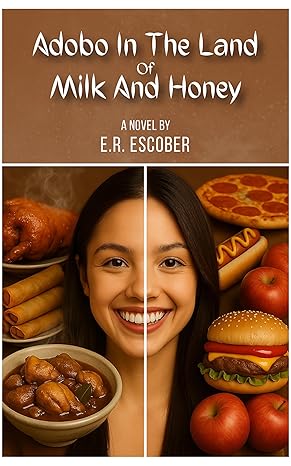

E.R. Escober’s Adobo in the Land of Milk and Honey is, at its heart, a story about identity, loss, and the complicated dance between assimilation and heritage. We follow Mirasol Mendoza Moreau, a sharp and ambitious Filipino-American executive who is sent to the Philippines to oversee the acquisition of a struggling fast-food chain, Pinoy Jubilee. What begins as a business assignment quickly becomes a deeply personal journey, forcing her to reckon with her late boyfriend’s absence, her mother’s silence about the homeland, and the messy, beautiful reality of a culture she has always kept at arm’s length.
Escober’s prose is remarkably vivid; rather than merely describing Manila, he immerses the reader in it. The airport scene, in which Mirasol is immediately enveloped by a wall of heat and commotion, vendors calling out, families embracing in noisy reunions, captures the overwhelming disorientation of arrival with striking immediacy. And later, the kalesa ride through Intramuros, Mirasol annoyed, Ramon smug, the horse nosing her shoulder, was both funny and strangely tender. I loved how Escober uses small, almost absurd details (like a horse drooling on a silk blouse) to pull Mirasol out of her polished New York shell. The writing has this knack for being sharp one moment and unexpectedly warm the next, which felt very true to the push and pull of identity crises.
What stood out most to me was how food served as the narrative’s foundation. The balut scene is a perfect example: Mirasol, determined to prove she isn’t just another “Fil-Am tourist,” dives into the duck embryo with salt and chili while Ramon watches like a judge at a reality show. It could have been written for laughs, but instead, it becomes a turning point, breaking down Ramon’s skepticism and showing Mirasol’s willingness to embrace discomfort. Later, when she eats Rosa’s adobo at the original Pinoy Jubilee, it isn’t just a meal, it’s an initiation into the heart of what the restaurant represents: family recipes, sacrifice, and tradition. Escober makes food not just symbolic, but alive, messy, and deeply emotional.
I felt conflicted about Ramon; his air of superiority often proved as frustrating for me as it was for Mirasol. His constant testing, comparing her to Olivia Rodrigo, making her ride a kalesa instead of a car, lecturing her about “real” Filipino culture, sometimes felt heavy-handed. But then Escober complicates him by revealing his own past heartbreak with another Fil-Am who “came back home” only to leave again. Suddenly, his sharp edges made sense. He wasn’t just gatekeeping culture; he was guarding against disappointment. That shift made him more compelling, and I found myself grudgingly rooting for the dynamic between him and Mirasol to thaw.
By the time I closed the book, I felt like I had been on the journey with Mirasol, not just through Manila’s crowded streets, but through the strange space of being between two worlds. Escober doesn’t sugarcoat it. The book is messy, emotional, and sometimes frustrating, but that’s exactly why it works. It’s not a polished postcard of the Philippines; it’s a story about finding pieces of yourself in unexpected places, whether in a noisy street market or in a bowl of perfectly braised adobo.
I’d recommend Adobo in the Land of Milk and Honey to anyone who enjoys stories about identity, grief, and rediscovery, especially second-generation immigrants who’ve ever felt the pull of a “homeland” that doesn’t quite feel like home. Even if you’ve never wrestled with cultural roots, the humor, the romance, and the sheer sensory detail make this a rich, rewarding read. It’s not just a business story. It’s not just a food story. It’s a story about being human and hungry, for meaning, for connection, and, for really good adobo.
Pages: 302 | ASIN : B0FHSZ95N7


Posted on September 8, 2025, in Book Reviews, Five Stars and tagged Adobo In The Land Of Milk And Honey, author, book, book recommendations, book review, Book Reviews, book shelf, bookblogger, books, books to read, contemporary, E.R. Escober, ebook, fiction, goodreads, immigration, indie author, kindle, kobo, literature, nook, novel, read, reader, reading, story, writer, writing. Bookmark the permalink. Leave a comment.



 LITERARY TITAN
Leave a comment
Comments 0