Blog Archives
Is This All A Simulation?

The Tatagonian Code follows a wisecracking ghostwriter whose bond with a memory-altering entity draws him into a mission across universes, forcing him to confront who controls his past and whom he can trust with the future. What was the inspiration for the setup of your story?
There’s been much discussion in recent years about the possibility that we are living within a computer simulation. The question that came to mind was: If true, who runs the simulation and why? Then I asked what would happen if the masters had conflicting goals. So, I created Tatagonians and divided them into two opposing factions: gold-plated Cybortics and swirling Energetics. So, as with all global (and interstellar) politics, humanity needed one of them to flip and take its side. I’m a big fan of John Scalzi, who tends to have sarcastic protagonists. So Daniel’s persona was developed along that vein.
How did Emma’s unequal memories of her relationship with Daniel shape your exploration of consent, responsibility, and the possibility of renewed intimacy?
At first, by remembering only bits and pieces of their previous relationships, Daniel felt betrayed by Emma—that she had used him to advance her project’s goals. But after he realized she actually HAD fallen in love with him twice, he knew there was something special between them. Rather than attempt to jump back into romance immediately, he allowed Emma to slowly regain her memories of their shared past. His love for her was the deciding factor in his participation in the war against the Cybortics.
What shifts in Daniel and Gofer’s relationship were essential to making an intrusive, memory-altering voice become someone Daniel could trust?
At first, Daniel viewed Gofer as a violation of his private life. Having an alien share your body would be discomforting, especially when you discover the reason is to experience existence as a human rather than a form of energy. Gofer also represented danger—an entity that Daniel couldn’t understand. Their relationship pivoted when Daniel realized he could use it to his benefit. For example, he could reverse Sierra’s implication in the killing of a thug who wanted to kidnap him and the alien. Still, he feared that such power could corrupt whoever possessed it. But after he realized the need for such power to save humanity, they became close friends even after Gofer separated from Daniel’s body.
How does Sierra’s friendship with Daniel, built through shared danger and insults, complicate his understanding of protection, vulnerability, and loyalty?
When Daniel first meets Sierra as his personal trainer at the gym, he views her as a potential romantic partner. She vanquishes that notion when she saves from being kidnapped and displays her militaristic, kill-when-necessary attitude. Knowing that Daniel lacks the toughness to be part of the mission to save humanity, she takes verbal shots at him to toughen up his mental game. Daniel doesn’t understand her killer instincts, but he begins to appreciate it when he realizes she brings to the table—unrelenting commitment to destroying the Cybortics.
Author Links: GoodReads | X | Facebook | Webstie
Daniel Cadence thought he had enough problems—his fiancée left him, he’s been assigned to write the memoir of a brain-addled backup guitarist, and he hates the physical trainer at the gym. But that was before he discovered the horrifying truth: humanity is living in a massive cosmic simulation controlled by an inscrutable race of astral beings called the Tatagonians.
Even worse, their species has fractured in two. While the Energetics use human hosts to experience the sensory world of Earth, the ruthless Cybortics purge and reboot civilization every 200,000 years.
Now, the clock on the latest wipeout is running out.
Teaming up with rogue scientists from Pullman Laboratories and bound to “Gofer”—a bizarre, sentient Energetic capable of bending reality across multiverses—Daniel is handed an impossible mission: infiltrate and destroy the Cybortic stronghold in another universe before humanity disappears one more time.
Armed with subpar tech, endless snark, and an alien entity he barely understands, Daniel must pull off the ultimate cosmic hack. If he fails, the next version of humanity will have to reinvent the wheel all over again.
Packed with sharp wit, mind-bending concepts, and Philip K. Dick–style speculative flair, The Tatagonian Code is a high-stakes sci-fi adventure about freedom, unintended consequences, and fighting back against interstellar creators. Scroll up and grab your copy today!
A Whole New Meaning

The Race for the Lost Coin follows a history teacher racing to rescue his kidnapped grandfather and protect an ancient teleportation coin from an industrialist intent on harnessing its power for his Nazi ambitions. What was the inspiration for the setup of your story?
I’m a bit of a fan of the Indiana Jones movies, a bit of a Trekkie, and an avid reader of sci-fi books and stories involving time travel. I wanted to write a story that combined my first love, ancient history and mythology, with contemporary fiction, particularly thrillers and action-adventure, incorporating the concept of teleportation.
It’s a unique mix, and I wanted to inject a bit of fun into the writing process. My first book, The Guardian’s Legacy, places the main character, Nikolaos, in the role of a reluctant hero and guardian of the coin. The Race for the Lost Coin introduces elements of the high-stakes chases we see in the Indiana Jones movies, the hunt for artefacts, and a recognisable foe: the Nazis.
Hitler and Himmler sought esoteric artefacts and spent thousands, if not millions, of dollars searching for sources of power and knowledge that they believed could help them win the war. It’s this combination of modern and ancient history that I wanted to explore and weave into my stories. At the same time, I hope to encourage readers to discover more about our ancient past.
How does Nik’s work as a history teacher shape his response to inherited guardianship, especially when protecting his grandfather disrupts his ordinary responsibilities?
It is Nik’s love of ancient history that not only piques his interest in becoming a guardian, but also helps him understand the importance of protecting the legacy of our ancient past for future generations. In many ways, this is what education is all about. Well, that’s why I studied teaching!
Nik’s role as a high school teacher places him in a position of responsibility, where he helps nurture the growth and intellectual development of young people. When he learns that his grandfather has been kidnapped, Nik must make a choice. Finding his grandfather becomes his priority, and his role as guardian takes on a whole new meaning.
This experience helps him understand what his grandfather had tried to explain during his training as protector of the coin: that some individuals use history to further their own agendas and gain power over those who are less able to defend themselves.
What guided your decisions about the coin’s painful landings, exhaustion, and unpredictable reactions, and how do those limits shape Nik’s choices?
I wanted to create an object of power that, while offering extraordinary means of transportation, also carried disadvantages for those who sought to control it. I decided that the impact of using the coin would physically manifest the consequences of a person’s decisions, with the effects potentially being either positive or negative. In this case, the coin’s power has a detrimental effect on the user.
Through his research into previous guardians and their use of the coin, Nik comes to realise the potential adverse effects of its continual use. He doesn’t make the decision to use the coin lightly, justifying his actions initially as a means of escape and, more recently, as a way to access resources he knows are available at his grandfather’s home. He understands that prolonged use could alter his biology, yet it’s a risk he is currently willing to take.
How did you develop Nik and Detective Sauveterre’s attraction through their repeated confrontations while preserving the distrust and conflicting obligations between them?
I wanted Nik to maintain his independence while building friendships with unlikely allies who could help him operate outside the boundaries of the law. The inclusion of Detective Sauveterre was initially intended to make the detective a foil for Nik, but as the story progressed, their relationship began to change.
Nik wants to trust the detective, and during their first meeting, he realises that doing so was a mistake. However, their subsequent interactions establish a tentative rapport, which gradually develops into an attraction that becomes more evident each time they meet.
Although they often butt heads, their mutual admiration and attraction continue to grow. Nik is desperate to find his grandfather and recover the second coin, using whatever means are available to him, while the detective is determined to follow the leads and work within the boundaries of the law. Their conflicting approaches create tension between them, even as their feelings for each other grows.
Author Links: Goodreads | X | Facebook | Website
One toss of the coin is all it takes.
Nik races to Paris to find an ancient coin with mythological forces before a clandestine organisation can use its destructive power to wipe out civilisations. However, the trip does not go as expected. Nik’s grandfather has been kidnapped, and he is on the run, evading the French police, Interpol agents and a powerful, wealthy Slovakian magnate.
Nik teams up with a French taxi driver, a hacker and a librarian to avoid capture. Clues take him to Geneva and Rome, where he learns there is more to the coin than what his grandfather told him. After a close encounter with the police, Nik forms an alliance with the most unlikely partner—Detective Sauveterre. But is that the right decision?
Fans of Steve Berry, James Rollins, and Dan Brown will love this latest action-packed and suspense story from Award-Winning author Luciana Cavallaro.
Experiences Accumulate and Shape Us

Six Weeks is a heartfelt memoir of caring for your dying sister Nancy, that explores family history, faith, loss, and the lasting impact of choices across generations. What inspired you to share your story with readers?
I didn’t initially set out to write a book about death. I wanted to tell the story of my sister’s life and our relationship, which happened to culminate in six extraordinary weeks.
Nancy and I shared a lifetime of experiences, some wonderful, some difficult, and often quite funny. When she became terminally ill, I found myself responsible for helping her navigate the final chapter of her life. Much of that responsibility involved ordinary things: paperwork, medical decisions, conversations, and simply showing up when I was needed.
Those six weeks became a lens through which I could examine the decades that preceded them. Decisions made years earlier suddenly acquired new meaning.
But there was another reason for writing the book: the quiet erasure of people and the lives they lived. Grace is often quiet. So is the labor of caring for others. Neither announces itself, and both risk disappearing from memory when the people who witnessed them are gone.
I believe our actions speak, sometimes more profoundly than our words. The ordinary things we do for one another, the responsibilities we accept, and the promises we keep tell a story of their own. I wanted those actions to be heard, and the people behind them to be remembered.
Ultimately, I wrote Six Weeks because Nancy was much more than her illness. I wanted readers to know the person I knew, and perhaps recognize something of their own relationships in ours.
How did you balance protecting Nancy’s privacy with telling an honest and complete story?
I don’t believe any memoir can tell a complete story. Memory is selective, perspective is necessarily limited, and a writer must decide what belongs on the page.
My guiding principle was to include only the people, events, and actions relevant to Nancy’s life or our shared journey. The purpose was never to expose others, but to show how circumstances, relationships, and choices shaped the story we were living.
I believe there is dignity in telling the truth about circumstances as they were, without embellishment or unnecessary judgment. That meant including difficult moments when they were essential to understanding our journey, while leaving aside details that served no meaningful purpose.
I tried to let events, conversations, and decisions speak for themselves rather than manufacture emotion or assign blame. Nancy was funny, intelligent, opinionated, and fully capable of speaking for herself. Preserving those qualities mattered as much as recounting the difficult circumstances surrounding her illness.
Honesty did not require revealing everything. It required including what was necessary to understand how we arrived at those final six weeks and the decisions we faced together.
For me, protecting Nancy’s dignity meant allowing her to remain fully human, while telling the truth about the journey that shaped us both.
What was the most difficult part of revisiting memories while writing the book?
I believe we are the sum of decisions made by us, for us, and sometimes upon us by generations before our own.
The hardest part of writing Six Weeks wasn’t revisiting individual memories, painful as some were. It was understanding and illustrating how those experiences were connected, how one decision influenced another, and how their accumulated consequences shaped the people Nancy and I became.
The book moves between Nancy’s final six weeks and events spanning decades. What initially appear to be separate experiences gradually reveal their connections. Circumstances that once seemed unfair or incomprehensible become part of a larger picture, one that helps explain the abilities, perspectives, and sometimes the limitations we carry into adulthood.
For Nancy and me, difficult experiences had forged skills that would later become essential. When her final illness confronted us with decisions neither of us wanted to face, those abilities helped us navigate the practical responsibilities of care while finding opportunities for reconciliation.
I wanted readers to recognize something similar in their own lives. Understanding how experiences accumulate, and how they shape the choices available to us, can reveal possibilities that may not have been apparent before.
Understanding and forgiveness go hand in hand. Forgiving does not require forgetting. Sometimes remembering clearly, and choosing a different response, is precisely what allows us to repair old fractures and forge new paths.
For me, that is how even painful memories can ultimately be understood with grace.
If Nancy could read the finished book, what do you think she would say to you about it?
I think Nancy would be pleased, because the book represents something she wished for me: the opportunity to rediscover a creative life I had set aside.
During her final six weeks, we spent considerable time reflecting on our lives, the trials and tribulations we had experienced, and the humor that had so often helped us through them. Nancy knew I had placed much of my creative life, including writing, on hold to pursue a business career and assume responsibilities that allowed me to help others in more practical ways.
She wanted something for me.
Nancy had written herself and dreamed of becoming a writer, but life never afforded her the opportunity to fully pursue that ambition. We had been forged in much the same foundry, shaped by many of the same experiences, and she recognized in me a creative passion that had remained largely unexplored.
She also wanted our lives and experiences to have meaning beyond the two of us. She believed the lessons we had learned through difficult choices, reconciliation, and grace might offer understanding and inspiration to others.
In her final letter to me, Nancy encouraged me to find peace and pursue new paths. Looking back, I see that wish as one of her final gifts. After years of practical responsibilities, she wanted me to reclaim something of myself.
Writing Six Weeks became a way to honor both wishes. Nancy’s life and our shared journey could be preserved, while the experiences that shaped us might help others better understand their own. At the same time, writing opened a door to the creative world I had deferred for so many years.
In that sense, the book reconciles much of our journey. It preserves Nancy’s story, offers the possibility of grace and inspiration to others, and allows me to explore a creative life that she understood and encouraged.
If Nancy could read the finished book, I think she would be pleased that her story continues to be told—and that I finally opened the door she wanted me to walk through.
And, of course, as my big sister, she would insist on having the last word.
Author Links: GoodReads | Website
When an unexpected diagnosis brought Nancy home for hospice, the doctor gave her about six weeks.
For her brother Bill, those weeks became more than a countdown. They became the final chapter in a family story shaped by duty, silence, erased women, hidden labor, and weight carried quietly from one generation to the next.
Moving between Nancy’s final days and the generations that came before her, Six Weeks is a literary memoir about caregiving, sibling love, family fracture, and a promise between siblings to reconcile the choices they made, the choices made for them, and the weight carried forward.
At its center is Nancy: funny, stubborn, faithful, private, and determined to meet the end with dignity. With those who loved her nearby, her brother tries to give her that dignity through the language he has always trusted: work, presence, protection, and love expressed through action.
Restrained, intimate, and deeply personal, Six Weeks is a witness against erasure and a record of what it means to carry someone home with grace.
Their Shared Determination

Patrol Officer Hudson follows a concerned woman searching for her missing brother, and her only clue leads her to an infuriating patrol officer who, while trying to keep her safe, is also keeping secrets from her. What inspired the setup of your story?
I do ride-alongs with my Sheriff’s office and assist in their new officer role-playing scenarios. Earlier this year, I had the opportunity to volunteer with our sheriff’s office during the National Police Bloodhound Association (NPBA) Certification Program. Hiding from those bloodhounds, combined with my experience as a retired high school teacher, inspired me to put a troubled teen at the center of the story.
How does the search for Pike force Hudson and Verie to build trust faster than they otherwise might, and what did you want their disagreements about honesty, protection, and independence to reveal about each character?
Hudson cares about Pike and Verie’s family. Although Verie had never met Hudson, she knew from her mother that he was someone she could trust, and Pike’s note telling her to find Hudson reinforced that trust. At the same time, I wanted Verie to remain suspicious of him because he was still a stranger to her. She had been cheated on in a previous relationship, so trusting a man didn’t come easily.
Hudson is all about protecting and serving his community, and that includes Verie, even when she doesn’t necessarily want his protection. Their disagreements allowed me to show Hudson’s protective nature while also showing Verie’s independence and determination. Hudson believes withholding information is sometimes necessary to keep people safe, while Verie believes she deserves to know the truth, especially when it involves her brother. Searching for Pike forces them to work through those differences and learn to trust each other much faster than they normally would.
What role does family loyalty play in both the romance and the suspense storyline?
Family is extremely important to both Hudson and Verie. Verie’s loyalty to Pike is what drives the suspense. She refuses to give up on her brother, even when searching for him puts her in danger. Hudson already cares about Pike and wants to protect him, but he is first and foremost an officer of the law. He can’t ignore what Pike has gotten himself involved in simply because he cares about him and his family.
That same loyalty also brings Hudson and Verie closer together. As Hudson becomes more invested in keeping Pike safe, he also becomes protective of Verie and the rest of her family. Verie begins to see that his involvement isn’t just about doing his job—he genuinely cares about what happens to them. Their shared determination to bring Pike home safely helps build the trust between them and ultimately strengthens their relationship.
What is the next book in the Haven Island PD: Protecting Paradise series that you are working on, and when will it be available?
The next book in the Haven Island PD: Protecting Paradise series is Diver Sawyer. I’m also writing my clean romantic comedies under my other pen name, NL DiDeo, so I’m splitting my writing time between the two series. Diver Sawyer is currently planned for release in April or May 2027.
Together they must find her brother before it’s too late.
Verie
My brother’s missing. His medicine sat untouched on his desk, and the only clue he left behind was a note scribbled on a crumpled math assignment.
Find Hudson. Need help.
So I do.
Officer Hudson Shaw is bossy, infuriating, and far too handsome for his own good. He promises to help me, but every answer leads to more questions—and he’s keeping secrets.
I.don’t. like. liars.
Hudson
Verie thinks I’m hiding the truth.
If she knew everything, her life could be in danger.
Her brother is tangled up in something worse than either of us imagined. Every move he makes pushes him deeper into the crosshairs.
I’ll do whatever it takes to bring Pike home.
If I fail, I won’t just lose the case—I’ll lose Verie, too.
Patrol Officer Hudson is a first-person, dual POV small-town romantic suspense featuring a protective hero, forced proximity, slow-burn chemistry with serious heat, and family loyalty. HEA guaranteed.
Murder Amour


Michael Alan Stimmel’s Murder Amour follows private investigators John Mathews and Kayla Van Saint from Portland to Los Angeles, where a job involving a fire at a movie studio leads them into a much larger tangle of money, sex, and personal loyalties. John’s background in fire investigation and Kayla’s experience as a homicide detective give their partnership a useful mix of skills, though their work is only part of what keeps them occupied. They’re also lovers trying to agree on what that means. The novel moves through hotel suites, studio grounds, fashion events, and the world of a powerful escort agency, giving its crime story a distinctly social character. Access matters here: who’ll take your call, who’ll open a gate, and who has something worth protecting.
John’s first-person narration gives the book much of its personality. He’s observant, hungry, easily distracted by beautiful women, and prone to acting before he’s thought things through. His jokes and running commentary make him easy company, while his jealousy, drinking, and desire to rescue people give that company some uncomfortable edges. His compassion can be sincere even when his judgment is poor, and that tension becomes one of the story’s more interesting concerns. Kayla brings confidence, practical experience, and an appetite for adventure to their exchanges. Their conversations have the familiarity of two people who know how to tease each other and exactly where to press. The friction between professional trust and romantic uncertainty gives their scenes a reason to matter beyond the next clue.
Stimmel writes in a direct, conversational style, with short chapters and plenty of dialogue. He’s particularly attentive to the physical pleasures and daily inconveniences of the setting: a good sandwich, an extravagant purchase, a convertible ride, or another stretch of Los Angeles traffic. Those details make the characters’ time in the city feel authentoc, and the recurring Cadillac becomes an enjoyable part of the book’s personality. The same habits can wear thin, especially the repeated descriptions of women’s bodies and the extended discussions explaining the escort business. Some exchanges sound like arguments prepared for the reader, and several investigative leaps depend on convenient timing or quick assumptions. The broad sexual humor also sits alongside graphic violence, creating abrupt changes in tone that can be jarring.
I think what gives Murder Amour its strongest emotional pull is its interest in the obligations people take on when they claim to care about someone. Protection, generosity, desire, and self-interest are closely tangled throughout the story. The escort agency provides a particularly charged setting for questions about women’s independence, vulnerability, and the cost of defending a business’s reputation. John’s perspective on those questions is uneven, and his judgments can feel reductive, but his involvement gives them personal consequences. I’d recommend the book most to adult readers who enjoy private-eye fiction with a talkative narrator, a complicated detective couple, and morally messy situations. Readers drawn to Hollywood settings and the everyday push and pull between two recurring leads will have plenty to enjoy, especially if they’re comfortable with blunt humor and disturbing crime scenes.
Pages: 242 | ASIN : B0HH7WBP36

Aletheia

Michael Karlsen-Williksen’s Aletheia is philosophical science fiction with a distinctly personal starting point: a childhood memory in northern Norway, where an uncle’s story makes the possibility of alien life feel immediate. From there, it follows a Norwegian astronaut into deep space with NOUS, an artificial intelligence whose company brings its own complications. The book’s central interests are belief, perception, and the need to feel that your life means something to someone. Its cosmic scale grows out of those familiar human concerns. I liked how the opening gives the journey an emotional history before the machinery and mission briefings take over. The longing to reach the stars has roots in family, place, and a boy’s willingness to trust another person’s voice.
The atmosphere is one of the book’s strongest features. Recycled air, aching muscles, awkward meals, and the small rituals of life aboard a spacecraft make isolation feel physical. There’s something especially effective about putting enormous questions beside bad coffee and the effort of growing a little greenery. Those details give the astronaut a life you can recognize, even as his surroundings become increasingly strange. NOUS is a compelling presence: clinically helpful, dryly funny, and unsettlingly persuasive. Their conversations work best when the astronaut’s irritation cuts through the machine’s polished reasoning. He wants company, wants to be useful, and wants some part of his day to belong to him. Watching those needs rub against an intelligence that can explain almost everything gives the book much of its tension.
Readers of Cixin Liu will recognize the fascination with cosmic silence, the risks of contact, and the speed with which uncertainty becomes a matter of survival. Liu’s dark forest idea is explicitly part of the novel’s intellectual landscape, so the connection feels deliberate. Aletheia develops those concerns through the close, uneasy relationship between a human being and the intelligence responsible for keeping him alive. The spacecraft becomes a place where arguments about civilization turn into personal questions about trust. How much authority do you give a voice because it sounds certain? What happens when you rely on it for both practical help and companionship? Karlsen-Williksen makes that dependence feel uncomfortable in a way that’s easy to understand. The technology is futuristic, but the habit of seeking reassurance from something that always answers feels familiar.
The prose is vivid and often lyrical, with recurring images of breath, mirrors, light, and silence giving the five arcs a consistent mood. The shifts into other perspectives also broaden the book’s interest in how different minds experience a shared world. Its appetite for philosophical discussion does affect the pacing: several conversations revisit ideas about reality, consciousness, and human decline, and some of NOUS’s longer speeches explain points the surrounding scenes have already made. I found the writing most persuasive when those ideas were carried by a bodily sensation, a small act of care, or a sharp exchange between the two companions. Even with that repetition, Aletheia has a clear emotional pull. It’s a good fit for readers who enjoy speculative fiction that lets a conversation become an event, and who are willing to sit with the discomfort of needing answers from a voice they can’t fully trust.
Pages: 297 | ISBN: 8269474304
The Girl with Free Feet
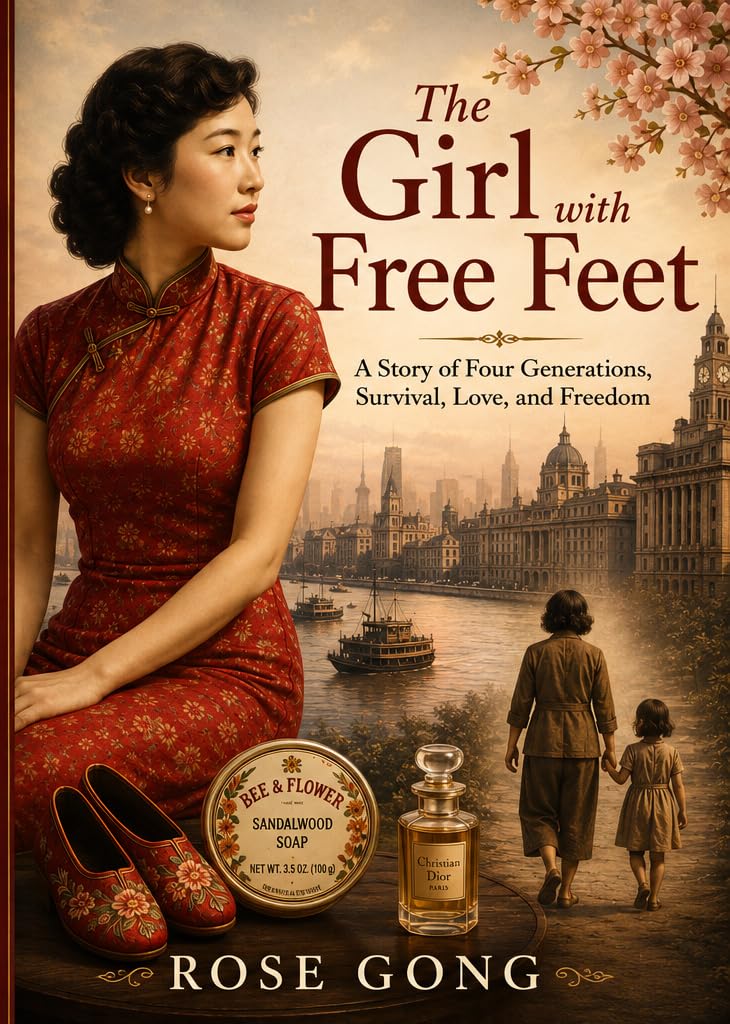
Rose Gong’s The Girl with Free Feet is an intimate family narrative about women’s freedom and the complicated work of claiming it. Drawing on family history and personal memories, Gong tells the story through reconstructed scenes and dialogue, with her mother, Rita, at its center. We meet Rita as a curious, quick-witted teenager in Shanghai, growing up in a household where education, elegance, and obedience carry considerable weight. Her mother Rong’s bound feet give the title its immediate meaning, while Rita’s questions introduce a wider concern: how much say does a woman have over her own life? That question connects the book’s treatment of love, motherhood, political upheaval, and immigration. Its emotional pull comes from seeing those concerns take shape within one family, through everyday conversations and competing expectations.
The book’s strongest feature is its feel for domestic life. Steaming breakfast buns, the scent of sandalwood soap, a carefully fitted qipao, and music drifting through a house give these memories texture. Objects carry associations that deepen as the story progresses, making the family’s past feel tangible. Rita herself brings plenty of energy to the page. She’s funny, impatient, proud, and eager to learn, and her teasing exchanges with relatives keep the early chapters lively. I especially appreciated the attention Gong gives to the women around her, including her sister and the people whose care sustains the household. Affection often appears through practical gestures: preparing food, adjusting clothing, sitting beside someone, or making room for a difficult conversation. Those details make the relationships feel close enough to recognize.
As the story moves through periods of fear and upheaval, Gong keeps her attention on how people experience them at home. History affects what families can say, which possessions they value, and what parents hope to preserve for their children. Education becomes particularly moving in this context, both as an opportunity and as a habit of questioning. The book also gives personal choice a complicated emotional life. Desire, loyalty, guilt, and gratitude can occupy the same relationship, and Gong acknowledges the responsibilities that accompany independence. Her prose is accessible and strongly shaped by dialogue, short paragraphs, and recurring images. At times, repeated reflections on feet, wings, movement, and freedom explain a scene’s meaning so fully that they soften its impact. Some conversations also have a polished, almost proverbial quality. The sensory details and family tensions are where the writing feels most convincing.
I’d recommend The Girl with Free Feet to readers who enjoy family memoirs, stories centered on women across generations, and accounts of Chinese immigrant experience. People interested in how political change enters private life will find plenty to consider, especially in the book’s attention to parenting, education, and the ways fear alters ordinary routines. It would also make a thoughtful book-club choice, with room to discuss the relationship between freedom and responsibility, the expectations daughters inherit, and the difficulty of understanding our parents as people with desires of their own. Its openly emotional style will appeal to readers who like warmth, humor, and reflection alongside painful material. What stayed with me was the care behind the telling: a daughter trying to understand her mother’s life and preserve the experiences that shaped her family.
Pages: 329 | ASIN : B0HGB5XQJ1
Entropy: A Marquis de Sade Saga


Lloyd R. Free’s Entropy: A Marquis de Sade Saga brings a sharp tongue and an uneasy conscience to the streets of revolutionary France. This historical fiction novel blends historical mystery and political thriller elements around an unusual central figure: the Marquis de Sade, an imprisoned aristocrat whose work as a royal investigator gives him access to a society simmering with resentment. Murder, royal scandal, secret societies, and competing visions of liberty all contribute to the tension. The appeal is in watching this difficult, intelligent man try to read the people around him while the rules governing their lives keep changing. Free gives the story room to expand, making personal danger part of a much larger struggle over power.
Paris supplies some of the book’s strongest pleasures. Free pays close attention to embroidered waistcoats, muddy roads, café newspapers, elaborate meals, and the smells that drift through prison walls. Those details give everyday life a physical presence, and they also show how status operates through clothing, food, and access to comfortable rooms. I especially enjoyed the cafés and booksellers’ shops, where gossip circulates alongside political argument and everyone seems to have an opinion worth overhearing. The theatricality of public life is another effective touch. Salons, performances, demonstrations, and ceremonies become places where people rehearse identities and influence an audience. For readers drawn to French Revolution historical fiction, this busy social world offers plenty to linger over.
Sade himself gives the novel its most interesting friction. He’s vain, observant, stubborn, and often funny, with a talent for defending his own interests through elaborate philosophy. His literary ambitions matter as much as his appetite for pleasure, and Free makes writing feel bound up with pride, money, recognition, and the need to leave something behind. There’s an uncomfortable fascination in hearing him praise freedom while remaining attached to the privileges he’s known. His need for friendship and affection adds another dimension, giving his intellectual posturing an emotional cost. The conversations about nature, religion, justice, and human behavior help establish that complexity. Mesmerism and occult speculation also lend the story a peculiar atmosphere, placing scientific curiosity beside prophecy and spiritual claims. The sexual candor and graphic violence contribute to a distinctly adult reading experience.
The book asks you to keep track of a substantial cast and a steady flow of political information. Extended speeches, introductions, and explanations of factions sometimes slow the momentum, and several ideas receive more repetition than they need. The richly furnished descriptions can have a similar effect: I occasionally wanted a scene to move forward sooner. Even so, the combination of character, setting, and political unease kept my interest. Free is particularly effective at showing how lofty language can serve ambition, fear, and self-preservation, which gives the historical intrigue a recognizable human edge. Entropy: A Marquis de Sade Saga will appeal to readers who enjoy historical suspense with philosophical conversation, a provocative protagonist, and a close view of a society arguing its way into upheaval.
Pages: 333 | ASIN: B0H8KBJ4YB


