Blog Archives
Light Seen Through a Dark Veil – Book Five


Light Seen Through a Dark Veil is a character-driven science fiction space opera that pulls together a whole web of lives at the moment humanity faces another “Harvest” from the alien invaders. We follow Myra, the sharp, ancient advisor trying to drag the mysterious Builders into the fight, Svetlana the orphaned ballerina who gets drafted off the streets of Alkonost, and Father Francis, the doubting priest turned battlefield chaplain, along with a wider orbit of Sisters, soldiers, and politicians scattered across the galaxy. The book moves back and forth between front-line chaos and big political maneuvers as different worlds burn, resist, and regroup, all while the Sisterhood and the Builders quietly set up a counterstrike that might actually change the rules of the game rather than just survive the next battle.
I kept feeling like the real focus was not “who wins the war” but “who these people choose to be while the war is happening.” The writing leans into that. Author Forest Woodes loves close, intimate scenes: Myra trading barbed jokes over tea at the bottom of an alien ocean, Svetlana stepping out of ballet rehearsal into apocalypse, Francis and his childhood friends arguing about God in a dingy neighborhood bar right before the sky falls in. The prose is clear and unpretentious with the occasional poetic punch, like when the book talks about suffering as “black ink meant for a pure white page.” The structure is almost episodic, hopping between fronts and characters, which sometimes made me want a breather, but it fits the feel of a galaxy-wide crisis. For a fifth book in a space opera series, it is surprisingly grounded. Battles matter less for their explosions than for what they do to people’s faith, identities, and relationships.
I also appreciated how many choices are political and spiritual at the same time. Myra’s trip to the Builder homeworld is not just a diplomatic mission, it is an old woman trying to keep her mother’s vision alive while the universe shifts under her feet. Svetlana, the “ballerina who dances on the graves of her enemies,” is very clearly still the hungry, lonely girl who once ate from dumpsters, trying to build a self that is more than just a weapon. Francis is probably my favorite. He is a priest who admits he is angry at God, terrified, and tired of being the adult in every room, yet he keeps stepping up anyway, doing field medicine and offering last rites to people who do not share his faith. That mix of doubt and duty felt very human to me. The science fiction frame, with alien Harvesters, Builder tech, and stealth ships, gives big stakes, but the heart of the book is small moments like friends sharing bad bar food while watching the end of their city on the news.
Stylistically, the book sits in a middle ground that I liked. It has the scale and moving pieces of classic space opera, but it reads more like character-centered speculative fiction than crunchy military SF. The tone can jump from darkly funny to grim to quietly hopeful, sometimes in the space of a page, which made it feel like people coping rather than characters in a perfectly plotted arc. There are a lot of proper nouns, factions, and previous events referenced and, If you’re someone dropping in at book five, you’ll have to just accept the history. Even so, the emotional through-line will keep you anchored. When Myra pushes back against despair, or when Svetlana learns to see herself as more than a drafted victim, I felt it.
I would recommend Light Seen Through a Dark Veil to readers who enjoy science fiction space opera that cares more about people than hardware, and who do not mind juggling multiple points of view and some dense series lore. If you like stories about found family, messy faith, and resistance built from ordinary lives under extraordinary pressure, this will probably hit you in a good way. Light Seen Through a Dark Veil is a strong closing chapter for this science fiction space opera series. If you have been following the series, I think this is a satisfying and earned finish. And if you simply enjoy character-driven space opera, with big stakes, strange worlds, and a lot of heart, this is the kind of book that makes the whole journey feel worth it.
Pages: 321 | ASIN : B0G429M8VR

The Ocean Between Light and Darkness – Book Four


Book Four in the Emergent Universe series follows Ravi and Shashi, twin investigators linked to a quiet outfit called The Group, and it starts on Izumo with a hunt for Builder ruins and strange “clocks” tied to a looming Harvest. They cross paths with Amy Sato, a local with grit and brains, and she can bully Builder tech into cooperating, so she ends up in the mix. The trail spreads outward to the lost Invictus Colonies, and the story keeps widening in scope as old human choices echo through abandoned stations, wrecks, and half-dead worlds. The countdown pressure never fully lets up, and the ending lands on a rough kind of hope, with time bought through a risky upload and a promise of more work ahead.
The voice feels direct and lived-in, and the book moves with purpose. I liked the rhythm between tense scenes and bits of humor, and the jokes often act like a pressure valve. Ravi reads open and earnest, Shashi reads sharper and more guarded, and the contrast keeps the pages turning. I also enjoyed the way places show up with quick detail that sticks, like a dive bar vibe on the edge of nowhere and the uneasy quiet of old metal drifting in the dark. I did hit a few stretches where the story slows down for explanation, and my attention wandered for a beat.
The ideas are the real hook for me, as it was with the other books in the series. The Harvest Cycle feels cruel and mechanical, and it gives the whole book a cold wind feel. I kept thinking about the theme of light and darkness in people, and it fits the characters and the larger history in a clean way. The Builders come off as powerful and unreadable, and humans come off as clever and messy, and neither side earns a free pass. The Invictus angle was emotional, since it points at ambition and pride and shortcuts, then it shows the bill coming due for everyone. I felt dread in the big reveal moments, then I felt a stubborn little thrill too, like the story was daring me to look into the deep end and not flinch.
I finished the book impressed, a bit unsettled, and honestly kind of pumped for the next book. The clock keeps ticking, and the story keeps nudging you forward. The Ocean Between Light and Darkness delivers a solid space adventure, and it keeps its moral spine intact, and it does not sugarcoat the cost of discovery. I recommend it to readers who want fast momentum, strong character chemistry, and a big sci-fi threat hanging over every choice, plus anyone who likes lost-colony mysteries and ancient tech with sharp edges.
Pages: 298 | ASIN : B0G4277JV9

Moonlight Falling on Dark Water – Book Three


In Moonlight Falling on Dark Water, author Forest Woodes drops readers into a human civilization still twitching after the appearance of Builder artifacts, and then asks me to follow Princess Sarasvati “Sara” Singh as she leaves the political gravity of the Saladin for a long, cold search: encrypted clues left inside her mother’s research LLM point toward an ocean world named Calypso, where a settlement called Abyss sits near a newly awakened underwater transport system that nobody trusts. Along the way, the expedition gets the unmistakable itch of pursuit—an unnamed ship stalking them through the smear of FTL, and the book keeps tightening its braid of exploration, paranoia, and high-stakes diplomacy until it becomes, unmistakably, a first-contact story with teeth.
What I enjoyed most was how the novel refused to treat “politics” as a separate genre from “adventure.” The same chapter can hold a scheming conversation about manufacturing legitimacy and then pivot into the physics-flavored terror of being hunted in deep space, where a “burp” of gamma radiation is floated like an ugly prayer. The moral texture is the point: Sara and her allies aren’t cartoon puppeteers, but they are willing to shape outcomes, and the book makes me sit with that. uneasy, complicit, and weirdly invested.
I also liked the book’s sense of scale, wide enough for fleets and constitutions, intimate enough to linger on the grit of a frontier bar and the sulfur hint in a beer you drink because the water is complicated. And when Sara finally finds her mother, the reunion lands with raw force: it’s not a tidy revelation, it’s a messy human break in the hull, tears, anger, relief, the blunt question that’s been waiting for years. That emotional honesty is what kept the cosmic machinery from feeling sterile.
Moonlight Falling on Dark Water is a book that turns the darkness from a backdrop into a character. I think readers who like space opera, hard-ish science fiction, first contact, interstellar political thriller, and exploration/adventure will feel at home here, especially if you enjoy watching a new order get forged in real time (the Nomads adopting a constitution and elevating Kara-Sal is pure history-in-the-making spectacle). If you’ve devoured The Expanse by James S. A. Corey and liked it for its lived-in future and factional chessboard, this has a similar appetite for consequence. But it tilts toward something more quietly metaphysical when the Builders, “the People Under the Shell,” choose to withdraw and keep watching.
Pages: 324 | ASIN :B0G42G7Z3J

Light in a Dark Place – Book Two

Light in a Dark Place by Forest Woodes is a science fiction space opera with a strong political thriller and military sci-fi streak, plus a pinch of cosmic horror. It opens with Yasmin Pasha and Crown Princess Sarasvati poking through a captured “ghost ship,” a vessel packed with corpses and scrubbed logs, except for a surviving clue that points to a mysterious Builder shipyard. The story then widens into court politics on Deva, a hunt for the warlord Bibi Khan, and a looming, much bigger threat that Sara insists is “coming” from the dark between the stars.
What I enjoyed right away is how Woodes balances big stakes with very human moments. The early banter between Yasmin and Sara in literal open space is funny and nervous in a way that feels earned, not “quippy for the sake of it.” Then, a few pages later, you’re in the Glass Palace with stormlight, marble, and all the weight of legacy, watching Sara try to convince her father that she is not being dramatic, she is being realistic. I also appreciated that the “ancient tech” thread is explained in plain terms through Clara, without turning into a lecture, just enough to make it feel dangerous and plausible in the book’s world.
The author’s choices get especially interesting when the book pivots from mystery into systems and power. There’s a coup speech that is chilling because it sounds like a real person justifying the unthinkable, and the book doesn’t soften that edge. And when Sara finally tells her twins what she is really up against, the mood shifts. The “little light” inside a black artifact, like looking at light under dark ice, is one of the few times the sensory language lands perfectly, because it matches the feeling of the whole book: hope, but faint, and surrounded. Then she goes further, laying out the towers, the countdown clock, and the Harvesters who leave dead worlds, and suddenly the story isn’t only about politics or even war, it’s about survival on a clock you did not know you started. That’s where it hooked me. It’s big, it’s scary, and it makes the smaller arguments feel tragically petty in a believable way.
I’d recommend Light in a Dark Place most to readers who like space opera that actually uses its scale, the kind where courtrooms and battle plans matter as much as starships, and where the “enemy” is not just a person but a whole pressure system. If you enjoy political maneuvering, morally complicated loyalties, and action that can jump from a tense ship investigation to a brutal public arena scene, you’ll find a lot here. If you like your science fiction a little stormy, with a professional, hard-eyed look at how civilizations crack and how people still try to build something anyway, it’s an easy recommendation.
Pages: 336 | ASIN : B0G42BPC1Z
Blinding Light / Implacable Darkness – Book One
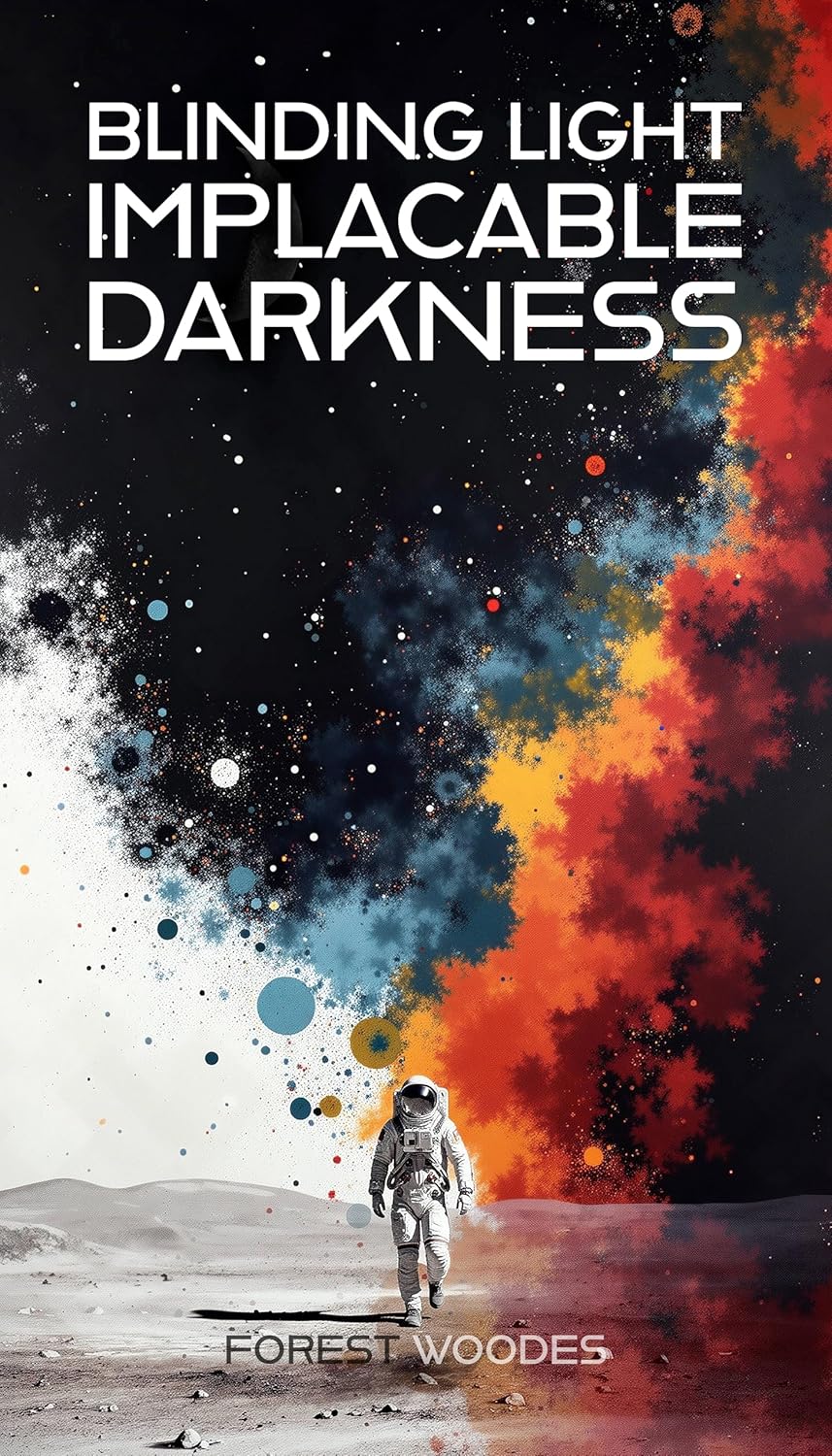
Blinding Light / Implacable Darkness follows Nico Laertiadis, a nineteen-year-old student on the colony world Ithaca, as his easy life crashes into galactic politics, terrorism, and full-scale war. A glittering trade summit on Ilium turns into a mass killing underwater. From there, the book tracks the slide from trade disputes to emergency laws, riots, and finally a draft and interstellar conflict. Nico becomes both a politician and a soldier, moving from protests in the streets to brutal missions on alien worlds, while his bond with his partner Emily and their dog Argos hangs by a thread. All of it is framed as an older Nico looking back, trying to give shape to chaos, openly telling us this is the story of the war, what happened to Earth, and his long journey home.
I really liked the writing. Nico’s voice feels casual and sharp, and it lets the book move from dry political debate to gallows humor to moments of real tenderness without feeling fake. Domestic scenes with Emily and Argos have a soft warmth I found disarming, like the quiet afternoon when she paints the dog while Nico reads Mary Oliver and worries about looming war. Then the book yanks that comfort away with a riot, or a bombing, or some other disaster, and the shift hits hard because the calm was so vivid. The action scenes are clear and tense. A sequence at a remote dam where turbine noise wakes a sky full of shrieking predators is pure nightmare fuel. Sometimes the worldbuilding comes through thick blocks of explanation and committee roll calls. Those stretches slowed me down a bit, yet they also gave the setting weight and made the later fighting feel like the inevitable result of a long chain of choices.
What stuck with me most were the ideas humming underneath the explosions. The book explores how fear, the media, and misinformation push entire societies toward war. We see false reports, staged clashes, and a protest that is very obviously engineered to turn into a riot, and it all felt uncomfortably plausible. The technology has the same moral bite. The entangler network that lets humans talk across the stars turns out to be a kind of haunted system. Someone, or something, listens in. The only way out is to break the network and blind everyone, which is exactly what a secretive faction does. I felt real anger at that choice and still understood why the characters made it. The story keeps circling back to trauma and responsibility. Therapy scenes, panic attacks, the way Nico’s jokes thin out as the war drags on, and finally his shaky, beautiful reunion with Argos and Emily at the end, all gave the book a heavy emotional punch.
The story does not pretend that war makes anyone noble. It shows people breaking, doing terrible things, and then trying to live with what is left. At the same time, it keeps finding small lights in the dark, like a dog that still remembers his person after years apart or a partner who keeps asking hard questions instead of walking away. For me, Blinding Light / Implacable Darkness is a strong pick for readers who like character-driven military science fiction, political thrillers set in space, or modern anti-war stories that still care about love, family, and ordinary life. If you enjoy books that balance big battles with close-up emotion, and you can handle vivid violence and themes of trauma, this first volume in the Emergent Universe series is well worth your time.
Pages: 457 | ASIN : B0G429RS11


