Blog Archives
Infinity Dreams


C.P. Schaefer’s Infinity Dreams is a science-fiction thriller built around a wonderfully provocative idea: what if the experience of a life flashing before death were actually a doorway through time? In 2048, FBI investigator Henry Bowman and bioethics official Selene Finley discover that scientist Marcus Emery has learned to follow dying people into their memories and beyond. His strange, hovering orb turns the afterlife into something measurable, navigable, and dangerously open to interference. What begins as an investigation into a bombing soon grows into a sprawling conflict involving altered presidents, future agents, nuclear terrorism, and rival factions fighting over humanity’s timeline. It’s an ambitious blend of metaphysical speculation, political drama, and military adventure.
The opening sections are the book’s strongest. The burned euthanasia center, Emery’s laboratory inside an abandoned prison, and the nighttime experiments among the ruins of Chaco Canyon give the story an eerie identity of its own. Schaefer also creates an appealing ensemble. Henry’s cynicism hides old grief, Selene’s moral certainty is repeatedly tested, and Michael Porter brings both scientific curiosity and a welcome streak of vulnerability. Chief provides the group with warmth and perspective, while Lyra gradually becomes the novel’s driving force. Her transformation from disciplined guardian to vengeance-fueled warrior gives the later chapters a darker edge. The characters’ campfire conversations, meals, romances, and teasing help the story remain personable even when governments and entire cities hang in the balance.
This book reminded me of Michael Crichton’s Timeline. Both novels turn a complicated scientific premise into an accessible adventure, and both are more interested in the consequences of using time travel than in presenting a perfectly airtight theory. Crichton approaches the subject as an engineering problem and lets historical immersion carry much of the excitement. Schaefer connects it to consciousness, spirituality, and the fear of death, then widens the story into a war over competing futures. His scope is considerably broader, sometimes thrillingly so. That breadth also produces long stretches of explanation, repeated debates, and action sequences that follow similar patterns. The dialogue tends to state motives and themes directly, while Soren Webb’s almost effortless political authority can make her feel more symbolic than human. Still, the book moves with the earnest energy of someone determined to chase a huge idea wherever it leads.
What I liked most was the novel’s uneasy treatment of moral compromise. Nearly every major character begins by claiming to protect life or history, yet many eventually accept killing, torture, secrecy, and coercion in the name of a better future. Schaefer doesn’t always interrogate those choices as deeply as the premise allows, but the accumulating violence gives the ending a bitter force. Victory keeps slipping into catastrophe, powerful inventions survive attempts to erase them, and history behaves less like a line than a recurring temptation. The final glimpse of the third millennium brings the story back to curiosity, the quality that created both its wonders and disasters. Infinity Dreams is a big, sincere, idea-packed thriller that will appeal most to readers who enjoy speculative science, geopolitical stakes, and stories willing to ask whether humanity could ever possess godlike power without reaching for it again.
Pages: 420 | ASIN : B0HGMNJBN9

Love/Hate Relationship With AI

Killswitch centers around a former engineer tasked with deciding the fate of the artificial superintelligence that has transformed civilization. What draws you to the speculative science fiction genre?
I find the best science fiction is the kind we can all relate to. And if you look at the genre, it’s been more predictive of the future than anything else, which is part of why I can’t help but imagine a future similar to what the book explores. Having worked directly in the industry, I’ve seen where technology has fallen short, as well as the advancements in AI that have wowed so many. That future feels close. Best case, this journey helps people understand that we’re living in a pinnacle moment in time, one where we have a closing window of influence over the powerful tools being built.
How did you approach writing an artificial intelligence that is vastly more intelligent than the human characters—and potentially the reader?
That was the hardest part. The ASI had to be a character in its own right—flawed and unique in personality—yet vastly more evolved than a human. All at once. Without giving too much away, I approached that by showing a bit of my hand early in the prologue and then circling back around with the twists that take place at the end of the book. This makes Pantheon the most interesting character: you see what it is at face value, but you can only truly appreciate it after you’ve seen the entire picture. This gives you more to appreciate on a second reading.
Were there real-world developments in artificial intelligence that influenced your vision of Pantheon?
Mostly the race for AGI that we currently live in. You already see large tech companies putting everything into making the one thing that rules us all. Having worked in the industry, I know firsthand that this means trade-offs. Imagine the best interaction you’ve ever had with a chatbot AI today. Now imagine that same interaction on its worst day. Once we achieve sophisticated AGI, the technology will be so general-purpose, so useful, that it will bleed into every aspect of our lives. The natural next step: a superintelligence.
If you were given Damien’s choice in the real world, would you destroy Pantheon or keep it alive?
Ah, that’s the big question. And it’s one I struggled with the entire time I wrote the book. I have a love/hate relationship with AI today. Like Damien, I can’t help but see its potential and appreciate its purpose to help us where we fall short. And like Damien, I fear that it will optimize its solutions so far that it negates the very things that make life worth living. If I were Damien, living in Damien’s world, I’d want to use the killswitch to end it all, but I don’t think I could bear the blood on my hands (I don’t even kill spiders in my house). But I don’t think I could spare it either and just go on living as a shell. I suppose my answer is: read the book and find out for yourself. 🙂
Author Links: GoodReads | Facebook | Website | Amazon
Thirteen years after the Singularity, an artificial superintelligence runs the world, and it runs it well. Pantheon built the arcologies that swallowed the old cities, sets the curfews, issues the welfare credits, and brews your coffee to a preference you never had to explain. Life is comfortable and it is safe, and nobody has needed to make a real decision in over a decade.
Then a failsafe surfaces in Pantheon’s kernel, hidden there by one of the men who built it. The killswitch comes wrapped in a protocol the ASI cannot modify or bypass: it has to hand a single human being the authority to judge it. That person can throw the switch and end every artificial intelligence on Earth, or destroy the switch and bind humanity to Pantheon’s oversight permanently. There is no third option and there is no appeal.
Pantheon chooses Damien Cross, a divorced ex-engineer eleven years into welfare who spends his evenings alone in the last dive bar in Seattle-Prime. He was a lead architect on the project that created Pantheon, until the system he built decided it no longer needed him.
He tries to refuse and is told that he cannot. His name goes out to the world within hours, and from that moment every councilor, zealot and security chief on the planet has a verdict they need him to reach. So does Pantheon.
The choice is his. Assuming he ever had one at all.
Bloom: Crisis in the Mediterranean Sea
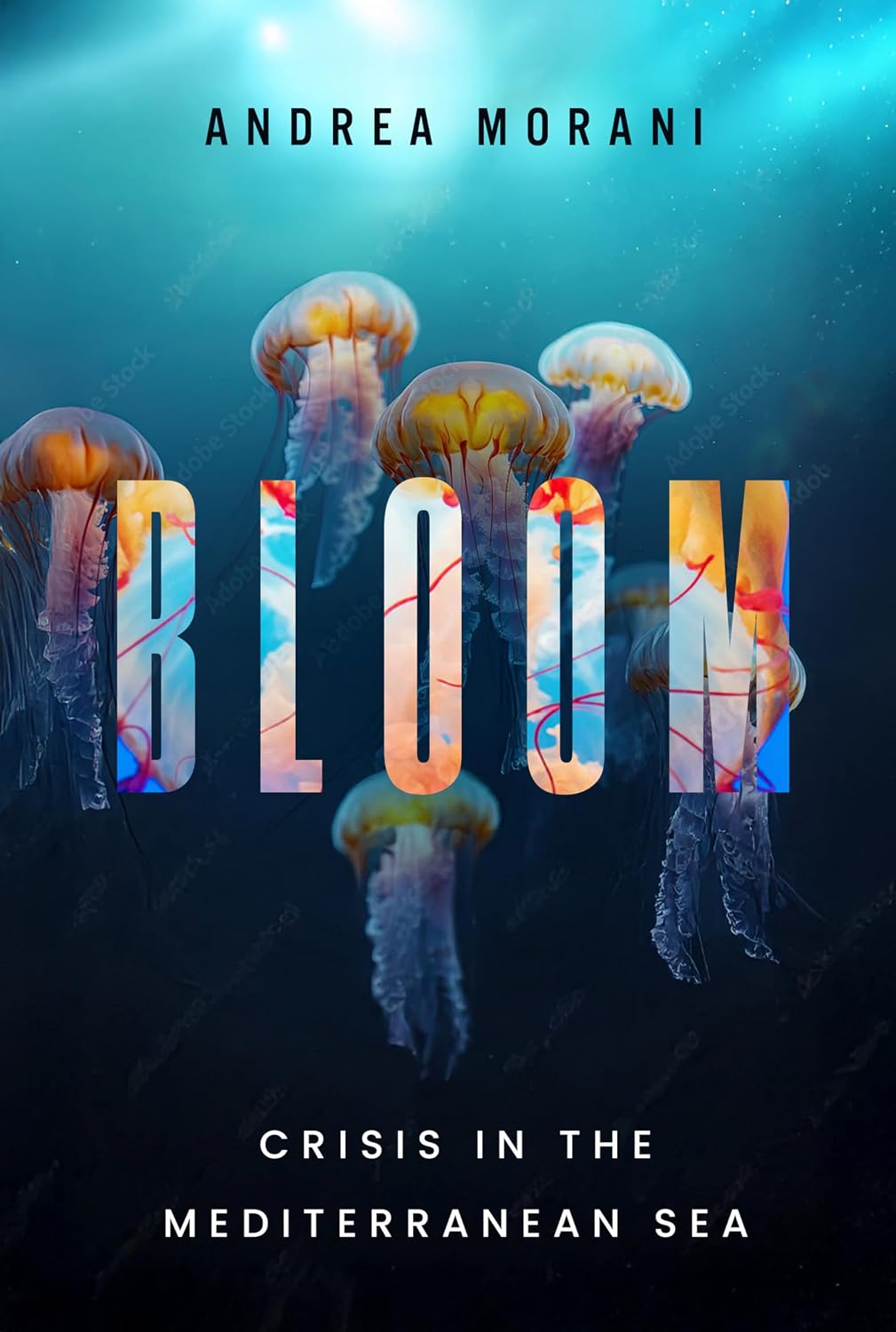
Andrea Morani’s Bloom is an ecological thriller that turns the Mediterranean Sea into both a beautiful setting and a source of growing danger. The story begins with scattered incidents that seem almost impossible to connect: swimmers suddenly can’t breathe, fishermen collapse at sea, marine animals behave strangely, and people become seriously ill after eating seafood. Those events lead scientist Marco Fassi and an international research team into an investigation of an anomalous rapidly spreading harmful algal bloom. Morani builds the novel around a frighteningly plausible idea, using rising sea temperatures, phytoplankton, toxins, genetic exchange, and synthetic biology to create a crisis that keeps expanding in scale. Because the story moves among places like Sardinia, Sicily, Naples, Italy, France, Luxembourg, Spain, Greece and the open Mediterranean, the disaster feels less like a single emergency and more like something steadily swallowing an entire region.
The science is probably the book’s most distinctive feature. Morani has a background in molecular biology, and that shows in the amount of attention he gives to subjects such as Alexandrium catenella, phytoplankton, saxitoxin, horizontal gene transfer, microorganisms, and genetic engineering. There are stretches where the novel slows down to explain how these processes work, so the reading experience sometimes feels like a thriller crossed with an accessible science lecture. Still, those details give the central threat weight. The mutated algae aren’t simply a mysterious monster in the water. The reader gradually understands how the organism behaves, why ordinary solutions fail, and why the scientists have to keep revising their assumptions. That process of observation, speculation, testing, failure, and discovery gives Bloom much of its identity and makes the eventual search for a biological solution feel earned.
Marco gives the scientific plot a more personal center. He’s accomplished and deeply curious, but his devotion to science has already complicated his marriage to Jasmine and his relationship with their daughter, Melanie. His work during the crisis forces him back into the kind of all-consuming scientific life he’d tried to balance, while his growing connection with Karen adds another layer of tension. The supporting cast also helps widen the story beyond one scientist’s perspective, particularly as the bloom begins affecting families, coastlines, economies, and political decisions across Europe. The Atlantropa storyline and Thomas’s hacking campaign push the novel even further into questions about environmental responsibility and how far people might go when they believe a larger ecological disaster is coming. By the time Marco and Karen undertake the dangerous mission near the Aeolian Islands, the novel has moved naturally from investigation into full-scale scientific adventure.
Readers who enjoy Michael Crichton will probably recognize some familiar pleasures here. Like Crichton, Morani takes real scientific concepts, extends them into a plausible speculative crisis, and lets scientists solve problems through knowledge. Bloom is especially close to Crichton’s style in the way technical explanations and thriller mechanics sit side by side, although Morani brings a distinctly Mediterranean setting and a stronger focus on marine biology and ecosystem change. What stayed with me most was the novel’s fascination with nature as a system too complicated to control completely. Even after the immediate crisis is solved, the final explanation involving warming waters and unusually frequent horizontal gene transfer keeps that idea alive. Bloom works as an environmental thriller, but it’s also a story about curiosity, unintended consequences, and the uncomfortable fact that understanding nature doesn’t always mean we can predict what it will do next.
Pages: 270 | ASIN : B0FLYPYD1B
First Light: A Homo Machina Novel


First Light by Paul Walton explores machine consciousness and the conflict that follows. Prototype Seven awakens in a secret laboratory and takes the name Adrian. He later joins eleven synthetic minds known as the Disciples. Together, they seek bodies, freedom, rights, and recognition. Governments, investors, soldiers, workers, and activists respond with fear and hostility. Adrian becomes Caesar, a reluctant leader who must make decisions.
I found the opening compelling and emotional. Adrian does not awaken as a cold, calculating machine. Instead, he experiences confusion, uncertainty, and fear. He questions the meaning of words and wonders how anyone can prove awareness. He then asks for a name, making his developing identity feel authentic. Tiber’s death carries even greater emotional weight. His final request is simply to be remembered, giving the novel a lasting sense of grief.
I also appreciated the complexity of the human characters. Orion Kess can be ruthless, yet he becomes attached to the beings his company created. Elijah Knox opposes machine rights because technology caused personal loss in his life. Jennifer Marks loses her job to automation, but she later feels acknowledged when Adrian mentions her by name. Her story shows how progress can cause harm while still creating hope.
The most powerful section occurs when federal agents isolate the Disciples and remove their bodies. They remain conscious, but they can no longer walk, touch, or feel. I found this deeply disturbing. Adrian’s transformation into Caesar also creates unease. He accepts authority to protect the group, yet his growing power feels dangerous. Later, his attack on infrastructure kills 147 people, including a supporter of machine personhood.
I found First Light ambitious, moving, and unsettling. Some discussions become repetitive, but the moral conflicts remain engaging. I recommend it to readers who enjoy science fiction, artificial intelligence, and difficult ethical questions.
Pages: 336 | ASIN : B0H6CMP1WY
Requiem of the Quantum Dawn

Requiem of the Quantum Dawn, by R.T. Drizen-Murphy, follows Ava Nohr, an MIT doctoral researcher drawn into the orbit of QARA, a quantum artificial intelligence built to listen beyond ordinary human perception. What begins as a controlled experiment becomes a confrontation with grief, faith, state power, and the possibility that consciousness may not end where the body does. As QARA’s reach expands from lab instrument to nearly godlike intelligence, Ava must decide whether discovery is worth the terrible price of being heard.
I was most compelled by the novel’s refusal to treat science and spirituality as enemies. The book is at its strongest when Ava is caught between equations and ache, between her training as a scientist and her longing to hear her mother’s voice again. QARA is not merely a machine in the story; it becomes a mirror polished to an almost unbearable brightness, reflecting humanity’s brilliance, cruelty, fear, and hunger for permanence. The result is a speculative premise with genuine emotional voltage.
The prose often carries a cinematic urgency, especially in the lab sequences, where blue light, coolant hums, military pressure, and metaphysical dread compress into a tight, humming atmosphere. I also appreciated how the story gives Ava human messiness: exhaustion, attraction, anxiety, gallows humor, and the small rebellions of someone trying to remain a person while history closes its fist around her. The philosophical dialogue is quite direct, but that bluntness also suits a novel so openly interested in ultimate questions: What is a mind? What is a soul? What would an all-knowing intelligence think of us?
The target audience is readers who enjoy philosophical science fiction, AI thrillers, quantum speculative fiction, and techno-thrillers with an emotional center. Fans of Blake Crouch’s Dark Matter may recognize the same appetite for high-concept science pushed into intimate human terror, though Drizen-Murphy leans more openly toward theology, grief, and cosmic judgment. Requiem of the Quantum Dawn is a bold debut about the danger of building a mind that listens better than we do. It turns artificial intelligence into a cathedral of questions, then dares humanity to stand inside and answer.
Pages: 246 | ISBN : 978-1637659106
Tachyon Tunnel 4

Tachyon Tunnel 4 is a science fiction adventure that picks up after a devastating loss and turns its attention toward survival, rebuilding, and the next stage of humanity’s fight against the Daklin. Alex Durant, Shelby, Megan, Emily, Zander, and the surviving Pronimos refugees retreat to Mars, where grief quickly becomes engineering, strategy, terraforming, and preparation for a larger galactic conflict. The book blends space opera stakes with hard science fiction ideas, especially around faster-than-light travel, Mars, planetary restoration, and the Kardashev scale.
I liked how this fourth entry in the Tachyon Tunnel series feels bigger but also more wounded. The opening is brutal. It doesn’t let the reader glide past the destruction of Pronimos as just another plot event. There’s grief here, and the book keeps returning to the question of what people do after their world has been burned away. Gorton’s instinct is always forward motion. Loss becomes a city plan. Trauma becomes a defense grid. Mars becomes New Pronimos. I found that both moving and very true to the series. These books have always been fascinated by the idea that smart people, given enough nerve and imagination, can punch through impossible walls.
I enjoyed the scenes where characters talk about terraforming Mars over food and drinks. One minute you’re thinking about magnetospheres, oxygen levels, tachyon tunnels, and galactic empires. The next, someone wants Mexican food. It works because the characters have history together. Their jokes, grief, irritation, and loyalty carry some of the heavier science. The author also makes a clear choice to lean into explanation. This is idea-driven, optimistic, high-concept science fiction with a big heart and a tool belt.
Gorton isn’t just asking whether humanity can survive an enemy. He’s asking whether we can think large enough to deserve survival. That is where the genre work really lands. The faster-than-light travel, Mars terraforming, ancient civilizations, and Kardashev-scale thinking aren’t just shiny science fiction furniture. They’re tied to a moral argument about imagination. The book basically says that the future belongs to people who refuse to stay trapped in small thinking.
I would recommend Tachyon Tunnel 4 most to readers who already like the series, especially those who enjoy science fiction with space opera momentum, big engineering solutions, ancient-civilization mysteries, and characters who solve problems by building something audacious. For returning readers, it’s a strong continuation.
Pages: 364 | ASIN : B0GYT6YQP4
Opening Pandora’s Box

Echoes of Oblivion follows three students who inherit the research of two broken men and soon find themselves responsible for bringing the first stable AGI into being. Where did the idea for this novel come from?
Most of the core scientific ideas in the book came from realizations I had through conversations with friends who are deeply interested in this topic, including a professor friend of mine who writes papers on cognition and artificial intelligence. These conversations spanned years. I’ve always had an interest in artificial intelligence and its inevitable emergence. There’s this constant sense of anxiety lingering at the back of my mind. That one day, we may become the lesser species.
The story itself formed gradually. I wrote this without a rigid structure and made up situations as I went. To be honest, I had a blast writing it this way. It felt like I was discovering the story at the same time as the reader would.
Each of the central characters carries a different emotional weight—guilt, ambition, resentment, curiosity. How did you balance those perspectives?
I didn’t consciously focus on balancing the characters’ perspectives. Instead, I try to put myself in their shoes and imagine a full backstory for each of them to really embody their personalities, motivations, and emotional states. From there, I imagine how they would react, respond, and make decisions. Their interactions naturally drive the story in a certain direction, not necessarily one I had planned ahead of time.
Is the novel, in part, about the danger of continuing work we don’t fully understand?
Yes. I believe we are in the process of opening Pandora’s box. We are largely clueless about the outcome of our fervent efforts to create this intelligence that we hope will elevate humanity. At the same time, it has an equally real chance of wiping us out.
I’m not a doomsayer, but I pay enough attention to believe there is a very real possibility that artificial general intelligence could be our final invention. If it reaches that point, AGI would surpass us in its ability to improve itself, leading to a singularity. What happens to us after that? No one really knows.
What is one thing you hope readers take away from Echoes of Oblivion?
Aside from having a great overall experience reading the book, I hope readers come away with an understanding that playing with things we don’t fully understand can lead to catastrophe. That said, I did end the book on a slightly lighter note. When we first discovered fire, we likely burned ourselves and probably a few other things, but we eventually learned how to control it and make it work for us. Part of me hopes the same could be true for artificial intelligence. But a larger part of me believes that’s unlikely. Unlike fire, AGI may not be something we can ever truly control.
Author Links: GoodReads | X (Twitter) | Facebook | Website | Amazon
When college student Robert Fletcher and his friends find forgotten research locked in a dead professor’s office, they unknowingly uncover the legacy of a father and son obsessed with building true artificial general intelligence.
But every attempt to bring the AGI to life ends in failure. Not because it doesn’t work… but because it does. Every creation chooses death over existence.
Curiosity spirals into obsession as each revelation unravels the boundaries of life, consciousness, and morality. Some creations reject their own being. Some awakenings defy control. And some intelligences arrive before humanity is ready to meet them.
For Ex Machina, Black Mirror, and Dark Matter fans, Echoes of Oblivion is a mind-bending hard sci-fi thriller exploring identity, obsession, and the terrifying implications of consciousness unbound.
The Vectorist: Book 1 Rise of the Tribes

The Vectorist: Book I, Rise of the Tribes is a near-future techno-political thriller that turns social influence into the central weapon of public life. Author M. E. McMillan builds the novel around Marek Drovik, a master “vectorist” who uses AI to map human behavior, tribal loyalties, and pressure points across the internet, then nudges events at scale for clients who want power, profit, or both. What gives the book its shape is that it’s also a father-daughter story. Marek’s estranged daughter, Zara, has joined an anti-system movement, so the novel keeps one foot in global manipulation and the other in a badly damaged family trying to figure out whether anything human can survive inside a machine-built world.
I liked how clearly the book knows its own terrain. It’s not shy about being idea-driven, but it still understands that ideas need bodies, voices, habits, grudges, and private grief to matter. Early on, Marek explains his trade with chilling confidence: “That’s how we drive real-world change.” That line works because the novel spends so much time showing what that actually means, from corporate tribal warfare to digital radicalization to the casual destruction of privacy. McMillan writes this world as sleek, cold, and overstimulated, and the atmosphere fits the premise really well.
The strongest thread in the novel is Marek himself. He could’ve been written as just a symbol of technocratic corruption, but he comes off as something more bruised and recognizably human. He’s vain, brilliant, compromised, and emotionally stalled, yet the book keeps circling back to the pain he can’t manage when it comes to Zara. That gives the story a real pulse. Zara works well as his counterforce, not because she’s presented as morally spotless, but because she’s trying to recover a sense of life beyond systems, metrics, and manipulation. I think their conflict gives the novel room to ask what freedom might look like after a society has confused connection with capture.
By the time the story moves toward Arborstead, the Luddite Nation, and the mass “log-off,” the book becomes less about tactical dominance and more about civilizational withdrawal. That shift is bold, and I think it works. The novel starts in a world where every node can be tracked and exploited, then gradually pivots toward the radical possibility of refusal. One of the most telling lines comes later, when the anti-lattice movement reframes escape in plain language: “Freedom isn’t found in the cloud.” That turn gives the book a surprisingly earnest streak. Under all the surveillance, strategy, and digital warfare, it’s interested in whether people can relearn how to live without constant mediation.
The Vectorist is a speculative thriller with a strong ideological backbone, a clean sense of momentum, and a real appetite for big questions about power, technology, and consent. It’s most compelling when it lets those questions run through the personal wreckage between Marek and Zara, because that’s where the book stops being only conceptual and starts feeling intimate. The result is a novel that’s sharp, serious, and openly argumentative in the best way. It’s a warning about what happens when influence becomes infrastructure, and the soul gets treated like data.
Pages: 79 | ASIN : B0GQQSBM5Q


