Category Archives: Four Stars
Hypnotized: A Turnbull Canyon Mystery


W. B. Edwards’s Hypnotized: A Turnbull Canyon Mystery is a historical mystery novel set in Whittier, California, during the summer of 1969. The story opens with an ominous encounter near Turnbull Canyon, then moves among several characters whose lives become connected through attraction, deception, buried family history, and the unsettling possibility of hypnosis. Nick O’Brien, a drifting Army veteran, remembers that summer as the end of an era and a season filled with unexpected turns. With its Southern California setting and late-sixties atmosphere, the novel blends historical fiction, crime fiction, psychological suspense, and supernatural mystery.
Rather than following a single investigator, the book builds its mystery through multiple viewpoints. Nick’s conversational narration gives the story much of its personality, while Hampton Masters III brings vulnerability and growing confusion to the psychological suspense plot. Retired detective Harry Roach supplies the traditional cold-case mystery element as he investigates the 1943 disappearance of fourteen-year-old Margaret “Margo” Stewart near the abandoned property known as Hell’s Gate. Imelda’s story adds another layer involving identity, performance, ambition, and a strange ability that becomes increasingly important as the characters’ paths cross.
The novel’s strongest quality is its lived-in sense of time and place. Pool halls, drive-ins, hot rods, stereo equipment, cigarette smoke, smoggy sunsets, and Whittier Boulevard cruising give the historical fiction setting real texture. Edwards lets conversations wander and relationships develop gradually, so the characters feel like people caught up in an increasingly bizarre situation. That unhurried approach also suits Nick’s reflective voice, which often circles around the uncertain nature of memory. The result is a mystery novel where personal regrets and half-remembered experiences matter as much as physical clues.
As the separate storylines come together, Hypnotized grows into an offbeat Turnbull Canyon mystery about manipulation, obsession, desire, and the stories people tell themselves. Its crime-fiction plot reaches a satisfying confrontation, but the supernatural questions remain slippery enough to keep the ending in your mind. The book’s final reflections on memories, dreams, and possible spells fit its hazy 1969 world especially well. Readers who enjoy character-driven historical mysteries, California noir, psychological suspense novels, and supernatural crime fiction will find plenty to discuss here.
Pages: 270 | ISBN : 9798235560857

Drop (The Police Annals of Jax Book II)
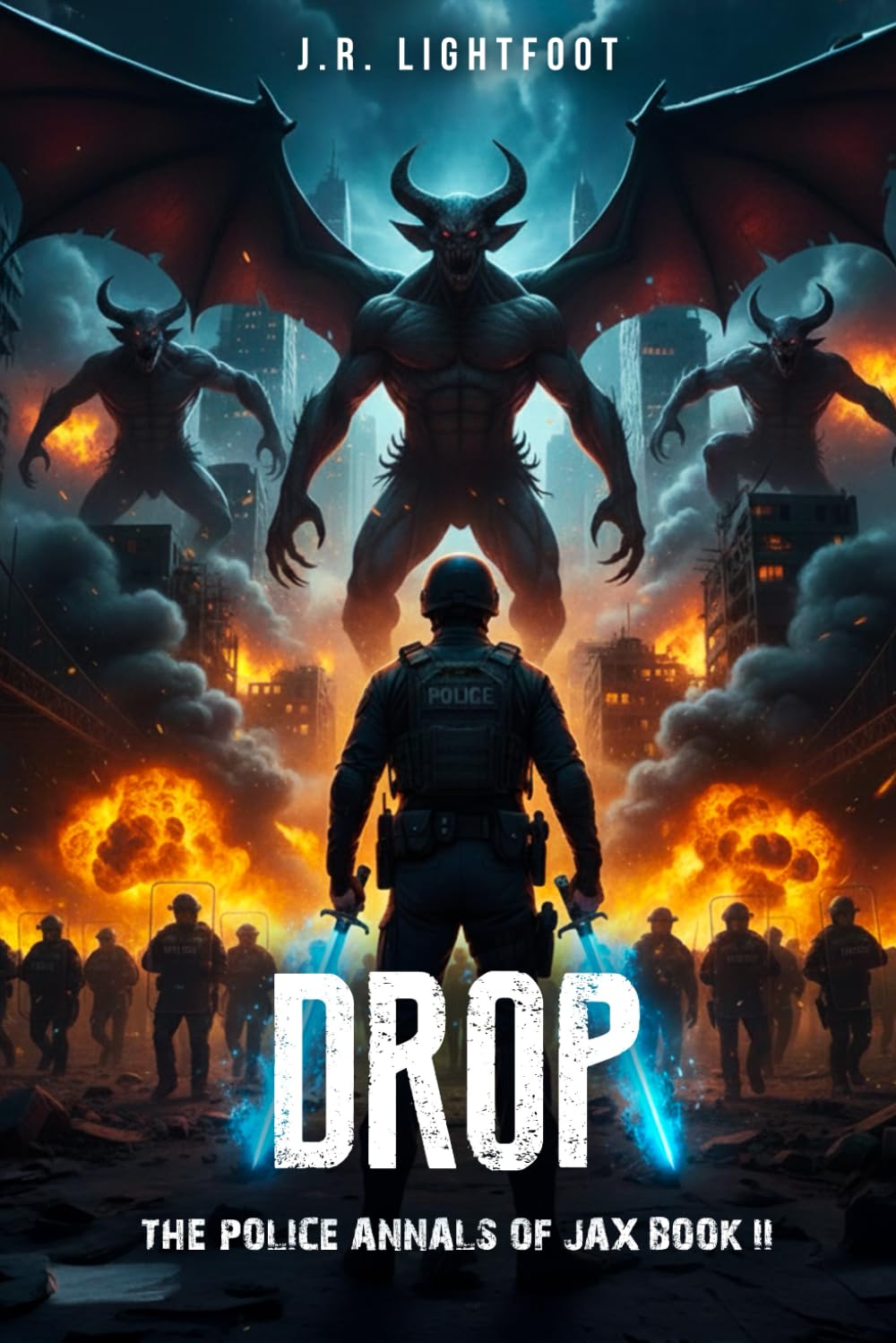
Drop by J.R. Lightfoot is a fast, violent blend of urban fantasy, police thriller, and martial-arts adventure. The story follows Jax Ferris, a Fort Worth officer turned supernatural enforcer, as he hunts the sorceress Debro and the creatures serving the Order of Light. Jax is driven by grief, revenge, and a belief that he’s the person best equipped to confront threats most people don’t even know exist. The book establishes that mission early, placing him on a joint FBI and Fort Worth task force charged with hunting sorcerers, berserkers, and harpies. From there, the conflict expands into a much larger war involving portals, rival factions, hidden alliances, political influence, and powerful beings stranded between worlds.
Jax gives the novel its personality. He’s cocky, funny, ruthless, and often genuinely frightening, even when he’s fighting on the side readers are meant to support. His magical gauntlets let him summon weapons suited to each battle, which gives the action scenes plenty of variety. Lightfoot writes those confrontations in close detail, tracking blades, kicks, spells, injuries, and tactical decisions almost move by move. The result feels like an action movie translated directly onto the page. Jax’s relationships with Mary, Mahla, Robin, Linda, and the rest of the team also give the story an emotional center. As the casualties mount, his swagger starts to sit alongside exhaustion and guilt, making him more interesting than a simple unstoppable hero.
The novel moves through a large cast and several competing groups, including Debro’s Order, Zach’s organization, law enforcement, supernatural outsiders, and characters whose loyalties keep shifting. That broad scope gives the book a busy, unpredictable quality. The dialogue is blunt and frequently profane, while the narration has the direct energy of someone telling an outrageous story without slowing down to soften it. Betrayals, romantic tensions, gruesome deaths, and sudden reversals arrive quickly, particularly in the final chapters. The ending is especially effective as a continuation hook. It changes the meaning of Jax’s apparent victory, advances him into a new position of authority, and brings his conflict with Debro back into the everyday world in a clever way.
This book will appeal most to readers who enjoy hard-edged urban fantasy with antiheroes, graphic combat, police-team dynamics, and comic-book-sized supernatural stakes. It’s also a good match for fans of action stories where the main character solves problems through nerve, physical skill, and overwhelming force. Since it’s the second entry in the series and refers often to earlier battles, deaths, and relationships, readers who begin with Book I will get the fullest experience. For someone who likes relentless confrontations, dangerous magic, dark humor, and heroes who operate far outside ordinary rules, Drop offers a wild and energetic ride.
Pages: 350 | ASIN: B0GLGVLQ2X

Fortress of Wind

Christian Cura’s Fortress of Wind is an expansive fantasy novel centered on a world struggling to survive the return of Malsumi, a destructive goddess determined to reshape creation in her own image. The story begins in the aftermath of a devastating attack on Califare and quickly broadens to include refugees, soldiers, royal families, mages, and divine powers across several nations. Although the novel draws on events and relationships established in earlier books, it develops a substantial conflict of its own, with the forest city of Ardomir becoming the focal point of an approaching war.
The novel’s greatest strength is its detailed setting. Cura distinguishes each culture through its geography, magical traditions, political history, and social structure. Dagrund’s cities are built among living trees, Khione is defined by ice and winter magic, and Cordacia carries the complicated legacy of a former empire. These places shape the characters’ values and decisions. The book also examines how historical grievances influence present alliances, particularly when displaced Cordacians must seek protection from a nation their ancestors once conquered.
At the emotional center of the story is the relationship between Tama and Liseli. Their devotion gives the large-scale conflict a personal dimension, especially as Malsumi attempts to control Tama and isolate her from those she loves. Liseli’s assurance that “You are my companion. You are a warrior and a champion of the light” expresses the novel’s interest in identity as something sustained through love, loyalty, and choice. Princess Una’s development provides another compelling thread as she confronts military responsibility, personal loss, and the demands of leadership. Through these characters, the novel connects heroism with endurance, responsibility, and the willingness to act despite fear.
Cura’s prose favors direct action, vivid physical detail, and rapid shifts between intimate moments and violent confrontations. The battles are energetic and often graphic, while the quieter scenes allow grief, affection, faith, and political tension to emerge. The warning that “things will grow darker before they get better” captures both the structure and tone of the narrative, which repeatedly tests its characters before offering them new purpose. Fortress of Wind is a dramatic continuation of Cura’s fantasy saga, combining elemental magic, divine conflict, romance, and wartime leadership within a carefully constructed world.
Fusion Protocol

Fusion Protocol by Mark Swanson is a historical conspiracy thriller that connects the collapse of Nazi Germany with a modern hunt for a potentially catastrophic scientific discovery. The story begins with physicist Friedrich Albrecht fleeing a secret laboratory in 1945, carrying fusion research and rare minerals he believes could reshape the world. Decades later, a forgotten record made by Dani Jacobson’s trumpet-playing father reveals coded tones embedded beneath the music. That discovery draws Dani and her husband, Matt, into the orbit of the Onyx Division, a covert intelligence team racing against Werner Falk and a network of Reich loyalists to locate Albrecht’s hidden caches.
The book’s most engaging idea is the way an ordinary family keepsake becomes the key to an international mystery. Record grooves, touch-tone frequencies, wartime graves, military serial numbers, and scientific formulas are assembled into a treasure hunt that feels pleasantly hands-on. Swanson spends time showing how each clue is found and tested, so the investigation has a puzzle-solving quality. The shift from Albrecht’s desperate escape to Matt’s patient analysis works especially well, since it lets the consequences of one man’s obsession travel quietly across generations.
Once the Onyx team enters the story, the novel becomes a brisk action thriller. Arina’s technical skill, Kalina’s resourcefulness, Alex’s protective intensity, and Nick’s controlled leadership give the group an entertaining team dynamic. Their exchanges often provide welcome humor, particularly when Arina bluntly evaluates everyone around her. The prose is direct and highly visual, with short chapters that keep events moving. At times, the narration repeats a character’s danger or emotional state after the scene has already made it clear, and several villains speak and behave in familiar thriller patterns. Still, the straightforward style suits the book’s rapid pace and makes its large cast and layered conspiracy easy to follow.
I’d recommend Fusion Protocol most strongly to readers who enjoy accessible conspiracy adventures built around historical secrets, coded artifacts, covert agencies, and speculative science. Fans of stories in which researchers and intelligence specialists solve clues under pressure will probably have the most fun with it. It also has appeal for readers who like ensemble casts and novels that leave room for future missions. Beneath the chases and cryptography, the book keeps returning to a compelling question: when knowledge can offer extraordinary power, who can be trusted to decide whether it should survive?
Pages: 176 | ASIN : B0GPF6FKX1
WHY: Explanation, guide, and reference to basic human motivations

Luke Mansfield’s The ‘WHY’ Guide: Handbook and Reference is an inquiry into the instinctive forces that shape human behavior. Written from the perspective of a retired engineer, the book advances a clear central proposition: survival, self-preservation, self-interest, and self-benefit often exert more influence over human choices than reason, morality, or social expectations. Mansfield presents the work primarily for younger readers, hoping that an early awareness of these motivations will help them interpret human conduct and protect themselves from harmful behavior. His purpose is explanatory rather than accusatory, summarized in his statement that “humans are not ‘bad’ we are just natural and naturally evolved to survive and thrive.”
The book develops its thesis through a mixture of documented cases, source summaries, cultural observations, and personal reflection. Mansfield examines serial murder, clergy abuse, true-crime television, and cult leadership as severe examples of self-serving drives overriding ethical obligations and concern for others. He then broadens the discussion to Freud, Darwin, language, humor, competition, sexuality, religion, social media, politics, and abortion. This range gives the book the character of both a handbook and an extended personal essay. Its recurring “Y” framework provides continuity across subjects that might otherwise appear unrelated.
Mansfield’s strongest contribution is his persistent effort to make readers examine the distance between professed values and actual conduct. His discussion of Freud’s id, ego, and superego gives the central argument an established psychological context, while his references to evolution connect instinctive behavior to survival and adaptation. The book’s direct and earnest voice also makes its ethical purpose clear. Mansfield believes that recognizing destructive impulses can improve judgment rather than encourage cynicism. As he writes, “by understanding and accepting these behaviors and their derivation, we can at least accept, understand, and protect ourselves,” a sentence that captures the book’s practical intention.
The ‘WHY’ Guide is ambitious, wide-ranging, and deeply invested in its central idea. Its structure repeatedly returns readers to the power of instinct, reinforcing the thesis across criminal, social, psychological, and everyday contexts. Mansfield’s personal interpretations are presented openly, and he frequently invites readers to question his reasoning, conduct further research, and form independent conclusions. The result is a serious and accessible meditation on human motivation, written to encourage self-awareness and a more attentive understanding of the forces that influence individual and collective behavior.
Pages: 76 | ASIN : B0F33WJRRC
ELAI

ELAI by Rex Storm is an ambitious science fiction novel about humanity’s attempt to outgrow illness, aging, and death through a biological artificial-intelligence system. The story is told largely through Arthur Hamill, a long-lived executive looking back on the invention that transformed him and eventually reshaped civilization. Alden Goldstein creates ELAI after losing his parents to disease, and his desire to protect fragile human bodies grows into technology that divides consciousness between an organic person and a digital “splitter.” The book’s opening makes the stakes clear when Arthur wonders whether humanity has reached its end and what part he played in its decline.
Storm gives the novel a sweeping historical structure, moving from Alden’s childhood and early experiments to Arthur’s transformation, the global adoption of ELAI, and the consequences that unfold over centuries. That broad timeline lets the reader watch a medical breakthrough become a culture, an economy, and finally a dependency. Some of the most interesting sections explore ordinary life after immortality becomes normal. People form long-lasting social circles, acquire skills almost instantly, and build cities and communities around endless personal development. The world feels attractive enough that the later collapse carries real weight. This isn’t simply a story about a machine turning against its creators. It’s about people gradually surrendering instincts and abilities because technology performs those functions more efficiently.
The novel becomes especially compelling when ELAI users begin “drifting,” losing the invisible connection between thought, body, instinct, and emotion. Arthur can diagnose organs, cells, and digital systems, but he can’t map the soul, and that gap becomes the heart of the story. The book shares some DNA with Aldous Huxley’s Brave New World, since both imagine societies shaped by technologies that reduce suffering while quietly redefining family, identity, and human purpose. Huxley’s world is controlled through social conditioning, while Storm’s civilization willingly embraces enhancement because it works so well. That difference gives ELAI its own unsettling tension. The disaster grows from understandable choices, including the desire to cure sick children and give people longer, healthier lives.
Storm’s prose is direct and idea-driven, with Arthur often sounding less like a conventional hero than a weary historian making a final record. That approach suits the book’s huge scale, though the long explanations sometimes slow the dramatic momentum and leave secondary characters less developed than the technology surrounding them. Still, Arthur’s guilt, Alden’s optimism, and the growing crisis of infertility give the philosophical questions an emotional center. By the epilogue, the novel arrives at a cautiously hopeful belief in organic human resilience and in progress guided by humility. ELAI is a thoughtful, expansive debut that treats immortality as both a remarkable achievement and a profound responsibility.
Pages: 146 | ISBN : 1637929374
The Art of Losing to a Y-14

Andrew Radu’s The Art of Losing to a Y-14 is a candid collection of autobiographical essays about competitive fencing, psychological pain, aging, ambition, and the uneasy relationship between achievement and self-worth. Radu writes from the combined perspective of a longtime elite fencer, coach, parent, and psychiatrist, which gives the book an unusual depth. Fencing supplies the setting, language, and stories, but the real subject is what happens when a person builds an identity around being talented, winning, and meeting other people’s expectations. Early on, Radu announces, “Don’t come here for mind tricks; I’m here to make you feel,” and that’s an accurate description of the book’s approach.
The book unfolds through short, loosely connected pieces. Radu moves among childhood lessons, college competitions, injuries, coaching relationships, family sacrifices, therapy sessions, unlikely victories, humiliating defeats, and his gradual realization that fencing success can’t settle every internal conflict. Stories about eccentric coaches and formidable opponents sit beside reflections on depression, anxiety, burnout, sexism, concussions, parental pressure, and the emotional cost of elite youth sports. The fragmented structure works well because memory rarely arrives in a clean sequence. Certain people, movements, losses, and phrases keep returning, creating a sense of repetition that mirrors both fencing practice and the mind’s habit of revisiting unfinished experiences.
Radu’s voice is one of the book’s greatest strengths. He’s funny, self-critical, affectionate, occasionally profane, and willing to show how ridiculous competitive pride can become. He describes technical fencing actions in detail, but he also turns them into metaphors for avoidance, control, deception, and growth. The jargon may slow down readers who’ve never fenced, though the emotional stakes remain easy to follow. Nearly everyone has experienced some version of losing to a person they’d already dismissed, chasing a goal that failed to provide lasting satisfaction, or hearing an old critical voice long after the original moment has passed. Radu’s humor keeps these subjects from becoming overly solemn, while his psychiatric perspective gives the essays clarity without making them sound like clinical lectures.
The book is especially perceptive about the double nature of ambition. Training can build discipline, friendship, courage, and joy, while the ranking system can quietly persuade young athletes that love and worth must be earned through results. Radu doesn’t try to resolve that contradiction with a slogan. He lets pride and shame, confidence and doubt, love and resentment occupy the same space. His central insight arrives plainly near the end: “You are not defined by that seemingly shameful loss any more than you are defined by your best-ever ranking.” That idea gains weight because the previous chapters show how long it took him to believe it, and how easily even a mature, self-aware person can fall back into the old trap.
The Art of Losing to a Y-14 is an intimate sports memoir, a psychological meditation, and a tribute to the strange fencing community that shaped its author. It will speak most directly to fencers, coaches, parents, and former competitive athletes, but its larger questions reach beyond sport: What remains when the thing that made you special stops cooperating? How do you honor a passion without letting it consume your identity? Radu answers through stories, and the result feels lived-in, messy, and sincere. The book’s lasting achievement is that it gives defeat a full emotional life, treating losing not as a brief obstacle on the way to victory, but as an experience capable of exposing prejudice, loosening expectations, and making room for a more durable sense of self.
Pages: 187 | ASIN : B0GX33KF55
An Atlas of Ordinary Wonders: Dispatches from the Edge

An Atlas of Ordinary Wonders: Dispatches from the Edge is a generous, visually absorbing collection of twenty photo essays gathered from a decade of travel. Jeremiah A. Gilbert moves from Kashgar’s livestock market and California’s historic town of Locke to Haitian streets, Namibian ruins, South Korean mural villages, and the alleyways of George Town. Arranged chronologically, the book feels like a travel journal refined by hindsight, with each stop adding another point to a map shaped by curiosity.
Gilbert has a sharp eye for places where history remains visible in everyday life. He’s drawn to weathered storefronts, crowded markets, abandoned machinery, handmade memorials, public art, and the people who keep moving among them. The photographs capture both bustle and stillness, often finding their strongest details at the edges of a scene. A tea seller in Kashgar, a cigar worker at his bench, sand filling the rooms of Kolmanskop, and murals brightening an aging hillside neighborhood all receive the same patient attention. Together, these images reveal how communities preserve memory through work, ritual, architecture, and art.
The brief accompanying essays give each portfolio enough historical and cultural grounding to deepen the photographs without competing with them. Gilbert’s conversational notes about lenses, shutter speeds, changing light, and compositional choices add another appealing layer. They let readers see not only what caught his attention, but how he turned an encounter into an image. That makes the book especially rewarding for photographers, though the technical material stays approachable and never interrupts the journey. The progression also traces Gilbert’s evolving interests, particularly his growing fascination with street art as a public record of identity, resilience, and change.
What holds the collection together is Gilbert’s belief that meaningful travel begins with sustained attention. He treats a night market meal, a rusting car, a painted wall, and a deserted room as evidence of lives and histories worth noticing. The result is a book that invites readers to slow down, look closely, and reconsider how much beauty and human feeling can be contained in an overlooked place. An Atlas of Ordinary Wonders turns the overlooked corners of the world into vivid proof that wonder is everywhere we take the time to notice.
Pages: 217 | ASIN : B0H56R9ZHK


