Blog Archives
Childhood’s Hour: The Lost Desert
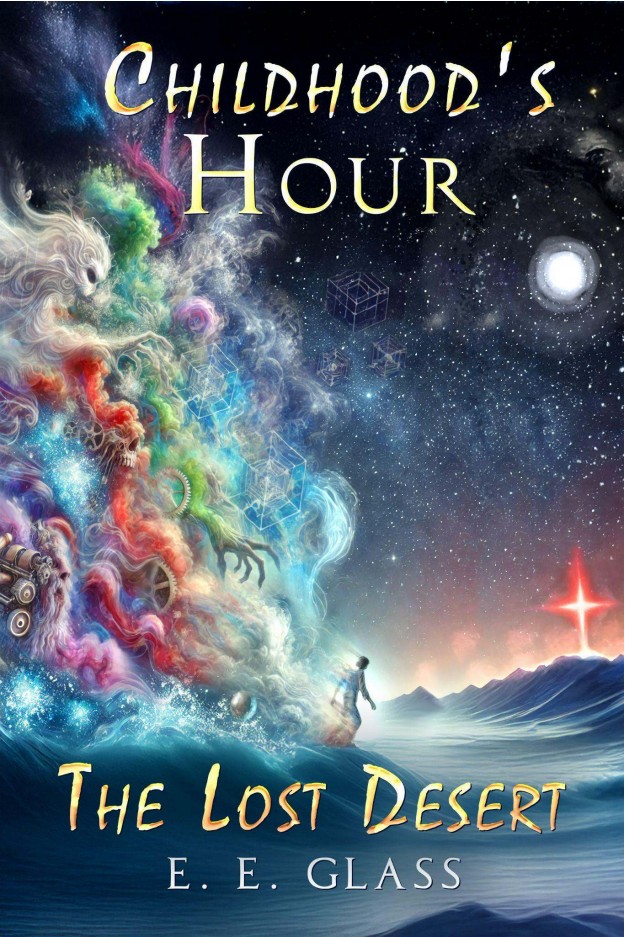

The Lost Desert unfolds like a fever dream. It tells the story of a man named Loste who escapes from a strange mist called the Fray and wanders into a dazzling desert of blue glass. He meets Nadhez, a wild, furred man who travels with a fierce, intelligent creature named Chihiti. The story drifts between hallucination and revelation, full of alien landscapes, glowing moons, and fragments of scripture that hint at a shattered world. Every page glimmers with dense imagery, where survival feels like both punishment and rebirth. It’s a story about memory, loneliness, and the fragile border between madness and faith.
I’ll be honest, this book messed with my head in a good way. Glass writes with the kind of poetic precision that makes you reread sentences just to taste them again. The prose is thick and alive, like breathing through incense smoke. At times I felt lost, much like Loste himself, drifting through scenes that seemed too vivid to be real. Yet, that confusion felt intentional. It put me right inside the character’s fractured mind. The dialogue between Loste and Nadhez was raw and strange but full of quiet heart. There’s something relatable in the way they stumble toward trust, both suspicious and starved for connection. And the imagery, my god, the imagery lingers. Every creature, every shimmer of sand feels carved from light and sorrow.
But this book isn’t easy. It asks patience. It doesn’t care if you understand everything. There were moments where I felt overwhelmed by the world-building, where the sacred words and mythic passages blurred into noise. Still, I never wanted to stop. The rhythm of the writing hooked me. It’s haunting and weirdly beautiful, like a dream you can’t shake off even when you wake. I felt equal parts awe and unease, that quiet tension between wonder and dread. It reminded me how fragile sanity can be when beauty becomes too much to bear.
I’d recommend The Lost Desert to readers who crave atmosphere more than clarity. If you like stories that make you feel rather than explain, that drown you in imagery and leave you gasping for air, this one’s for you. It’s not a comfort read. It’s a plunge into the surreal, but it rewards anyone willing to surrender to it. Lovers of dark fantasy, strange worlds, and lyrical writing will find something unforgettable here.
Pages: 550
Childhood’s Hour: The Lost Desert

Childhood’s Hour: The Lost Desert by E.E. Glass unfolds in a dark and unnerving world where memory, identity, and survival constantly collide. At its heart is Loste, a man who emerges from the mysterious Fray with no clear past, only fear and a desperate drive forward. He stumbles into a land of sapphire sands, uncanny creatures, and strange sentient companions like Nadhez, whose furred presence and bound loyalty blur the line between guide and hallucination. The novel draws heavily on the clash between what is real and what is illusion, blending cosmic dread with intimate moments of connection. Every page balances wonder against horror, and every encounter threatens to dissolve into the static haze of madness.
The prose is lush, almost dreamlike, yet it never lingers too long on beauty without reminding me of the lurking terror beneath. I felt caught in the same paranoia as Loste, scanning every moment for the telltale crackle of the Fray. That immersion was brilliant, though it sometimes left me exhausted, like I had trudged through the dunes alongside him. The rhythm of fear and relief, tension and stillness, worked on me in waves, and I admired how the author never let comfort last for long.
What I liked most was how human the book felt despite its alien setting. Loste’s fractured identity, his mistrust of others, and his fragile hope for connection all hit me in the gut. Nadhez, with his easy laughter and sharp teeth, became a figure I wanted to trust, even when I doubted his reality. The dynamic between them gave me flashes of warmth, then snatched it away with reminders of cruelty and despair. That tension felt real, and it left me questioning my own instinct to trust. I also appreciated the playful absurdity woven through, the honking seal pup, the comic relief of bodily mishaps, which gave the darkness a sharper contrast.
Childhood’s Hour is not a book for the faint of heart. For readers who enjoy strange, surreal fantasy that bends toward horror while still offering moments of raw human tenderness, it is unforgettable. I’d recommend it to readers who like their fiction unsettling and immersive, who don’t mind being disoriented, and who find beauty in the uncanny.
Pages: 550



 LITERARY TITAN