Blog Archives
A Saga Was Inevitable

The Family Speaks follows a family across 2019 and into the first year of the pandemic as people who’ve spent years living apart discover that distance hasn’t erased what they owe, fear, remember, or feel about one another. Why was 2019 the right moment to begin this part of the family’s story?
Hello. Thank you for inviting me to this interview.
Your question goes back to the first novel, Timewall Speaks, which takes place over the summer and early fall of 2018. I set Timewall in 2018 because that was the year I made my third thru-hike of the Appalachian Trail, and the year that I hiked into the town that Bilbo is based upon, which would become the genesis of the entire saga. (For those curious, there is an explanation for the name Bilbo in Ridley Speaks. For those even more curious, I derived Bilbo from an actual town in Texas called Bobo.)
At the time, though, Timewall Speaks was meant to be a stand-alone novel that explored the inequities of the Appalachian rural poor, or as I have described previously, somewhat of a cross between Daniel Woodrell’s Winter’s Bone and Barbara Ehrenreich’s Nickel and Dimed. It dealt mostly with Timewall’s struggle to overcome the incarceration industry, an insidious institution that leaves uncountable ex-cons victim to the lassitude of an apathetic bureaucracy, oppressed, almost impossible to reenter civil life.
That novel mostly revolves around Timewall and Blaize, with Timewall fighting the system while Blaize secretly pursues the murderer of her young daughter, Baby Rose. The other siblings had long-since scattered. These siblings are mentioned as background for the story, characters I’d had no intention to explore further. But readers were curious about Blaize, how she had become the hard woman she was. This led to Blaize Speaks, and now a saga was inevitable.
With the crumbs of detail I’d dropped in Timewall, late-2018 became the launching year, the year Timewall defeats the system and walks onto the Appalachian Trail to recuperate, setting everyone else’s ages at that time. The Covid pandemic intruded into this timeline. I didn’t want to write a Covid novel, so used it as a time stamp instead. 2019 became the year in which each character came to grips with their lives, and 2020, amid Covid, became the year they sought reconciliation.
What interested you about exploring the gap between how parents understand their choices and how their children remember them?
Much of this derives from my experiences as a young teenager. Half of my family are from the Appalachian region. I wasn’t introduced to them until I was about fourteen. I’m sure that if I’d wandered into those woods without my grandfather’s bona fides I might have been accosted or worse. I felt as if I were an outsider no matter how warmly they patted me on the back, struggling to decipher an almost unintelligible accent, every hollow containing a cousin with a brood of kids—also cousins—living in dilapidated security and prepared to mobilize in a moment if called upon to do so.
Listening to the old fellows in their porch rockers, chewing tobacco and sharpening their chain saws, I picked up titillating bits of family history, allusions to previous wives and other kids now elsewhere (in this instance aunts and uncles and closer cousins), with seemingly no apparent motivation to have these people in their lives. I couldn’t comprehend that indifference. I also pondered why I felt as if I were a foreigner among people of my own blood. It wasn’t until years later that I realized memes arise in families—and in this branch of the family, the desperation of the Great Depression still lingered—often happenstance occurrences that imprint and are then passed on, children, grandchildren, and great-grandchildren expressing these memes with no idea that they are memes or even where they came from. In my case, carrying on to this day, it’s “clean your plate, never waste food, rise early and get to work, and don’t put on airs.” The Speaks Saga explores this as well. Blaize, as an abused orphan, has no model, so her life experiences become memes that are passed on to her children.
What did you want to capture about the tension between wanting to leave a place and discovering that it remains part of you?
I have a saying: You are where you’re born. This is not a law of nature, certainly not universal, but I’ve seen it in myself and others often enough to consider it nontrivial. My people are from Tennessee, and have been here for more than two hundred years, one branch nearing three hundred years. I, however, was born in Texas. Although I haven’t lived in Texas for decades, and although I have lived in my family’s ancestral Tennessee home for almost two of those decades, I still feel the pull of my far-south Texas hometown. That hometown no longer holds any resemblance to what it was when I was a boy. Still, when I go there I know the streets I once walked barefoot, the mesquite trees I climbed, the houses we lived in, the hospital I was born in, and my accent doesn’t clash. I can breathe easier because I belong, even though I am now a stranger and have no desire to live there again.
When readers leave the Speaks family, what do you hope stays with them about home, belonging, childhood, and the importance of simply showing up?
All the elements previously discussed come together with this question. I would hope that readers achieve a new appreciation of where they are from, that grounded sense of belonging that even wars can’t erase, and that sometimes a sense of belonging is anchored in family as well. I hope children, especially those from troubled circumstances, can understand that their parents might only have acted out what they knew to do, through no conscious decision, manifesting a long succession of archaic memes. So do show up when needed, because our parents and their parents are also where we’re from.
Author Links: Website | GoodReads
It is now 2019. Timewall is on the Appalachian Trail, Tommy is fighting in Afghanistan, Ridley is pondering life and relationships, Priscilla is holding ad hoc physics lectures, Robbie has found religion in prison, Lainey discovers that she’s pregnant, Jocela takes a new breath of purpose, Bo’s heart begins to fail, and a middle-aged Blaize is debating the value of her life.
As Covid flares across the country, the estranged members of the Speaks family find themselves challenged to fulfill their duties to one another as events race toward a poignant and heartbreaking climax.
The Family Speaks


Kirk Ward Robinson’s The Family Speaks is a contemporary family saga rooted in Bilbo, a fictional Appalachian town where Blaize Speaks raised five children through poverty, addiction, and loss. By the time the novel opens, those children have made lives far beyond her trailer, though none has left their childhood entirely behind. Tommy serves in the Army, Ridley lives in Colorado with her partner and children, Priscilla works in physics, Robbie is in prison, and Timewall is walking the Appalachian Trail. Robinson follows them through 2019 and into the first year of the pandemic, giving each a chance to speak before Blaize’s failing health draws the family home. It’s a story with a wide reach and a close interest in the people at its center.
The rotating chapters make this multigenerational family drama feel personal. Tommy is respected by the soldiers he leads, yet combat memories and drinking are wearing him down. Ridley loves the life she’s built in the mountains, even as questions about her son and her own past unsettle her. Priscilla’s work and her relationship with Dhakiya give her room to grow, while contact with her family asks something new of her. Robbie’s faith becomes tangled with power inside prison. On the trail, Timewall finds friendship, physical endurance, and space to consider what he feels for the people back in Bilbo. Their lives are different enough that returning to each character feels like picking up a conversation you’ve been waiting to finish.
Blaize holds those conversations together. She’s sharp, stubborn, widely read, and capable of acts of care that she has trouble putting into words. She’s also kept secrets that shaped how her children understand themselves. Robinson gives her room to remember the choices she made and to see how her children experienced them. His descriptions of the Appalachian Trail and the mountains around Bilbo bring a strong sense of place to the novel, while details such as Christmas cards, shared meals, and calls that end too soon give its relationships weight. Jocela, Blaize’s oldest friend, has a moving story of her own as she grows more confident and prepares to become a grandmother.
The Family Speaks takes its time, as a book with this many lives to follow needs to. The payoff comes when the scattered threads meet and people who’ve spent years imagining one another finally have to talk face to face. Some of those meetings are tender; others are awkward or painful. All of them carry the history Robinson has spent the novel building. Readers drawn to Appalachian fiction and literary fiction about family, belonging, and the lasting effects of childhood will find plenty to stay with here. What stayed with me most was the family’s willingness to show up, even when they weren’t sure what to say.
Pages: 440 | ASIN : B0H2JKL49H

Freedom Highway

Priscilla Speaks follows a young girl living in poverty who is cast out of her home at sixteen, leaving her to set out on the Appalachian Trail, where she meets diverse people who help her learn about life and relationships along the way. What was the inspiration for the setup of your story?
The answer is broader than you might have anticipated. I have thru-hiked the Appalachian Trail four times, and have found each journey to be life-changing or life-affirming. As a consequence, it is an element in much (although not all) of my fiction. I find the trail to be regenerative. Most who successfully thru-hike it or even hike long sections of it feel the same. It is the total immersion that does it, having one’s ego worn down by sweat and hunger and bugs until the real you is exposed. A long weekend on the trail won’t quite get one there.
Relating to the Speaks Saga as a whole, and Priscilla in particular for the moment, during Hike 3 in 2018 I hiked into a town for resupply, a town brought closer by a trail relocation and a town I’d never been to before, in an area where rednecks were known to harass hikers, and where I’ve personally witnessed hillbillies doing some pretty bizarre things. I was struck by the despair of the place before I’d even entered the town, considering the drug paraphernalia I spotted littering the curb. Once in the town, I encountered people almost unintelligible in their speech who volunteered the most offensive racist comments to a total stranger, and many of whom sported the missing teeth and cleft lips of heavy meth addiction. I couldn’t hike out of that town quickly enough.
I pondered as I continued my hike, wondering how one could wrest oneself out of that environment, then realized that the Appalachian Trail, an actual freedom highway, lay right at their doorstep. I conceived the first novel, Timewall Speaks, within the next hundred miles, and have used the Appalachian Trail as a means of escape for every character since.
Priscilla is born into a world of poverty, addiction, and abuse, but refuses to let that define who she is or who she will become. What was your process to bring her character to life?
I knew from the beginning that Priscilla might be the most complicated character in the Saga, and I had to reimagine her a few times before I felt I’d gotten her right. The epiphany came as I was writing Chapter Two, the fight scene, her brother injured, and I knew right then who I wanted Priscilla to be. I raced back, did a lot of re-writing, made Pris autistic and fearless, had her cut off her braid (probably spoilers in this), and evolved her into an outsider in her own family. Unknown to Pris, she is more like her mother at that age than she would ever want to accept, strong, unyielding, fierce, and in her own emotionally-numbed way, proud.
What were some themes that were important for you to explore in this book?
As always, that transformation from dysfunctional to emotional health, and that people are not defined by their circumstances, but defined by themselves. I wanted to demonstrate that it is possible to escape, despite the burdens that Pris carried. I have known people in similar circumstances who have rescued themselves, so Priscilla’s journey is not a stretch.
Will this series continue in another book, or are you working on a different story?
There will be one more novel in the Saga, The Family Speaks, in which a story arc covering fifty years will be brought full circle. I intended to end it there, although I have been encouraged by many to expand the Saga to incorporate some of the secondary characters. That might happen in the future, novels in a Speaks Universe if you will, but immediately after The Family Speaks (and a fifth Appalachian Trail thru-hike), I will begin work on some unrelated novels that have been nagging me for a few years now.
Author Links: Goodreads | Website | Amazon
In Book Four of The Speaks Saga, Blaize’s second daughter, Priscilla, born during the worst of her mother’s addiction, begins at an early age to count the years until she can escape the drudgery and boredom of her dismal, impoverished life, all the while watching as her older siblings leave one by one.
Cast out on her own at the age of sixteen, Priscilla ventures forth in search of an uncertain future while grappling with her sexuality and the phenomenal capacity of her mind. Using the Appalachian Trail as a means of escape, distracted from her obsessive nature by the day-to-day trials of the wilderness, her journey thrusts her into the company of diverse people who steer her toward a fuller understanding of the complexities of life and relationships. Through confounding emotions, heartache, and moments of grace, she is forced to confront mortality, love, and loss, all pointing her toward a staggering awareness of space and time.
With deliberate cunning, Priscilla does battle on her own terms, calling forth the hardened legacy of her family as she fights against the abuses she encounters in society.
Priscilla Speaks
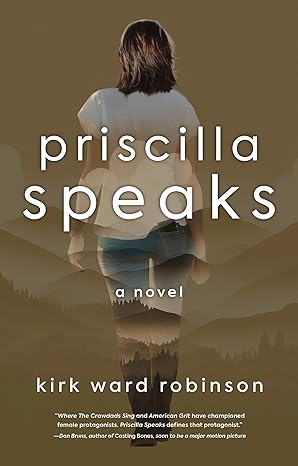
Priscilla Speaks is a raw and moving novel about a young girl born into the harshest corners of Appalachian poverty. The story begins before Priscilla’s birth, with her mother, Blaize, a fierce and wounded woman, doing whatever she can to care for her children and survive in a world that gives her nothing. We follow Priscilla as she grows up in the town of Bilbo, navigating her family’s deep dysfunction, community violence, and the emotional scars passed down from one generation to the next. Robinson crafts a brutal yet intimate look into this young girl’s life as she slowly begins to understand who she is, who her family really is, and how to carve her own place in a world that keeps trying to swallow her whole.
The writing is bold and fearless, with a rhythm that swings between lyrical and gritty. The dialogue feels authentic. The world is murky and tough. The people are full of contradictions. Blaize, for instance, is both the villain and the savior in her children’s lives. Her pain is palpable, but she also passes that pain along. It made me uncomfortable more than once, and that’s a compliment. As a reader, I felt like I was sitting on the edge of a splintered porch with these characters, watching lives unravel and harden, sometimes all in the same breath.
What really stayed with me, though, was Priscilla’s voice. She doesn’t say much, but her silence is louder than everyone else’s shouting. Her mind is sharp. She sees through people. She aches to be seen herself. And when she finally acts, whether it’s to cut off her hair or confront someone who’s hurt her brother, it never feels like a big triumph. It just feels necessary. The author never turns her into a cartoon hero. She’s messy and guarded and real. And the book respects that. The pacing slows in a few places, and some characters feel like they pop in just to fill a theme. But it doesn’t matter much because the emotions land hard.
I’d recommend Priscilla Speaks to anyone who’s tired of polished stories and wants something jagged and honest. It’s not a light read. But it tells the truth in a way that sticks. If you grew up poor, or close to someone who did, you’ll recognize the ache in these pages. And if you didn’t, it’ll open your eyes to what strength and survival really look like.
Pages: 332 | ASIN : B0FB43QHG1


