Blog Archives
Beginning With The End In Mind

The Last Altar Boy follows a deeply wounded man traveling through the American heartland to scatter his daughter’s ashes and make peace with his past. What was the inspiration for the setup of your story?
I’m an ardent believer in beginning with the end in mind.
In September 2014, I had a dream, unlike any dream I ever experienced. (If readers wish to know more about that dream, they’ll find the link to an essay I wrote in 2023, before launching “Charlie”: https://carlreinelt.com/blogs/blog/the-story-behind-the-story-of-charlie )
When I took to the road in June 2015 to begin writing what would become an epic quest for redemption, I wasn’t thinking at all about a series. I was merely responding to a calling to write a story that paralleled the sins of my own dysfunctional life. I wasn’t even sure why, but I was acting on faith. Prior to that road trip, three years of intensive psychotherapy had opened my eyes to many aspects about the nature of childhood trauma, drug addiction, and the terrible cost they exact on families, friendships and the human spirit. Bundle all that with other family tragedies of abuse, neglect, and loss, and you’ve got a character named Charlie Houden.
Reflecting, two years later, on the surreal nature of that 2015 road trip, I realized that any true healing arc for Charlie Houden must begin with psychological healing, culminating in the intense desire to traverse the bridge into spiritual healing. Thus, the realization that “Charlies Ladder” was merely the beginning. Surprisingly, I had already acquired the material necessary for the sequel from that original road trip.
Revision upon revision over the next four years brought me to a Roman Catholic priest, who validated the assumption that true healing must occur in this order. (That priest, by the way, has a Ph.D. in clinical psychotherapy.)
It seemed like you took your time in building the characters and the story to great emotional effect. How did you manage the pacing of the story while keeping readers engaged?
What a perceptive question! Pacing and plot management, indeed, were major challenges. Realizing I needed an ultimate antagonist, such a figure had to lurk and operate in the shadows for a time, to introduce an itch the reader couldn’t scratch. Using the theme of a demon Charlie couldn’t exorcise from his psyche, and amplifying the mischief that demon could cause — “through the prudent use of humans” — kept me thinking about ways to continually “up the ante” by painting Houden ever more tightly into the demon’s trap. Doing so without Houden’s knowledge made for some delicious options and detours into dramatic irony.
Given Houden’s early grounding in Catholic doctrine and theology, which informed his choices, I had to become quite familiar with the spiritual teachings of the “father of western philosophy,” Saint Augustine. Providing the reader with enough data — to help their understanding of Charlie’s actions — had to be carefully balanced with the need for ever-faster pacing.
However, the biggest challenge was bringing all the lethal forces together at once — in a sequence that felt logical — while approaching a frenzied pace. Scene changes had to be swift and creative, yet revealing. Tightening the narrative prose with constant rewrites over time helped “tighten the noose,” amplifying the sense of dread.
What were some themes that were important for you to explore in this book?
There were several themes that kept presenting themselves. Part of the value of the rewrites was sharpening the focus on the most salient themes to the story arc. Seven themes emerged:
- Trauma, and its dark impact across generations.
- Apophenia — and its challenges as a result of trauma.
- Human capacity for good and evil.
- The power of faith and our relationship to God.
- Conversely, the loss of that faith, and how it blinds us to truth.
- Agape love and self-sacrifice.
- The vital role of self-forgiveness in healing.
Where do you see your characters after the book ends?
Generally speaking, none of the characters are unaffected. No one who was there on the seventh day could remain indifferent. Without indulging spoilers…I think the three characters who most inspire imagination concerning the direction of their lives are:
- The papergirl
- The Police chief
- The priest
However, all who witnessed the climactic confluence of good vs evil are forever changed. And that truly IS the point: in the end, Charlie Houden is each of us; and we ARE Charlie…struggling to bring order from chaos, thereby finding our ultimate purpose.
Last Altar Boy
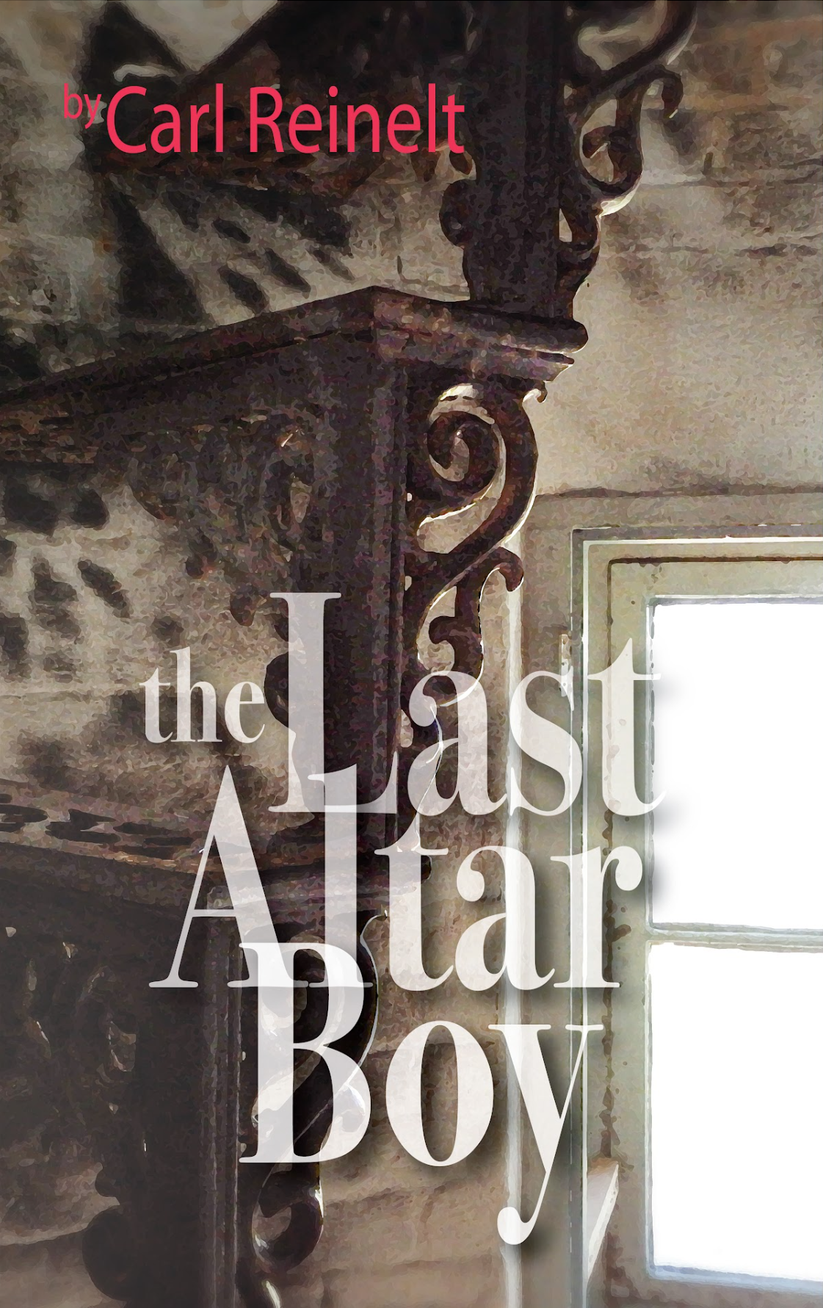

Carl Reinelt’s The Last Altar Boy is a genre-blending novel that weaves together grief, addiction, spirituality, and historical memory. The story follows Charlie Houden, a man on a haunting road trip from Texas to Michigan to carry out a mysterious plan involving the ashes of his daughter. Along the way, he confronts demons both real and imagined, relives past traumas, and finds unexpected moments of grace. The narrative slips seamlessly between timelines, voices, and even the spiritual realm, grounding Charlie’s personal journey within a broader meditation on generational pain and redemption. We get glimpses of American history, the harrowing account of the 1881 Michigan fire and the forced relocation of Native peoples, all echoing the central theme: what do we do with the suffering we inherit?
Reinelt has a gift for capturing the internal disarray of someone at the end of their rope, yet his prose remains grounded and sharp. Charlie is messy, stubborn, and endearing in that deeply flawed way that real people are. The dialogue is snappy and real, the dreams are terrifying and surreal, and the flashbacks carry the weight of memory like bruises. There’s a scene in a decrepit Arkansas motel that plays out like something from a psychological horror film, and I found myself tensing up like I was watching it on screen. And then, in the next chapter, he’ll drop you into a quiet sunrise on Lake Huron and let the stillness do its work. The book is honest, reflective, and aching. It meanders in places, sure, but so does grief. And Charlie’s road trip is less about a destination and more about the slow crawl toward any kind of peace.
What surprised me most was how the book balances pain and beauty without flinching from either. There’s trauma here, lots of it. Loss of a child, addiction, estrangement, inherited guilt. But Reinelt doesn’t drown in it. He gives Charlie these tender moments of human contact: the kindness of a stranger, a well-timed joke with his partner Mia, a newspaper from a girl who might not be entirely of this world. Those moments hit harder than any grand revelation. Reinelt also doesn’t force a neat ending, and I appreciate that. Life rarely gives us one. Instead, Charlie’s journey offers something quieter: the chance to keep walking, even when your legs are shaking. That resonated with me more than I expected it to.
The Last Altar Boy is for anyone who’s ever carried around guilt like a stone in their pocket. It’s for people grappling with grief that doesn’t go away just because the world keeps spinning. I’d recommend it to fans of Cormac McCarthy, T.S. Eliot, or even folks who enjoy quiet, lyrical indie films. But more than anything, I’d recommend it to people who are trying to make sense of their pain.
Pages: 320 | ISBN: 978-1-7362149-5-4



 LITERARY TITAN