Blog Archives
Salt in the Fifth House: A Queer Novel of Love, Art, and Survival
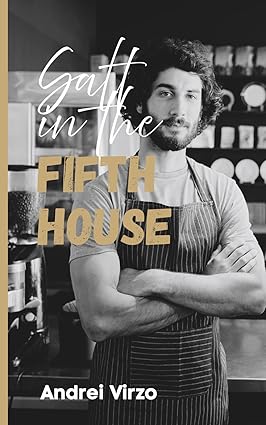

Salt in the Fifth House is a raw and luminous memoir-novel hybrid that explores the fierce, complicated love between siblings, the brutal ache of addiction, and the lingering weight of generational trauma. Told through the lens of a queer Latinx narrator recounting her life and relationship with her brother Luca, the story interweaves memories of their immigrant upbringing, their mother’s protective strength, and a haunting betrayal involving an ex-boyfriend’s art exhibit that exposes their private wounds. Virzo writes with intimate ferocity, shifting effortlessly between scenes of laughter and devastation, offering a portrait of a family built more on tenderness and tenacity than perfection.
The writing is rich and emotionally relentless. Virzo’s voice doesn’t shy away from the messy stuff: resentment, trauma, jealousy, exhaustion, guilt. And yet, it’s laced with so much love it hurts. I found myself laughing at one paragraph and tearing up the next. There’s something magical about how the author captures the way love and pain dance together in the same space. It doesn’t feel performative. It feels lived in. And honestly? That’s what made it hit so hard.
That said, it’s not a gentle read. It punches you in the gut. But that’s the point. Some of the most vivid writing comes when Virzo confronts the commodification of her brother’s trauma—the way art and storytelling can exploit instead of heal. Her righteous anger is palpable. As someone with a complicated family of my own, I found myself underlining whole pages. I felt seen, but also deeply challenged. The characters are flawed. The parents make mistakes. Love isn’t perfect. And yet, the story holds all of that complexity like a prayer. It reminded me that survival can be sacred, and that family, chosen or not, is stitched together with every stubborn act of showing up.
Salt in the Fifth House is for anyone who’s ever been tasked with loving someone through their darkest hour. For those who’ve been caretakers, truth-tellers, wanderers, or the ones who left and still felt the guilt miles away. If you’re queer, if you’re Latinx, if you’ve grown up carrying more than your share—this book will speak to you. I recommend it to readers who crave emotional honesty, crave stories about broken families trying their best, and who understand that healing isn’t always linear, but it is always worth it.
Pages: 264 | ASIN : B0F9V7MWDB

The Self-Righteousness of Religion

The Gift follows a gay young man who is cast out of the Jehovah’s Witnesses and his mom’s home and life, who embraces the life of a cowboy while learning to accept himself. What was the inspiration for the setup of your story?
When I started writing, I had no preconceived ideas or outline for what this story would be. I began with a simple premise of a gay male character named Butch and intended to write a gay western/romance novel, but as I wrote and that character took shape, the story just traveled down the path it wanted to go.
I felt this novel’s supporting characters were intriguing and well-developed. Who was your favorite character to write for?
My favorite character is Butch. He and I share many similarities in temperament and history. But I also really enjoyed writing the villain in this narrative. Dick Stinchfield had so many flaws, but I also wanted to depict him as human. That character was enjoyable to create.
What were some themes that were important for you to explore in this book?
I didn’t know it when I started writing, but after the characters and narrative took shape, it was clear that I was writing three themes into this novel. All three are themes of contrast: black vs white, good vs bad, beauty vs ugliness.
Intolerance, racism, genderism, sexism, and homophobia are all ugly, and I wanted to contrast them against the self-righteousness of religion.
Gay men don’t all match the stereotype. Today, that wouldn’t surprise anyone, but at the time when this story takes place, it was inconceivable that a masculine cowboy could be gay.
There is a tremendous beauty in the landscape and solitude of the rural American West, but at the time when this story takes place, it was often accompanied by a strong rejection of people who were different. My favorite line to write came from a resident who had absolute confidence in his faith and community – “the good people around here won’t put up with any of those in this town. Dick was the only one, as far as we know, and good riddance to him.” At that time, there was a tremendous level of hate coming from a place of so much beauty.
What is the next book that you’re working on and when can your fans expect it out?
The next novel I am working on is a fictional story of a single mother who has traveled across the country in search of her father. It is still several years away from being ready for release.
Author Links: GoodReads | Facebook | Amazon
Seeking comfort in the isolation of the western landscape, young single mother Pansy Blackwell brings her son Butch to the Siskiyou Mountains. Fully engulfed in the Jehovah’ s Witnesses assurances for a soon-to-arrive end of the world, Pansy raises her son to conform to the constrictive requirements of their religion. But as Butch discovers the wonders of the world around him with an endlessly patient and kindhearted rancher, he embraces the cowboy culture and struggles to live as his authentic self.
In the late 20th Century, rural communities in America were often hostile to the rising-awareness of LGBT people, and Butch is soon cast aside by his church for homosexuality. In The Gift, Scott Terry crafts a memorable and historically-accurate tale of religious extremism and the struggle for acceptance, before the truth of those times are swept under the forgotten rug of history.



 LITERARY TITAN