Blog Archives
It Started With a Postcard

Falling Through the New World follows an Italian-American family from the time of WWI in Italy to the United States in 2018. What was the inspiration for the setup of your story?
Falling Through the New World arose out of a fascination with my personal history as the American granddaughter of Italian immigrants and the events that spurred that history—World War I and the Spanish flu epidemic of 1918. My mother often told the story of her own mother surviving the epidemic while her sister perished, calling for water to quench her thirst until her last breath. That image of two sisters sharing very different fates traveled with me down the years until I could finally understand enough about Italian history and that country’s involvement in World War I to write about their impact on my characters’ lives, primarily through the lenses of the stories’ female protagonists.


Artifacts and photographs inspired many of the stories. My maternal grandmother, Anna De Francesco, was a bobbin lacemaker. Several pieces of her handiwork have passed down through four generations of our family, including the bureau scarf pictured here. While I admired the lace, I had no idea how it was created. When I began to envision the stories of Falling Through the New World, I knew that bobbin lacemaking would be integral to the early stories. I chanced across a photo of an Abruzzesi woman in provincial dress creating a bobbin lace doily and spent hours examining it, as if the picture would reveal the intricacies of the art. It didn’t. Months of research followed. In 2003, when I first conceived the collection, the internet was in its early years, so I had to rely mostly on books for background, their pages yellowed with age and, I’m sorry to say, hardly touched. One of the most useful resources was Lace by Virginia Churchill Bath, itself a testament to the author’s desire to preserve on paper what had become a lost art, at least in America.
The most poignant artifact in my possession is a postcard that my maternal grandfather sent to my grandmother from the Italian front near Caporetto. On the front is a photo of Giovannissimo


posing proudly in full Italian uniform. On the back is his message to his gentil signorina Anna—Saluti infiniti e baci di amore (endless greetings and kisses of love). I think of this postcard as the starting point of Falling Through the New World—the springboard from which the rest of the linked stories flow. All I knew of this postcard was that soldiers were able to have their pictures taken and these postcards made to send to their loved ones. That fact alone is a mystery. It seems like very advanced “technology” for 1917. I’m also intrigued by my grandfather’s stance—proud, confident, fearless. The postcard is dated February 27, 1917, eight months before the battle of Caporetto during which the Austrians soundly defeated the Italians. Family lore tells me that he fought in that battle and was captured by the Austrians. From there, I imagine the “after”—how he was changed by his war experiences and how those experiences ripple through the subsequent generations of the fictional Desiderio family.
The final form of this book—a novel in stories rather than a traditional novel—partly arose from this “piecing together” of the artifacts and photographs. But the form also owes itself to my typical process. I tend to write in fragments—episodes, scenes, descriptions—and then build them into a coherent whole, arranging the pieces and filling in the gaps as a form takes shape. In this case, the process led me to envisioning a novel in stories early on, rather than a traditional novel. It also enabled me to publish some of the stories as I completed them, which felt like progress over the long twenty years it took to write the book.
Each generation in this novel faces unique struggles, yet they all have a common bond of survival and the pursuit of a better life. Did you plan the tone and direction of the novel before writing, or did it come out organically as you were writing?
Although the stories are obviously connected through images and metaphors, to some extent those connections are serendipitous. I started with pages and pages of notes based both upon family history and the research that the history provoked. As I scribbled into my notebooks, a story would begin to coalesce, and I’d pause in my notetaking to write the story. In this way, the stories arose organically from my research rather than from an orderly outline. In fact, though the stories appear in chronological order, they were written out of sequence, with the first published story being “Sign Language,” set in 1965.
Regarding tone, most of the stories deal with difficult subject matter—death, trauma, war, family dysfunction. Thus, the overall tone of the collection is quite serious. I wanted to honor my characters’ struggles in this way, even if they don’t always behave admirably. A good example is the character of Anna’s mother—Mamma/Nonna. Some critics have taken issue with how atypically she behaves. She is a far cry from what most readers think of as the “Italian mother/grandmother.” But she’s human—she’s motivated by her fear of death and her pride, and those attributes lead directly to her actions. Some readers miss her gesture toward her daughter just before she departs for America. I won’t spoil it here, but I think the gesture goes a long way toward redeeming her.
Given the serious subject matter, the challenge then was to find ways to balance the somber scenes with lighter ones. Two of the last stories I wrote, “Black Tuesday” and “The White Nightgown,” were intended to do just this, despite the fact that both stories are set against difficult backdrops—the stock market crash and Anna’s death. In fact, “The White Nightgown” ends with the word happiness.
Tone is also conjured in the characters’ voices. One of the most difficult aspects of writing this collection was to distinguish the voices of the many characters, particularly since so many of the stories are written in first-person. Given that the characters inhabit such very different worlds—Old and New, Italy and America, 1918 through 2018—it was imperative that the characters sound different by reflecting their very specific milieus. Using more formal diction and methods of address in the earlier stories, for example, conveys a very different tone than the more informal diction and address in the contemporary stories.
What were some themes that were important for you to explore in this book?
I don’t write thinking about “theme,” that is, the critical lens through which the reader views the work. I write stories in which characters confront situations, and from this writing, themes emerge. Who determines those themes? Readers do. Readers complete the work. I always find it remarkable how readers interpret my stories—often in ways that I didn’t intend—and that is their prerogative.
In his essay “Theme vs. ‘What My Story Is About’” (in The Art & Craft of the Short Story), Rick De Marinis makes this very argument: “If there [is] a thematic point to be made, it would have to emerge from the natural interaction of the characters.” He asserts that if writers start with theme, or even think about how themes are emerging as they write, then the story will become overdetermined. For example, a motif that first emerges organically might then be overly exploited for fear that the reader won’t “get” what the writer is trying to say.
So the question for me is “What is my story about?” Here, I can speak about my intentions as I wrote Falling Through the New World: to portray the immigrant experience as both unique and universal; to investigate how external events (such as war, the Spanish flu, the stock market crash, and changing moral and cultural values) affect the characters’ personal lives; to explore how faith works differently to sustain each of my characters; to trace how the past shapes the present, especially how the repercussions of past events reverberate through succeeding generations; and to consider how identity is subsumed (or not) into an immigrant’s adopted culture and its mores.
What is the next book that you are working on, and when will it be available?
My novel The Last Whaler is forthcoming in September 2024 from Regal House Publishing. The novel was inspired by my travels in the Arctic and my love of that landscape. It’s a very different book than Falling Through the New World.
The Last Whaler is an elegiac meditation on the will to survive under extreme conditions. Tor, a beluga whaler, and his wife, Astrid, a botanist specializing in Arctic flora, are stranded during the dark season of 1937-38 at his remote whaling station in the Svalbard archipelago when they misjudge ice conditions and fail to rendezvous with the ship meant to carry them back to their home in southern Norway. Beyond enduring the Arctic winter’s twenty-four-hour night, the couple must cope with the dangers of polar bears, violent storms, and bitter cold as well as Astrid’s unexpected pregnancy. The Last Whaler concerns the impact of humans on pristine environments, the isolation of mental illness, the consolation of religious faith, and the solace of storytelling.
Author Links: Website | Goodreads
Falling Through the New World
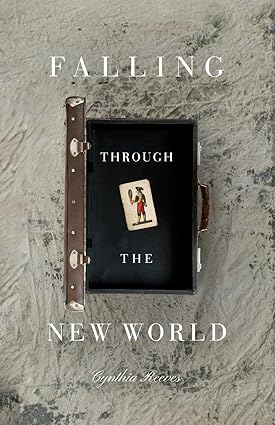

Cynthia Reeves’ Falling Through the New World is a captivating tale that weaves through four generations of an Italian-American family, artfully set against the backdrop of the dynamic 19th century. This novel, concise yet rich in detail, masterfully explores the ebbs and flows of family life, delving deeply into themes of religion, identity, warfare, and the intricate dynamics of familial relationships. The narrative is beautifully balanced, juxtaposing scenes of warm domesticity against those of poignant loss. It centers around how the Desiderio women, across various generations, navigate their grief through the lens of tradition and faith.
The story commences in a quaint Italian village, but its canvas stretches across continents, oscillating between Italy and the United States. Through fourteen interconnected narratives, Reeves constructs a journey that begins in the early stages of the First World War—an era she refers to as the “Old World”—and culminates in the America of 2018. The novel strikingly captures the complex emotions tied to immigration, as characters like Anna and Vincenzo relinquish the familiarity of their homeland for the prospect of a brighter future for their descendants. The narrative resonates with a poignant, bittersweet sentiment as they cling to their dreams, leaving behind a part of themselves in the land they once called home. Reeves’ prose is nothing short of mesmerizing. Her attention to emotive detail and her ability to paint vivid, poetic imagery through dialogue is remarkable. The novel skillfully portrays each character’s internal struggle to merge the “old world” of their heritage—fading customs and beliefs—with the realities of a rapidly changing modern world. Reeves employs symbols and metaphors to bring critical themes to life, creating an immersive reading experience where the echoes of the characters’ dialogues seem almost audible.
Falling Through the New World is a thought-provoking exploration of the trials and sacrifices endured by immigrant families, a narrative that resonates deeply with the experience of building a life in new worlds. This book is highly recommended for readers who seek to understand the legacies of their forebears and to experience a richly painted panorama of an immigrant family’s journey through time.
Pages: 172 | ISBN : 1737780860




 LITERARY TITAN