Blog Archives
The Brothers of Dane
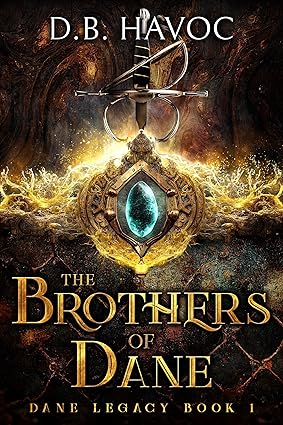

D.B. Havoc’s The Brothers of Dane begins as a tale of mischief and theft, but it quickly expands into something much grander. On the surface, the novel follows Balran, Mak, and Dag, three notorious outlaws whose exploits make them both feared and strangely admired. What starts as a high-society robbery soon spirals into a quest tied to ancient artifacts, the legendary city of Dhravendor, and the fabled Udin Stone. Beneath the adventurous exterior lies a narrative about loyalty, betrayal, and the often-fractured bonds that hold families, chosen or otherwise, together.
The opening scene at Counselor Imara Enas’s estate establishes this duality immediately. The cultivated elegance of an elven dinner party collides with the chaos of the Brothers’ sudden intrusion, led by Balran’s dryly menacing declaration: “This is a robbery.” The episode is both dramatic and darkly humorous, and it illustrates Havoc’s ability to balance tones with confidence. The moment also introduces Maeve, whose tense but charged interaction with Mak provides an early glimpse of the interpersonal conflicts that run beneath the novel’s more visible plot.
The novel’s strongest element is the interplay between the brothers themselves. Their dialogue is sharp, unpolished, and filled with an authenticity that makes their quarrels and camaraderie equally compelling. Dag, for instance, provides a mix of cynicism and biting humor, as when he mocks Mak’s affection for Maeve through his song “Sweet Maeveriene”. Balran assumes the role of pragmatic leader, while Mak wrestles with the tensions of his half-elven identity. Together, they form a partnership that feels volatile but indispensable, and it is this sense of lived-in brotherhood that makes the narrative resonate beyond its adventurous trappings.
The scope of the story broadens dramatically with the introduction of Emperor Elric Veshlor, the so-called Sun Eagle. The confrontation in the Tower of Tiriel, particularly the battle with a shadowed figure whose blows are revealed to fall from a wooden blade, is a pivotal moment. Elric’s eventual appearance transforms the narrative from one of petty thefts into an epic struggle intertwined with exile, history, and the hope of redemption. The Brothers’ shifting responses, debating whether to assist, betray, or outwit the emperor, add moral complexity and highlight Havoc’s interest in the gray spaces between honor and survival.
By its conclusion, The Brothers of Dane reveals itself as more than an adventure tale. Havoc blends action with myth, allowing the reader to move seamlessly from tavern brawls to weighty reflections on power, freedom, and legacy. At times, the exposition particularly in the sections concerning the Treaty of Maltran Heights and the dwarven astrolabe leans heavily on lore. Yet even these passages contribute to the sense that the Brothers are entangled in a world where their small-scale ambitions intersect with forces far greater than themselves.
The Brothers of Dane is recommended for readers who appreciate fantasy that is bold, atmospheric, and character-driven. It will appeal especially to those who enjoyed the grit of Scott Lynch’s The Lies of Locke Lamora or Christopher Buehlman’s The Blacktongue Thief. Havoc has crafted a story that captures both the recklessness of outlaw life and the enduring weight of myth, producing a work that is as much about the bonds of brotherhood as it is about treasure and survival.
Pages: 302 | ASIN : B0DPR7YM66




 LITERARY TITAN