Blog Archives
No Plan, No Outline

Talking White Owl follows a 15-year-old teen who wins a prestigious academic scholarship, but he has no idea this is part of a plan that has been in the works for decades. What was the inspiration for the setup of your story?
First off, I wish to thank Literary Titan for the thoughtful review of my novel. The image of the young man who was to evolve into Viktor Talking White Owl was conceived in my teen years and remained with me well into adulthood when, out of the blue, he began to relate his story to me. Viktor was greatly inspired by W.H. Hudson’s wood-nymph Rima in his book Green Mansions. The setting was the Venezuelan jungles and Rima was the lone survivor of a race that had vanished. A favorite movie at the time that surely influenced me was the 1939 version of Lost Horizon. The idea of Shangri-La, a hidden valley tucked deep within the Himalayan mountains, sparked my imagination.
When creating Viktor Talking White Owl, did you have a plan for development and character traits, or did it grow organically as you were writing the story?
No plan, no outline. Plot and characters unfold as I write, which is fun. It’s a mystery as to how things emerge from the subconscious. That Viktor should be a Lakota Indian from South Dakota surprised me, having never met any Native Americans nor been exposed to aspects of reservation life. As the storyline took shape, I did a lot of research, in order to better inform myself about events, places, and the personalities involved.
What were some themes that were important for you to explore in this book?
It is only in hindsight that I recognize some themes since I didn’t start out with an agenda. My purpose in writing the book was to entertain the reader from beginning to end. Family dynamics turned out to be far more important than was ever intended. I realized early on that Native culture would play a prominent role, and I therefore needed to make details surrounding Viktor’s background especially believable. I wanted to convey the satisfaction derived from intellectual pursuits, as well as the sheer joy that comes from playing a sport, which in Viktor’s case is football.
Where do you see your characters after the book ends?
The end of the book alludes to a history-making event that will occur a decade into the future, one spearheaded by Viktor along with his daughter, Honor Red Hawk, who by then becomes a force in her own right.
Approximately 679 pages long.
Talking White Owl
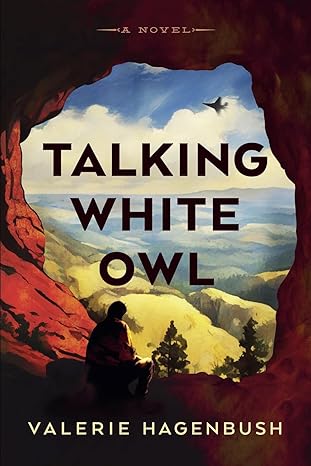

Talking White Owl, a 15-year-old descendant of the Lakota Tribe, has spent his life near the sacred Black Hills of South Dakota. When he learns he’s been awarded a prestigious academic scholarship from Ohio State University, it feels like the beginning of something promising. What he doesn’t realize is that this single moment will ignite a chain of events that will alter his life and possibly much more.
Unbeknownst to him, the elusive Rawakota Tribe, believed by many to be extinct, has been watching closely. Their sights are set on reclaiming land lost to broken treaties, a mission tied to the larger ambitions of the Council of First Nations. Their plan? To use Talking White Owl as a key figure in their efforts.
Valerie Hagenbush’s Talking White Owl is a contemporary fiction novel that blends cultural legacy, political struggle, and personal awakening. Echoes of the TV series Dark Winds and the film Thunderheart will resonate with readers, though Hagenbush brings a voice and vision distinctly her own.
Tackling Native American issues, especially the ongoing consequences of stolen land and fractured treaties, requires sensitivity and courage. Hagenbush approaches the subject with both. Her narrative doesn’t tiptoe; it confronts. And while the topic is fraught, the writing never veers into melodrama. Instead, it invites thoughtful reflection, balancing historical injustice with deeply personal stakes.
At the heart of it all is Talking White Owl himself. Grounded in tradition but disconnected from its deeper meanings, he begins to sense a spiritual link to the mysterious Rawakota. Visions push him toward answers, but clarity doesn’t come easily. As secrets emerge, he finds himself torn between honoring his heritage and questioning the motives of those who claim to protect it.
There’s a lot in motion here, political undercurrents, spiritual revelations, coming-of-age dilemmas, but Hagenbush juggles these threads with skill. She manages to weave suspense, emotional gravity, and cultural nuance into a seamless whole. Her supporting characters are vivid, her pacing assured, and her prose charged with conviction.
Talking White Owl is more than a compelling read; it’s a powerful, introspective journey. As its young protagonist grapples with his identity, legacy, and the weight of expectations, readers will find themselves drawn into a story that lingers long after the final page.
Pages: 680 | ASIN : B0DNF5JXLM




 LITERARY TITAN