Dispatches from the Couch: A Neuroscientist and Her Therapist Conspire to Reboot Her Brain
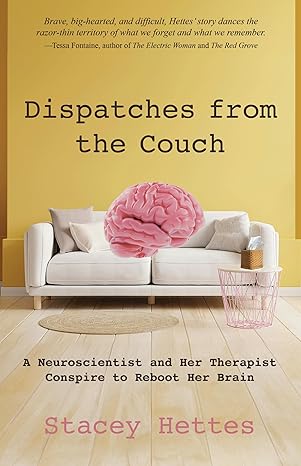

Stacey Hettes’ Dispatches from the Couch is a raw and fiercely intelligent memoir about the enduring scars of childhood sexual abuse and the intricate, often agonizing process of healing. Told from the perspective of a neuroscientist navigating the wreckage of trauma with the guidance of her therapist Piper, the book interweaves personal narrative with scientific insight, exploring how trauma rewires the brain, hijacks memory, and resurfaces across time and context. Structured in therapy sessions and personal reflections, it chronicles Hettes’ journey from silence to voice, from academic achievement to emotional reckoning.
What grabbed me first was the voice. It’s wry, self-aware, cutting through pretense like a scalpel. Hettes doesn’t just tell us she’s hurting. She shows us vividly and unflinchingly. The scene where she recounts the morning after “Breakdown Saturday” and calls her mother sobbing was brutal in its honesty. I loved how she didn’t let herself off the hook, even as she tore into systems and people who failed her. Her relationship with her inner child—at times full of rage, shame, and fierce resistance—is explored with aching detail. In Session 1, she admits, “I full-on loathe her,” when asked to revisit the child self who was abused. That line stuck with me. It’s not the sanitized survivor story; it’s messier, truer.
I also appreciated how Hettes uses her neuroscientific background not as a crutch but as a lens. She doesn’t over-intellectualize the trauma—she complements it. When she explains in the prologue how trauma disrupts memory circuits, or how the limbic system reacts before the thinking brain does, it’s not for show. It’s not jargon. It’s deeply personal, almost like she’s trying to convince herself as much as she is educating us. That balance between head and heart made this memoir something special. Her account of how trauma impacted her at work—especially in Chapter 3, when a university administrator tried to use her “authentic voice” to cover institutional cowardice—was rage-inducing, and familiar. It’s not just about what happened to her as a child. It’s about what keeps happening in a world that still doesn’t know how to hear survivors.
But it wasn’t all darkness. There were so many flickers of light. Piper, her therapist, is rendered with such care and nuance. She feels real—not a savior, but a steady presence who knows when to speak and when to let silence hold space. And then there’s the humor. Hettes’ dry wit shows up even in the bleakest moments. Her description of therapy offices smelling like “mint, ink, and warm paper” actually made me laugh. She’s not just surviving. She’s still herself—sharp, funny, stubborn, and deeply human.
Dispatches from the Couch left me shaken, moved, and strangely hopeful. It doesn’t promise neat closure—just better, not all better. And that felt honest. This is a book for survivors, certainly, but also for anyone who’s ever felt like they’re supposed to be fine when they’re falling apart inside. It’s for therapists who want to understand their clients better. It’s for educators, feminists, and truth-seekers.
Pages: 362 | ASIN : B0DQG8KWNH


Posted on March 28, 2025, in Book Reviews, Five Stars and tagged author, book, book recommendations, book review, Book Reviews, book shelf, bookblogger, books, books to read, Dispatches from the Couch, ebook, goodreads, indie author, kindle, kobo, literature, memoirs, nonfiction, nook, novel, read, reader, reading, Stacey Hettes, story, true story, writer, writing. Bookmark the permalink. Leave a comment.



 LITERARY TITAN
Leave a comment
Comments 0