Book 1 – Galileo’s Points of Light in the Night Sky (Dr. K’s Portal Through Time)
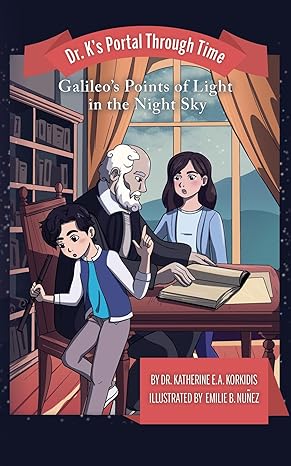

Dr. Katherine E.A. Korkidis’s Galileo’s Points of Light in the Night Sky is the first book in her Dr. K’s Portal Through Time series, and it’s part history lesson, part science primer, and part adventure story. It follows Jennifer and Daniel, a pair of curious siblings, who stumble upon Dr. K and her magical time portal. Together, they travel back to Renaissance Italy, step into Galileo Galilei’s workshop, and experience firsthand the wonder of his telescope and the audacity of his discoveries. Along the way, the kids not only learn about Jupiter’s moons, the phases of Venus, and the birth of modern astronomy, but they also discover the importance of curiosity, observation, and persistence.
The first thing that caught my attention about this book was how effortlessly it weaves fact with fiction. For instance, the scene where Jennifer helps Galileo build his telescope is not just a charming piece of dialogue; it’s a clever way to introduce kids to optics and focal lengths without feeling like a lecture. I found myself smiling at Jennifer’s excitement when the blurry image sharpened into Jupiter and its moons. That moment carried the same sense of awe I remember from my own first look through a telescope. The science was accurate but approachable, and that balance is hard to pull off in a children’s story.
I also appreciated how personal the narrative felt at times. Jennifer’s relationship with her grandfather in the opening chapter set the tone beautifully. Their bond over stargazing gave the adventure real heart. Later, when Jennifer and Daniel stood side by side at the end, promising to always explore the stars together, it felt earned. The book wasn’t just about Galileo’s discoveries; it was about how science can be shared, passed down, and made meaningful within families. That emotional thread made the whole story more engaging.
Another highlight was the way Dr. Korkidis portrayed Galileo himself. She didn’t make him an intimidating genius, but rather a patient teacher who invited the kids into his world. His explanation of the moons of Jupiter and how he realized they orbited the planet was fascinating, and his gentle encouragement to keep asking questions stuck with me. The inclusion of real historical details, like the Medicean stars and Galileo’s struggles with skepticism, grounded the story while still keeping it light enough for younger readers.
This book left me feeling inspired and a little nostalgic. It reminded me of the first time I realized science could be an adventure. I’d recommend Galileo’s Points of Light in the Night Sky to curious kids around 7–12, but also to parents, grandparents, and teachers who want to spark a love of STEM in children. It’s not just a story about Galileo, it’s a story about why wonder matters, why questions matter, and why we should never stop looking up.
Pages: 104 | ASIN : B0F4NQTCNP


Posted on September 16, 2025, in Book Reviews, Five Stars and tagged author, book, book recommendations, book review, Book Reviews, book shelf, bookblogger, books, books to read, Children's Fiction, Children's Historical fiction, Dr. Katherine E.A. Korkidis, ebook, Emilie B. Nuñez, Galileo’s Points of Light in the Night Sky, goodreads, indie author, kindle, kobo, literature, nook, novel, read, reader, reading, sci-fi, science fiction, story, time travel, writer, writing. Bookmark the permalink. Leave a comment.



Leave a comment
Comments 0