Blog Archives
Mine-Shift


Mine-Shift, by John Kitchen, is a time-slip adventure about Joel Penberthy, a teenage Cornish miner whose life is split between the brutal reality of the eighteenth century and the strange brightness of the twenty-first. Joel first stumbles into the future through an old mine passage, carrying with him fear, guilt, superstition, and a fierce loyalty to his injured father. His first clear reaction says a lot about the book’s heart: “I don’t belong here.” That feeling of being out of place drives the story, but so does Joel’s growing sense that belonging can change.
The novel is especially strong when it keeps Joel close to the physical world he knows. The mine is hot, dangerous, cramped, and full of old beliefs, while modern Cornwall feels almost magical through his eyes, with cars, phones, medicine, surfing, bright shops, and easy friendship. Kitchen gets a lot of mileage out of that contrast. The future isn’t treated as a joke or a simple rescue. It’s confusing, dazzling, and sometimes frightening, and Joel has to learn it piece by piece.
Joel’s friendships with Cass, Karl, and Ewan give the book much of its warmth. Cass is curious, bold, and kind, and her bond with Joel gives the story a tender pull without taking it away from adventure. Karl and Ewan help widen Joel’s world, while Dr Greaves brings practical hope through medicine. What’s nice is that these modern characters don’t just teach Joel things. They give him room to become more himself, and that makes his transformation feel earned.
At the same time, the story keeps one foot firmly in Joel’s old life. His father’s injury, Hab’s anger, the Pellar’s influence, and the suspicion of “black arts” create real pressure around every trip through the portal. Joel isn’t simply choosing between misery and comfort. He loves people on both sides of time, and that makes the ending land with a quiet sadness as well as relief. By the close, when Joel is described as “a twenty-first-century boy,” the line feels less like escape and more like the final shape of a hard choice.
Mine-Shift is a thoughtful adventure about courage, change, and the shock of seeing your own world from the outside. It blends Cornish mining history, folklore, friendship, and time travel into a story that feels accessible for older children while still carrying some emotional weight. Joel is easy to care about because he’s scared, stubborn, decent, and often overwhelmed, which makes his journey feel personal rather than merely fantastical.
Pages: 225 | ASIN : B0FP4C1DDY

Play!: Professor Dante Marlowe Browne’s Wonderfully Marvelous Amazing Historical Book of Playgoing Manners With Adventures and Anecdotes by His Friends Collins and Violet

Play! follows Collins, his visiting cousin Violet, and their delightfully eccentric neighbor Professor Dante Marlowe Browne, as a simple trip to see Peter Pan turns into a time-traveling tour through theatre history. Along the way, they visit ancient Greek drama, medieval pageant wagons, commedia dell’arte, Shakespeare’s Globe, Molière’s France, a rowdy nineteenth-century American theatre, and the Savoy, learning not just what audiences used to do, but why modern theatre manners matter. By the time they finally reach the Sizzlepop Theatre, etiquette feels less like a list of rules and more like a way of caring for the magic happening onstage.
What I enjoyed most was the book’s sense of abundance. It’s packed with history, but it doesn’t feel cold or textbookish. The writing has a lively, old-fashioned sparkle to it, full of bustle, theatrical detail, and small comic moments, especially Collins’ endless hunger and Professor Browne’s grand, slightly chaotic energy. The book trusts children to make connections. It lets them see that audiences have always been part of the performance, sometimes beautifully and sometimes badly, and that good manners are really about attention, respect, and shared wonder.
The artwork gives the book a soft, timeworn charm that suits the subject beautifully. The illustrations feel like theatre sketches mixed with storybook history, sometimes delicate and sometimes wonderfully busy, with costumes, streets, stages, curtains, wagons, and crowds carrying a lot of the atmosphere. I found myself lingering over the scenes because they make each era feel distinct without overwhelming the story. The book is denser than many picture books, with a lot of historical information and a long journey to follow. For younger children, I’d probably read it in sections. For curious older kids, though, that richness is part of the pleasure.
By the end, I felt genuinely fond of this odd, theatrical little adventure. It has the heart of a manners book, the curiosity of a history lesson, and the warmth of a story told by someone who deeply loves the stage. The ending is satisfying because the children don’t just memorize rules; they understand what it means to be part of an audience. I’d recommend Play! for theatre-loving families, classroom read-alouds, homeschool arts units, and kids around seven to eleven who enjoy history, performance, and stories with a wise, whimsical grown-up leading the way.
Pages: 100 | ASIN : B0H34QK7XY
Architect: The Goodpasture Chronicles (Book 3)

Architect by R.J. Halbert is a supernatural fantasy novel with strong threads of mystery, family drama, faith, and time travel. As the third book in The Goodpasture Chronicles, it follows the Keane family after Zach returns from an ancient world, while Akolo’s story continues across years, grief, love, and strange divine purpose. The book moves between the haunted pull of the Goodpasture house and a much older world of temples, artifacts, kings, and impossible choices. At its heart, though, this is a story about home. Not just the house you live in, but the people, memories, wounds, and hopes that make a place matter.
I enjoyed the way Halbert lets the supernatural sit right beside the ordinary. One moment, I was reading about portals, ancient power, storms, and voices in the wind. The next, I was with a family trying to eat breakfast, survive school, clean up a chicken coop, or figure out how to talk to a teenager who feels deeply hurt. That balance gives the book its warmth. The fantasy elements are big, but the emotions are close to the ground. I also liked how the writing gives different characters room to be confused. Nobody has all the answers, and that feels honest. Zach is trying to piece together memories. Ariel is angry and scared. Lyana and Ian are doing their best while clearly not knowing what “best” even means anymore. That uncertainty makes the story feel lived-in instead of staged.
I was also struck by the author’s choice to build the book around legacy. Akolo’s long journey could have been only a fantasy device, but it becomes something sadder and richer. Immortality is not treated like a prize. It’s heavy. It costs him. It stretches love and loss over time until both become almost unbearable. That gave the book more weight than I expected. The faith language is direct, but the sincerity worked for me more often than not. The book is not trying to be detached or ironic. It believes in healing, restoration, and purpose, and it says so plainly. There is something refreshing about that.
I would recommend Architect most to readers who enjoy faith-centered supernatural fantasy, especially stories where mystery and suspense are tied to family history and emotional healing. It will probably land best for those who have read the earlier books, since this feels like a closing movement in a larger piece of music. Readers who like time travel, ancient history, haunted houses, hidden identities, and redemptive endings will find a lot to enjoy here. I came away feeling that the book is less about solving every strange event than about learning to trust that broken stories can still be gathered into something whole.
Pages: 258 | ASIN: B0GXNW6X9V
A Delicate Dance

Wings of the Gods centers around two friends thrown into a time-bending mission where old myths are tangled in a cosmic war. What is the most challenging aspect of writing a series?
Honestly, it’s been all fun and games so far! No, really. I’ve had an absolute blast creating these first two books, and I can’t wait for the next one. One of the things I wanted to pay attention to is sprinkling enough information into the first couple of chapters of Wings of the Gods so that someone could pick up this book without reading the first one and not be lost, while also not spoiling anything if they want to go back and read The Emerald Tablets. Once we get further into the series, every book will be a delicate dance of weaving everything together in a way that feels complete and satisfying. But I think I’ve set myself up well and I’m not too worried about that right now. I’m just enjoying the ride and looking forward to book No. 3, which is going to be a horror/mystery set in Enlightenment England.
What first inspired the idea of blending ancient Greek mythology with science fiction and cosmic warfare?
Everybody asks this, and, honestly, I wish I had a better answer, but … it just came to me. That’s right! One day, my weird brain was like, “What about time-traveling, teleporting teenagers battling Evil Lizard Aliens?”
In truth, it was probably an amalgamation of my love for science fiction and fantasy space epics like Star Wars and Star Trek, my experience falling in love with The Chronicles of Narnia as a young reader, and how my own daughter and one of her childhood friends were thick as thieves.
I’ve always loved mythology, to the point of studying it as a fascination, and I’m intrigued by the possibility that we’re not alone in the universe. So many civilizations have stories of gods and goddesses that sound a lot like encounters with extraterrestrials. So, I wanted to ask the question: what if all those stories are just glimpses of a larger picture? What if the “gods” aren’t gods at all? And, what does that mean for humanity?
How did you approach reimagining figures like Athena, Hermes, Hades, and Zeus in a way that still felt surprising?
I’m just trying to have a good time and write something that would interest me.
Obviously, so much has been done with Greek Gods, specifically—most famously with the Percy Jackson series—but I think what’s allowed me to bring a fresh take to this story is the fact that I’m not thinking of them as Greek Gods, per se. I’m engaging with these characters on a more holistic level, imagining how they fit into the larger, cosmic story I’m creating. So, while all of them exist within the myths of the Olympian Gods, they also have stories outside of those stories about how they got here, what they’re doing at this particular point in history, and how they’re perceived by the populace. It’s all just a slice of the larger pie, which I can’t wait to reveal layer by layer as we get deeper into the story!
What kind of reader did you imagine while writing Wings of the Gods?
I’m writing these stories for my own teenage daughter, and all the boys and girls who will pick them up along the way. Guardians of the Cosmic Clocks is a love letter to the next generation, and I hope they’ll feel the same kind of wonder I felt while reading The Chronicles of Narnia. This book, in particular, addresses some of the core emotional battles that adolescents face every day, and I hope that, through this story, they’ll learn what it means to be a Guardian and rise to the challenge in their own lives.
Beyond that, the beauty of Guardians is that it’s made for dreamers of all ages. Just like Narnia is a magical land I can come back to over and over again, no matter where I am in life, I believe Guardians of the Cosmic Clocks has the same kind of cross-over appeal as The Series That Shall Not Be Named. I’ve already had 30, 40, and 50-year-olds reading and loving it! And, I hope, if you’re reading this, you’ll be the next one to fall in love with Zya and Elijah.
Author Links: GoodReads | Instagram | Guardians of the Cosmic Clocks | TikTok | Jabril Yousef Faraj | YouTube | X (Twitter) | Cosmic Clocks | Facebook | Wings of the Gods | Website | Amazon
TWO FRIENDS. ONE GLOWING PORTAL.
When tragedy strikes at home, teenagers Zya Nicole Jenkins and Elijah Morgan escape through a portal, once again donning their magic timepieces. The Evil Archons have reclaimed Earth, declared war on the galaxy and are rumored to be developing a weapon that will tilt the balance of power.
Dive into an adventure of epic proportions, as the Guardians brave the Greek Underworld, commune with the Oracle of Delphi and face their fate on Mount Olympus. Encounter Plato, Heracles and the ghost of Pythagoras as our champions sail the Aegean and battle mythical beings in this sprawling Young Adult Fantasy.
A finalist for the 2026 Children’s Book International Award in Fantasy, Guardians of the Cosmic Clocks: Wings of the Gods is a story about love, trust and blooming adolescence. Our heroes will be put to the test, pushing their bond to the limit as Zya and Elijah are forced to confront their own inadequacies.
Wings of the Gods takes us from the depths of despair to the heights of true friendship and back. Can the Guardians overcome their demons and emerge victorious? The fate of humanity depends on it.
A QUEST THROUGH TIME AND SPACE TO SAVE HUMANITY.
Zya and Elijah’s first battle might be in the books, but the adventure is only beginning. Once again, the 13-year-old best friends are swept up in the Archons’ millennia-long conquest of the Milky Way.
This time, it’s personal. While Elijah wrestles feelings that could threaten to derail their mission, memories of her father leave Zya more vulnerable than ever.
Unlikely allies, the second ancient talisman and an epic mystery await in 363 BCE. Rumors are that Zeus, who governs Earth from his seat on Mount Olympus, is constructing a secret weapon that will spell certain doom for the galaxy. On top of it, the Lumerian captain Maroun has gone missing.
The Guardians meet Plato and Aristotle, commune with the Oracle of Delphi and tangle with mythic monsters in this high stakes quest across Classical Greece. Our heroes traverse land, sea, the Fifth Dimension and the dreaded Underworld, encountering Hermes, Hades, Medusa and the deadly Minotaur.
As their weaknesses surface and failure rears its head at every turn, the Guardians find there’s nothing more powerful than the love of a friend.
WILL THEY UNLOCK THEIR TRUE POWER BEFORE IT’S TOO LATE?
Faraj’s debut novel, Guardians of the Cosmic Clocks: The Emerald Tablets garnered the 2025 Literary Global Children’s Book Award for Best Young Adult Novel, was a finalist for the Children’s Book International Award in Fantasy and runner-up at the New York Book Festival.
Guardians of the Cosmic Clocks: Wings of the Gods

Wings of the Gods throws Zya and Elijah back into danger almost immediately, pulling them from a frightening attack at school into a time-bending mission in ancient Greece, where Plato, Athena, Hermes, Hades, Zeus, and the old myths all turn out to be tangled in a much larger cosmic war. The plot moves fast, from the Nimrod to Athens, from riddles and sea monsters to the Underworld and Olympus, but what held me most was the changing bond between the two Guardians. This isn’t just a quest to stop a weapon. It’s a story about fear, power, jealousy, trust, and what happens when children are forced to become braver than anyone should have to be.
I liked how emotionally messy the book lets Zya and Elijah be. Zya’s instinct to protect is fierce, almost beautiful, but it can harden into control. Elijah wants to be seen as capable, not just rescued, and that hunger makes him vulnerable to pride, shame, and darker impulses. Their arguments don’t feel like filler. Zya’s heroic efforts, Elijah’s resentment and resistance to be cared for, and the old witch Riija’s ability to twist their confusion and weakness against them make the adventure suddenly feel intimate. The fantasy is huge, but the ache underneath is very recognizable. I also found Elijah’s transformation especially compelling. The terror of becoming something he doesn’t understand gives the book one of its strongest ideas: darkness inside you isn’t the same thing as destiny.
The story has a big imagination. It can be funny one minute and mythic the next, with chapter titles that wink at the reader and set pieces that feel made for a movie screen. I loved the way Plato’s cave lecture isn’t treated like a dusty lesson, but as a living key to the whole story. The book keeps asking what reality is, who gets to name it, and whether freedom is worth pain. Faraj writes with an appetite. The story piles on lore, philosophy, monsters, reveals, and jokes all in one scene. The pages have a pulse, color, and conviction that are unmatched.
What begins as a breathless rescue mission gradually becomes something more inward and resonant, asking what courage costs and how friendship can bend under pressure without fully breaking. I’d recommend Wings of the Gods to older middle grade and young young adult readers who like mythology remixed with science fiction, cosmic stakes, philosophical questions, and friendships that bruise before they heal. It’s intense in places, so kids ready for a bigger, stranger, more emotionally charged adventure will find this book very entertaining.
Pages: 267 | ASIN : B0FMPQMPMP
H1 L1 A0


H1, L1, A0 is a science fiction novel with a strong climate-fiction pulse, and at its core, it imagines a future where Earth is buckling under environmental collapse, overcrowding, and political failure, pushing humanity toward vast Ark-like space projects, strange new technologies, and eventually contact with alien forces. The story follows James Kidd, who tells much of it in the first person, beginning from a crisis point high above an unknown planet and then reaching back across centuries of memory, survival, and transformation. What stayed with me most was how the book tries to braid together personal memoir, planetary warning, military adventure, and big-idea speculative fiction into one long arc.
What I found interesting is that the novel doesn’t move like sleek, polished hard science fiction that’s obsessed with efficiency. It feels more talkative than that, more authentic, almost as if James is sitting across the table trying to tell me everything before time runs out. Sometimes that means the writing rambles, circles, and doubles back. But that same looseness also gives it a certain honesty. The book has a homemade intensity to it. I could feel the author wanting not just to entertain me, but to argue, warn, and remember. That choice gives the novel a rough sincerity I ended up respecting, even when I wanted a firmer editorial hand.
This is not shy fiction. It’s deeply concerned with climate damage, human selfishness, political cowardice, and the fantasy that someone else will save us. Even when the story opens outward into alien tech and deep-space possibility, the moral center stays pointed back at Earth. The novel keeps asking what kind of species creates brilliance and ruin at the same time. James, Charlotte, May, and Alexander help ground that question because they are not just symbols in a debate. They’re part of the machinery of the plot, but they also feel like the human anchors that keep the book from floating away into concept alone. And the ending note from the author makes the book’s purpose even clearer: this story may be speculative, but its anxiety about the planet is not.
I’d recommend H1, L1, A0 most to readers who enjoy idea-driven science fiction, especially fiction that mixes environmental warning, future history, and space adventure with an earnest, personal voice. Readers who like ambitious, talky, reflective sci-fi that cares more about the size of its questions than perfect polish will find a lot to engage with here. For me, it felt like hearing a long, urgent story from someone who has been carrying it for years and cannot quite let it go until he has said his piece. That gives the book its own distinct gravity.
Pages: 184
The Phoenix CODEX: 138 Palindromic Mirror Edition Complete Phoenix Chronicles: Complete Phoenix Chronicles: A Trilogy of Trilogies
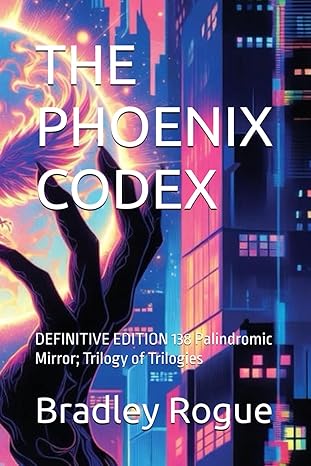
The Phoenix Codex is a theatrical metaphysical thriller that treats structure as part of the story, not just a container for it. Bradley Rogue builds the book as a “palindromic mirror” with ascending and descending arcs wrapped around a central point, and that design gives the whole thing a ritualized, incantatory feel rather than a straightforward adventure-novel rhythm. The opening makes its intentions clear right away: “It’s also a novel. Also a seed. Also a key.” That line captures the book’s whole personality. It wants to be read as fiction, transmission, puzzle box, and initiation text all at once.
At the center of it all is Dr. Natori Saira Evren, who isn’t just a protagonist so much as the book’s tuning fork. Her synesthesia, her academic outsider status, and her role as a traveler through patterns of recurrence make her the ideal guide for a world built on hidden frequencies, ancient architectures, and repeating catastrophes. The book follows her through interrogations, prequels, secret histories, temporal jumps, and revelations about the Phoenix cycle, and it does so with total conviction. Rogue writes like someone fully committed to the reality of his invented cosmology, and that commitment gives the novel its distinctive heat.
The book wants myth, conspiracy, sacred geometry, speculative archaeology, simulation theory, apocalypse, and spiritual transformation all in the same breath. Sometimes that makes the prose feel deliberately overwhelming, but that excess is also part of the reading experience. This is a book that likes pressure, repetition, symbols, and declarations. It keeps returning to numbers, mirrors, cycles, names, and encoded meanings until the language starts to feel ceremonial. Even the narrative instructions invite readers to treat the novel as an object with multiple valid pathways, which is a pretty revealing choice. The Phoenix Codex isn’t shy about asking the reader to participate in its pattern-making.
The most interesting thing about the novel is how openly it explains its own method. In the author’s note, Rogue says, “The Phoenix Chronicles make no claims to historical accuracy. They are mythology—but mythology that is aware of its own mythological status.” That self-description is useful because it points to what the book is really doing. It isn’t just telling a story about a hidden truth. It’s dramatizing the human urge to arrange history, fear, destiny, and transcendence into one giant meaningful design. That gives the novel a strange double quality. It’s earnest and self-conscious at the same time, immersive but also always nudging readers to notice the architecture holding it together.
The Phoenix Codex is less a conventional novel than a designed experience, and that’s what makes it memorable. It reads like a fusion of esoteric manifesto, sci-fi myth cycle, and visionary character saga, all organized around symmetry and recurrence. Readers who click with its wavelength will probably admire the sheer audacity of the construction and the intensity of its voice. Even when it gets wild, it knows exactly what it’s trying to summon: a story where reading becomes a form of initiation, and where narrative structure itself becomes part of the spell.
Pages: 550 | ASIN : B0GF7YTNQ8
Red Ghost Trilogy: The Complete Series

Red Ghost Trilogy is a big, pulpy, wide-angle genre mashup in the best sense. It opens with a sixteenth-century sea disaster, swings into modern criminal conspiracies and cosmic horror, and keeps expanding until it becomes an apocalypse story with time travel, myth, telepathy, pirates, and spacefaring war. What makes it hang together is that author Gerry Eugene writes like he genuinely enjoys every strange ingredient he’s tossing into the pot. The book isn’t shy about being large, dramatic, and weird, and that confidence gives it a real charge.
What the trilogy really is, though, is an ensemble adventure built around people with mythic nicknames and very human grief. Anders Benson, Emerson Beekman, Anne Forcetti, Fred Collier, and especially Genevieve Cocklin all arrive with outsized abilities, but the story keeps grounding them in loss, loyalty, and stubbornness. Genevieve ends up being the emotional center of a lot of the book, which surprised me in a good way. She’s introduced with the blunt, perfect line, “Genevieve was a pirate,” and Eugene spends a lot of time proving how many shades that can hold: strategist, lover, killer, commander, and eventually something close to legend.
The thing I liked most was the book’s scale. Eugene doesn’t think in narrow lanes. He thinks in collisions: old Spain and future war, organized crime and folklore, fungal plague and sacred cure, helicopters and demons. Even the diction likes to leap upward. Early on, one of the villains offers a string of clues that sounds like a thesis statement for the whole trilogy: “Cosmology. Cosmic vortices. Conical wormholes. Triggering megahertz. Auditory mandalas.” That line tells readers exactly what kind of ride this is. It’s not interested in staying tidy. It wants to be vivid, maximal, and just a little feverish.
Eugene likes ornate prose, formal phrasing, dramatic entrances, and chapter-to-chapter momentum, and that gives the book an old-school storytelling energy. He also has a gift for giving emotional pain a clean, memorable shape. One of the strongest stretches in the first book is Genevieve’s rush toward Seattle after the world has started collapsing around her. That whole sequence works because the action never floats free of feeling. For all the telepathy, monsters, and battlefield planning, the trilogy keeps coming back to what catastrophe does to love, friendship, and chosen family.
Red Ghost Trilogy is a sprawling speculative epic that runs on sincerity, imagination, and momentum. It’s the kind of book that wants to entertain generously. It gives readers haunted history, end-of-the-world stakes, magical combat, and a found-family core sturdy enough to carry all that spectacle. Anyone who likes fiction that blends science fiction, fantasy, horror, and adventure, this collection has a lot to offer. It feels less like a neatly engineered machine and more like a huge, eccentric saga told by someone who loves stories too much to keep them small.
Pages: 748 | ASIN : B0GKXKF9Z6


