Blog Archives
Honor


Honor is a big-hearted sci-fi and fantasy anthology built around one of those ideas that fantasy readers love to chew on: what does honor look like when the sword is heavy, the road is ugly, and the “right thing” costs something? Edited by Brittany and Z.S. Diamanti, the collection gathers twenty-two authors and lets them approach honor through dwarves, mages, soldiers, thieves, strange planets, living soil, trials, rebellion, sacrifice, and loyalty. The editor’s note frames it nicely: “The concept of honor is such a multifaceted and beautiful enigma.” That’s exactly the lane this book lives in.
What I liked most, as someone who loves fantasy, is that the anthology treats honor as something lived rather than preached. In “The Leacher,” for example, Zur’s magic is bound up in pain, labor, land, and invisibility. His victory isn’t a crown or a song, but a field of wheat and the private knowledge that he gave everything he had. That story captures one of the book’s strongest instincts: honor can be quiet, muddy, painful, and still deeply heroic.
The range is also part of the fun. One story can feel like classic secondary-world fantasy with spears, soil, and old grief, while another jumps into spacefaring duty, trials, and political responsibility. There are stories about rebellion and mercy, duty and defiance, thieves and warriors, grief and chosen sacrifice. That variety makes the theme feel alive instead of repetitive. The book keeps turning the gem in the light so every story catches a different color.
The characters aren’t just trying to look noble. They’re trying to protect someone, keep a promise, carry a burden, or stand when they’re afraid. For fantasy readers who love moral stakes as much as magic systems and battle scenes, that gives the collection a satisfying emotional weight.
Honor feels like a gathering around a long tavern table where every storyteller has their own world, scars, gods, monsters, and idea of courage. Some stories are grand and martial, others intimate and aching, but together they make a warm, earnest case for honor as compassion in motion. It’s the sort of anthology that’s especially easy to recommend to fantasy fans who like discovering new authors, because each piece feels like a doorway into a bigger world.
Pages: 769 | ASIN : B0GDNSQ8BV

Signs of The Fall


Signs of The Fall is a Christian speculative thriller with strong paranormal, sci-fi, dark romance, and moral allegory elements. The story begins with Hogarth Hughes, a lonely teenage outsider in Salem, Virginia, aching for connection after another rejection, then follows a widening web of characters whose desires, secrets, faith, technology, and temptations pull them toward different kinds of “falls.” What starts as an awkward, intimate portrait of adolescent longing grows into something stranger and darker, moving through church life, sexuality, social media, gaming, military imagery, alien encounters, and spiritual warning signs.
The writing spends a lot of time inside hungry, restless minds, and sometimes that closeness feels almost claustrophobic. Hogarth’s thoughts are messy, repetitive, funny, lonely, crude, and sad, often all at once. I found that honest in a way. The author doesn’t smooth him into an easy hero. He’s needy, observant, resentful, sincere, and painfully young. That mix gives the early pages a raw charge.
The author’s choices are bold. The book blends genres without much apology, and that can be both its strength and its challenge. One moment I felt I was reading a coming-of-age story, then a critique of modern desire, then a church drama, then a supernatural warning tale, then something closer to sci-fi horror. It’s a lot. Still, the repeated language of signs, falls, fruit, stars, phones, games, and hunger gives the novel a clear moral gravity. The book is interested in what people reach for when they feel empty, and what those cravings cost when they go unchecked.
I would recommend Signs of The Fall to readers who like faith-inflected speculative fiction that is dark, strange, and morally direct. It’s not a quiet literary novel, and it’s not a clean genre piece either. It’s more like a storm system moving across several kinds of fiction at once. Readers who enjoy Christian thrillers, paranormal suspense, social critique, and stories about temptation will probably get the most from it. For me, it was uneven but memorable, and I respected its willingness to stare at uncomfortable desires rather than pretend they’re not there.
Pages: 338 | ASIN : B0GZYKTL8T
The Phoenix CODEX: 138 Palindromic Mirror Edition Complete Phoenix Chronicles: Complete Phoenix Chronicles: A Trilogy of Trilogies

The Phoenix Codex: 138 Palindromic Mirror Edition is a speculative science-fiction thriller with strong elements of conspiracy fiction, metaphysical fantasy, horror, and mythic adventure. At its center is Dr. Natori Saira Evren, a synesthetic researcher drawn into a hidden pattern of Phoenix cycles, ancient Egyptian consciousness technology, alien hunters, simulation theory, and recurring resets every 138 years. The book presents itself not just as a story, but as a codex, a puzzle box, and a ritual object, with its mirrored structure, sacred numbers, and recurring symbols shaping the reading experience as much as the plot itself.
The book is committed to its own mythology. It doesn’t ease the reader in gently. It opens with pain, blood, classified files, impossible geometry, and a heroine who is already half legend before we really know her. That choice gives the novel a charged, feverish energy. Sometimes it works beautifully. The world feels huge, dangerous, and strangely magnetic, like every room has a hidden door and every number is whispering. The book wants to explain its patterns, prove them, dramatize them, and make the reader feel implicated in them all at once. That’s ambitious, but it can also be overwhelming at times.
The writing is at its best when it trusts atmosphere and image. Copper, burnt cinnamon, cold concrete, humming frequencies, jungle silence, blood on leaves: those details make the strange ideas feel physical. I could feel the book trying to turn paranoia into texture. The author’s biggest choice, though, is structural. The palindromic design, the 138-year cycle, the ascending and descending arcs, and the central mirror are not decorative. They’re the book’s engine. Even when I questioned some of the repeated exposition, I could see the purpose behind it. This is genre fiction that wants the form to become part of the spell. It’s a story about recursion.
I would recommend The Phoenix Codex most to readers who enjoy big, strange, high-concept speculative fiction, especially people drawn to ancient mysteries, secret histories, simulation ideas, cosmic horror, and books that blur the line between novel, artifact, and prophecy. Readers who like genre fiction that swings hard, builds its own symbolic language, and treats conspiracy, myth, and science fiction as parts of the same burning machine, this book has a fierce pull.
Pages: 501 | ASIN : B0GBVLRVXP

WITHOUT A FACE

The novel begins in 1967 with Kurt and Alice Franklin living an ordinary married life in Rescue, until a news bulletin about a deadly virus and a late-night intrusion crack their world open. What follows is a strange, escalating flight through woods, factories, false histories, impossible technology, and revelations that make Kurt and Alice question not only where they are, but what their lives have really meant.
I liked how the book starts with domestic texture: television knobs, bad reception, steak dinners, cigarettes, private marital shorthand. That groundedness matters because the plot soon becomes vertiginous. Author Lonnie Busch lets the absurd arrive by increments, so the reader is trapped alongside Kurt, trying to make sense of each new wrongness before the next one appears. The result is less a clean puzzle-box thriller than a feverish corridor, one door opening onto another, each more bewildering than the last.
I was impressed with the machinery of the premise, as well as the emotional ballast of Kurt and Alice’s marriage. Their grief over Reed gives the book its ache, and their attachment to each other keeps the speculative elements from floating away into pure contrivance. The explanations grow heavy, especially when the story pauses to deliver big historical and cosmic disclosures, but the novel’s best moments return to the small human question underneath the spectacle: what do you choose when reality itself becomes negotiable?
The target audience is readers who enjoy science fiction thrillers, alternate history, dystopian mysteries, and time-bending suspense with a strong emotional spine. I’d compare it to Blake Crouch’s Dark Matter in its interest in identity, reality, and the terror of being displaced from your own life, though Busch’s book feels more homespun, more mournful, and stranger around the edges. A reality-warping thriller with a bruised heart, Without a Face asks whether home is a place, a past, or simply the person still holding your hand.
Pages: 266 | ASIN : B0GT697CVF
The Last People Who Knew
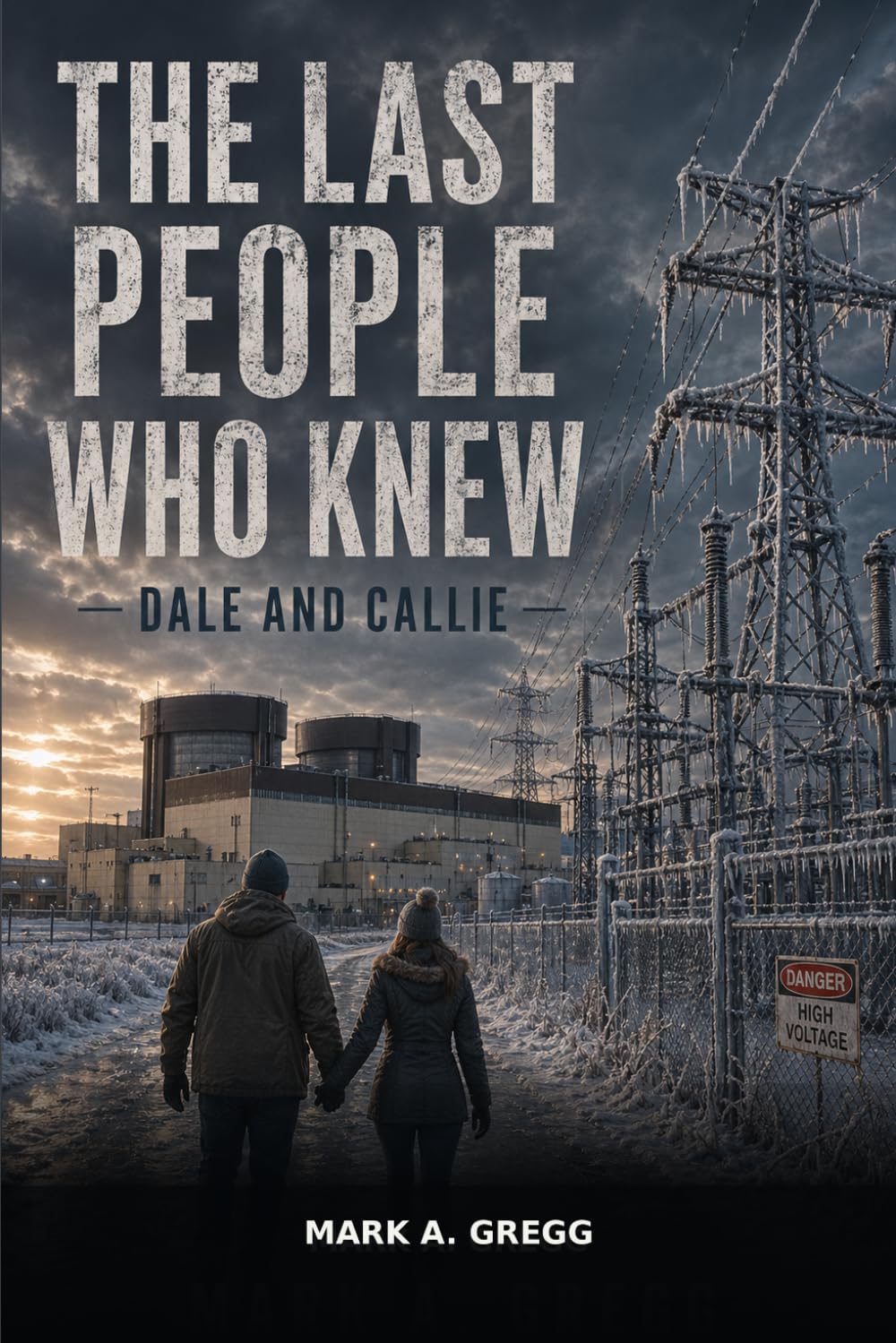
The Last People Who Knew by Mark A. Gregg is a techno-thriller and infrastructure disaster novel about an electric utility, MidAtlantic Energy, slowly trading depth, experience, and maintenance margin for cleaner balance sheets. What begins with small plant problems, thin staffing, aging equipment, and corporate pressure grows into a wider crisis involving the power grid, nuclear plants, black start capability, and a severe storm that exposes how fragile “managed risk” can become when everything goes wrong at once.
I found the book most compelling when it stays close to the machinery and the people who understand it. The control rooms feel alive. Alarms, radios, valve positions, transformer gases, turbine vibration, ice loading, and operator judgment all become part of the tension. It’s a very practical kind of suspense. Not glamorous, exactly. More like watching a hairline crack spread across something everyone assumed was solid. The writing has a plainspoken confidence, and that works well for the genre. This isn’t a sleek spy thriller or a character-first literary novel. It’s a systems thriller, and its real monster isn’t one villain, but the slow narrowing of safety margins.
I also appreciated how candid the book is about leadership choices. Stephen Langford and Warren Buffton are not written as cartoon villains. That makes the story more interesting. Their decisions often sound reasonable in isolation: cut waste, demand efficiency, trust smart people, avoid unnecessary spending. But the novel keeps showing how a reasonable choice can become dangerous when it is made far away from the equipment, the weather, and the people who know where the weak points are. The technical explanations are heavy. The book wants the reader to feel the weight of what operators, engineers, and plant managers carry.
The title is not just dramatic. It’s sad. The “last people who knew” are the ones who remember why a spare part mattered, why a transformer report could not be ignored, why a black start plant was more than an old asset on a spreadsheet. I read the novel as a warning about modern life’s hidden dependence on people whose work is only noticed when it fails. That idea lands hard, especially because the book doesn’t end with a neat fix. Repairs happen. Lessons are written down. Some changes stick. Some don’t. That felt painfully believable.
I would recommend The Last People Who Knew to readers who enjoy technical fiction, disaster novels, workplace thrillers, or grounded techno-thrillers where the suspense comes from systems under stress rather than gunfights or conspiracies. It’ll especially appeal to engineers, operators, utility workers, and anyone curious about what keeps the lights on. Readers who like their fiction built from real bolts, budgets, weather maps, and human judgment will find a lot to admire.
Pages: 427 | ASIN : B0GVYNL1DQ
Trouble in Cyborgia (Night Crusaders Series Episode 4)

Trouble in Cyborgia is a compact superhero adventure with a pulpy, futuristic setup and a surprisingly earnest moral core. It is the fourth entry in the Night Crusaders series, and the book frames itself as one of the series’ shorter “companionless mini adventures,” with the spotlight falling mainly on Simeon while Thomas Givens serves as the first-person narrator who pulls readers through the story. That choice gives the novel a nice angle. Instead of feeling distant or mythic, Simeon is seen through the eyes of someone who is impressed by him, puzzled by him, and gradually changed by what he witnesses.
What the book does best is establish its world in bold, direct strokes. Georgia City, nicknamed Cyborgia, is a place where cybernetics shape public life, work, policing, media, and power. The novel leans into that setting with real conviction, turning corporate technology into the engine of both wonder and abuse. The early dungeon sequence is especially memorable because it takes a bright futuristic city and reveals the machinery underneath it as cruel and predatory. Even a line like “Because I am a Night Crusader” works with a straight-faced sincerity that tells you exactly what kind of heroic register the book is working in. It’s not coy about heroism. It believes in it.
The book is also very much a story about labor, dignity, and the spiritual cost of letting convenience replace conscience. Thomas opens the novel by asking, “Whatever happened to that good old-fashioned work ethic?” and that question ends up shaping far more than the background. It gives the whole story a distinctly moral and social frame. This isn’t just a tale about a hero punching robots. It’s a tale about what kind of society gets built when efficiency, profit, and technological expansion stop answering to anything human. The novel keeps returning to institutions, jobs, media narratives, and public responsibility, which gives the action a larger civic backdrop.
What I found appealing on a craft level is the book’s plainspoken confidence. It moves scene to scene with very little fuss, and that gives it an old-school serial energy that fits the “Episode 4” label. Simeon isn’t presented as an unreachable icon. He gets trapped, weakens, makes risky choices, falls for people, and has to rely on others. That matters, because it turns the book into more than a victory lap for a superhero. It becomes a story of exposure, endurance, and community, with journalists, coworkers, allies, and ordinary citizens all helping shape the outcome. By the time the corporate collapse and legal reckoning arrive, the novel has built a world where public evil has public consequences.
Trouble in Cyborgia is a sincere, energetic blend of superhero fiction, dystopian corporate thriller, and moral fable. It has the feel of a story told by someone who likes heroes to be heroic, villains to stand for something rotten, and settings to carry an argument about the world. Its tone is openhearted, its themes are clear, and its best moments come from how fully it commits to its own vision of justice, technology, and human worth. If you meet the book on those terms, it’s an engaging ride through a futuristic city where the fight isn’t only against machines, but against the system that built them.
Pages: 145 | ASIN : B0FZDGXPFZ
Purple Bleed Naughty Beasts

Purple Bleed Naughty Beasts is a work of speculative fiction that blends apocalyptic horror, satire, and psychological thriller elements into one jagged story. At its center is Henrietta Dobie, a teacher and trauma survivor who comes back to ordinary life after a brutal ordeal called Project Purple, only to find that ordinary life is no longer stable, and maybe never was. As Henri tries to navigate small-town routines, old classmates, a psych ward, and the creeping collapse of the country around her, the book keeps asking whether she is unraveling, seeing the truth, or trapped in some awful overlap between the two. That tension drives almost everything in the novel, and it gives the book its pulse.
The author writes with a mean streak, but also with real control. The book can be funny in a way that catches in your throat, then ugly, then sad, sometimes all in the same scene. A principal trying not to fart, a baby shower gift of shotgun shells, an Olive Garden that feels like a haunted checkpoint in the end times, all of that sounds absurd on paper, yet the writing commits so hard that it becomes its own reality. I also think the author makes a risky choice by pushing satire right up against trauma and social breakdown. Sometimes it feels brilliantly unhinged. Sometimes it feels like the book is daring you to keep up. For me, that mostly worked because Henri is never treated as a gimmick. She is bruised, sharp, isolated, and believable even when the world around her goes feral.
What I found most interesting is how the novel refuses to give easy comfort about what is “really” happening. The hallucinations, the bodily disgust, the public violence, the cult logic, the talk of worms in soft wood, all of it builds a world where decay is social, spiritual, and physical at once. That could have turned into noise, but Greco keeps returning to the same core ideas: betrayal, surveillance, hunger, the desire to belong, and the danger of surrendering yourself to a story that explains everything.
This is a bold, abrasive, and oddly mournful novel. I would recommend it most to readers who like genre fiction that crosses lines, especially people drawn to horror with satirical teeth, dystopian fiction that is less about neat world-building and more about psychic collapse, and stories that leave you unsettled rather than reassured. If you want something fierce, strange, and uniquely intriguing, this is a worthy read.
Pages: 190 | ASIN : B0GSCPBFS3
Richard: Distant Son

Michael W. Hickman’s Richard: Distant Son opens with a wonderfully outsized premise: an ordinary fifteen-year-old from Ohio discovers that he is the lost heir to a galactic throne and is swept from suburban life into a sprawling interstellar kingdom of court ritual, prophecy, old betrayals, and species drawn from both science fiction and myth. What follows is a chosen-one story with a deliberately maximal appetite, part space opera, part royal fantasy, part coming-of-age tale, as Richard is tutored by the enigmatic AAL and forced to grow into a destiny much larger than his own imagination ever allowed.
What I liked most was the book’s refusal to behave modestly. Hickman doesn’t nibble at worldbuilding; he heaps it on. The novel moves from cosmic prologue to Ohio basement to a kingdom populated by aliens, winged horses, political operators, and ceremonial grandeur, and I found that sheer amplitude genuinely fun. Richard himself is appealing because he does not arrive pre-polished. He’s gawky, impulsive, occasionally funny without trying to be, and still recognizably adolescent even when everyone around him wants to turn him into a symbol. That contrast of teenage bewilderment set against imperial expectation gives the novel much of its momentum and charm.
I also found the book interesting in the ways it exceeds the boundaries some readers might expect from its premise. Beneath the wish-fulfillment engine, there’s a streak of earnest strangeness here: sexuality is more explicit than a typical younger-YA adventure, the mythology of Richard’s bloodline is treated with near-feudal seriousness, and AAL’s guidance carries a persistent undertow of secrecy and control. The novel can feel overfull, even unruly, but for me that unruliness is part of its character. It reads like a story written by someone who genuinely loves the idea of throwing star empires, prophecy, palace intrigue, romance, and adolescent dislocation into the same crucible and seeing what burns hottest. The result is not sleek; it’s exuberant.
I’d recommend Richard: Distant Son to readers who enjoy science fantasy, space opera, royal-intrigue fiction, chosen-one narratives, and coming-of-age adventure with a romantic thread. Readers who like the dynastic scale of Dune but want something more accessible and emotionally direct, or fans of Christopher Paolini-style earnest mythmaking pushed into a galactic register, will probably find a lot to savor here. This is a book for people who don’t mind a little grandeur in their storytelling and maybe prefer it a touch unbuttoned.
Pages: 493 | ASIN : B0B627767G


