Anything Can Be Denied
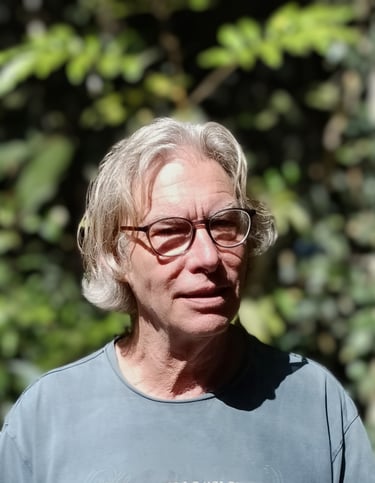
Shaking the Trees follows Jake, an environmental activist, who is pushed to sabotage a coal rail line in a desperate act of protest that sets off a chain of events that can threaten his future. What was the inspiration for the setup of your story?
There were two inspirations: the first was climate change itself and specifically a coral reef scientist telling me how little time the Great Barrier Reef had to survive. The Reef has had a profound influence on me. That news sent me into a prolonged depression shadowed by both grief and anger. From there, the book’s initial scene of sabotage took hold.
The second was less an inspiration than an epiphany – I wanted a shadow story for the story of Jake and climate change. Out of some deep recess in my subconscious, I said, ‘The Siege of Sarajevo’. Literally, I stopped and said aloud, ‘but Jeremy, you don’t know anything about the Siege of Sarajevo.’ And that turned out to be, in good part, the point. It was a war ignored not only by those who could have stopped it, but those, like me, who thought I was paying attention. I began to realise that anything can be denied.
A significant amount of time was spent crafting the character traits in this novel. What was the most important factor for you to get right in your characters?
Two factors stand out: the need to integrate the political and the personal. Activists don’t see these as separate, for anyone. They are intimately linked even when they are not always easy to reconcile and even when the relationship between one’s personal life and political life isn’t always clear. Even withdrawal from the plethora of events in our lives that are political, is a direct and political response to a society that feels too brutal, ugly or cold.
The characters wanted to show me how much of what we face or are forced to face in the world is entangled not only in politics but in our own histories and even histories older than we are – family and community histories. Excavating these histories is not a simple or rapid task. Like an archaeologist who finds an object deeply buried, we must gently remove a lifetime of encrustations and then – equally hard – try to make sense of what this strange object from our past is, what it signifies, whether it is only a small part of a larger whole.
I began to realise that the characters, forced by circumstances and choices none of the characters could entirely control, were living out their psychological histories in new and often damaging ways. I had to listen closely to the characters, to explore how histories of love and lovelessness, trauma, fear, ambition, repression, denial were still alive in them as the story unfolded. I often had no idea what the characters would show me.
What themes were particularly important for you to explore in this book?
1 – The various faces and types of denial. Denial can be personal and a useful form of self -protection. Often, when the need for self-protection is gone the behaviour remains. Like an auto-immune disease the brain responds in destructive ways to news or information it desperately wants to be untrue. Sometimes, particularly, amongst our leaders denial has no excuse, no value except in serving the interests, usually pecuniary, of themselves or other members of their privileged class. I was particularly interested in how we – individually and as a society navigate between the necessary and the destructive? How do we face the reality that anything can be denied, just as anything can be believed? How to think about faith? Is it destructive, protective, or simply a kind of disappearing from the world? And is love, too, a kind of faith?
2 – I didn’t know when I started the novel how important the theme of love would be – its many faces, its profound power and profound capacity, if love is lost, to tear us from our moorings. I also didn’t know when I started that I would find the heart of the book to be the effort of Jake to try and reconcile his love for the planet and his love for Julie, loves perhaps too large for any single person to hold.
3 – Finally, I wanted to explore activism. How people choose to face conflicts that can radically subvert their ideas of democracy, community and shared ideals. How activists struggle with a life’s work primarily characterised by failure and in a system that at every turn makes activism and change harder. Watching a political system treat activists like criminals and corporate criminals like friends is the kind of stark reality that activists experience throughout their working lives. It’s confronting work. So many activists leave this work in order to do something more immediately rewarding and kind. That said, young activists keep coming into activism, with new energy, new ideas, and old ideas they think are new. They give of themselves in ways impossible not to admire.
What is the next book that you are working on, and when will it be available?
I am completing a last edit on a manuscript that was shortlisted in 2024 for the Dorothy Hewett award in Australia. The book is called Vanishment, the story of a young man who fights to protect a species threatened with extinction. It is loosely based on the true story of the extinction of the Christmas Island Pipistrelle and loosely based on Christmas Island, often called the ‘Galapagos of the Indian Ocean’ but also an island subject to a dismal history of misery industries – phosphate mining, a massive casino for high rollers from Jakarta and finally a detention centre carved out of the Island’s unique rainforest. Love and loss are the dominant themes and like Shaking the Trees, both those themes have many faces.
I don’t have a publisher yet so I’m not sure when it will be available, but I hope next year.
Author Links: GoodReads | Facebook | Website
When Jake, a passionate environmental activist, desperate for action on climate change, starts to take drastic action, he sets off a chain of events that threatens everything he holds dear—his freedom, his future, and the woman he loves. As the storm he ignited grows more violent, Jake loses control even over his own life.
Meanwhile, his father Ian—an aging academic and firm climate sceptic—faces a reckoning of his own. With the death of his wife comes the uncovering of long-buried truths, including a cache of unopened letters from his sister lost to war and trauma. Letters that speak of survival, betrayal, and a city under siege.
Spanning continents and generations, Shaking the Trees is a gripping novel about the legacies we inherit and the choices that shape us. It asks how far we’re willing to go for what we believe—and whether love can endure the fallout.
Posted on October 1, 2025, in Interviews and tagged author, book, book recommendations, book review, Book Reviews, book shelf, bookblogger, books, books to read, ebook, Environmental Fiction, fiction, goodreads, indie author, Jeremy Tager, kindle, kobo, literature, nook, novel, political fiction, read, reader, reading, Shaking the Trees, story, writer, writing. Bookmark the permalink. Leave a comment.



 LITERARY TITAN
Leave a comment
Comments 0