Blog Archives
An Unabashedly Progressive Manifesto

Tristan 4 America follows a laid-off tech executive grieving the loss of his career and camaraderie, whose growing anger at American politics drives him toward an ambitious but highly impractical plan. What was the inspiration for the setup of your story?
This is a “write what you know”–style book, in the sense that, after that first pandemic summer, I retired from a Sales Operations job in Silicon Valley, and I have for some time been experiencing anger at the state of American politics, an anger that runs through my brain constantly. In fact, this exchange between Tristan, the protagonist, and his wife Cindy, from page 38 of the book, fits me perfectly:
“It’s the politics, honey,” he said. “The politics of the moment. It just fucking pisses me off so much. You’ve seen me when I get exercised about it.”
“Well, we haven’t lost any friends yet, but yeah, we’ve come pretty close.”
“Yeah, and for every one of those times I just sort of lose it, there are hours and hours of just running over all this shit in my addled brain. It’s driving me shithouse.”
Beyond this, on page 22, Tristan first becomes aware of the amounts of money even failed presidential candidates can pull in, a realization that gives him the idea to run himself. In that passage, the “latest Republican challenger, a former southern state governor” was rather transparently inspired by former South Carolina Governor Nikki Haley. I distinctly recall when Haley announced her candidacy, with the revelation that she had, at the time of her announcement, already raised two million dollars for her campaign.
So the inspiration was literally what was happening in real-time as I was developing the story in my head. I had been working on a sequel to my first book, The Cyclone Release, and I was pretty stuck, partly because the 2024 campaign was in full swing and I was constantly getting distracted by the latest outrage. So I decided to put the sequel down and write Tristan 4 America instead. The Cyclone Release took me somewhere between 11 and 13 years to write. Tristan 4 America took me three.
Did you begin with the political satire, the characters, or the idea of someone searching for purpose after losing his career?
I’m not ashamed to admit that I created the character of Tristan to speak for me. In fact, in my pitch to publishers, I described the story as an “unabashedly progressive manifesto.” As such, I definitely started with the character of Tristan, after which the whole thing just became so damn much fun. Creating the characters of Shonda, Nance, and Laz just set the table for this great line of irreverent banter—the kind of thing that is really common in the kinds of high-performing Silicon Valley teams I was accustomed to working in during my career. So, as far as the satire is concerned, I was just having a blast doing the writing on this one. And as for the conflict of someone searching, late in life, for purpose, that was a natural conflict that just fit the story like a glove, and just happens to also be something many, many people struggle with, particularly late in life. I kind of have to pinch myself when I reflect on the writing of this book. I’m not sure I’ll ever be able to have that much fun writing a book again, and I think I came away with something intriguing and thought-provoking.
Tristan is both sympathetic and flawed. How did you balance his ambition, frustration, humor, and vulnerability?
Man, this is a great question to think about. I guess the only honest way to answer it would be to admit that I write fiction partly to engage my own fantasies. As a person, a writer, who would never have the stones to do what Tristan does, to stand in front of audiences, some of them innately hostile, and say the things he does—to say nothing of running for President of the United States—I am able to create that person and those scenarios in fiction. We novelists live vicariously through our characters, so I created a character who has a balance of qualities that I most decidedly do not have, but really wish I did. So the answer to the question of how I balanced those qualities in Tristan is that I did so by creating a person I personally would love to be. One of the first comments from one of my first readers was, “I’m not sure I like Tristan very much.” And I actually loved that because I never want any protagonist to be 100% lovable and sympathetic. I don’t want that because that’s not real. That’s not how humans work. We all have a dark side, and we’re all molded to some degree by the circumstances we find ourselves in. And first and foremost, I wanted Tristan to be real. I wanted readers to recognize him in themselves and the people around them, and I think all of his flaws and virtues accomplish that quite well.
What do you hope readers think about after finishing Tristan 4 America?
We live in ignorant times. Everything has been dumbed down so thoroughly that the unthinkable has now happened: we have managed to elect a complete narcissistic buffoon as the “leader of the free world.” And I think one of the results of that general tilt towards ignorance is that intelligent people are reticent to wield their intelligence in their everyday lives. I’ll admit that I personally suffer from this. There’s a fear of not being heard, or of embarrassing oneself by not getting the facts quite right, or of appearing insincere or inauthentic. And so, I hope readers will see in Tristan a person who has no compunctions, a person who is not just willing, but anxious, even inspired, to wield an intelligence that has been laying dormant throughout a rewarding, but somewhat superficial career in Silicon Valley. I of course want people to learn from the facts Tristan promotes in his diatribes, but more than that, I want them to be inspired to, as Shonda describes it early in the book, “bring the funk” just like he does. In fact, I’m hoping the book will change me, and that I’ll do a better job of bringing the funk in my own life—beyond that funk I’m bringing through Tristan’s voice, of course.
Author Links: GoodReads | X | Facebook | Website
After the pandemic costs him his career-and his sense of purpose-Tristan Heller makes an unthinkable decision: he runs for president of the United States. Not to win, but to say what no one else will.
Backed by a scrappy crew of Silicon Valley outsiders, Tristan’s long-shot campaign cuts through the noise of the 2024 election with blunt, incendiary truth. What begins as a protest quickly gains traction-drawing in voters hungry for honesty…and attention from far more dangerous forces.
As his message spreads, so does the backlash.
Online fury spills into the real world. Money, misinformation, and power close ranks. And Tristan finds himself in a fight he never intended to start-against a system that doesn’t reward disruption, and the people who will do anything to silence it.
In a nation defined by division, speaking the truth can make you a target.
A sharp, provocative literary novel with the pulse of a political thriller, Tristan 4 America explores the fault lines of modern democracy-from campaign finance and disinformation to identity, power, and the high cost of dissent.
Tristan 4 America


Bruce Overby’s Tristan 4 America is a political satire with the bones of a campaign novel, the mouth of a Silicon Valley happy hour, and the nerves of a country that can’t stop vibrating. Tristan Heller is a laid-off tech executive who misses his team, misses being useful, and is furious enough about American politics to do something wildly impractical. When he hears how much money even doomed presidential candidates can raise, he decides to launch a campaign of his own. It starts as a scheme, sure, but Overby has more fun than that in mind. The campaign becomes a strange vessel for grief, vanity, civic anger, friendship, and the weird thrill of being listened to.
What makes the book work is the ensemble around Tristan. Shonda, Nance, Laz, Cletus, Sissy, Shay, and Cindy all bring their own rhythm to the story, and the dialogue often has the loose, needling warmth of people who’ve known each other long enough to be rude with affection. Early on, Shonda sums up their old tech life by saying, “This has been a magical run, guys,” and that feeling carries into the campaign, even when the whole enterprise is ethically wobbly and legally sweaty. The team’s chemistry gives the novel its comic charge. They argue, joke, scheme, drink, panic, and somehow keep building something that feels more real than Tristan intended.
The novel is also very much about money, media, and performance. Tristan’s campaign grows because he’s good in front of people, but also because modern attention rewards the blunt, the funny, and the slightly unhinged. Overby is sharp on how political messaging becomes content, how content becomes fundraising, and how outrage can turn into both a business model and a personality. The campaign’s “rapid response” gimmicks, social media machinery, podcast appearances, and donor spikes all feel specific and lived-in. It’s funny, but the humor lands because the mechanisms feel recognizable.
As the book widens, it brings in darker material through Howie, right-wing trolls, the Patriots of the Pacific, and the Pilots of Progress. That thread gives the novel a more dangerous edge, turning what begins as a satirical campaign caper into a story about political violence and the fantasy of power. Overby doesn’t treat the militia material as a separate genre detour. It grows out of the same world of resentment, online bravado, and broken civic trust that Tristan is trying, clumsily and sometimes selfishly, to talk about. By the end, when Tristan admits, “I’m thinking it’s a goddamn good thing I never actually became president,” the joke carries a real shiver.
Tristan 4 America is a lively, profane, surprisingly earnest novel about a man who backs into a public voice and then has to live with what that voice stirs up. It’s at its best when it lets its characters talk, spar, and talk some more, because that’s where the book’s politics feel most human. Tristan may begin with a cynical plan, but the story around him keeps finding pockets of sincerity inside the hustle. Overby has written a comic political novel about people trying to make sense of a country where every speech, post, donation, joke, and threat seems to arrive already plugged into the same overloaded circuit.
Pages: 226 | ISBN : 978-1972197080

A False Accusation of Murder

The Saundra Gray Affair centers around a congressman whose public life is wrecked when the young intern he is romantically involved with goes missing. Where did the idea behind this novel come from?
The idea behind the story came from the Gary Condit-Saundra Levy affair in 2001, about which the reader can learn more using GOOGLE or Wikipedia if interested. My novel is set in the 1980s, with a moderate Democratic congressman from Iowa and his chief of staff as the central characters. To me, the incident highlighted many of the flaws in our political culture, while also containing the elements of a very good whodunit. Throughout my own long career in Washington, I noticed there is a frequent disparity between the truth and what the public believes based on media coverage and the spinning by various interest groups for political reasons. I thought the Condit-Levy affair illustrated that disparity as well as anything I had experienced in my career.
The novel spans decades rather than focusing on a single investigation. Why was that broader timeline important to the story you wanted to tell?
Rather than focusing exclusively on Saundra Gray’s disappearance, I wanted to give the reader a broader sense of who Congressman J.D. Clay is. Thus, there are a few chapters leading up to the disappearance providing both early biographical information as well his activities in Congress. I hoped the reader would view him as the kind of congressman they would want to vote for—at least in terms of his approach to politics and policymaking if not positions on issues. Thus, the reader would feel a sense of loss from his downfall. Many political figures otherwise admired have been forgiven for affairs. But a false accusation of murder is a far different animal.
Did you always know where J.D.’s journey would end, or did his character evolve during the writing process?
Because there was so much of the Condit incident to draw from, I knew J.D.’s political journey would end in a similar manner. His personal journey after that is my own invention but I had a general idea of how I wanted to end it, given the theme. (See next question.) In terms of his character, I had a very firm idea at the outset of what represents to me the ideal politician which I wanted to portray.
What do you hope readers take away from reading your novel?
I hope most readers will take away from this a sense of their own public responsibility to remain skeptical about being driven to a conclusion by the media and interest groups with a vested interest in one angle of a story. Socrates said true wisdom is knowing you know nothing. That’s an obvious overstatement but I think what he was getting at was knowing what you don’t know. This can be a very difficult task in an information-saturated world. But an open mind and intellectual curiosity helps!
Author Links: Goodreads | Website
—James Fallows, former White House speechwriter and New York Times–bestselling author of Our Towns
When a Capitol Hill intern mysteriously disappears, a congressman finds himself in a media firestorm in the midst of a heated primary race.
Congressman J.D. Clay had the makings of a presidential contender—an Iowa Democrat, war hero, and one-hit-wonder songwriter who made Washington work by listening to all sides and finding common ground.
But then Saundra Gray, an attractive young intern in his office, disappeared.
As accusations of an affair and even involvement in her disappearance explode around him, Clay’s world—along with that of his loyal chief adviser, Wally North—is turned upside down.
In a saga spanning more than two decades and continuing long after Saundra’s killer is found, journalist Isaiah Stone untangles a winding web of sex, secrets, and lies at the highest levels of government.
In the spirit of classic novels like Primary Colors and All the King’s Men and inspired by the true story of the still-unsolved Chandra Levy case, The Saundra Gray Affair is more than a murder mystery. It’s a powerful commentary on power, politics, and the brilliance and flaws of both our laws and our leaders.
Jeanne la femme en rouge


Jeanne la femme en rouge, by Isabelle B.L., is a historical novel about Jeanne Tunica y Casas, a fierce political agitator, teacher, artist, wife, and aging woman whose life stretches across Nîmes, Paris, Nouméa, Sydney, and Santo. The novel frames Jeanne in her later years, confined to a retirement home in 1967, while memory keeps pulling her back to Paco, her beloved husband, and to the decades she spent writing, organizing, arguing, teaching, and defending exploited workers in New Caledonia. It is a story of love and ideology, but also of erasure: a woman who fought to be heard now has to fight against institutional silence, old age, and the soft violence of being managed.
What struck me first was the book’s refusal to make Jeanne easy. She is not softened into a saint of justice or tidied into a tragic widow. She is abrasive, brilliant, difficult, lonely, funny, and sometimes exhausting. I admired that. The prose keeps returning to objects, vinyl chairs, folded handkerchiefs, flowers, newspapers, Paco’s clothes, an ugly institutional room, and these details become emotional detonators. Jeanne’s mind is never still; it attacks, remembers, mourns, judges, and revises. The novel makes consciousness feel like a crowded room where history, grief, and political conviction are all speaking at once.
I also appreciated the way the book treats politics as something lived in the body, not merely debated in pamphlets. Jeanne’s communism, pacifism, and anti-colonial anger are not decorative backstory; they shape how she sees chairs, labor, flowers, language, and even the manners of nurses. The novel can be rhetorically intense, and some readers may find Jeanne’s interiority sharp-edged or relentless, but that relentlessness feels honest to the character. The book is most moving when it lets tenderness and fury occupy the same sentence: Paco’s death, Jeanne’s memories of teaching children, her refusal to be patronized, and her terror of dying alone all gather into a portrait that is both intimate and insurgent.
This book is best suited for readers of historical fiction, biographical fiction, feminist fiction, political fiction, and novels about aging, memory, and social justice. Readers who appreciate the moral seriousness of Isabel Allende or the politically charged intimacy of The Book of Night Women by Marlon James may find a similar urgency here, though this novel is quieter, more interior, and more elegiac. Jeanne la femme en rouge is a tribute to a woman history nearly misplaced, and it burns brightest when it lets her remain inconvenient. A vivid, unsentimental novel about a woman who would not become quiet simply because the world preferred her that way.
Pages: 214 | ASIN : B0GHG89KSB
Nothing Left to Lose

Nothing Left to Lose, by Len Joy, is a literary family drama about Tawni Carter, a prominent anti-abortion activist whose public convictions collide painfully with her private life. After she tries to take legal control of her pregnant daughter, Charlotte, Tawni loses more than a court case. She loses trust, family, and the story she has told herself about who she is. The novel moves between 2018, the 1960s, and the early days of COVID, building a layered portrait of mothers, daughters, regret, survival, and the hard work of letting go.
I liked how willing Joy is to sit with complicated people. Tawni could have been written as a symbol, but she isn’t. She’s proud, sharp, manipulative, wounded, funny, selfish, and capable of real tenderness. That makes her frustrating in the way real people can be frustrating. I didn’t always like her. I was not always meant to. But I kept wanting to understand her, and that is where the book earns its emotional weight. The shifts into Clover’s past also give the novel a wider shape, moving it beyond one family crisis into a story about inheritance, not just money or blood, but belief, grief, stubbornness, and love passed from one generation to the next.
Joy’s writing is clean and direct, with dialogue that often carries the charge of a courtroom argument or a family fight at the worst possible moment. The book takes on big issues, abortion, faith, political identity, addiction, aging, illness, and the pandemic, but it works best when those ideas are pressed through intimate scenes. A hospital room. A phone call. A daughter at the door. Those moments feel authentic. I did sometimes feel the novel was juggling a lot, especially as it stretches across decades and social conflicts, but the emotional line stays clear. This is a book about a woman who has built a life around certainty and then has to survive the collapse of that certainty.
I would recommend Nothing Left to Lose to readers who enjoy character-driven literary fiction with the sweep of a family saga and the tension of contemporary social drama. It will especially appeal to readers who like morally messy protagonists, intergenerational stories, and novels that ask hard questions without pretending the answers are easy. It is not a light read, but it is a thoughtful one, and by the end, I felt the title land with force.
Pages: 217 | ASIN : B0GXLJRYWF
Echo Through The Centuries

Tinker follows the estranged daughter of a tax collector who writes under an assumed name as she struggles with family loyalty and the desire to make herself heard. Where did the idea for this novel come from?
The Whiskey Rebellion is a particularly interesting era in American history, as it was the first domestic conflict that truly tested our young nation. France was undergoing its own revolution at the time, and there was a consciousness in American government that the world was watching how it would respond when challenged by its people. The family divisions, the voicelessness, institutional betrayals, and the seeming lack of representation within the government echo through the centuries, and carry a certain timelessness that makes the era relevant.
As an interpreter of history and a storyteller, I wanted to bring this conflict to life through an unconventional character. It enabled me to explore the human side of the conflict with more precision and clarity. Embodying Tinker’s identity within the tax collector’s estranged daughter was a very early choice, before I even compiled my primary sources.
Did you begin with the history itself, or with Caroline’s voice as the lens into that history?
They were simultaneous ideas, but I did not flesh out Caroline’s character until after I completed my historical research on the conflict. Numerous primary sources are available, including several memoirs from participants. Leaning on those sources while building a detailed timeline of the rebellion came before any plotting of Caroline’s story.
Caroline and Tench’s relationship grows through books, argument, and political disagreement. Why was intellectual intimacy important to their connection?
For Caroline to become Tom the Tinker and play the role to the end, she needed strong socio-political values inherited from (and in reaction to) her family. Without her emphasis on justice and intellectual pursuits, she would have given up on Tinker too early for the story to unfold. Tench, as love interest, needed to act as both literary foil and friend. By embodying similar values, prioritized differently, he was free to clash with Caroline in ways that compel them both to make bad choices and face harsh consequences. But their curiosity and intellectual connection kept them coming back together, even as it magnified their flaws. It made them a fun couple to write.
What is the next book you are working on, and when will it be available?
I am currently working on biographical historical fiction set in the early 19th century, telling the life of an early American woman ironmaster. No release date yet!
Author Links: GoodReads | Facebook | Website
Pittsburgh, 1794. The people of western Pennsylvania suffer under a hefty tax on whiskey. When the local militia takes up arms against the hated tax collector, his estranged daughter finds herself caught in the crossfire.
Her safety threatened and her name in tatters, Caroline Neville begs her father to present the farmers’ case to the President and ask for relief. When he refuses, Caroline adopts a nom de guerre, submitting articles to the Gazette under the pseudonym “Tom the Tinker.” She calls for a peaceful gathering to coordinate a plea for the tax’s repeal, hoping to turn the tide before her family’s lives are lost.
Then she meets Tench, the reporter who prints her demands. He’s part of the militia opposing the tax, and he has no idea she’s Tom the Tinker or a Neville. The deeper they fall in love, the harder it is to tell him the truth. Meanwhile, Caroline’s efforts for peace take a turn toward rebellion. As she faces losing her family, her home, and Tench, she must race to put it all right before she’s charged with treason.
TINKER, alternate historical fiction set during the Whiskey Rebellion, is the latest release from Jennifer M. Lane, award-winning author of Of Metal and Earth, Downriver, and The Collected Stories of Ramsbolt.
Tinker
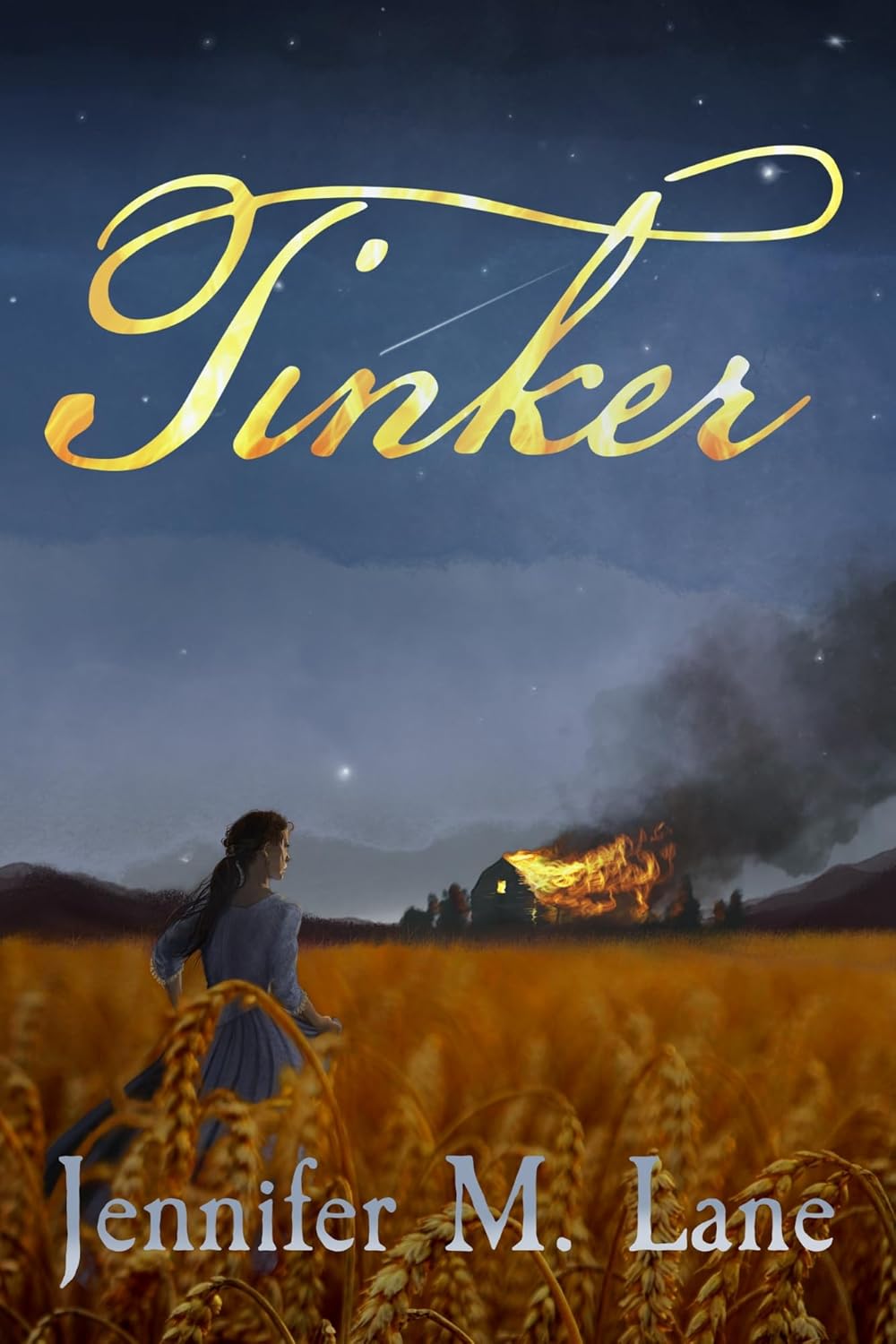
Jennifer M. Lane’s Tinker is a sharp and intimate historical novel set during the Whiskey Rebellion, told through Caroline Neville’s eyes, a woman caught between family loyalty, political unrest, and her own hunger to be heard. Caroline is the daughter of John Neville, whose role in collecting the whiskey tax has made the family name dangerous in western Pennsylvania. From the opening image of her father burned in effigy beneath a “Liberty and No Excise” ribbon, the book makes it clear that Caroline’s world is already on fire, even before she starts writing under the name Tom the Tinker.
What makes the novel work so well is Caroline’s voice. She’s funny, stubborn, observant, and often painfully aware of the ways men underestimate her. Her first battle over a bottle of ink with Tench Coyle is playful, but it also sets up the larger conflict of the book: ink matters because words matter. When Tench later says, “The written word stands as nothing more than a testament to its creation,” it feels like the book is telling us what it’s about.
The romance between Caroline and Tench gives the story warmth without pulling it away from the political stakes. Their connection grows through books, banter, shared ideals, and secrets that can’t stay hidden forever. Tench isn’t just a love interest, and Caroline isn’t simply choosing between love and family. She’s trying to decide what kind of person she’ll be when every side claims righteousness, and when silence might be safer than honesty.
I appreciated the way Lane makes the Whiskey Rebellion feel personal rather than like a history lesson. The tax, the writs, the smashed stills, the burned homes, and the fear spreading through the countryside all come through in lived-in details. Caroline’s position is especially compelling because she sees the farmers’ suffering, but she also understands the people within the Neville household. Her line, “I just wanted people to have some hope and stop feeling powerless,” captures the heart of her choices.
Tinker is a thoughtful and lively novel about voice, consequence, and the messy places where private lives meet public history. It has the sweep of historical fiction, but its best moments are often small ones: a horse betraying Caroline by liking Tench, Nonnie’s blunt wisdom, a family argument that finally cracks something open. The result is a historical fiction novel that feels grounded, romantic, tense, and deeply interested in how ordinary people try to do the right thing when the whole world around them is choosing sides.
Pages: 290 | ASIN : B0GP8XQ481
Exoskeleton

Exoskeleton is a military techno-thriller with strong sci-fi elements, and it reads like a prequel that’s eager to light the fuse. The story follows Alec Byrnes, a former Air Force special operations lieutenant who’s now a bitter paraplegic drinking himself into a corner, pushed hard by his powerful senator father to “play the cards” he’s been dealt. When a secret program offers him a shot at walking again through an experimental exoskeleton suit, Alec throws himself into the work, joins a tight, high-risk unit, and ends up in a widening conspiracy tied to LEGION and a ruthless inner-circle betrayal that turns the mission personal.
The book opens in an emotional place, with Alec’s anger and humiliation sitting right on the surface, and the writing leans into that heat. There’s a lot of close-in sensory detail, the kind that makes you feel the stale breath of last night’s booze and the claustrophobia of being “trapped inside” your own life. It’s not subtle, but it is effective. The author makes a clear choice to keep Alec prickly, sarcastic, and sometimes simply hard to like early on, and I appreciated that commitment. You don’t get a polished hero. You get a guy who’s bleeding on the page and daring you to look away.
Once the story pivots into the program itself, the book becomes more about systems and stakes. There are big chunks where the author explains how the suit works and why it fails, and it’s surprisingly readable because it’s framed as problem-solving and ego, not a lecture. And when the action comes, it does so with zeal. The Alaska sequence, the hostage trap, the close-quarters fight with Amy, it’s nasty and fast and has that cold feel of a nightmare you cannot wake up from. I also liked the underlying idea that “power” is never just hardware. The suit can make a body move, sure, but it doesn’t automatically fix the damage inside the person wearing it. The book keeps exploring that truth even while it’s throwing punches.
By the end, I felt like I’d finished the first part of a bigger story, not a neat standalone novel. The closing pages push the threat outward and set up the next stage of the conflict in a way that’s pretty blunt about what’s coming. I’d recommend this book to readers who like high-energy military thrillers, special-ops team dynamics, and near-future tech that feels just plausible enough to be unsettling. If you enjoy the Tom Clancy energy but you also want exosuits, AI, and conspiracy creep, this will hit the spot. For everyone else, especially fans of action-forward sci-fi thrillers that don’t pretend trauma is tidy, it’s a compelling ride.
Pages: 329 | ASIN : B0GFXXZW3G


