Author Interview – Kiril Kristoff – “Finding Your Roots”
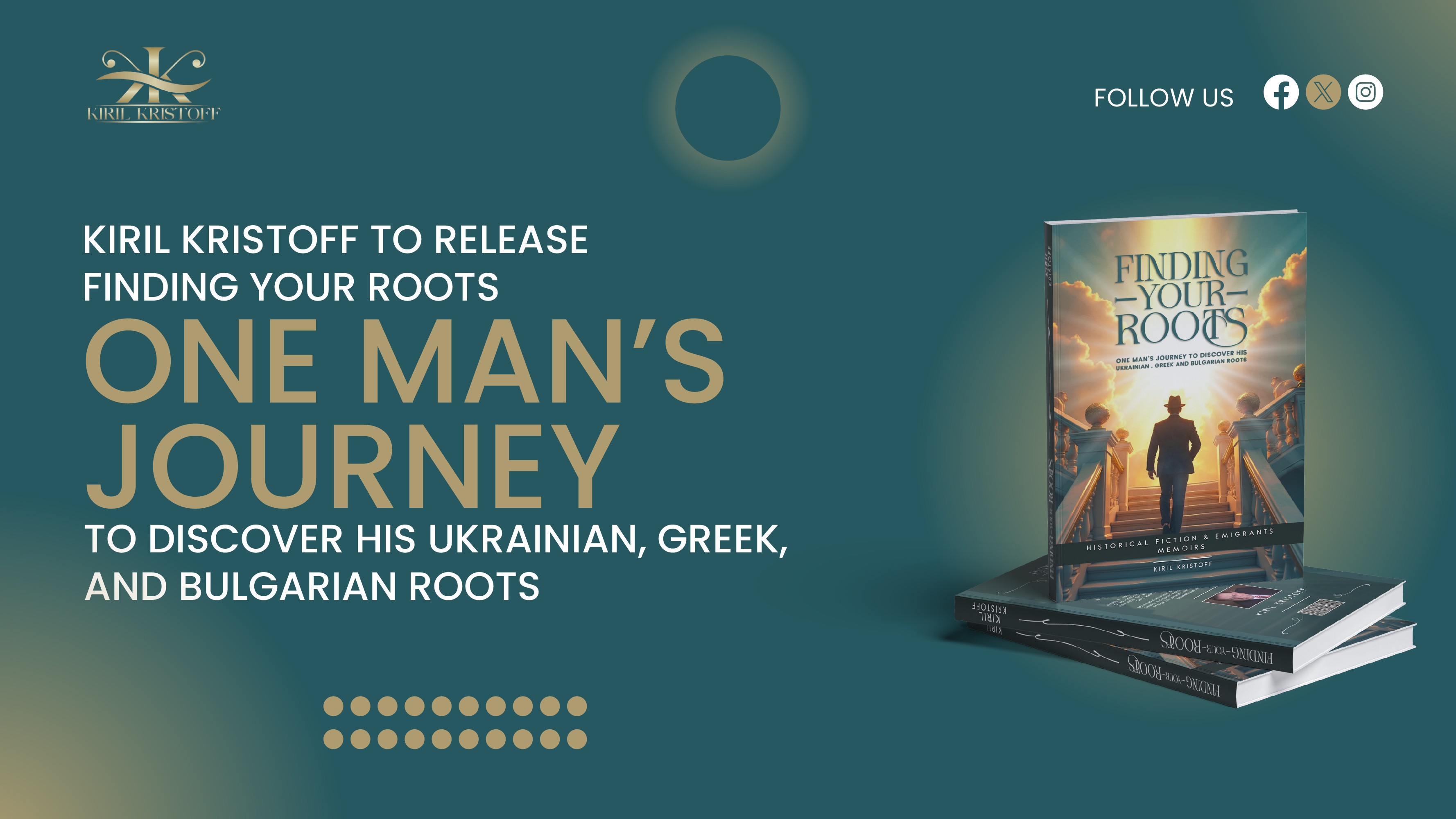
“Finding Your Roots” ‘One Man’s Journey to Discover His Ukrainian, Greek, and Bulgarian Roots’ follows an American man born into privilege who, after a near-fatal car accident, is transported back in time to 19th-century Tsarist Russia as a serf, where he faces the struggles and hardships that his ancestors once endured. What was the inspiration for the setup of your story?
The seed for this story came from a very simple but haunting question: What if we could truly step into the lives of our ancestors and feel what they felt? I’ve always been fascinated by the contrast between where we stand today and what those before us endured to get us here. For many of us, privilege, security, and opportunity are things we take for granted—but just a few generations back, the reality was far harsher.
I chose the device of a car accident and time travel because I wanted the contrast to be immediate and visceral. One moment, the protagonist is surrounded by the comforts of modern America; the next, he’s stripped of everything and forced to survive in a world where human dignity was often denied. It’s not just about history—it’s about empathy. By placing him in the shoes of a serf, I wanted to collapse the distance between past and present, so readers could feel that struggle as if it were their own.
Ultimately, the setup was inspired by my belief that our roots are never as far away as we think. The hardships of our ancestors still echo in us, and sometimes it takes a dramatic shift—whether in life or in literature—to remind us of that truth.
What inspired you to create Alexander Kakhovskiy, and how did you craft his outlook on life and the emotional changes he experiences?
Alexander Kakhovskiy was born into privilege—a spoiled child of the American Dream, raised in excess, never wanting. He was a prince of modern times, arrogant in his entitlement, untouched by struggle. He had it all— money, power, status—but no sense of who he was. Then, in a single night, everything was ripped away, and everything changed for Alex and Jennifer. After being drunk and high at a bar, a life-altering accident strikes him and his girlfriend, by another reckless driver. He falls to the ground, his body crushed beneath the weight of his choices. The next thing he knows—he is not in America anymore. He is no longer the wealthy, carefree boy of the 21st century, his family patron St. George sends them into a coma. Due to Saint George in Heaven, and his Grandpa George’s prayers on Earth, Alex survives, but remains immobilized in a Chicago hospital. But the accident triggers an otherworldly journey that defies time, faith, and even death. Alex and Jenniffer soon find themselves in the 19th-century Tsarist Russia, in the animal barn of his great-great-grandfather in his Kakhovka estate. It’s 1860, during the reign of Emperor Alexander II, the Liberator. There, the rebellious grandson meets his great-great grandfather, Alexander Kakhovskiy ( his namesake), a wealthy nobleman. Alex is not part of Kalhovskiy’s powerful family, but as a mere serf-a peasant bound to the land, a nobody, a slave in a world that does not know his name.
Then Alex begins to understand the true legacy of his ancestors. He is not just Alexander Kakhovskiy, the rich boy from America. He is part of a lineage that stretches across centuries—a bloodline shaped by war, ambition, loyalty, and betrayal. As he walks in the footsteps of his forefathers – Georgiy and Vasiliy Kakhovskiy-he sees the world through their eyes. One brother, Georgiy, stood for honor and tradition, remaining loyal to the empire that defined his people. The other, Vasiliy, was a radical, a Bolshevik, a man consumed by revolution and the birth of the USSR. Their choices shaped history. Their actions changed nations. And now, their story is his.
Now Alex must choose his destiny, whether he prefers the harsh cold of empires or the warm bonds of family. Discover faith, love, and redemption-and a battle between good and evil.
What were some themes that were important for you to explore in this book?
Several themes guided me as I wrote this story, but at the heart of it all was the question of identity—who we are when everything familiar is stripped away. I wanted to explore the fragile balance between privilege and survival, between the comforts of modern life and the raw struggles of those who came before us.
Heritage was another vital theme. By sending my protagonist back into the lives of his ancestors, I wanted to show that our roots are not abstract—they are lived realities that continue to shape us. The sacrifices, suffering, and resilience of those who endured oppression and hardship echo in us whether we acknowledge them or not.
I was also drawn to themes of empathy and transformation. Alexander’s journey is, in many ways, about learning to see the humanity in others and to measure worth not by wealth or status but by dignity, compassion, and endurance.
And finally, I wanted to explore time itself—how the past and present are never fully separate, how stories, memories, and even bloodlines carry forward across generations. By blending history with fiction, I hoped to show that while the settings may change, the human struggles of belonging, loss, and hope remain universal.
Where do you see your characters after the book ends?
For me, the ending of the book is not a closure but an opening. Alexander doesn’t return to his old life as the same man—he carries the imprint of what he has endured, and that awareness changes the way he looks at privilege, family, and responsibility. I imagine him moving through the modern world with a different kind of vision, one that allows him to see both the fragility and the strength of human existence.
The ancestors he encountered—those who shaped him in ways he could never have imagined—remain alive within him. Their voices may not guide his every step, but their lessons form a compass he will never be able to set aside.
In a broader sense, I see the characters continuing to live in the minds of readers. Their journeys don’t belong only to the page—they’re meant to spark reflection on our own roots, our own resilience, and the choices we make in light of those who came before us.
So while the written story ends, their inner lives keep unfolding—quietly, persistently—like heritage itself.

About the Author
Kiril Kristoff is an internationally recognized author whose works combine historical fiction, spirituality, and the immigrant experience. He is the recipient of the Literary Titan Gold Book Award, the International Impact Book Award (Author of the Year 2025) , Fiction & Historical Fiction), and accolades from Indies Today. His contributions to diaspora literature have been featured in The Philadelphia Journal.
📧 Email: kirilkristoff3@gmail.com
🌐 Website: booksbykirillristoff.com
Facebook: https://www.facebook.com/authorkirilkristoff/
Linkedin: https://www.linkedin.com/company/kiril-kristoff
Instagram: https://www.instagram.com/kirilofficial1/
Pinterest: https://www.pinterest.com/kirilkristoff/

Posted on October 4, 2025, in Interviews and tagged author, book, book recommendations, book review, Book Reviews, book shelf, bookblogger, books, books to read, ebook, Finding Your Roots, goodreads, indie author, kindle, Kiril Kristoff, kobo, literature, memoir, nonfiction, nook, novel, read, reader, reading, story, writer, writing. Bookmark the permalink. Leave a comment.


 LITERARY TITAN
Leave a comment
Comments 0