Becoming a Positive Outlier
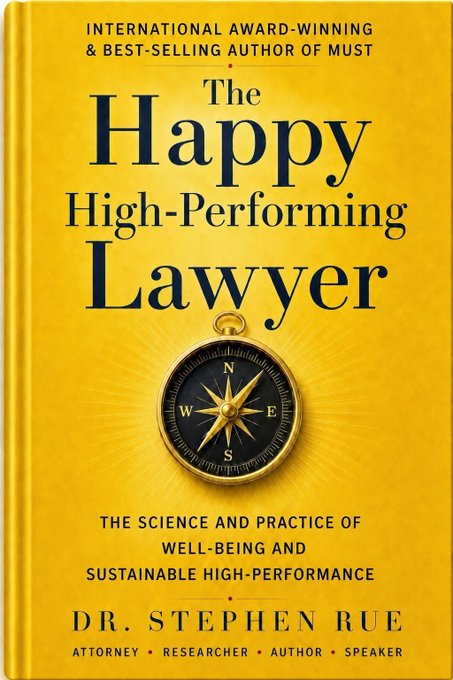
The Happy High-Performing Lawyer asks whether lawyers can do excellent, ethical work over a lifetime while protecting the health, relationships, and sense of meaning that make it possible. Why was this an important book for you to write?
I have practiced law for almost four decades, and over those years I became increasingly interested in a paradox within our profession. Lawyers can become extraordinarily successful by conventional measures—income, reputation, clients, verdicts, transactions, and leadership positions—and still discover that something important has been depleted along the way.
That became more than a professional observation for me. It became a research question. In my doctoral work, I studied lawyer well-being and performance, including the experiences of supervising and subordinate lawyers. I subsequently went much deeper into the research on positive psychology, flourishing, motivation, leadership, relationships, resilience, and sustainable human performance.
What emerged was the conviction behind this book: lawyer well-being and high performance should not be treated as competing objectives. The question is not simply how lawyers can feel better. It is how we can remain excellent at difficult work over decades without unnecessarily consuming the health, relationships, meaning, judgment, and human capacities that make sustained excellence possible.
I also wanted to write the book I wish lawyers received much earlier in their careers. Law school teaches us how to think like lawyers. It generally does not teach us how to build a sustainable life as one. We learn analysis, advocacy, issue spotting, and professional responsibility, but comparatively little about managing ambition, recovering from chronic stress, protecting relationships, leading other lawyers, understanding career fit, or deciding what “enough” means.
That is why I use the idea of becoming a Positive Outlier. I am not asking lawyers to become less ambitious. I am asking whether we can broaden our definition of success so that excellence includes not only what we accomplish, but the kind of people, professionals, leaders, spouses, parents, colleagues, and human beings we become while accomplishing it.
How can a lawyer tell when exhaustion calls for a personal change, and when a firm’s workload or incentives must change?
That distinction is essential because one of the mistakes we can make in discussions about lawyer well-being is locating every problem inside the individual lawyer.
Sometimes personal change really is necessary. A lawyer may be chronically sacrificing sleep, neglecting physical health, remaining electronically connected at all hours, abandoning relationships, failing to recover, or pursuing goals that are no longer aligned with his or her values. Those are areas where individual agency matters.
But telling someone to meditate, exercise, sleep more, or establish boundaries does very little if that person works within a system that makes those behaviors practically impossible.
So I encourage lawyers and leaders to ask a diagnostic question: Where is the recurring source of the problem?
If one lawyer consistently struggles across otherwise reasonable environments and demands, there may be personal habits, expectations, coping strategies, or career-fit questions worth examining. But when capable lawyers repeatedly encounter the same exhaustion, excessive workload, lack of control, unclear expectations, inadequate recognition, incivility, or conflict between professional demands and basic human needs, we should examine the system rather than continually trying to “fix” the individual.
The same applies to incentives. Organizations generally get more of what they measure and reward. If a firm publicly celebrates well-being while its compensation, promotion, staffing, or cultural systems reward chronic overwork, lawyers will respond to the actual incentives rather than the stated values.
Responsibility therefore exists at multiple levels. Lawyers have agency over many aspects of their lives, but leaders and organizations have greater control over working conditions. Sustainable high performance requires us to be honest about both.
You urge ambitious lawyers to define “enough”; what makes that threshold difficult to recognize in the course of a successful career?
Because success has a moving finish line.
Early in a career, “enough” might mean graduating, passing the bar, finding a good job, or earning enough to become financially secure. Then it becomes making partner, earning more, acquiring better clients, winning larger cases, receiving greater recognition, building a larger firm, or reaching the next professional milestone.
There is nothing inherently wrong with those ambitions. Accomplishment can be deeply satisfying. The problem arises when we assume that the next achievement will finally produce a lasting sense of arrival.
Human beings adapt remarkably quickly to improved circumstances. What once seemed extraordinary can become normal, and the reference point moves again. Lawyers are especially vulnerable to this because ours is a profession filled with measurable comparisons—compensation, billable hours, rankings, titles, clients, case results, partnership status, and professional recognition.
Defining “enough” therefore does not mean abandoning ambition. It means deciding what ambition is for.
A lawyer can continue growing, creating, leading, earning, and accomplishing after defining enough. The difference is that achievement becomes intentional rather than an endless attempt to reach a destination that continually recedes.
I encourage lawyers to ask broader questions: What kind of life am I trying to build? Which relationships must remain protected? What does financial security actually mean for me? How much time and health am I willing to exchange for additional achievement? What work remains meaningful? And if I reach the next goal, what do I expect it to give me that I do not have now?
Those questions do not diminish ambition. They can make ambition considerably more intelligent.
If a managing partner took your account of legacy seriously, what would change in how the firm develops younger lawyers?
The definition of legacy would expand.
A managing partner’s legacy is not simply the firm’s revenue, profitability, rankings, or client roster at the end of that person’s tenure. It also lives in the lawyers whose careers were shaped under that leadership.
That changes how we think about developing younger lawyers. They are not simply units of production or future revenue generators. They are developing professionals who need excellent training, meaningful feedback, increasing autonomy, appropriate challenge, mentoring, recognition, psychological safety to ask questions and learn from mistakes, and opportunities to understand not only how to practice law but how to build a sustainable professional life.
Accountability remains essential. Psychological safety does not mean lowering standards, and well-being does not mean avoiding difficult work. Younger lawyers need demanding assignments, candid feedback, and high expectations if they are going to become excellent lawyers. But challenge and development are not opposites.
A leader who thinks seriously about legacy asks different questions: Are the lawyers I supervise becoming more capable because of my leadership? Am I teaching judgment rather than merely correcting mistakes? Do people understand why their work matters? Can they raise concerns before small problems become serious ones? Am I creating future mentors and leaders, or simply producing exhausted high billers?
Eventually, every managing partner leaves. Revenue figures change, clients move, and institutional titles belong to someone else.
What can endure is the effect a leader had on other people. If younger lawyers eventually become excellent lawyers, ethical decision-makers, thoughtful supervisors, good mentors, and healthier leaders partly because of what they learned under us, that is a professional legacy worth leaving.

Posted on October 2, 2026, in Interviews and tagged author, book, book recommendations, book review, book reviews, book shelf, bookblogger, books, books to read, ebook, goodreads, indie author, kindle, kobo, literature, nonfiction, nook, novel, read, reader, reading, Stephen Rue, story, The Happy High-Performing Lawyer, writer, writing. Bookmark the permalink. Leave a comment.



Leave a comment
Comments 0