Blog Archives
The Surf Kidz Riding Waves
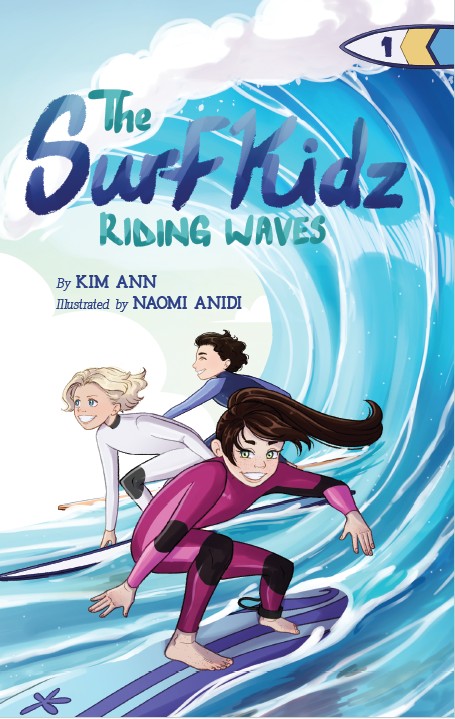

The Surf Kidz: Riding Waves, written by Kim Ann and illustrated by Naomi Anidi, is a lively, fast-moving, and emotionally resonant chapter book that immerses readers in a world shaped by salt air, rolling waves, and the intensity of childhood friendships. From the opening pages, the story carries readers straight into the ocean alongside Maya, Oliver, and Jack, better known as the Surf Kidz, three lifelong friends who have grown up on surfboards and in the water. Surfing defines who they are. Life, however, demands more than waves alone. School responsibilities, family pressure, and an escalating rivalry test their balance and resolve. When a high-stakes surfing competition is announced, the Surf Kidz finally have a chance to prove themselves, particularly against rivals determined to undermine them at every opportunity.
One of the book’s greatest strengths is its accessibility and relatability for its intended audience. The language feels natural and engaging, allowing young readers to connect easily with the characters and move through the story with confidence. Short, well-structured chapters maintain a strong sense of momentum, making the book especially welcoming for readers who are new to chapter books. Naomi Anidi’s illustrations appear throughout the text, adding visual energy and emotional depth. Surf sessions feel dynamic. School scenes feel familiar. Rival encounters carry real tension.
Beyond the action on the waves, the story thoughtfully explores challenges many children face in their own lives. Maya’s struggle to juggle academic expectations with her passion for surfing feels grounded and believable. Pressure comes from multiple directions, creating conflict without feeling exaggerated. At the heart of the story is the friendship between Maya, Oliver, and Jack. Their bond anchors every chapter. They study together. They train together. They support one another through disappointment and doubt. Time and again, they demonstrate what it means to stand united when confronted with rivalry or bullying. The message is clear and powerful: teamwork, loyalty, and encouragement matter, both in competition and beyond it.
The rivalry with the Wave Warriors adds excitement while never overpowering the book’s positive core. Conflict serves a purpose. It challenges the Surf Kidz to stay focused, confident, and compassionate, even when faced with negativity. The story builds steadily toward a thrilling conclusion and closes on a cliffhanger that leaves readers eager for more, inviting them to imagine what lies ahead as they await the next installment.
The Surf Kidz: Riding Waves encourages young readers to chase what they love, stand by their friends, and believe in their own abilities. It may even inspire them to try something new, whether that means catching a wave or finding the courage to ride through challenges of their own.
Pages: 52 | ISBN: 978-1-953774-56-9
There is Something Fishy About Ed. A Gentle introduction into mental health and eating disorders
This book is a heartfelt, poetic exploration of a family navigating the stormy waters of an eating disorder. Told through the eyes of two young fish siblings, it follows their journey as they learn about their mother’s struggle with “Ed” (short for eating disorder). The story gently unpacks complex emotions, fear, confusion, and love and highlights the importance of communication, support, and coping skills. With a mix of tender moments and childlike wonder, it presents a difficult subject in a way that feels safe and accessible for children.
Right from the beginning, the writing pulls you in with its simple yet evocative language. The author does an incredible job of using poetry to create a rhythm that mirrors the ups and downs of mental illness. At times, the verses feel light and playful, especially when the siblings count fish or share inside jokes but there’s an underlying weight that makes the story feel real. The metaphor of the ocean, the storm, and the lurking presence of “Ed” makes this a powerful and relatable read.
One of the most striking aspects of the book is how it doesn’t shy away from the raw emotions children might feel when a parent is struggling. The book captures that feeling of helplessness kids experience when they sense something is wrong but don’t quite understand it. At the same time, it reassures them that they’re not alone. The way the siblings support each other, like when one comforts the other with a quick fin hug, shows the power of small moments in making a big difference.
The ending takes an unexpected yet imaginative turn when the children transform from fish into humans, symbolizing growth and newfound understanding. It’s a creative touch that reinforces the idea that struggles don’t define a person they evolve, they change, they learn to cope. The final message, “Together we’ll rise! No storm will divide!” leaves readers with a sense of hope and resilience. And the fact that they still giggle about “Fred” (instead of “Ed”) makes it feel authentic because healing isn’t just serious work, it’s also about finding joy along the way.
There is Something Fishy About Ed? (A Gentle) Introduction to Mental Health and Eating Disorders would be a great fit for families wanting to introduce mental health discussions in a way that feels safe and engaging. It’s perfect for kids who might be dealing with similar challenges at home or anyone who wants a deeper understanding of how eating disorders affect not just individuals, but the people who love them. It’s emotional, beautifully written, and, most importantly, filled with hope. Whether you’re a parent, teacher, or therapist, this book is a conversation starter that will leave a lasting impact.
Misconceptions of an Introvert

Misconceptions of an Introvert follows Sherry, a quiet sixth-grader who loves her own space, only to find herself misunderstood by classmates and even her teacher. After a rough experience with a superlative assignment that leaves her hurt and confused, she gathers courage and explains what it really means to be an introvert. By the end, she teaches her whole class something important about personality, kindness, and listening.
Reading this children’s book hit me in a soft spot. I kept thinking wow, I have felt that exact sting before. The writing is simple and warm, which makes the hard moments land even harder. I could almost feel Sherry’s chest tighten every time she worried about group work. The scenes with the superlatives made my stomach drop. Kids can be so blunt, and the book does not hide from that. It shows how quick people can be to judge someone. I liked that the author took her time letting Sherry figure out what to do instead of giving her an instant fix. It made the whole thing feel real.
I also enjoyed the focus on self-advocacy. It felt good watching Sherry speak up for herself, even though she was scared out of her mind. The book has this gentle way of saying hey, quiet kids are thinking deeply, and yeah, they deserve space without being labeled as strange or rude. I found myself rooting for her, and cheering when her class actually listened. The explanation of introverts was kid-friendly, and it felt smart without trying to sound fancy.
The art style in the book feels clean and clear in that classic Pixar kind of way, with a mix of lifelike moments and more playful animated ones that blend together. Some scenes look almost real, while others lean into softer shapes and bright colors that feel light and fun. No matter the style shift, every character’s face carries a ton of emotion, which makes the story hit even harder.
I think Misconceptions of an Introvert is the perfect picture book for kids who feel misunderstood, teachers who want to support all personality types, and parents who want to help their children open up or feel seen. It is kind, heartfelt, and full of truth. I would happily recommend it to any classroom or home where a quieter kid might be waiting for someone to understand them.
Pages: 35 | ASIN : B0CFZC6VW8

The Tail That Told the Truth

Felix is a playful, cheerful fox who enjoys a largely carefree life in the forest. Yet one peculiar trait sets him apart from the other animals. Whenever Felix tells a lie, his tail changes color. Unsure how to handle this embarrassing problem, he attempts to hide his tail from those around him. Over time, however, Felix comes to an important realization. When he chooses honesty, no matter how uncomfortable the truth may be, his tail remains unchanged, and the problem disappears entirely. Though the choice is not always easy, he commits himself to telling the truth for the rest of his life.
The Tail That Told the Truth by Jory Perry is a children’s book aimed at readers roughly ages four to eight. It’s clear moral places it alongside classic instructional stories such as The Berenstain Bears, in which each installment focuses on a specific behavioral lesson. Some readers may also be reminded of Pinocchio, with its memorable consequence for dishonesty, though Perry’s approach is gentler and more age-appropriate.
Honesty can be challenging at any stage of life. For children especially, a small lie can feel like the easiest solution in the moment, even if it leads to bigger problems later. This book acknowledges that struggle and presents truth-telling as a skill worth practicing, rather than a rule enforced through fear.
Perry delivers this message with warmth and restraint. There is no real danger here beyond the sting of embarrassment, making the story well suited for younger audiences. The charming illustrations further enhance its appeal and are likely to encourage repeated readings, whether at bedtime or during quiet moments throughout the day.
While older readers will likely outgrow the book as they move on to more complex stories, The Tail That Told the Truth is an excellent choice for early readers and children beginning to navigate social situations. Its message is simple but enduring. Learning to tell the truth is a lifelong skill, and this story offers a graceful and engaging place to begin.
Pages: 32 | ASIN : B0G1SY5CCG
Yoey Does It Her Way

Yoey Does It Her Way follows Yoey through her everyday joys. The playground. The swings. Swimming and frozen yogurt. Picture books and music. Bedtime moments. This picture book shows a child who learns at her own pace and keeps going. Her family cheers her on. The story ends with a clear message. Yoey is more than her challenges, and she is proud of who she is.
The writing is simple and direct. That works well here because the book is for young children. I liked how the focus stays on what Yoey loves instead of what she struggles with. It keeps the tone positive. I love how it treats learning differences as one small piece of a whole kid. That line stuck with me. It feels kind and true. The pride from her brother and parents were emotional moments that young readers will be able to see through the emotive images. The ending note for adults adds depth and meaning.
The illustrations on each page are bright and colorful and full of life. Yoey appears in many different scenes, like the playground, the beach, and bedtime, and each one feels cheerful and warm. I loved how her smile, focus, and excitement change from page to page and help tell the story without many words.
I would recommend this children’s book to families with young children. Especially families who want stories about inclusion and kindness. It would be great for classrooms and therapy spaces, too. It feels best for early readers and read-aloud time. This book celebrates kids being themselves.
Pages: 30 | ASIN : B0G54CW1G6

Royce Saves The Day; A Magic Propeller Cap Book 1

Royce Saves the Day is a sweet and lively children’s book about a boy who finds a magical propeller cap that lets him and his little sister float out of their bodies and zip into all sorts of wild adventures. One minute, they are at home in Portland, and the next, they are helping an old woman find her lost cat, putting out a fire behind a hotel, or hanging out with Sasquatch families near their soon-to-be Habitat for Humanity house. The book hops from normal life to magic in a blink, and the whole thing feels warm and cozy and full of a big heart.
While I was reading it, I kept smiling because the writing feels soft and gentle, almost like someone telling a bedtime story. The moments with Royce and Yoey were very emotional. I loved how the author lets their bond guide every choice. The magic never feels scary, just surprising, and it works because the story keeps circling back to kindness and curiosity. I found myself really rooting for Royce, especially when he tries so hard to be brave for Yoey, even when he is obviously freaking out a little. That felt real and sweet.
The images were fun and humorous, just like the story. I also liked how much everyday stuff sits next to the big magic. Pancakes and pool days. Habitat for Humanity visits. Video games with friends. It makes the magical bits feel even brighter. The writing is simple but not boring, and some scenes pulled me in more than I expected. The fire scene caught me off guard and made my stomach twist for a second. The Sasquatch world made me laugh because it was just so cheerful and weird in the best way. A unicorn. Why not. It all felt like a kid dreaming with total freedom.
This children’s chapter book was a fun ride. I would definitely recommend it to young readers who like gentle adventures, kids who enjoy stories about siblings sticking together, or families looking for something light and magical to read out loud. It has the kind of charm that makes you want to grab a snack, curl up under a blanket, and drift along with Royce and Yoey as they float toward their next surprise.
Pages: 36 | ASIN : B0G6VPNWTH
My Dad Knows a Superhero

My Dad Knows a Superhero is a sweet little story about a boy named Westin who asks his dad if superheroes are real. Dad says yes, then slowly reveals that the hero he knows is actually Westin’s mom. Page by page, the book shows Mom using all sorts of playful “powers” like super strength, X-ray vision, emotional radar, time-bending, and more. By the end, Westin realizes she really does do everything a superhero would do, and he proudly hands her his cape.
I found myself smiling a lot while reading this. The writing is simple in a warm way that made me think of bedtime stories. It moves fast and stays light, which felt nice. I loved how the powers start out sounding like things a comic book hero would do. Then they slowly shift into everyday mom stuff that feels epic when you look at it through a kid’s eyes.
The idea behind the book hit me harder than I expected. It feels like a hug for moms. It also felt like a reminder for kids that heroics happen in tiny moments. The Emotional Radar bit got me. Mom kneels down to comfort her daughter, and it feels loving and patient. I liked that the book never tries too hard. It just shows these moments and lets you feel them. I kept thinking, this is exactly how kids see their parents when they slow down long enough to notice.
The illustrations use a vibrant and polished digital style. The artist employs soft shading and a bright, saturated color palette to create a welcoming atmosphere, drawing the eye immediately to the emotional interactions. The characters are particularly expressive as well.
I’d recommend this children’s book to young kids and to parents who want a sweet, quick read that sparks some warm feelings. It seems perfect for bedtime. It would also make a cute gift for a mom who needs a little cheer. The whole thing feels cozy and honest, and it made me want to call my own mom and thank her for all the powers she never bragged about.
Pages: 34 | ASIN : B0FVTFLNM6
How to Host a Unicorn: A Tale of Hospitality & Manners

Dag, the unicorn, is devoted to order. It shows in his neat attire. It shows in his measured speech. It defines his careful, structured view of the world. Nick, by contrast, is a bear powered by noise, disruption, and cheerful mayhem. Their friendship is unexpected from the start. When Nick invites Dag to visit, good intentions collide with very different ideas of fun. Nick tries hard to entertain and include his guest. The results are disastrous. Dag is stunned by Nick’s lifestyle and unsettled by the chaos surrounding him. The question at the heart of the story is simple and resonant: can two opposites find common ground and truly understand one another?
How to Host a Unicorn: A Tale of Hospitality and Manners, by Sara Causey, belongs to a thoughtful corner of illustrated children’s literature. It tells a charming story while also offering clear moral guidance. The book is especially well-suited to readers aged ten and up, inviting them to engage with its richer social moments and emotional depth in ways that older children are well-equipped to appreciate.
The illustrations carry much of the emotional weight. Dag’s expressions are especially effective, capturing his anxiety and confusion with precision and humor. The artwork also delivers several memorable set pieces, each escalating Nick’s attempts at hospitality. Every effort to improve the situation only compounds the disorder, pushing the narrative forward with visual energy and comedic tension.
Causey’s message is clear and handled with care. Not everyone experiences the same activities as enjoyable. That difference deserves respect. Dag and Nick represent contrasting personalities, neither wrong nor superior. Friendship, the book suggests, requires compromise and empathy. Shared experiences must feel safe and pleasant for everyone involved.
At its core, How to Host a Unicorn is a story about inclusion. It presents that idea in a way that feels accessible and sincere. It is also a lesson worth learning early. Taken to heart, it has the potential to shape kinder interactions well beyond the page.
Pages: 32 | ASIN : B0FXYGMZHX



 LITERARY TITAN