Blog Archives
Explore and Teach

Who Says Poo is a delightful and hilarious story that plays on words from different languages, each sounding like “poo” but with entirely distinct meanings. What was the inspiration for creating this unique story?
My partner was sitting on our couch in the living room using Duolingo to learn French. I was in the bedroom folding laundry. And then I heard her say “Poupée” and I giggled at how it sounded like “poo.” Then I instantly thought, ‘I wonder if there are words in other languages that also sound like poo!’ And that single moment sparked the creation of Who Says Poo!
The art in this book is fantastic. What was the art collaboration process like with the illustrator?
I wanted to make sure that the collaboration process was as seamless as possible. So I created a few PDFs that I sent to the artist. The first PDF was about character design, thoughts on color, and overall formatting. The other PDF was the full formatted layout of the book, and I included many reference images for each page, including detailed descriptions of exactly what I wanted in the illustration of each scene. But I also made sure to leave room for the artist to experiment, have fun, and add their own twists to each image.
My artist, Mark Nino Balita, did such a great job of making the art come alive! They were easy to talk with, and a joy to collaborate with. Mark would send me proofs, and if I had any notes, I’d send them their way. Mark nailed it! I had very few notes. Mark even added a few spins on the book that I had never even thought of doing. Mark’s hard work and expertise shine on every page.
What scene in the book did you have the most fun writing?
I made so many wonderful memories while writing Who Says Poo. But the scene I had the most fun writing would be on page 24, the Japanese sound, あっぷっぷ (“A-Poo-Poo”). It was the most challenging to write. Unlike the other words that have a perfect literal translation, this does not. It’s like a colloquialism, mixed with an onomatopoeia. So to try to craft the right definition for it, and use it in a sentence created such a wonderfully fun challenge, and when I look back through the book, it makes me so proud that I nailed it.
Is this the first book in the series? If so, when is the next book coming out, and what can your fans expect in the next story?
I never expected to actually write one children’s book, much less a series! For now this is just a single book. But if reception is good, I do have a few great ideas to turn this into a series of books where I might explore the onomatopoeia of different languages compared to English. There are some fun sounds out there to explore and teach. Other languages and cultures teach us so much about the world, and I think it’s a beautiful thing to start getting your child curious at a young age!
Author Links: GoodReads | Amazon
With a pet dog and a pet chicken, there are no normal days for Sally and her family. As they go about their wacky day, you learn words in different languages that all sound like the English word, Poo!
Through these pages, your child will learn words in other languages in a fun and silly way that helps to foster an enthusiasm for foreign languages and cultures.
Ideal for children ages 3-8 who think the word “Poo” is funny! Not only will this book help them steer away from Poo being “poo”, but it will show them that other languages are fun!
This Book:
• Helps kids talk about poo differently!
• Encourages language learning
• Shows that learning new languages can be fun
• Suitable for all readers and dyslexic-friendly!
Who Says Poo
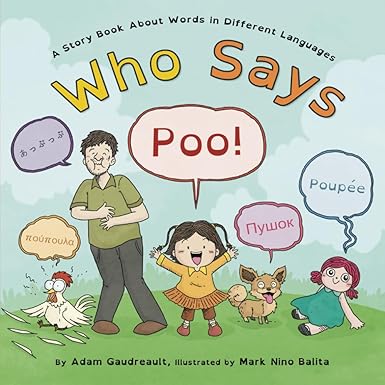

Who Says Poo is a delightful and hilarious story that’s sure to capture the attention of younger readers. Adam Gaudreault brings a truly original narrative that plays on words from different languages, each sounding like “poo,” but with entirely distinct meanings. On each page, Gaudreault introduces these words, guiding readers through their pronunciation and then cleverly incorporating them into simple sentences. Through this engaging approach, the story of Sally—a cheerful girl searching for her doll before heading outside to play with her dog—unfolds, while introducing children to new languages and cultures in a fun and approachable way.
What makes Who Says Poo stand out is its inventive combination of humor and learning. I particularly admire how Gaudreault seamlessly weaves foreign words from places like Greece, Japan, and France into the narrative, making them feel familiar and accessible. This clever strategy not only sparks children’s curiosity about language but also encourages them to think critically, making connections as they follow along. The repetition of new words serves as a gentle memory exercise, while the storyline itself is playful and relatable. Sally’s simple adventures—searching for her doll and playing with her dog—are presented in a humorous, light-hearted way that resonates with young readers.
The book’s format is another highlight. Each new word is bolded, followed by its pronunciation in parentheses and a brief definition that explains its origin, all wrapped up in a short sentence that moves Sally’s story forward. This layout is both engaging and easy to follow, providing structure while keeping the story lively. Visually, the illustrations are colorful and vibrant, adding to the humor with characters pulling funny faces, especially in the scenes that involve mentions of farts and poop. Though these topics can be tricky to handle, they’re presented in a way that’s playful and child-appropriate, sparking laughter rather than discomfort. The only minor downside is the use of white backgrounds on the text pages. While there are small illustrative details scattered throughout, colored backgrounds could have made the pages more visually dynamic. That said, the overall design is still very appealing, especially with the foreign words written in their original alphabets, giving young readers a glimpse of different scripts and writing systems.
In the end, Who Says Poo offers more than just entertainment. It’s a short, simple story packed with value, introducing children to new languages, promoting critical thinking, and making the learning process enjoyable. For parents and educators alike, this book is a charming and effective tool to engage young readers while teaching them something new.
Pages: 35 | ASIN : B0DCQ5MR7W




 LITERARY TITAN