Blog Archives
The Doctor’s Future


Dr. Pietro Garbelli’s The Doctor’s Future is a deep dive into the fast-approaching world of AI and robotics in medicine. The book blends practical guidance, cautionary tales, and a rallying cry for doctors to take charge of the transformation ahead. Garbelli covers everything from the current state of AI adoption in healthcare to predictions of where technology could lead us, both in best-case and worst-case scenarios. He introduces the “Healthcare Convergence Framework” as a blueprint for ensuring AI serves the profession without eroding its core values of empathy, ethics, and patient-centered care. Along the way, he doesn’t shy away from discussing threats, like loss of professional autonomy or the risk of over-reliance on black-box algorithms, and he offers concrete strategies to navigate them.
Garbelli’s writing is straightforward, peppered with vivid metaphors, and there’s a clear emotional undercurrent. He’s worried about what’s coming, but he’s also hopeful. I appreciated his honesty about the profession’s blind spots, such as resistance to change and discomfort with having decisions second-guessed by machines. Some parts hit hard, especially his reflections on burnout and the fragile trust between doctors and patients. It’s not just theory; he folds in surveys, examples from different specialties, and even patient reactions to AI, which makes the book feel grounded and real.
I found myself alternately nodding along and pausing to think. The “doomsday” scenarios were unsettling, yet they didn’t feel like fear-mongering. Instead, they made the stakes clear. Garbelli’s insistence that doctors must lead, rather than follow, in this transformation stuck with me. He clearly loves medicine and wants to protect it, and that passion comes through in every chapter. There’s also an undercurrent of empowerment here: he’s not telling us to survive the AI revolution, but to shape it. That’s a refreshing change from the usual doom-and-gloom takes.
The Doctor’s Future is more than a technology primer. It’s a call to action for medical professionals, policy makers, and even patients who care about the integrity of healthcare. I’d recommend it to any doctor who’s curious, worried, or skeptical about AI, as well as to healthcare leaders responsible for steering their organizations into the next era. It’s also valuable for medical students because the sooner they understand what’s ahead, the better prepared they’ll be. If you want a book that challenges you to think critically while giving you practical tools to safeguard your profession, this one’s worth your time.
Pages: 252 | ASIN : B0FGCNY5HH

The Warrior’s Garden: Tools for Guarding Your Mind Against Big Tech


The Warrior’s Garden is a gripping and clear-eyed look at the dark side of Big Tech and its impact on our mental health, attention, and autonomy. Richard Ryan, a seasoned tech entrepreneur and media strategist, peels back the curtain on how platforms like YouTube, Facebook, and Google manipulate human behavior through targeted content, algorithms, and psychological tactics borrowed from the gambling industry. The book unfolds in two parts: “Input,” which outlines the problem and the ways tech hijacks our brains, and “Output,” which offers practical steps to reclaim control, from detoxing to building community and cultivating gratitude. Ryan also shares his personal journey, admitting how he, too, was caught in the dopamine-fueled race for views and likes, making the book feel authentic.
Ryan’s writing isn’t flowery or academic, and that’s exactly what makes it powerful. It’s blunt. Honest. Sometimes, even funny. There’s a mix of tech-savvy insight and heartfelt reflection, which makes for a ride that’s as relatable as it is eye-opening. I felt anger, shame, and even sadness at some points, especially when he described how our time and attention are commodified without our full consent. But I also felt hope. Ryan doesn’t wag his finger or tell us to throw our phones into a river. Instead, he gives tools—real, practical ones. His “Thirty-Day Challenge” isn’t gimmicky. It’s grounding. I tried a few of the exercises and, surprisingly, they helped.
What really stuck with me, though, was his personal story. Ryan was once a full-blown player in the system, pulling the very strings he’s now warning us about. That inside perspective gives him a rare credibility. He’s not preaching from a mountaintop. He’s been in the trenches—addicted to the metrics, chasing the next viral video, watching relationships wilt in the glow of a screen. That’s what makes this book more than a critique. It’s a confession. A redemption arc. And it’s written in a way that feels like a conversation with a smart, slightly battle-worn friend who genuinely wants to help you get your life back.
The Warrior’s Garden is for anyone feeling overwhelmed, burned out, or just a little uneasy about how much time they’re spending on their phone. If you’ve ever caught yourself doomscrolling or felt your mood tank after too much time online, this book is your wake-up call. It’s not for tech haters or off-the-grid purists. It’s for regular folks who want their time, focus, and peace of mind back.
Pages: 227 | ASIN : B0F4LWGPXB

Enterprise GENERATIVE AI Well Architected Framework & Patterns: An Architect’s Real-life Guide to Adopting Generative AI in Enterprises at Scale
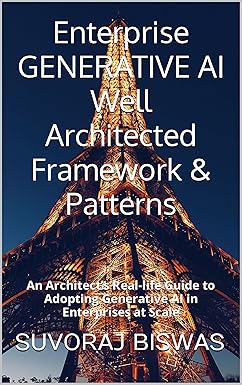

Enterprise GENERATIVE AI Well Architected Framework & Patterns by Suvoraj Biswas presents a pragmatic and insightful exploration of generative artificial intelligence (AI) in enterprise settings. Drawing from his extensive experience as a Solutions Architect, Biswas skillfully outlines various frameworks and approaches that will greatly benefit IT professionals. The book introduces the necessity of a well-architected framework for GenAI in enterprise applications, covering topics like Large Language Models, content moderation, observability solutions, and cost optimization practices.
Biswas’s work is notable for its clarity and practicality, particularly in how it makes complex concepts accessible. One of the book’s strengths is its use of real-world examples, such as the development of a QnA chatbot for legal teams, which effectively illustrates the cost-effectiveness of the RAG pattern in handling organization-specific, dynamic data. The book is well-structured, featuring reader-friendly content augmented by illustrative pictures and clear segmentations. It’s a valuable resource not just for its theoretical insights but also for its practical applications. Readers looking to implement these lessons will find the discussions on open-source tools and offerings from leading software providers like LangKit and Langfuse particularly useful. Additionally, the inclusion of actual code and screenshots of OpenAI prompts is a commendable aspect that enhances the book’s utility.
Enterprise GENERATIVE AI Well Architected Framework & Patterns stands out as a comprehensive resource for understanding and applying sophisticated technological strategies in the realm of AI. It’s an essential read for AI professionals and enterprise leaders seeking to deepen their knowledge of Generative AI or explore its various organizational benefits. This book is particularly timely, offering valuable guidance for maintaining competitiveness in the rapidly evolving AI landscape.
Pages: 117 | ASIN : B0CJ6J4F75



