Blog Archives
Phil Was the Real Deal

That Man in the Gold Lamé Suit delves into the complex life and career of Phil Ochs, exploring his steadfast dedication to music and his unwillingness to conform to popular trends. Why was it important for you to tell his story?
There were several reasons why I felt Phil’s story had to be revisited.
First, one of the courses I used to teach was “Music & Politics.” Phil’s name & music kept popping up as I looked for materials for this class. As I looked at this material and became familiar with his music, politics, and who Phil was as a person, I had the epiphany that Phil Ochs was the person that everybody believed Bob Dylan was in the 1960s. Phil was the real deal–a committed topical songwriter and political activist, neither of which Dylan ever was.
Second, Phil’s story often gets told with too much emphasis placed on his alleged bipolarism, his alcoholism, and his suicide. They became the centrality of how his story was told rather than be presented and understood as simply parts of a very complex artist who struggled with a sense of who he was. These three circumstances in Phil’s life allowed people to glaze over that his very search for self was essential to understanding who he was, how Phil saw himself, and how that search was central to both his artistic creativity & his politics.
Third, I met his older sister, Sonny Ochs who is a force of nature in her own right and a champion in keeping her brother’s music alive and being played at the grassroots level. After my first meeting with Sonny, I knew I had to write about Phil.
Phil Ochs was an influential musician in his time. What were some goals you set for yourself as a writer in this book?
One of the goals I’ve already mentioned in response to the last question, and that was to address the imbalance in how Phil’s life story is usually told.
Beyond and above that is that I set for myself the goal of telling Phil’s story through his eyes and to present it as much as possible as he would if he was still here. That is why I employed the theory and method of Self Psychology in writing this book. By relying as much as possible Phil’s own words, he was then able to reveal to me what his search for self entailed; the triggers for this search; for what voids he was trying to compensate in this search; how his search manifested in his music, politics, and relationships to others; and how it ultimately led to his suicide.
Did you find anything in your research of this book that surprised you or a story that stood out and left an impression?
It’s not too far from the truth to say just about everything stood out and left an impression. Phil was not an easy person for me to get to know. There were times when I would pour over his words for hours only to have it take days for him to reveal what it was that he wanted me to know and write. However, one of the biggest things that stood out was how much his desire to be a hero and to see heroism in others defined his search for self, his music, and his politics. Phil desperately wanted to be like his heroes of the Silver Screen such as John Wayne. He embraced people based upon their perceived heroism. That’s why he could idolize both John Kennedy and Che Guevera. His own politics was defined by heroism. For instance he saw America in heroic terms. His opposition to the Vietnam War wasn’t an opposition to war per se, but to an unheroic war that wasn’t worthy of his heroic America. I could go on and on but I won’t.
Also what also stood out to me was just how much Phil needed and craved affirmation from others. He simply wasn’t secure enough in his self to see how talented he was and how worthwhile his own life was. This need and craving were scars left from early childhood trauma of parents unable to respond with the affection & affirmation their young son needed. That need & craving for affirmation drove Phil as much as did his desire to be a hero. Frankly, they are interconnected. That comes through throughout the various chapters in the book.
What is the next book that you are working on and when will that be published?
Hmmm—this book on Phil took 6 1/2 years of my life so I’m not certain if I have another one in me at the time being. Phil was a calling, a type of destiny, and I haven’t felt a similar calling yet. But never say never. I’ve got a couple of possible subjects if that call ever comes in. One would be a book on Kris Kristofferson. Another would be a book on Michael Nesmith.
In the short term, I’m focusing on music. I’ve got a new band called Calico Bunny, and I am trying to get back into songwriting again. For the curious, I have 3 CDs of original music on Spotify, Apple Music, and the other streaming services. Their titles are “Tequila Lips,” “No Apology,” and “Seeking Calm Waters.”
Author Links: GoodReads | Website
That Man in the Gold Lamé Suit explores who Phil Ochs was as he saw and understood himself to be; how he wanted to see himself; and how he wanted to be seen by others. In presenting this exploration of Phil Ochs, author Jim Bowers delves deep into Ochs’s personality to craft a narrative that allows the singer/songwriter to tell his own story rather than the story others would impose upon him. In letting Ochs tell his own story, Bowers in That Man in the Gold Lamé Suit provides the reader with insights into how Phil Ochs’s search for self came to define who Ochs really was and how it, in turn, shaped his music, his politics, and his relationships with such contemporaries as Bob Dylan.
That Man in the Gold Lame’ Suit: Phil Ochs’s Search for Self
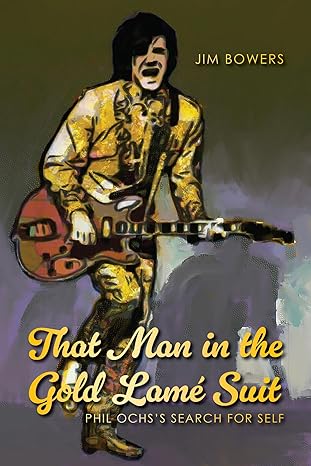

That Man in the Gold Lamé Suit by Jim Bowers delves into the complex life and career of Phil Ochs, exploring his steadfast dedication to music and his unwillingness to conform to popular trends. Bowers presents Ochs as a musician with a clear vision, unyielding in his artistic integrity. The book intertwines Ochs’ musical journey with his political views, shedding light on his perspectives on notable figures such as Mao Zedong and John F. Kennedy. It also highlights his admiration for icons like Elvis Presley and Bob Dylan.
The narrative begins with Ochs’ early influences, chronicling his struggles with addiction, turbulent relationships, and the challenges he faced with his fan base. Bowers meticulously portrays Ochs’ life, connecting his emotional experiences to his lyrics and providing readers with a deep understanding of the stories behind his songs. For instance, the song “First Snow” is illustrated to depict Ochs’ acceptance of his role in a romantic breakup, adding depth to his musical expressions. Several features make this book particularly engaging and informative. Each chapter opens with a quote that sets the tone, and a comprehensive reference section at the end offers additional resources for further exploration. Bowers effectively weaves together opinions from various individuals, Ochs’ own words, and insightful analyses, creating a rich tapestry of historical, political, and cultural contexts. Reading Bowers’ detailed account of Ochs’ life feels like a personal journey, fostering empathy for his struggles with depression and alcoholism. Despite these challenges, Ochs emerges as an admirable figure, passionate about his art and committed to authenticity. This book serves as a poignant tribute to Ochs’ legacy, emphasizing the importance of artistic integrity and balance in life, free from the pressures of public approval.
That Man in the Gold Lamé Suit stands as a comprehensive, creative, and enduring homage to Phil Ochs, offering valuable lessons for musicians and artists worldwide. It is a must-read for anyone seeking to understand the heart and soul of a true artist who remained unwavering in his commitment to his craft.
Pages: 360 | ASIN : B0CLKYF15N




 LITERARY TITAN