Blog Archives
The Economic Impact of a Pandemic

The Fed and The Flu: Parsing Pandemic Economic Shocks explores how pandemics have shaped economic history by illuminating the complex interplay between health crises and economic structures, giving readers a panoramic view of pandemics’ far-reaching effects. What inspired you to write this book?
David Kotok:
My curiosity about epidemics, pandemics and plagues originated when I was in the US Army as a second lieutenant in 1966. My first assigned unit was a very specialized organizational structure that dealt with preventive medicine for the entire 7th army in Europe. Our regional focus was Europe, Africa, and the Middle East (EMEA). I recall the readiness preparation when the 1967 Middle East War broke out in the Middle East. We went on alert status in Germany with orders to be ready to deploy on four hours’ notice. We loaded live ammunition and slept in fatigues with our vehicles ready to roll on any notice. Fortunately, we didn’t have to deploy. That mission focus was preventive medicine against known pathogens in the Middle East. On other occasions, readiness was tested in other parts of the world and against other pathogens. I have been intrigued with the impacts of disease on geopolitics and economics ever since.
In June of 2020, a paper about the medium-term economic impacts of pandemics, published at the San Francisco Fed, caught my attention. The authors’ findings inspired me to pursue a study of pandemic economic shocks through history and to consider the Fed’s response to the COVID pandemic economic shock. An undertaking this big was best accomplished with a team approach, and Elizabeth, Tristan, and Mike came aboard to help.
What were some key ideas that were important for you to share in this book?
David Kotok:
Human beings repeat mistakes throughout history. The book demonstrates that characteristic of human behavior in governance, economics, preventive medicine, disinformation, and the disruption that follows epidemics, pandemics, and plagues because they are unique types of shocks. The book and the research our team did shows that we haven’t learned much from the 4000 years of confirmed history discussed in the book. We’re still a flawed species when it comes to dealing with pathogens.
Mike Englund:
The U.S. economy was severely impacted at the start of the pandemic by both fear of the disease itself and by the initial policy response by state and local officials of mandated lockdowns. Politicians at the national level prompted an opposite upside policy jolt via the CARES Act that took effect soon after the collapse in most economic gauges. Macroeconomic forecasts diverged sharply at the time, as there was little precedent for either of these two massive disruptions to the economy.
Economists invented new terminology for the shape of this new type of bust-boom business cycle, be it an “L” shaped cycle with a big bust and small boom, a “K” shaped cycle where parts of the economy rebound sharply after collapse but other parts do not, and a “V” shaped cycle where the economy turns off then on like a light bulb. The macro data exhibited properties of all these dynamics, as some urban areas downsized and never fully recovered, and some industries recovered more sharply than others. Mostly, however, the recovered proved “V” shaped, as broad measures of economic activity quickly resumed the secular pre-pandemic growth path.
Tristan Erwin:
A key takeaway, historically, is that a pandemic is the ultimate bringer of chaos, causing both economic and societal upheaval and breakdown. Whether we are talking about humans in 430 BC or the modern human in 2020, the basic human reactions to pandemics remain.
Elizabeth Sweet:
My key takeaways are that humanity has real choices now that it did not have before, thanks to medical science; and these can make a tremendous difference to the outcomes of pandemics. Effective public health mitigations paired with economic interventions can reduce the magnitude of a pandemic shock, even though they cannot prevent the shock or the “pandemic economic hangover” altogether. Some approaches to recovery, too, helped to regenerate economies over shorter or longer periods.
Did you find anything in your research of this story that surprised you?
David Kotok:
Yes. I didn’t expect to see linkages to climate change in the way they were revealed. The Justinian Plague is a great example. The volcanic eruptions triggered a cooling of 2 degrees which allowed the flea to flourish and become the vector for a disease that killed almost half the population of the Roman Empire. Climate effects and how they interact with pathogens is more vivid for me after this book research journey. Today we confront global warming instead of cooling. Coincidentally the 2-degree threshold is at work although it is warming, not cooling. And the mosquito has replaced the flea as the vector. Witness the growing number of malaria cases in the United States. Something new for Americans to confront.
Mike Englund:
The shift in public perceptions, the surge in political polarization, and the divergent regional responses to the virus were arguably the most surprising, and this was evident in the macroeconomic data. The political polarization was probably responsible for the additional and excessively large stimulus packages in late-2020 and early-2021 that added aggregate demand to an economy that was already overheating, as partisan’s adopted divergent interpretations of reported macro data. The resulting inflation surge extended through the period covered in the research, and we have yet to see if the ultimate implications of these policy responses.
Tristan Erwin:
We found that human indulgence in quackery and attraction to “false prophets” dates to the very beginning. When we looked at how ancient people reacted to pandemics and then how our society reacted to the COVID pandemic, it turns out that the technological and medical superiority of modern medicine didn’t shield us from our own tendencies. Ancient people pleaded for a cure with no answer. In the COVID pandemic, medical science mustered vaccines and treatments that reduced severe illness and deaths. Yet, a substantial portion of the population rejected them, preferring bizarre or unproven “cures” and conspiracy theories over working together to end the pandemic. The ancients never had that choice.
Elizabeth Sweet:
Though the same things that surprised David, Mike, and Tristan surprised me, too, I’ll add something different. I was surprised at the resourceful strategies Athens used after the Plague of Athens, the Peloponnesian War, and the overthrow of the Thirty Tyrants, to create an economy that did not rely on tribute anymore, as it had before, but on trade. Since adult male Athenian citizens were in much shorter supply after the plague and the war, Athenian society became more open to outsiders than it had been before, in order to power the city-state’s recovery.
What is one thing that you hope readers take away from The Fed and The Flu?
David Kotok:
I hope readers get inspired and appreciate the lessons of history and absorb them for societal benefit. Unfortunately, the record of history as a teacher is poor if the history has time gaps between events. Churchill warned us. When he said, “Study history, study history.” Maybe this book can add to that discussion for some folks who find it arousing of their curiosity. I hope so.
Mike Englund:
A pandemic was seen by many as a “black swan” event that couldn’t have been foreseen, yet the book documents the regularity of pandemics through human history and the various similarities of human and policy responses to them. Of course, the timing of the 2020 pandemic was unknown, but society was largely unprepared for this eventuality, and the public and policy response was more arbitrary and counter-productive than it had to be. Debates over the policy response should have been more open and transparent, and politicians should have been more focused on finding common ground to keep the policy response less partisan. A broader understanding by the public regarding the various issues associated with pandemics would have also been useful, and perhaps the material in this book can play a role in this regard.
Tristan Erwin:
I hope that readers see how far we’ve come, and how far we have to go.
Elizabeth Sweet:
I hope that readers come to see the meaningful roles that human behavior, science, and policy have to play in determining pandemic outcomes, economic and otherwise.
Author Links: Website | BlueSky | LinkIn | X | Facebook | YouTube
Covid Wars: America’s Struggle Over Public Health and Personal Freedom


COVID WARS is a sweeping, deeply researched chronicle of the COVID-19 pandemic in the United States, weaving together science, politics, and personal freedoms. Ronald Gruner, with the precision of a historian and the curiosity of a citizen, takes us from the roots of virology in the 19th century all the way to the chaotic years of 2020–2022. The book doesn’t just tell the story of a virus—it lays bare the cultural and political divide that shaped America’s uneven and often painful response.
I was surprised at how readable this book was, given the mountain of data it packs. Gruner’s writing is crisp, and he breaks down complex topics without dumbing them down. I really enjoyed his opening chapters—“Contagium” and “The Warning”—which build a compelling backstory on pandemics past, from the 1918 Spanish Flu to the eerie predictions of the Bush and Obama administrations. I didn’t expect to be pulled in by 19th-century plant viruses, but Gruner somehow made that story feel urgent and important. His calm but clear-eyed tone gave me confidence in what he was saying, even when it felt frustrating to relive just how preventable some of this was.
The book isn’t shy about calling out failures. Politicians, conspiracy theorists, media figures, and even some public health leaders get held accountable. The chapter “The Divide” lays it all out—how the pandemic morphed from a health emergency into a political food fight. Gruner points fingers but backs it all up with evidence, charts, and historical comparisons. His takedown of the 2019 Global Health Security Index was a real eye-opener: America was ranked the best-prepared country in the world, yet we fumbled the ball harder than most. I felt both informed and a little angry reading that section.
What I appreciated most, though, was Gruner’s balance. He’s clearly frustrated with misinformation and poor leadership, but he doesn’t come across as bitter or one-sided. The chapter “Lockdowns” captures this tone perfectly. He acknowledges the economic devastation and emotional toll, especially on kids and small business owners, while also recognizing that something had to be done.
If you’re curious about what really happened, how we got here, and how it could’ve been different—this is worth your time. I’d recommend COVID WARS to history buffs, policy nerds, teachers, and frankly anyone who wants to understand how a virus exposed the fractures in American society. It’s not just a book about a pandemic. It’s a mirror, and what it reflects is both sobering and necessary.
Pages: 394 | ASIN : B0DXR5FL7K

The Fed and The Flu
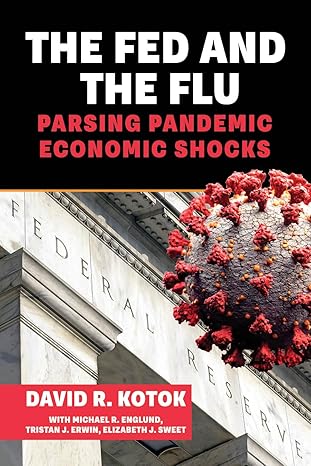
The Fed and The Flu: Parsing Pandemic Economic Shocks delves into how pandemics have shaped economic history. Written by David Kotok and co-authored with Michael R. Englund, Tristan J. Erwin, and Elizabeth J. Sweet, the book traverses millennia—from ancient plagues to the COVID-19 pandemic—to dissect how disease reshapes labor markets, governance, and financial systems. Through detailed case studies and insightful analysis, the authors illuminate the complex interplay between health crises and economic structures, giving readers a panoramic view of pandemics’ far-reaching effects. With its data-rich examination of historical and modern events, the book balances academic rigor with a sense of urgency about the lessons history imparts.
What stood out to me was the sheer depth of historical context. The section on ancient and medieval plagues, such as the epidemics in the Kingdom of Mari and the Black Death, goes beyond recounting events. It illustrates how societies grappled with the economic aftershocks—whether through wealth transfers due to high mortality or shifts in labor markets from population losses. I particularly appreciated the vivid recounting of the Mari epidemic, where Zimri-Lim’s precautions against infection eerily mirrored modern social distancing measures. The authors make ancient history feel unexpectedly relevant. Yet, I found myself wishing for a bit more narrative energy here. Some chapters leaned heavily on details that might deter readers seeking a more engaging storytelling style.
The exploration of the Federal Reserve’s role during pandemics, especially in the COVID-19 era, was a standout section for me. The discussion of the Fed’s emergency lending programs and balance sheet expansion offered valuable insights into how monetary policy adapted to unprecedented challenges. The analysis of how the Fed’s response differed from its approach during earlier crises, like the 1918 influenza pandemic, was compelling. For example, Table 12.1, which catalogs COVID-era emergency lending programs, was both enlightening and alarming in showing the scale of intervention required. As someone interested in finance, I found this part very interesting—it’s clear the authors know their economics.
One of the most striking and thought-provoking sections was the discussion of long-term societal changes induced by pandemics. The authors’ argument that pandemics drive innovation and erode trust in institutions was very interesting. Chapter 16’s focus on the pernicious effects of disinformation during crises was a timely reminder of the power of communication in shaping outcomes. The analysis of long COVID’s economic implications—with estimates of disability affecting millions—was sobering. The chapter drew a clear connection between health and productivity, emphasizing the enduring scars pandemics leave on the labor force. This mix of personal health and economic analysis made me think about the fragility of interconnected systems.
The Fed and the Flu is a treasure trove for anyone interested in the crossroads of finance, history, and public health. The meticulous research and comprehensive coverage make it ideal for readers with a strong interest in economics or infectious diseases. Readers willing to engage with the material will come away enlightened and, frankly, a little unsettled. This book is a wake-up call for policymakers, economists, and curious minds alike.
Pages: 552 | ASIN : B0DCK1ZHJT



 LITERARY TITAN