Blog Archives
Gratitude to My Teachers

In Figure Drawing: Rhythm and Language of the Human Form, you provide anecdotes, technical instruction, and the fundamentals involved in figure drawing. Why was this an important book for you to write?
Drawing the figure has been a transformative activity and experience in my life. Although I drew other things and forms as a child, almost forty years ago, figure drawing sessions sparked my interest and passion for drawing live models. I loved the challenge of capturing the human form from many possible angles and vantage points, with different lighting, and so on. Then, more recently, I realized that hundreds of drawing hours and the resulting drawings represent my learnings, technical and otherwise, and the inspiration of this art form imbued in me. The book originates in gratitude to my teachers and is a personal legacy. Anecdotes, drawing fundamentals, and technical drawing aspects meld in it for that reason. I hope the book inspires those desiring to draw the figure to follow their dreams.
What inspired you to combine storytelling and exposition within your book?
The technical aspects of drawing the figure can be dry. Some might even consider them boring. There is a lot to pay attention to and much to know and to practice. By weaving in storytelling, I aim to ease the technical aspects, considerations, and instructions of life drawing. The book considers master draftsmen and -women as a way for readers to dig deeper and find their own starting points.
What is one thing you hope readers take away from your experience?
The experience I’d love for readers to take away from my experience is how transformative, beautiful, fun, and fulfilling drawing the human figure can be.
What will Volume 2 offer readers? When can we expect to see it released?
Volume 2 offers an expanded Settings and Materials section and other resources. The book focuses on drawing exercises that provide instruction about fundamental and basic drawing exercises and exercises specific to figure drawing. The drawing exercises are both timed and untimed, depending on how users wish to apply them. Drawing anything can be a joyous, yet time-consuming activity. Many readers may have busy schedules, so the book provides them options for short or long drawing spurts.
This volume is an accompaniment to Volume 1 and comes out at the same time: on December 20th, 2024.
I’v included links for the Workbook (Volume 2) as well.
Author Links: GoodReads | Website | Volume 1 Draft2Digital | Volume 2 Draft2Digital | Volume 1 Kobo | Volume 2 Kobo | Amazon
The body is a dance, and what it shows for those willing and trained to see are internal and external factors: structure, rhythm, motion, emotion, and more.
Whether you are a novice, intermediate or advanced artist, this book covers a range of figure drawing topics to learn and improve your skills to capture the human form.
Learn to draw the figure with ease
Master the basics and improve your skills
Enhance your understanding of the human form and anatomy
Capture the essence of movement and emotion in your drawings
Avoid common mistakes and perfect your technique
Gain insight from the author’s extensive figure drawing experience
Access helpful resources and references
And much more…
Figure Drawing: Rhythm and Language of the Human Form, Volume 1
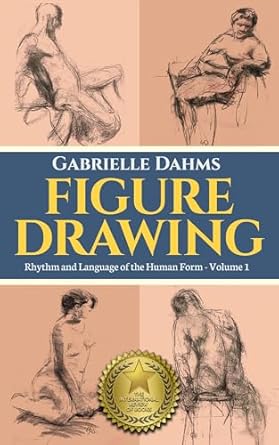

Gabrielle Dahms’ Figure Drawing: Rhythm and Language of the Human Form is an insightful guide for aspiring and seasoned artists alike, diving deeply into the intricate art of capturing the human figure. The book weaves together technical instruction, personal anecdotes, and artistic philosophy, emphasizing both the fundamentals and the expressive possibilities of figure drawing. From understanding proportions and anatomy to mastering gesture and rhythm, Dahms frames drawing as a discipline that blends observation, skill, and creativity.
The author’s writing is earnest and passionate, often reflective. I appreciated how she shared her own struggles as a novice artist, particularly her initial impatience and desire for praise. This vulnerability makes the book relatable, transforming it from a mere instructional manual into a personal narrative about artistic growth. Her storytelling, such as returning repeatedly to a Rembrandt painting over decades, adds a poignant layer to the technical advice. Dahms excels in breaking down complex concepts into approachable lessons. The section on foreshortening is particularly helpful, guiding readers through the challenges of perspective with practical steps and vivid descriptions. Her advice to “abstract forms into geometric shapes” before layering detail is a game-changer for simplifying seemingly daunting tasks.
What truly stood out to me was her emphasis on the emotional and spiritual aspects of drawing. Her perspective that figure drawing is “observation in action” and a “meditation about life” resonates deeply. In discussing live versus photo-based drawing, she beautifully argues that “anything alive has something messy about it,” celebrating the imperfection and energy that live models bring to art. This poetic view of artmaking injects inspiration into the otherwise technical material.
Figure Drawing: Rhythm and Language of the Human Form, by Gabrielle Dahms, is a rich, thought-provoking guide for artists who crave both practical techniques and a deeper connection to their craft. I’d recommend it to art students eager to learn the nuances of drawing or experienced artists looking to refine their skills and philosophies. This book isn’t just a tutorial; it’s a call to see the world and oneself through the eyes of an artist.
Pages: 112 | ASIN : B0DNNR8GB4




 LITERARY TITAN