Blog Archives
Math is NOT Dry and Boring

What is the Shape of My Ears? follows a miniature horse and a miniature donkey as they discuss how the shape of their ears and find similar shapes around their farm home. What was the inspiration for your story?
What a great question!
In other words, why Pearl? Why Duke? Truth be told, I have a host of critters to choose from!
I knew prior to writing the storyline, it would be a challenge to explain the meaning of triangle, starting with the term angle.
With this in mind, I needed a character who is clever, someone who could “think outside the box” to break down the meaning of triangle then apply it in ways that make sense to early math learners.
Pearl—hands down—landed the part!
Duke, her faithful sidekick, may not be the perfect student, but he’s willing to follow Pearl’s lead.
Minus grazing!
Your stories focus on math concepts, a subject that not all children are excited about. What is about math that excites you and makes you want to write books for children on this subject?
Safe to say, I understand why many people across age groups find math to be dry, boring, and often question its relevance. However, I truly enjoyed math stemming back to my elementary years, and I enjoyed teaching it. I tutored starting in high school well into my first year of college. However, across domains, geometry was the one area that I did not enjoy. Oddly enough, this became a focus in my research program as a graduate student—not geometry per se but (in part) the challenges that US students often face in learning geometric concepts from an early age. As a new venture in my academic career, I decided to shift gears so to speak and apply what I learned in my research (and the work of others). As is the case with many children’s books on mathematical learning, the goal is to engage children: give them reason to believe that math can be fun, and how it is so much a part of our everyday lives. In the words of Silkie and Pearl, you just need “to look closely.”
The art in this book is fantastic and draws the readers in, making the math concepts less intimidating. What was the art collaboration process like with the illustrator Gabriela Vega?
Unlike writing an article for an academic journal, there are many challenges to writing a children’s book, particularly for a debut, self-publishing author. The learning curve is nothing short of steep! That said, I credit Gabriela for our accomplishments with the series—What Is the Shape of My Egg? 15 honorable mentions and awards to date!
She is incredibly talented in addition to her outstanding work ethic and willingness to take on challenges.
Do you have more adventures and learning experiences planned for the Farm Friends? If so, what can young readers look forward to in the future?
We do! What Is the Shape of My House? is set to be published for 2025. This final book of the Shape Friends series focuses on squares and rectangles. Fern, a Nigerian dwarf goat, is the main character. I will be posting updates on my website by year end. A supplemental activity book that will feature all of the characters in the series is a possibility as well.
Author Links: Website
A horse’s ears?
A cat’s ears?
If you’re thinking triangle, that’s correct!
BUT … there are all sorts of triangles.
Triangles can be long, short, skinny, fat—even stubby!
In What Is the Shape of My Ears?, the second title in the Shape Stories with Farm Friends series, children are introduced to the properties of triangles. The storyline stars Pearl (a clever miniature donkey) and her sidekick Duke (a humble miniature horse) who questions why ears―whether long or short―can still be the same shape. Together, the “Minis” explore the basic elements of triangles and learn that when you look closely, you find triangular shapes are EVERYWHERE!
What is the Shape of My Ears?
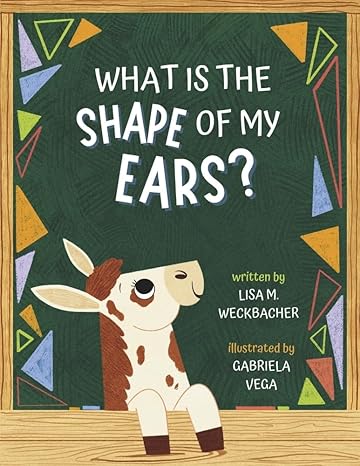

Learning to recognize triangles is a crucial milestone in children’s development, enhancing spatial perception and introducing fundamental mathematical concepts. Lisa M. Weckbacher’s What is the Shape of My Ears? addresses this beautifully through the engaging story of Pearl the miniature donkey and Duke the miniature horse. Over breakfast, these farm friends discuss their responsibilities in keeping the farm safe by listening for predators, a task at which Pearl excels. Duke believes Pearl’s success is due to the shape of her ears, prompting a conversation about the differences in their ear shapes and leading to an exploration of triangles, their angles, and their identification in the environment.
Weckbacher’s storytelling provides an excellent framework for explaining geometric concepts. Her clear and engaging narrative is complemented by charming illustrations that reinforce the roles of lines and points, making the learning process enjoyable. Set on a picturesque farm with a variety of animals, the story remains captivating through the characters’ humorous observations and their learning journey.
The friendly interaction between Pearl and Duke, marked by mutual respect and eagerness to learn, sets a positive example for young readers. The book also includes additional sections for parents and teachers, offering tips on explaining different types of triangles and distinguishing between triangles and pyramids, making it a comprehensive educational resource. One notable aspect is the introduction of new vocabulary, which may be challenging for some children. However, these terms are well-explained and visually represented, aiding understanding. Weckbacher’s meticulous attention to detail enriches readers with insights into spatial thinking and the significance of ear positions in donkeys. This thoughtful approach makes What is the Shape of My Ears? an ideal book for fostering a love for both reading and mathematics.
What is the Shape of My Ears?, by Lisa M. Weckbacher, is a delightful and educational story that will captivate young readers. Its blend of engaging narrative, charming illustrations, and clear explanations makes it an excellent resource for parents and educators. This book is perfect for children who are beginning to explore geometric concepts and for anyone looking to instill a love of learning and curiosity about the world around them.
Pages: 36 | ASIN : B0D4HLM54V




 LITERARY TITAN