Blog Archives
The Costs of Technology

The Jovian Madrigals follows four characters promised immortality on Jupiter’s moon Callisto, only to discover that the utopian dream sold by an authoritarian global power comes with sinister costs. What was the inspiration for the setup of your story?
I worked in the tech industry for several years, and continue to work on the edges of it. The narrative of “tech will save us” or of each development being a step forward has dominated much of my professional career outside writing. This experience has also made me very aware of the costs of technology at every level, and what the end user sacrifices in exchange for that technology. I see the nanobots and the concept of Callisto as an extension of that tech-as-saviour myth, and as an extension of what we’re already giving up in the name of convenience. Setting it in a future dystopia let me extend the ideas and crises we’re already seeing into a world that could be. I got to play with possibility, and enjoyed it every step of the way.
The concept of immortality intertwined with nanotechnology raises fascinating ethical questions. What drew you to explore this theme, and did any real-world scientific advancements shape your approach?
One question I kept asking myself while writing “The Jovian Madrigals” was whether I would ever enter the Lottery. While the Lottery itself is a distant, fantasy idea, the more general idea of technological immortality is becoming more and more of a reality. Technology like Neuralink, our vast digital footprints, and the rapid modernisation of medicine and artificial body parts are blending the distinction between humans and machines in ways that will define what it means to be human. We’re each making decisions about how much of this “technological immortality” we want to engage with, even as the ability to choose diminishes more and more. Much of what I explore throughout the Jovian Symphony explores that question of what humanity means when there is no true death. For the Callistans, the definition of humanity may have been narrowed to exclude them, and they’re left to deal with the consequences of that new reality.
Did any particular historical or contemporary political events influence the creation of this dystopian society?
While it plays a quiet, background role in “The Jovian Madrigals,” much of the world of 2193 is shaped by the realities of climate change and the influence of capitalism on humanity’s response to the climate crisis. Many of the chapter introductions throughout the book reference war and destruction; I imagined these being the direct result of resource shortages and climate-driven conflicts. The world of 2193 is a dystopian one, but closer to a post-dystopia than the true dystopia of its past, at least depending on who you ask. I suspect Padraig and Cassandra would have very different answers to the question of whether theirs is a dystopian world.
What is the next book that you are working on, and when will it be available?
The sequel to “The Jovian Madrigals” is currently in the final stages of editing. “Dream Sweet in a Minor Sea” will be available in late March/early April of 2025, and I’m excited to share it with everyone! I am also currently working on the third book of the series – tentatively called “A Blue Moon Waltz” – which will be available in October 2025. Keep an eye on my socials for more news on exact dates and where you can pick them up!
Author Links: GoodReads | Twitter | Blusky | Facebook | TikTok | Instagram | Website | Book Review
It’s 2193, almost a century since scientists on Callisto discovered immortality. Every year, the Party sends a group of Earth’s best and brightest to receive this immortality. No one ever comes back.
Four people are making the journey to Callisto to receive immortality. Padraig, a brilliant physicist, dying of cancer. Cassandra, an orphan from the irradiated ruins of New York. Jocasta, a veteran of the Yugoslav Wars. Gautier, whose presence on Callisto no one will adequately explain. Immortality is meant to change them for the better. But once they’re on Callisto, what happens when they just want to go home?
The Jovian Madrigals
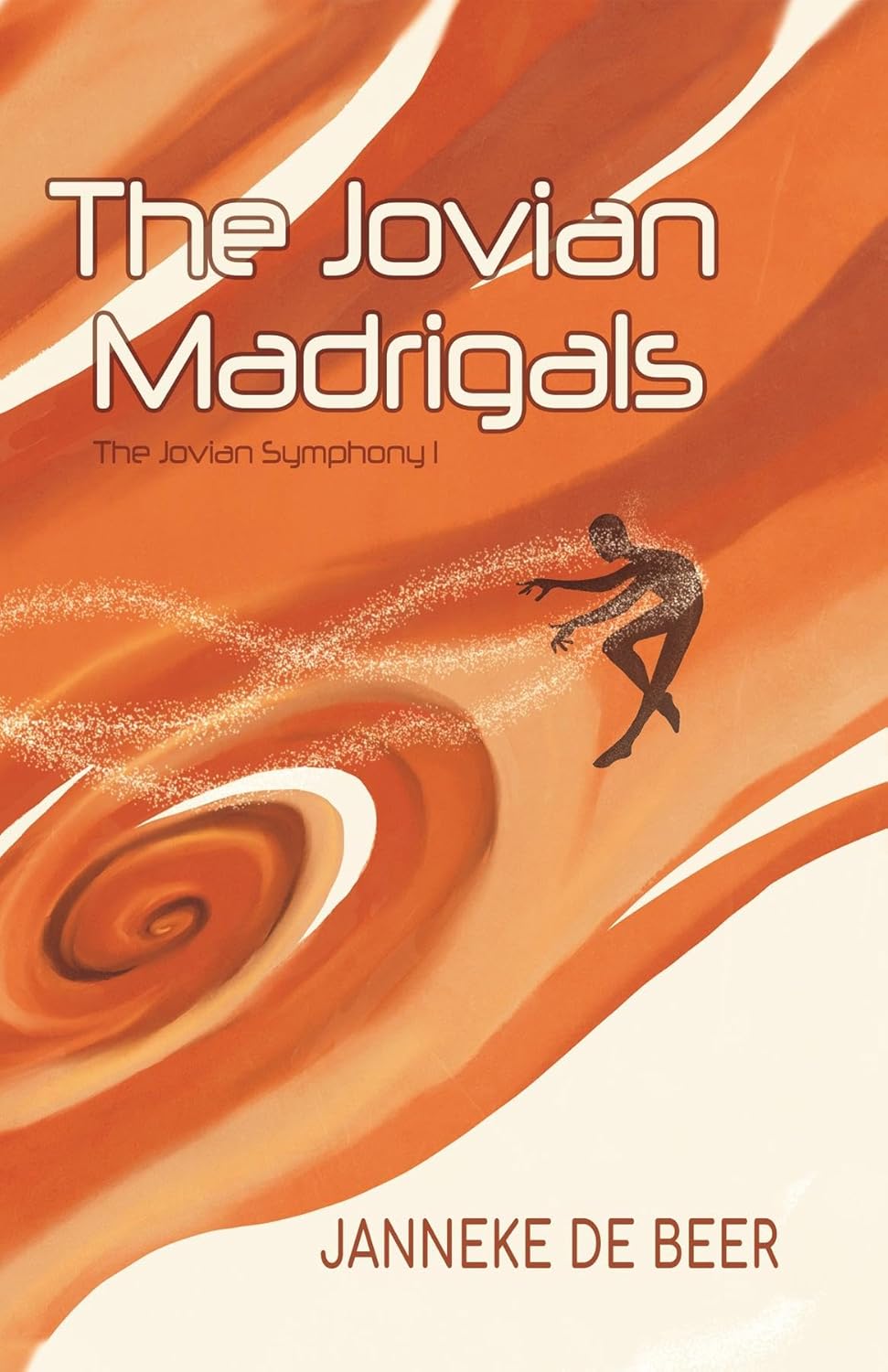

The Jovian Madrigals marks a bold and refreshing debut for Janneke de Beer, who delivers a science fiction tale rich with intrigue and thematic depth. Set in the year 2193, the novel explores the ever-fascinating concept of immortality intertwined with advanced technology, but with a modern, thought-provoking twist. The story revolves around four distinct characters selected to journey to Callisto, a constructed utopia on one of Jupiter’s moons, promising them eternal life. A dream sold by the ever-looming “Party,” an authoritarian global power shrouded in secrecy and ulterior motives. Too good to be true? Absolutely. As de Beer skillfully unravels the plot, the Party’s promise of immortality through nanotechnology reveals itself to be laced with hidden costs and dangerous stipulations. Nothing comes without strings, especially when the pursuit is something as fantastical as eternal life.
One of the most impressive feats of this novel is its intricate structure, modeled after a musical madrigal. As a musician herself, de Beer uses this to create a narrative symphony with four intertwining voices that harmonize yet remain uniquely individual. Each character’s perspective adds rich layers to the story, and despite the challenge of juggling multiple leads, de Beer succeeds in making every one of them feel fully developed and distinct. The characters pulse with complexity, their journeys woven together in a seamless yet emotionally resonant tapestry.
World-building stands out as a true highlight. De Beer’s vision of the future under the sinister rule of the Party is disturbingly vivid and textured. A dystopian society coated in false respectability breathes life into the narrative, creating a perpetual sense of unease. Historical documents and fictional excerpts cleverly peppered throughout the novel lend authenticity, skillfully avoiding monotonous exposition. These elements enrich the story and raise thoughtful questions about the ethics of technological advancements in the grip of authoritarian rule.
De Beer keeps readers engaged by shifting perspectives, maintaining a sense of momentum and freshness. However, I felt there were moments when the pacing slowed, particularly when the story delved deeply into character psyches or the world’s intricate details. The narrative’s complexity may also be a double-edged sword. While often an exhilarating read, it can become overwhelming, with certain storylines, like Cassandra’s, feeling particularly hard to follow. Some plot threads remain unresolved, which might leave readers craving more closure, but this could bode well for anticipated sequels.
The Jovian Madrigals is an impressive and captivating science fiction story. Janneke de Beer has successfully combined character-driven drama with high-concept ideas, crafting a world that feels both authentic and mesmerizing. Her debut novel promises a thrilling exploration of humanity’s reach for immortality and the shadowy costs that come with it. This is a world worth revisiting, and I, for one, eagerly await what she has in store next.
Pages: 471 | ASIN: B0DCDNM91W




 LITERARY TITAN