Blog Archives
Such Myths Should Not Be Dismissed

The Great Flood in Legend, Science, and History explores one of the world’s most enduring legends, the Great Flood, and examines geological evidence alongside stories from Mesopotamia, the Bible, Greece, and Native American legends. Why was this an important book for you to write?
This was an important book to write because research into other topics indicated that a major event involving extraordinary flooding definitely occurred about 5,000 years ago, which is about the time that Noah’s Flood is considered to have happened. The evidence used is almost entirely geological and archaeological and comes from orthodox academia.
What were some ideas that were important for you to share in this book?
Important ideas to share are that myth and legend might indeed be based on real events and such myths should not be dismissed as based solely on the imaginations of our forebears. This book shows that a flood such as Noah’s did occur and was caused by the close approach and pass-by of a cosmic body such as a comet.
Did you find anything in your research on this topic that surprised you?
Probably the most surprising thing was the abundance of scientific evidence testifying to a great flood as having occurred in the deep past.
The Legend of Atlantis & The Science of Geology is a fascinating series that sheds new light on geological events. What can readers expect to learn about in Volume IV of the series?
Volume IV of the series for the most part addresses the archaeology of the Mediterranean region, from Greece to the Levant and around to Egypt, where the evidence is analyzed and compared with the standard mainstream interpretation. This region is home to a considerable number of archeological puzzles that are difficult or impossible to explain via standard doctrine. The book also examines the surface geology of Egypt and North Africa and finishes up with an exploration of the enigmatic buildings on the Maltese Islands.
Author Links: GoodReads | Amazon
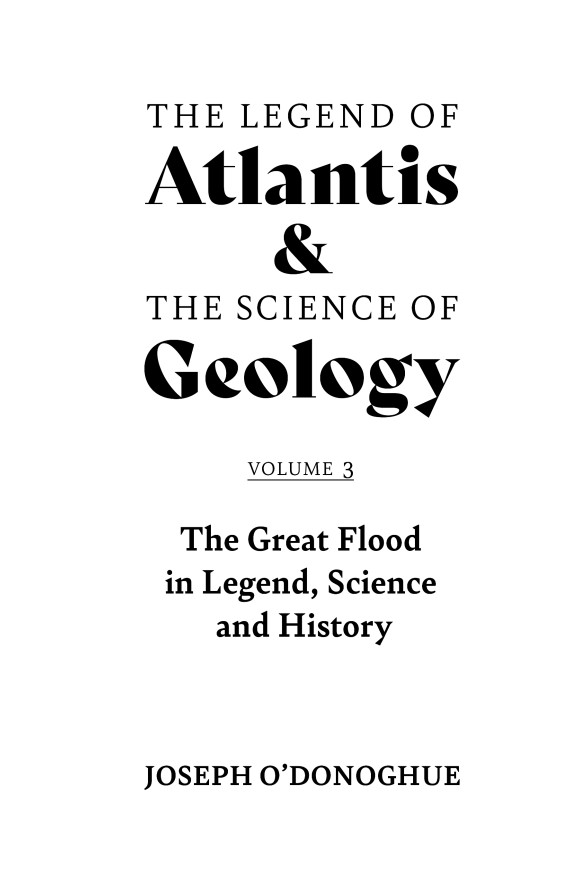
This book takes a very different approach to the Great Flood, and floods in general, as compared to academic geology or archaeology. As before, the book deals with the legend of a great flood in a serious, open-minded, and scientific way, in an effort to determine whether there is something behind these flood legends, or if, indeed, they can be dismissed as easily as orthodoxy claims.
The Great Flood legend, and many others are first discussed, including those of the Makah and Klallam we examined in volume 1. The book then deals with how geomythologists treat the Great Flood legend. Unsurprisingly, modern geology gives these legends no credence whatever, and explains the Flood in the usual fashion of a mere local flood exaggerated into a great global disaster. That or a bolide impact causing a tsunami or a sill-overtopping flood into the Black Sea.
Considering the parallels between the Great Flood legend and those of the Makah and Klallam, a comparison seems compulsory, and, as we recall, the nature of the Native American flood descriptions suggested a cosmic body as being the most likely cause, which cause might possibly be the same for the Great Flood in Mesopotamia.
The first part of the book, therefore, examines the Flood from the point of view of legend and makes a case for why the legend cannot be so easily dismissed.
Building on that conclusion, the second part of the book addresses the Great Flood, and major floods in general, from an entirely scientific viewpoint. We begin with the early days of modern science in the sixteenth century and the first efforts to explain the Flood scientifically. Two scientists, Edmond Halley and William Whiston suggested a cometary cause, the reason being that there appears to be nothing on or within the earth that could cause such a flood as described in the Bible.
As the natural sciences developed during the eighteenth century, much of the evidence seen all over Europe was interpreted as due to large-scale flooding, and the term “diluvialism” came into use. While it was initially thought that the flooding in question was due to Noah’s Flood, by the end of the century it was generally held that the evidence implied that a much different and far more powerful flood was involved.
By the early nineteenth century, Noah’s Flood had been abandoned as the cause of the evidence by the majority of geologists and a much more dynamic flood was envisioned. Again, a comet was proposed as the cause and diluvialism remained a general belief until Charles Lyell published his books in the early 1830s, promoting uniformitarianism, which denied the reality of major flooding as ever having occurred.
Since Lyell was inspired by the theories of James Hutton, who advocated an infinitely old earth with geological change happening too slowly to be observed, we take a close look at Hutton’s famous Siccar Point unconformity. Contrary to Hutton’s conclusions, this book finds that Siccar Point represents a catastrophic event and not a long slow sequence of gradual change.
An examination of two long-recognized outburst floods due to natural dam failures follows and both are, in fact, found to be misinterpretations of the evidence by the geologists involved.
The book then moves to the realm of archaeology and we begin with Leonard Woolley and the evidence of a major flood in the valley of Mesopotamia. Woolley found exceedingly thick layers of sediment at the site of Ur of the Chaldees, and other such layers were found at many other sites. While the evidence was “explained away” as a number of individual floods, a close study finds that they are all synchronous and due to one flood, the Great Flood of legend.
Further, a cuneiform tablet shows a comet in the sky at 3123 BCE, close to the estimated date of the Flood from other evidence. Hence, this book proposes that the Great Flood occurred in 3123 BCE.




 LITERARY TITAN