Blog Archives
Parental Love and Support

Orphans of the Living tells the story of a family’s complicated history spanning from 1920s Mississippi through decades of poverty and social change. What inspired you to write this novel?
The novel is based on my mother’s own family, of which I knew little. But things in the past have a habit of invading us today, and the more I researched, the more I realized my mother’s lived experiences influenced my life, and my children’s lives, in ways I had not understood. Yes, this is a novel, but the skeleton, the bones of the story, are real. It is a hell of a story, and I wanted to dig deeper into it.
Can you share with us a little about the research that went into putting this book together?
I really had three sources. Here’s how they came into play, for instance, in my grandfather’s sojourn in Mexico. I had the bits and pieces my mother gave to me in her life, between bouts of addiction and mental illness, such as “My father went to Mexico to grow bananas.” I explored the vast trove of information and connection at Ancestry.com and Newspapers.com, such as records of my grandfather’s trip to San Francisco, where he took a steamer to Mexico, and a manifest for a ship that brought him and his bananas to Galveston. And the third piece was how I followed what I learned from Ancestry.com and Newspapers.com. For example, I spent a lot of time learning how bananas were grown and raised in the tropics, and how United Fruit, then one of the largest corporations in the world — owned by men from the American South — employed Jim Crow tactics to control their labor force in Central and South America. Weaving all these sources together was an act of imagination and conjecture, and that’s why it’s a novel, not non-fiction.
What were some themes that were important for you to explore in this book?
So much about this era, and these people felt so current to me: the multi-generational impact of poverty, racism, inequality, sexism; the experiences of people who were at the margins, lacking education, perhaps confused about their gender or sexual orientation, long before there was any general knowledge of these issues; the impact of Western expansion and “manifest destiny” on how average Americans in the west thought about land and success; the importance of parental love and support.
What is the next book that you are working on, and when will it be available?
I have completed a memoir that is in many ways a sequel to Orphans of the Living. She Writes Press will publish it in spring 2027. And I’m way deep into writing a third book, another novel, a near-future political thriller.
Author Links: GoodReads | Threads | Instagram | Facebook | Website | Amazon
In the shadow of the Great Depression and Jim Crow south of the 1930s, an impoverished white family escapes—with the help of Black sharecroppers—from a vengeful Mississippi plantation overseer intent on lynching them. Arriving in California to start a new life, Barney and Lula Stovall are haunted by the past, the children they’ve left behind, and the daughter they cannot love or protect.
Orphans of the Living follows the peripatetic life of the Stovall family, woven from four parallel stories: Barney and Lula Stovall, and two of their nine children, Glen and Nora Mae.
Their California sojourn—from their hardscrabble dairy farm, to the brig at the San Francisco Presidio, to the building of the Golden Gate Bridge—lead them on paths toward each other and forgiveness. But redemption doesn’t come to them all.
Orphans of the Living: A Novel
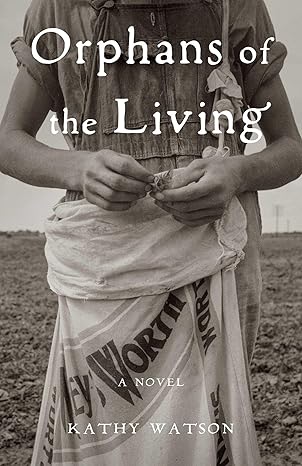

Orphans of the Living is a novel steeped in generational trauma, racial violence, and the slow unraveling of the American dream. Kathy Watson tells the story of Lula Stovall and her tangled family history, spanning from a Mississippi plantation in the 1920s through decades of poverty, migration, and social change. Lula, a white sharecropper’s wife, becomes both victim and agent in a life defined by loss and desperation. The novel, inspired by Watson’s own family, shifts between perspectives and decades, revealing how choices, often forced, sometimes chosen, echo through generations. It is part historical fiction, part personal reckoning, layered with the grit of real events and imagined truths.
Watson’s writing hits like a storm. The language is raw, unvarnished, and aching with honesty. The prose feels lived-in, like the old quilts and wood stoves that fill her characters’ homes. The pain is immediate and unrelenting. Lula’s desperate act with a piece of fencing wire early in the book stunned me. Not just because of what happened, but because of how real it felt. Watson doesn’t write for comfort. She writes to bear witness. There were moments when I had to put the book down and walk away, not because I didn’t want to keep going, but because it hurt too much to stay in the scene. That kind of writing is rare.
But it’s not just the writing that stuck with me. It’s the ambition of the book. Watson dives deep into race, class, history, and motherhood, often all at once. She gives space to the Black characters in Lula’s orbit, making sure they aren’t just there to prop up a white story. Violet Byrd, especially, is a force. Her presence radiates power and calm in a world built to crush her. The author makes the brave decision to include racist language and brutal events for historical accuracy. Nothing in this book is simple. No character is purely good or purely bad. Everyone is just trying to survive.
Orphans of the Living is not just a story about one woman’s brutal life. It’s about inheritance. What we’re given, what we pass on, and what we bury. I respected the story deeply. It’s a hard, unblinking book that left me gutted, moved, and wide awake. I’d recommend this book to readers who aren’t afraid of discomfort. If you’re drawn to stories like Jesmyn Ward’s Salvage the Bones or Toni Morrison’s The Bluest Eye, this will resonate. It’s a hard read, emotionally, but one worth sticking with. Anyone interested in Southern history, generational trauma, or the quiet violence of poverty should read this.
Pages: 352 | ISBN : 978-1647429782



