Blog Archives
Lost In My Imagination

Teneō is a powerful novella about a formless entity navigating survival, sensation, and selfhood as it inhabits human hosts and stumbles into the vast, aching wonder of being alive. What was the inspiration for the setup of your story?
It sounds so grand when you put it that way (I appreciate it)!
I think I often want the world to be more full of magic, wonder, and the unexplained than it actually is. And often I have to remind myself that the world IS an amazing adventure of a place despite the mundanity. I think that’s the basis for the creature. An otherworldly existence that could live beneath our notice, and also something appreciative of the worldly things I take for granted.
Outside of the creature, the inspiration for the story is all very grounded in my own experience. I am the person wandering through life lost in my imagination. I’ve stumbled into a life where the majority of my needs are met: I have free time, some disposable income and no idea what to do with them. I look around at all the various ways in which someone can live their life. The ways people are living their lives. And I wonder if I would be better off living mine like theirs.
It’s much more fun examining that through a formless entity’s perspective.
The tone of Teneō is so rhythmic and dreamlike. How did you develop that voice, and did it evolve as you wrote?
First off, thank you so much! Feedback on the rhythm and voice of the narration has been really gratifying to hear. I spent a lot of time trying to figure out the right flow and wording to communicate how I thought this particular creature would think (and I’m happy it seems to have worked). I wanted it to be very sparse and raw. Full of emotion and experience, but free of overthinking, anxiety, or any need for justification.
I don’t think that central idea changed much through my writing process. But the voice definitely evolved to be a bit more thoughtful and less purely experiential as the story went on. More human in a way? I’m not sure it’s a good thing for the character, but I think it’s appropriate for the story.
The book is emotionally rich despite the abstract narrator. How did you approach building empathy for something essentially alien?
It took some trial and error, honestly. I started with the idea of having both the creature and Jeanne as narrators, but it dramatically changed how a reader would interpret the story. Jeanne instantly became the defacto character you identify with, as the one most like you. I didn’t like that. And I also wasn’t looking forward to grappling with some of the more unseemly things later in the plot (from Jeanne’s perspective) as that’s not really what the story is supposed to be about.
So I tried to eliminate any human characterizations and just lean as hard into the narrator’s characterization and interpretation of the world as I could. A lot of my approach was inspired by Felix Salten’s “Bambi, A life in the woods.” I think that novel does an incredible job of not only ensuring you are entrenched in the mentality of a deer, but also making humans so…alien? I definitely didn’t do as well on the latter front, but it was a really great example to have read.
What is the next book that you are working on, and when will it be available?
There’s something I’ve started about friendships, being seen for what you truly are, and the storm of emotions that circle when someone enters or leaves your life.
I’m unfortunately not far along enough to give you a release date, but I’m very stressed out and ashamed about that now. So that’ll hopefully fuel a few chapters. In the meantime…I don’t know. Stay tuned?
Author Links: GoodReads | Instagram | Website
They’re all around us.
Wherever there’s enough of us to keep them alive. Waiting for their chance to occupy those of us whose consciousness lapses. There when we get lost in a thought. A daydream. A moment.
Through us, they experience the joys of the world in fleeting moments. By feeding on the scraps of attention we let wander, they live a little longer.
For most, those small glimpses of how we experience the world are all they get.
But some want more. They find another way.
They live among us. Within us. And in some cases, instead of us.
Teneō: A Novella
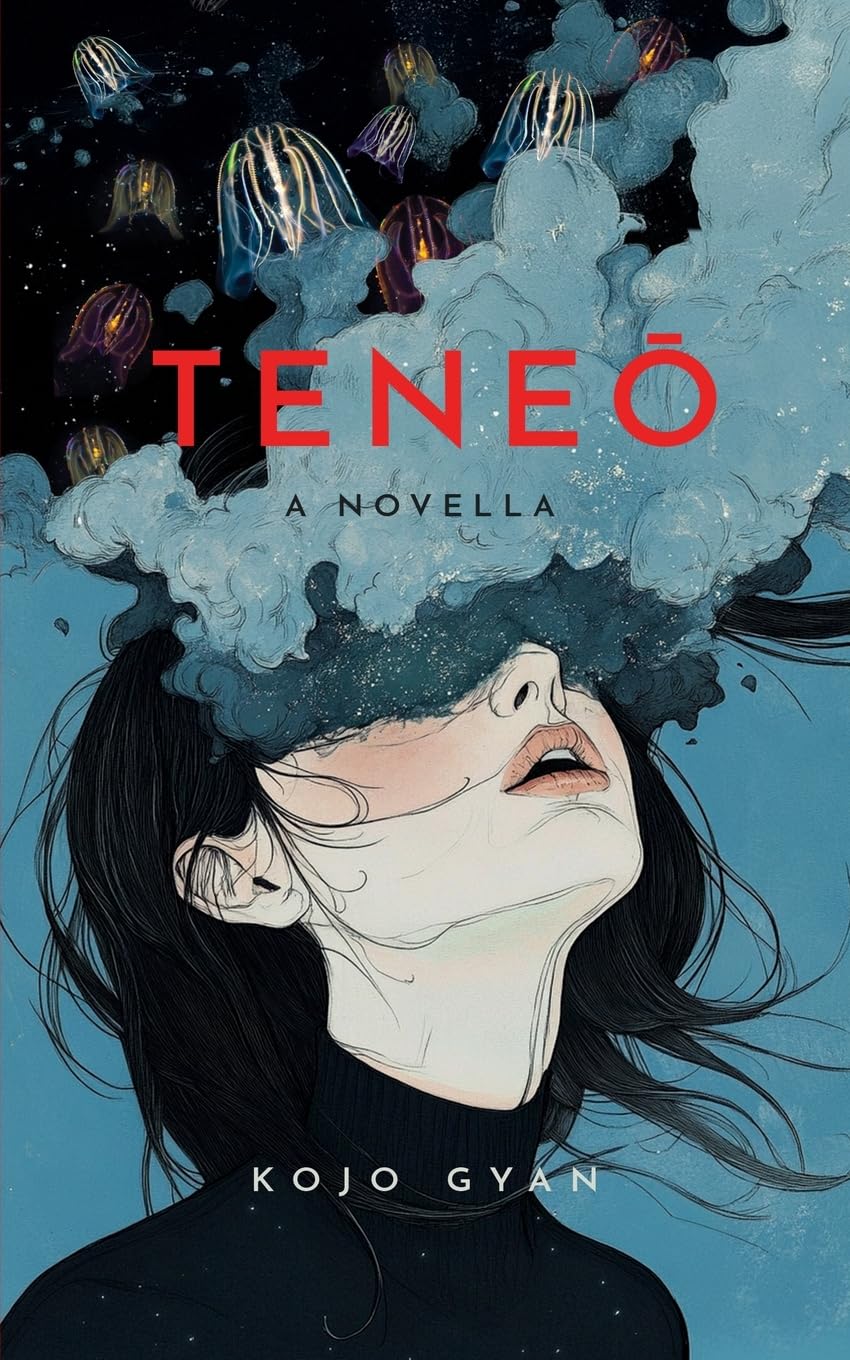

Teneō is a quiet, eerie, deeply intimate novella about a formless being surviving by occupying human consciousness, always flickering between freedom and unbearable pain. The story follows this unnamed entity as it discovers a strange new possibility, hosts that offer not just temporary refuge, but full control and, most shockingly, satisfaction. What starts as survival turns into a slow, fascinated exploration of humanity: of sensation, thought, even emotion. As the entity grows, it brushes against others like itself, raising huge questions about existence, identity, and connection. It’s a short story, but it sticks in your mind long after you put it down.
Right off the bat, I loved the opening lines. “I live for the moments in-between. Those precious seconds of flight.” That intro sunk a hook right into me. Kojo Gyan’s writing has a floaty, almost dreamlike style that fits perfectly with the narrator’s formless existence. He captures feelings, loneliness, hunger, and wonder with this sparse, rhythmic voice that’s somehow both gentle and urgent. I thought the descriptions of the city from the being’s eyes, like the “storm of senses” when inhabiting the woman in heels, were especially vivid. It didn’t feel like a human looking at humans; it felt alien, sharp-edged, new. I found myself slowing down just to savor the language.
Sometimes that dreaminess made me feel a little lost. There’s this sequence when the being meets another of its kind inside a weird “recharging station,” and for a few pages, I had no clue what was happening. The being couldn’t move, it couldn’t speak, there were voices inside its mind… it was wild but disorienting. Part of me thinks that was on purpose to make the reader feel the same confusion and fear, but it was frustrating. Still, I kind of loved that frustration. It made the moments of clarity, like when the being finally learns how to “open” its boundary and absorb energy, feel like such a hard-won victory.
Emotionally, this book surprised me. I didn’t expect to feel so much for a formless consciousness! But Gyan pulled it off. The scenes with Jeanne, especially the little things like the shower scene or the pizza moment, were weirdly beautiful. They captured this innocence, this pure joy in discovering life’s tiny pleasures. I smiled a lot, especially when the being carefully cleaned Jeanne’s messy apartment just to make her smile. There was a deep, gnawing loneliness under everything. When the being looked up at the giant ones in the sky and felt how small it still was… that hit me hard. It felt so real, even though it was so fantastical.
Teneō is one of those rare books that feels bigger on the inside than it looks from the outside. It’s strange and slow and quietly powerful. It’s for readers who like wandering, who like atmosphere and emotional resonance over fast plots. Anyone who’s ever felt a little lost or a little in awe of being alive will find something here that tugs at them.
Pages: 158 | ISBN: 1069344419




 LITERARY TITAN