Blog Archives
Questioning the Reality

Reckoning follows the ongoing battle between radical feminists, transhumanists, and those caught in the middle over the future of human evolution. This is an intriguing setup for a novel that is high in social commentary. What was your moral goal when writing this novel, and do you feel you’ve achieved it?
The moral landscape of Reckoning is carved from the reality that, in many of the world’s wealthiest nations, governments have been transformed into tools for weaponizing gender—elevating women to a near-deified status while reducing men to mere utilities, expected to serve and provide without question. Laws, social dogma, and cultural narratives reinforce this imbalance, systematically eroding the individual agency of men under the guise of progress.
My goal was not to proselytize but to speculate—to take a social trajectory that already exists and extend it into a near-future dystopia where the pendulum has swung too far. The result? A world where men, in the face of absolute exclusion, establish a means of survival in societies where women no longer exist. The deeper thread running through Reckoning is the inevitability of history’s correction. Tyrannies, regardless of ideology, eventually crumble under the weight of their own excesses. The human condition ensures that no extreme remains unchallenged forever. Have I achieved my goal? If readers walk away disturbed, questioning the reality they’ve taken for granted, then yes, I believe I have.
What are some things that you find interesting about the human condition that you think make for great fiction?
The contradictions of human nature are an endless reservoir for storytelling. We are creatures of belief, yet belief often blinds us. We idolize wealth, but that idolatry degrades our sense of self. And then there’s deception—the art of lying and the rush of getting away with it.
That last one, in particular, is fascinating for building tension. A lie, when successfully executed, grants the liar power—over perception, over truth, over consequence. Readers are complicit in this power until the deception is exposed. Then the emotional response shifts: the thrill of the lie mutates into disgust, betrayal, even rage. That emotional pendulum is what makes fiction electric. The greatest characters are the ones who manipulate this dance between what they present to the world and what they truly are.
What were some themes that were important for you to explore in this book?
One of the more obscure but potent themes in Reckoning is the evolution of personal symbology. The protagonist is covered in ink—tattoos that depict the suffering of women across history. But as the novel progresses, as her perspective darkens and her role in the story shifts, those tattoos evolve. They are not just decorations but shifting ideologies etched into her skin. They are a reflection of a deeper transformation, a living testament to how belief systems, when pushed to extremes, can decay into something monstrous.
Another theme is the shifting tide of reproduction and societal survival. In modern times, we already see trends of men stepping away from marriage, from fatherhood, from traditional roles that once anchored civilization. Populations are shrinking in major world powers, and governments are scrambling for solutions—some restricting abortion, others incentivizing childbirth, others turning to technology to create artificial solutions. Reckoning plays with the idea of what happens when this crisis reaches its breaking point.
And finally, the theme of deception—the industrialization of lies. We live in an era where hero worship is no longer based on achievement but on the ability to manipulate perception. The most successful leaders are those who have perfected the art of fabrication, shielding their deceptions through laws, through controlled narratives, through a populace that would rather be comforted by a beautiful lie than face an uncomfortable truth. And perhaps the most unsettling realization is this: people love their deceivers. They fight for them. They revere them. Reckoning doesn’t just ask what happens when power is built on deception—it asks, what happens when deception becomes the very foundation of society?
What is the next book that you are working on, and when can your fans expect it to be out?
Reckoning marks the final entry in the Nirvanaing series, and while that chapter is now closed, another one is well underway. I’m currently deep into the second novel in the Married Stupid series—a thriller trilogy that draws from a true story and drags readers into the tangled, chaotic life of a man trying to escape the prison of his past.
The next installment, BERTRAND, is slated for release in December. It’s a deep dive into desperation, ambition, and the brutal realization that wealth alone does not equate to freedom. At its core, BERTRAND is about a man trying to break through the obstacles of his birth—poverty, ignorance, the long shadows of bad blood. But escape is never clean, and the past never stays buried. Fans of psychological suspense, real-world stakes, and the gnawing terror of inescapable fate will find much to unravel in this next entry. Look for it in December.
Author Links: Bluesky | Facebook | Website

RECKONING
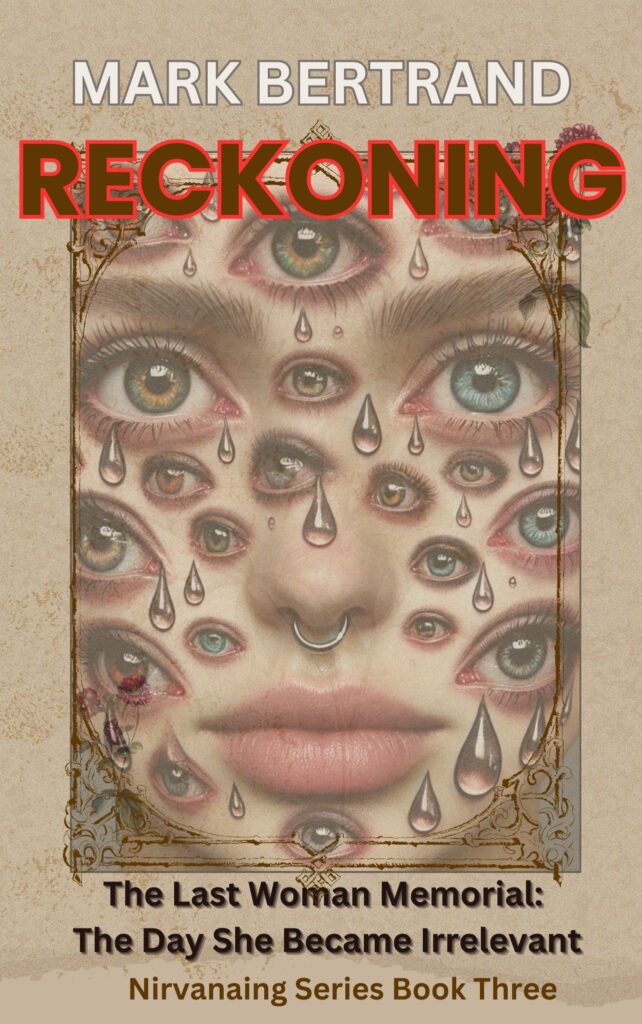

Mark Bertrand’s Reckoning is a bold and intense addition to the Nirvanaing Series, blending speculative fiction with biting social commentary. The novel follows Lydia Daniels, a literary agent on the brink of professional and personal collapse, as she navigates her crumbling marriage, a failing business, and an unexpected pregnancy. Meanwhile, the story also delves into a high-stakes ideological battle between radical feminists, transhumanists, and those caught in the middle, culminating in a confrontation over the future of human evolution. Bertrand takes readers on a winding journey through power struggles, identity crises, and moral ambiguity, creating a world that is both unsettling and fascinating.
From the very first chapter, the book sets an electrifying tone with Lydia’s explosive argument with her husband. The dialogue is raw, the emotions unchecked, and the intensity palpable. Lydia’s fierce independence clashes with her own self-destructive tendencies, making her a compelling yet frustrating protagonist. While her internal struggles feel painfully real, her aggressive outbursts sometimes push the boundaries of believability. The scene where she berates the hotel clerk for merely doing his job is particularly grating. Her flaws are part of what makes her an interesting character, but there are moments when her anger feels less like righteous frustration and more like unchecked cruelty. Bertrand paints a complex picture of a woman on the edge, but at times, it’s difficult to sympathize with her.
One of the book’s most engaging aspects is its deep dive into the ideological war over gender, power, and technology. Laura Benton, a former politician turned musician, serves as a counterpoint to Lydia’s struggles. Laura’s goal is clear: to dismantle the oppressive structures of the past and forge a new future where women hold the reins of society. But she is not without flaws. Her vision is extreme, her tactics ruthless. The moments where she reminisces about her lost love, a man who chose to become a transhuman hybrid, add depth to her character, revealing the personal cost of her crusade. Bertrand creates a world where the line between hero and villain is constantly shifting, forcing readers to question where they stand in the ideological battle.
The novel’s most chilling figure is Dr. Victor Lang, the architect of AnthroGenesis, a future where humanity is stripped of gender and biological limitations. His appearance on the World Show interview is one of the book’s most riveting moments. The contrast between his calm, calculated rhetoric and Adam Cole’s desperate attempts to expose the truth makes for a gripping scene. The idea of humans being “optimized” into a soulless collective is terrifying, and Bertrand taps into the deep fears surrounding transhumanism and loss of individuality. However, Lang is not a caricatured villain; his motivations are layered, and his beliefs are unsettlingly logical. This is where the book truly shines. It doesn’t offer easy answers. Every side has its strengths, its pitfalls, and its moral compromises.
Reckoning is a thought-provoking and unsettling read, perfect for those who enjoy speculative fiction with a strong philosophical edge. Readers who appreciate books like The Handmaid’s Tale or Brave New World will find much to dissect here. If you enjoy stories that challenge your worldview and aren’t afraid to wade into uncomfortable territory, Reckoning is a must-read.



 LITERARY TITAN