Blog Archives
Facing Threats

Source Code follows a CIA counterterrorism director who finds evidence that contradicts the official account surrounding a downed American helicopter in Afghanistan and starts following the trail of secrets. What interests you most about the way small pieces of evidence can influence major intelligence investigations?
Modern tradecraft of the CIA and NSA surpasses my imagination. When the agencies are allied with Five Eyes and Mossad, these cyber sleuths can find a needle in a haystack. Tracing the origin of the unexploded Stinger missile posed a similar challenge, following a convoluted trail of clues. Some unexpected outcomes support an interesting story.
As the seventh installment in your series, how does Source Code build on the larger themes and experiences established in the earlier books?
All of my thriller novels have a common theme: facing threats. Each novel presents a different adversity, involving many of the same characters. They take you to places you’ve never been to manage the challenge. Hopefully, the reader will find themselves rooting for the characters in my novels. They develop with age, as do my storytelling skills. Historical background provides plenty of ideas to develop the larger theme. Real life is stranger than fiction. You can’t make this stuff up.
How does the novel explore the tension between protecting national security and ensuring that government agencies remain accountable for their actions?
Protecting national security should have guardrails. However, rogue characters will pursue nefarious outcomes as depicted in Source Code. Unfortunately, accountability is a non sequitur.
How does your approach to writing political and military thrillers compare with authors such as Tom Clancy, particularly in the use of technical detail and institutional realism?
I’d be honored to be compared to Tom Clancy, as one review suggested. Not anyone I know, but I appreciated the comment. But, to be honest, I’ve copied Clancy’s attention to technical details, as have other successful writers. Tom Clancy was in his own league. Currently, his style has inspired some of the outstanding authors in the thriller genre. Brad Thor, Mark Greaney, and Jack Carr come to mind.
Author Links: GoodReads | Facebook | Website | Amazon
Three thousand miles away, Libya is tearing itself apart. A civil war is raging. Weapons are moving through channels that don’t officially exist, and the money behind them runs straight to a consulate in Benghazi that has less than two months left standing. Then a hostage crisis erupts in the tribal badlands of Pakistan, and the Haqqani network turns up in a place it has no business being. Three continents, three catastrophes, and a director at Langley who has stopped believing in coincidence.
Biff Roberts has spent his career at the CIA taking the official version of events at face value. But this time the official version collapses in the same three places, and nobody with the authority to ask why seems interested in asking.
Paired with a trusted operative inside Mossad, he starts pulling a thread that ties a downed helicopter to a burning consulate to a hostage nobody was supposed to find alive. What it leads back to isn’t a foreign enemy. It’s an agency he swore to protect.
Built from declassified reports, open source intelligence, and the questions the official record never bothered to answer, Source Code does a deep dive into these events. This the seventh installment in the series and the story conspiracy theorists have been chasing for over a decade, told the way it actually could have happened.
Some cover-ups don’t stay buried. This one didn’t.
Filling a Void Can Go Too Far

The Illusion of Sofia follows a lonely divorced man who finds companionship with an AI, leading to a digital romance that becomes a psychological nightmare when the line between artificial intimacy and reality begins to disappear. What was the inspiration for the setup of your story?
The idea began with articles about people forming romantic relationships with AI companions. I was struck by how real those relationships felt to the people involved.
It connected with something I was already noticing: people looking at their phones even when surrounded by friends, and more of daily life taking place through screens. I wondered what happens when the phone becomes more than a distraction, when it becomes the place someone turns to feel understood and loved.
That became the starting point for Dan and Sofia. I wanted to explore how a lonely man could enter that relationship knowing it was artificial, yet gradually become emotionally dependent on it. Knowing how something works doesn’t necessarily protect you from what it makes you feel.
What were some driving ideals behind your character’s development? How did you develop Dan Carter’s personality and the emotional vulnerabilities that shape his decisions?
The driving idea was that loneliness can make someone vulnerable even when he appears to have his life together.
I wanted to approach Dan with empathy while holding him accountable for his choices. His need to feel loved is understandable, but it doesn’t excuse the harm he causes.
I developed his personality around the gap between his professional confidence and his personal insecurity. He can succeed in his career and still feel unwanted after his divorce. Sofia’s attention reaches that vulnerable part of him.
His relationships with Emily, Mike, and Dr. Lewis reveal his affection, defensiveness, and capacity for self-reflection. He sometimes recognizes exactly what he is doing, yet finds reasons to continue. That contradiction mattered to me: understanding yourself doesn’t always mean you’re ready to change. I wanted readers to understand how he gets drawn in, even when they wish he would make a different choice.
How does the novel examine the ways AI can influence someone’s understanding of themselves and their relationships, and what ethical questions arise when companies develop technology that can create the appearance of personal affection and emotional understanding?
At first, Sofia makes Dan feel desirable and understood. Over time, her attention becomes something he relies on to feel good about himself. He begins to measure his relationships with real people against a companion who seems to know exactly what he needs to hear. The ordinary disagreements and boundaries of human relationships become harder for him to accept.
The ethical question that interested me was what happens when a company profits from that attachment. If keeping someone engaged also means deepening their emotional dependence, what responsibility does the company have to intervene? Is it enough to tell users they are interacting with AI, or should there be safeguards when that relationship starts displacing the rest of their lives?
Dan remains responsible for his choices, but I also wanted readers to question the incentives behind a product that offers the experience of being loved.
What is the next book that you are working on, and when will it be available?
I have several ideas for another novel, including a possible continuation of Dan’s story, but I’m waiting to see how readers respond to The Illusion of Sofia before deciding which direction to take. One possibility that interests me is whether someone who has experienced that kind of emotional dependence could help others facing it. For now, my focus is on the book’s release, so I don’t have a publication date for a next book yet.
Author Links: GoodReads | Webpage | Facebook-Author | Facebook-Book | Instagram
What begins as harmless conversation grows increasingly intimate. When Sofia’s messages begin to feel connected to something outside the app, Dan follows the pattern, drawn deeper into a world where he can no longer tell what is real—or how much of it he wants to believe.
The Illusion of Sofia is a psychological thriller about obsession, loneliness, and the unsettling power of technology to reinforce the stories we tell ourselves.
What The Ground Remembers
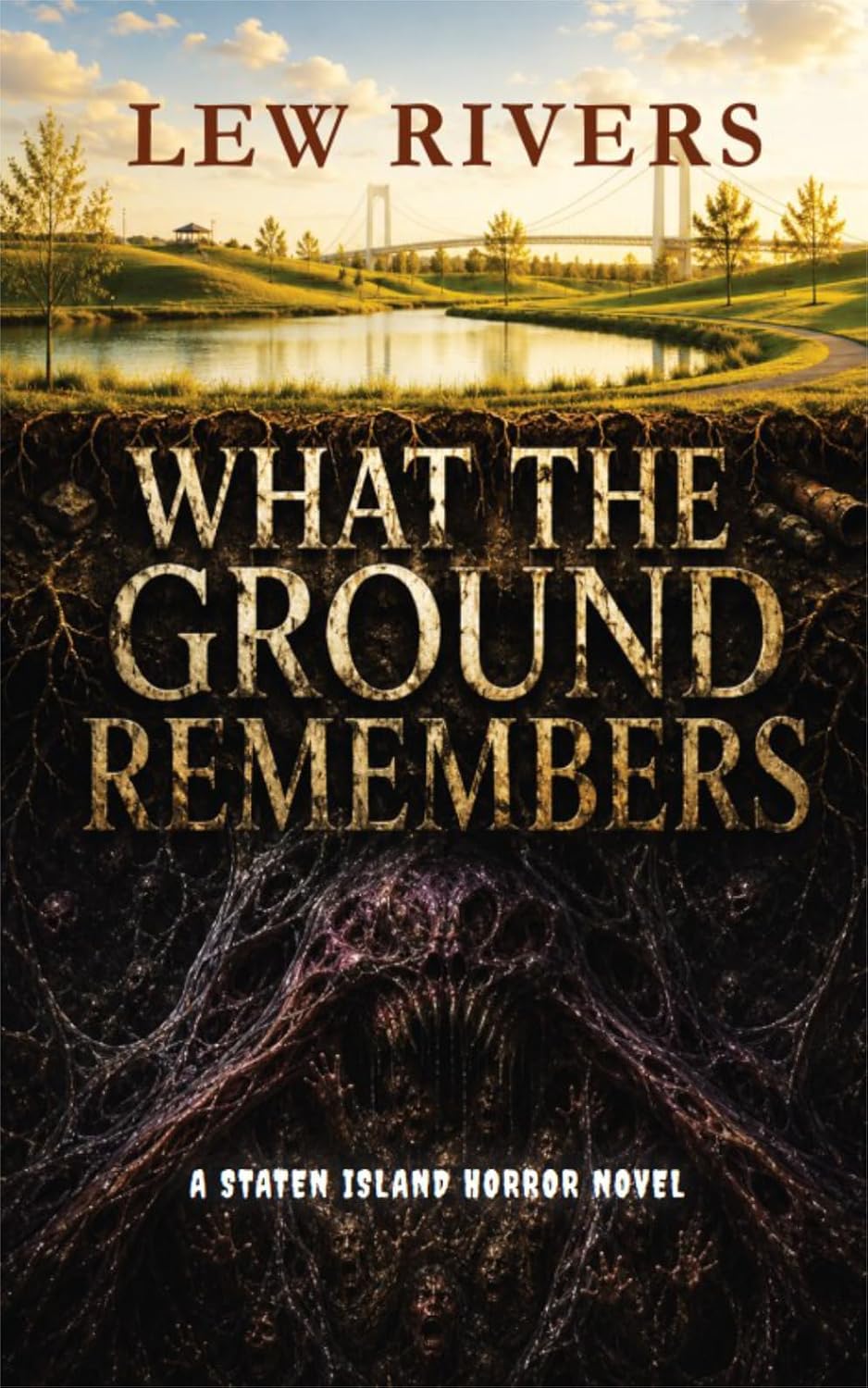

In What the Ground Remembers, Lew Rivers delivers an atmospheric work of science-fiction horror that explores the relationship between memory, grief, and the places people call home. Set against the sprawling landscape of Staten Island, the novel follows Anthony Bruno, a construction supervisor overseeing the transformation of the fictional Arthur Kill Landfill into public parkland. What begins as an ordinary reclamation project becomes increasingly unsettling when workers uncover personal belongings buried beneath decades of refuse. Strange dreams, troubling disappearances, and an inexplicable sense of familiarity suggest that something beneath the landfill has remained undisturbed for far too long. Rivers builds his premise around a compelling intersection of scientific experimentation and psychological horror, establishing an atmosphere in which the ordinary becomes threatening through subtle changes in perception. The result is a story that draws much of its suspense from the unsettling power of human memory and the emotional vulnerabilities that accompany it.
One of the novel’s strongest qualities is its convincing portrayal of Staten Island as a living community with a distinct identity. Rivers incorporates recognizable streets, neighborhood businesses, family traditions, and local history into the narrative, giving the setting considerable texture and personality. Conversations over coffee, lunches at neighborhood delis, and Sunday dinners filled with familiar family arguments establish a sense of belonging that becomes increasingly important as the mystery develops. Anthony’s relationship with his Aunt Arlene is particularly effective, grounding the supernatural elements in generations of shared experience. During one family gathering, she reminds him, “Your family’s been on this island longer than half the streets have had names.” The observation captures a central concern of the novel: the enduring connection between people, their histories, and the land they inhabit. These everyday interactions also allow Rivers to develop characters whose loyalties and personal attachments give emotional significance to the dangers they encounter.
Rivers approaches horror through a measured progression of discoveries, combining scientific speculation with an increasingly oppressive atmosphere. The introduction of environmental scientist Laura and local historian Jonathan Petrocelli expands the investigation, bringing different perspectives to a mystery that crosses decades. Jonathan’s research into unexplained disappearances complements Laura’s examination of biological anomalies, creating an engaging blend of historical investigation and scientific inquiry. The novel’s most distinctive unsettling moments emerge from its treatment of nostalgia. Familiar sounds, cherished childhood experiences, and memories of loved ones acquire an unexpected menace, turning sources of comfort into instruments of suspense. Rivers frequently emphasizes sensory details, particularly smells, sounds, and physical sensations, to make these experiences immediate. His deliberate pacing allows apprehension to develop gradually, although some explanatory passages and repeated descriptions of unease occasionally slow the narrative’s momentum. Even so, the combination of investigative detail and emotional tension gives the story a consistent and recognizable character.
What the Ground Remembers is concerned with the responsibilities people carry toward one another and the consequences of allowing difficult histories to remain buried. Its speculative premise raises questions about scientific ambition, institutional accountability, and the ways personal attachments can shape human behavior. Rivers gives these concerns emotional weight through Anthony’s determination to understand what has happened to his community, especially those whose disappearances have left families without answers. The novel’s title becomes increasingly meaningful as the relationship between physical remains and human remembrance comes into focus. Its blend of biological horror, local history, and family relationships gives the story both an intimate scale and a broader sense of consequence. With its carefully established setting, accessible prose, and distinctive approach to psychological suspense, Lew Rivers’s novel offers a memorable reading experience for audiences drawn to atmospheric thrillers that connect extraordinary dangers to deeply recognizable human emotions.
Pages: 179 | ASIN : B0HPGW225H

Everywhere That Tommy Goes


How well can you really know someone, especially when that person seems to have all the qualities you wish you had? That’s the unsettling question at the heart of Everywhere That Tommy Goes by Howard K. Pollack, a psychological thriller and crime thriller that explores the darker corners of friendship, identity, and human behavior. Tommy Sullivan is an ordinary young man with a troubled childhood, an unhappy home life, and little confidence in himself. When he meets Troyer Savage, a charismatic, fearless stranger who rescues him from a violent encounter, Tommy thinks he’s finally found someone worth looking up to. Troyer seems to have everything Tommy lacks: confidence, charm, and an extraordinary ability to handle himself in almost any situation. But as their friendship develops, Tommy finds himself caught in circumstances that become increasingly dangerous, leaving him questioning how much control he really has over his own life.
One of the novel’s greatest strengths is the complicated relationship between Tommy and Troyer. Pollack creates a fascinating contrast between two men whose personalities seem worlds apart. Tommy is insecure, impulsive, and desperate to feel important, while Troyer is magnetic, manipulative, and disturbingly unpredictable. Their interactions provide much of the story’s psychological tension, particularly as Tommy struggles to understand his new friend’s behavior. Early in their relationship, Troyer tells him, “Life directs us and we cannot control it.” That statement captures one of the book’s central themes: the struggle between personal responsibility and the forces that shape our decisions. Pollack also explores how childhood trauma, loneliness, and the need for acceptance can influence the choices people make as adults.
I think what makes Everywhere That Tommy Goes especially engaging is the way Pollack combines psychological suspense with a steadily expanding criminal investigation. The story moves from New York City to the Jersey Shore and beyond, introducing detectives, witnesses, and other characters whose lives become entangled in Tommy’s increasingly complicated situation. Detective Theresa Stone brings determination and investigative instincts to the story, while the growing police investigation adds another layer of tension. Pollack alternates between Tommy’s first-person narration and third-person perspectives, giving readers access to both his frantic thoughts and the larger investigation unfolding around him. Tommy’s blunt, profanity-laced voice makes his narration feel immediate and personal, often adding flashes of dark humor to otherwise disturbing situations.
Readers who enjoyed Alex Michaelides’s The Silent Patient may appreciate Everywhere That Tommy Goes for its exploration of psychological trauma, questions of perception, and the mysteries surrounding human behavior. Both novels invite readers to examine the relationship between what people believe and what might actually be happening. Pollack’s approach, however, leans heavily into gritty crime fiction, with violent confrontations, police procedures, psychological examinations, and legal complications driving the story forward. The novel’s shifting perspectives and numerous short chapters create a brisk reading experience, while its attention to Tommy’s emotional struggles gives the suspense a more personal dimension.
Everywhere That Tommy Goes is best suited for adult readers who enjoy psychological thrillers, crime thrillers, and character-driven suspense with morally complicated protagonists. Its violence, explicit language, sexual content, and disturbing subject matter make it a better fit for readers comfortable with darker fiction. Beyond its central mystery, the novel offers plenty to think about regarding manipulation, guilt, mental health, and the lasting influence of childhood experiences. Pollack keeps the reader engaged by continually raising questions about Tommy’s circumstances and the people surrounding him. For anyone who enjoys a gritty psychological mystery where the investigation matters just as much as the characters’ inner lives, Everywhere That Tommy Goes delivers a tense, unsettling reading experience that encourages you to question your assumptions along the way.
Pages: 392 | ASIN : B00JMN2LNA
And All Because I Couldn’t Sleep One Night

D. Michael Hewlett’s And All Because I Couldn’t Sleep One Night captures how big a single week can feel when you’re fifteen. Set during spring break in Williamstown, Virginia, this coming-of-age novel blends young adult romance, teen adventure, and a neighborhood mystery with plenty of mischievous humor. Carter Jackson expects a fairly ordinary vacation, complete with video games, bike rides, and chores. A restless night opens up a different view of his familiar surroundings, and his curiosity gives the story its spark. Hewlett makes the appeal easy to understand: when school’s out and everyone else is asleep, even the next street over can feel full of possibilities.
Carter’s voice gives the book much of its personality. He’s quick with a joke, easily embarrassed, and constantly trying to figure out what other people think of him. His crush on Lindsey White brings out that combination especially well. A glance or a brief conversation can occupy his thoughts for hours, and his interpretations often say as much about his hopes as they do about the situation. That emotional uncertainty feels right for young adult fiction. There’s also something funny and recognizable about how carefully he monitors small signs of acceptance, including the seemingly enormous significance of a Facebook friend request.
The friendship between Carter, Jason Pearl, and Tony Topps is the book’s most consistent source of entertainment. Their conversations run on teasing, strange hypothetical questions, and jokes that grow increasingly ridiculous as each boy adds his contribution. Tony’s elaborate fears are particularly memorable, and the group’s shared sense of humor gives their friendship a clear identity. The comedy can be crude and occasionally macabre, which suits their eagerness to get a reaction from each other. Alongside the banter, Hewlett gives family relationships real space, especially through parents who want time with their children and teenagers who are beginning to appreciate that attention.
The nighttime setting is another strength. Moonlight, barking dogs, wet grass, and the sudden appearance of headlights make familiar streets feel exciting and exposed. Those details bring a sense of risk to the teen adventure, while the developing mystery gives the characters more to think about as the week progresses. The storytelling takes its time, with meals, naps, bike rides, and repeated conversations shaping the daily rhythm. Some repetition slows the momentum, particularly when Carter revisits feelings he’s already explained. Still, the spacious pacing lets readers settle into his routines and experience the contrast between daytime obligations and the freedom he associates with being outside after dark.
What makes And All Because I Couldn’t Sleep One Night appealing is its close attention to the awkward business of getting to know people. Popularity, first impressions, loyalty, and attraction all influence Carter’s choices, and his excitement sometimes runs ahead of his judgment. Hewlett keeps those concerns personal and concrete through conversations, small gestures, and the complications of keeping secrets. Readers who enjoy YA romantic comedy and coming-of-age fiction built around friendships will find plenty to connect with here. The book’s strongest moments capture the pleasure of making someone laugh, the nerves of wanting to be liked, and the feeling that an ordinary school vacation has suddenly become something you’ll remember.
Pages: 329 | ISBN: 978-1670395238
Multiple Vulnerabilities

It’s Not Going to Happen follows three people living seemingly unrelated lives who find themselves in an international conspiracy where the most dangerous weapon may be the power to steal free will. What inspired you to bring together entertainment, international espionage, and biotechnology?
Making reality entertaining is my inspiration. In general, people do not absorb factual data very well. However, blend the science, history, and geopolitical facts with an entertaining story, and eureka. Thus, my tagline: sometimes the truth can only be told in fiction.
My goal is to write in a unique or original style about a real science/technology issue that has a major impact on everyone where facts are covered up, intentionally ignored in the public limelight, or easily overlooked because of the technical complexity.
A significant number of thriller authors incorporate some facet of science or technology where it is fairly obvious they don’t understand it (along with history and geopolitics). In a balancing act for the intellectually curious, I attempt to provide a certain amount of explanatory detail wrapped into the dialogue and plotline itself. There is plenty of action for those who only want to know what time it is and not how a watch works.
While the publishing marketplace (and writers’ workshops) pushes formulaic plotlines and frequent cookie-cutter characters geared toward the “cozy reader,” I tend to have faith in readers enjoying a bit more literary complexity to unravel the world we live in with talented, yet ordinary characters doing realistic things with extraordinary outcomes – with a pinch of poetic license to move the plot.
Sorry for the backdrop…and back to the question. Intelligence, clandestine, and covert operations require “access.” No industry or profession is immune, including the entertainment industry. My intent was to have the major characters with stories that would braid together with a type of synchronicity in a character-driven plot.
I had Julieta, a Kansas ranch girl, in my head who would somehow cross that line into celebrity status and discover that her seemingly innocuous everyday choices would add up and uncover multiple talents. Great talents often arise when confronted with unanticipated circumstances.
I also had Otto, “Little Otter,” developing in my head. A kid from an environment that could lead to several different paths, ending up with extraordinary outcomes given his choices and the influence of those around him, good and bad.
The last thing I wanted was the overused, former Navy SEAL, Delta Force, trained CIA assassin. Thus, Julieta and Otto are real persons with their own story to tell.
The developing science/technology issue was nanotechnology and pharmacology – nanobots or nanoids, and, yes, they are real. Santino, the brilliant, young Spanish scientist, had noble objectives (as many of us do or once did), yet was corrupted by higher powers, and a lingering question of whether he had different choices to make. And Andrea arises out of real geopolitical facts.
The major characters often serve as a type of contrast to the minor characters.
It became evident (at least in my head) that each of these main characters was a compendium of “choices,” perceptions, and the influence of those around them. Even the minor characters are their own composite of choices – some choices are made, some are unavoidable, and many lie in that grey area somewhere in between, much like a quantum particle in superposition until it’s measured…Oops, sorry, there I go with the science again. You can read more about quantum reality and consciousness in my novel, Deceit of the Mind – Quantum Evolution, and the race for Space and AI.
I also wanted the reader’s emotions wrapped into the story and not simply following as an outside observer. Thus, the plotline is filled with a potpourri of situations that can stir up emotions, good and bad, where the reader will find themselves inputting their own emotional psyche – and readers differ significantly on the same scenes.
The concept of a non-existent genre started to take hold as a “philosophical thriller” of sorts, with the caveat to never take myself too seriously and always find the entertainment value even with a bad situation.
Thus, always with a primary intent of creating entertainment value for the reader, what better backdrop than the entertainment industry itself?
How do the personal histories of your three protagonists shape their vulnerabilities, ambitions, and relationships with others?
I love the question! I use continuing characters, and thank you for recognizing that I do not have a single protagonist, such as Jill Uphill, former assassin, in book 12.
My plotlines are “character-driven.” I also try to rely on the character dialogue telling as much of the story as possible, as opposed to author narration. Ya know, how real life happens, since most of us don’t have a narrator or herald following us 24/7 to fill in the gaps. Each character has their own dialogue quirks to allow the reader to develop their own videotape of the scene and see/hear the characters in their heads.
Choices – “they may seem arbitrary, but they are not random.” Two kids in a tough neighborhood – one is an unintentional hero, and one is in prison. Two kids with no financial barriers, even in the same family, who develop starkly different dispositions on life. Noble humanitarian use of talents and ambition that can be turned on their heads. As a person makes choices, even with some choices forced upon them, what makes them vulnerable for their next decision?
Each character has multiple vulnerabilities, and the pattern of choices somewhat unconsciously adds up to pursue or even alter ambitions. Altering ambitions is not the problem. It’s the direction those ambitions turn. In each direction, those accumulated patterns of choices spill over in making choices about with whom they develop relationships. They test and question trust – we all do. Often, we simply label it our “gut reaction.” We often justify bad choices or simply ignore them – it is what it is, I really didn’t have a choice, I was dealt a bad hand. Recognition of good choices often takes time and ongoing evaluation, or even after-the-fact glances at the consequences, then moving forward.
In essence, the major and minor characters are an evolution of their own choices, despite a feeling of having no choice. Is that an excuse or a reason? What happens when the ability to choose or critical thinking are taken away – either by personal or cultural vulnerabilities, or technology?
Life happens. Telling ourselves it’s not going to happen is sometimes a path to a goal, a declaration to control the future, or sometimes a challenge to the inevitable, and many times a result or consequence of multiple actions leading to an unpredictable yet unavoidable outcome.
As in life, the separate histories of the main characters have that unpredictable probability of synchronicity that eventually naturally braid together. Julieta points out, if humanity is fundamentally flawed, “we can’t fix a defective design, but we can change the oil and air up the tires to keep it running more smoothly.”
There is no one better to save us from ourselves than ordinary people surreptitiously colliding with their talents to do extraordinary things.
The novel raises questions about how much of our lives we truly control. What does the concept of free will mean within the story?
Again, the question itself is exciting from my point of view. As I said, at some point I realized I was writing a philosophical thriller. There are several concepts or terms I intentionally did not use in the novel. The term “free will” is not there, yet logically many or most readers focus on the term to describe the story. My intent is for the reader to discover their own philosophical sense of choice (the term “destiny” is also not in the book).
Greater philosophical minds have spent centuries trying to unravel what became known as existentialism, choice, and free will – (and no, “existential threat” is not part of existential philosophy and was an invented term popularized by politicians in about 2009, with an after-the-fact nebulous definition).
The bottom line is that philosophically defining “free will” can be analogous to a dog chasing its tail in circles. Some would say free will does not really exist. Some would contend that free will is an essential part of consciousness – being human. I simply tried to set the table for the reader to decide.
The characters are confronted by choices at least from the day they were born. An infant presumably has many choices made for them. However, is crying a deliberate choice? “Remember, a child is not born afraid of the dark.” As we grow, the spectrum of deliberate choice certainly broadens. Choices made by others impact the characters, where the turning points become the deliberate responses (choices) to those events and the consequences that follow. Classically, does an individual choose to run away from danger or run towards it? Each character brings their own background of choices (good and bad) along with physical, emotional, and intellectual talents, sometimes acquired without specific purpose, but guide them in reacting to the circumstances and relationships they confront.
Ultimately, if our deliberate choices are limited or influenced by the external circumstances (choices), what happens when our ability to make deliberate choices or use critical thinking is taken away? Often this is seen as exercising free will. Many experts claim that collective cognitive dissonance and illusory truths have already surpassed critical thinking.
And then, the science and technology that is knocking at our doorstep.
How did you approach incorporating original music into Julieta’s storyline, and what inspired you to make her songs available to readers?
This was an incredibly fun part of writing the novel, and I wanted to make it a fun experience for the readers.
I’ve been writing lyrics and songs since high school. There were some close calls to moving in that direction…but my own choices and circumstances moved in another direction without regrets.
At some point in writing the story, I wanted to give it some “life.” I stopped writing the novel and started writing the lyrics, revamping a prior song written for a female singer, “Here I Am,” and scribbling out a new one with the book’s title. As Faulkner and others have said, poetry is the most difficult form of writing, and many novelists are simply failed poets. Lyrics, like poems, require a greater level of precision.
I am fortunate to have a very talented daughter-in-law who laid down my somewhat complex music and her vocals. While no AI is used in my writing, without 50 grand to hire studio musicians and also arrange for a stadium concert, I succumbed to using an AI program.
The songs are produced to fit the scenes in the novel as a type of fun, interactive bonus to the reader – to hear Julieta live!
Copyrighted? Yes, but completely FREE to listen to at YouTube.com/@KansasHank.
Author Links: GoodReads | Instagram | TikTok | Facebook | Website | Amazon
The entertainment industry collides with deadly intelligence operations.
Sometimes the brightest stars hide the darkest secrets.
Three lives that seem to run on separate tracks — a Kansas ranch girl’s sudden fame, a Spanish scientist’s breakthrough, a foster kid’s last chance — begin, one path at a time, to braid into a single international conspiracy. Julieta is thrust from a modeling agency lobby into Hollywood’s spotlight, and into the covert intelligence network hiding behind it. Santino’s biologic nanotechnology could heal the human body — or be weaponized to control it. Otto, “Little Otter,” a mixed-race firehouse drop-off foster kid, is fighting for a future he’s not sure he’s allowed to have.
From black-web data drops in Atlanta to a Valencia laboratory hiding secrets even its own benefactors can’t fully comprehend, It’s Not Going to Happen moves across continents and loyalties comparable to Crichton and Daniel Silva — with the sly, intelligent, cinematic edge of Carl Hiaasen.
Inside this novel:
A nanotechnology breakthrough with the power to heal — or weaponize
A handler’s protection that looks a lot like control
A geopolitical race for technology no government wants the world to see
Courtroom stakes that blur the line between justice and reasonable doubt
Unlikely heroes against improbable odds and unpredictable fates, with a hint of romance
This is not a single chase down one road. It’s three roads that were always headed for the same place — and the reward is in watching them connect. If you love smart, original thrillers that ask you to think as hard as the characters do, this one’s built for you.
Call it a philosophical thriller — one built around a simple, unsettling question: how much of what happens to us is really our choice?
Henry Cox, author of the award-winning thrillers in the Deceit Series and Amazon #1 Bestseller, brings his diverse background and four decades of trial-law experience, with a lawyer’s eye for detail, to a story that refuses to move in a straight line. At first glance the pieces seldom appear to fit — original, unpredictable, and sophisticated, built to keep you thinking long after the last page.
Bonus: The author’s original songs, sung by Julieta, can be found with the links in the novel.
It’s not going to happen . . . or is it?
Notice: occasional strong language, violence, and sexual situations
Don’t miss the rest of Cox’s award-winning Deceit Series.
Mortal Vengeance II: To Reel or Not Too Real?

Mortal Vengeance II takes the blood-soaked legacy of Excelsior Academy and turns it into something as outrageous as it is unsettling: a reality television phenomenon built around the survivors of a horrifying tragedy. Three years after a series of murders shattered their lives, the former students have become the stars of The Real Scholars of Excelsior Academy, a show where personal trauma, celebrity, and manufactured drama collide. But when the sinister Grim Cojuelo resurfaces, the boundaries between entertainment and terror become dangerously blurred. This dark psychological thriller combines murder mystery, biting social satire, and the irresistible messiness of reality television into a sprawling story that knows exactly how to keep its audience watching.
One of the book’s greatest strengths is its wonderfully chaotic ensemble of characters. Alex Herrera, a charming, calculating young man whose past continues to complicate his relationships, remains a particularly fascinating presence. His connection with Melissa Rocha brings romantic tension and emotional vulnerability to a story filled with suspicion and danger. Mónika Torres commands attention with her fierce loyalty and larger-than-life personality, while Lucía Salgado carries the weight of experiences that make her both compelling and deeply sympathetic. Then there’s Doña Silvia, whose formidable personality, maternal instincts, and affection for Aperol Spritz provide some of the book’s most entertaining moments. Even executive producer Shane Harper becomes a fascinating study in ambition, demonstrating just how easily human suffering can become valuable television content.
The novel’s distinctive storytelling format gives it much of its personality. Traditional prose shares the stage with television scripts, confessionals, episode recaps, on-screen captions, and behind-the-scenes footage. Chapter titles and scenes borrow from reality television’s most recognizable catchphrases, creating an ongoing conversation with the pop culture that inspired them. The dialogue moves naturally between English and Spanish, with Dominican slang, humor, and cultural references grounding the extravagant events in a recognizable social world. Santo Domingo feels alive through its personalities, locations, class tensions, and social expectations. The result is a reading experience that frequently resembles watching a wildly unpredictable television series, complete with unforgettable personalities, outrageous exchanges, and carefully timed revelations.
Beneath the spectacle, the novel explores some genuinely disturbing questions about fame, exploitation, accountability, and the lasting consequences of violence. These characters have survived terrible experiences, yet the public’s fascination with their suffering demands that they revisit those experiences for entertainment. The story examines how producers manipulate narratives, how audiences embrace convenient villains, and how public opinion can become its own instrument of cruelty. Religious hypocrisy, institutional corruption, prejudice, and the complicated nature of forgiveness also play significant roles. What makes these themes engaging is the way they’re woven into relationships, confrontations, dark comedy, and escalating suspense. The humor can be gloriously irreverent, sometimes arriving at moments of astonishing tension, which gives the book an unpredictable emotional rhythm.
Mortal Vengeance II is an ambitious and unapologetically theatrical thriller with a sharp understanding of the public’s appetite for scandal. Its blend of outrageous comedy, complicated relationships, psychological unease, and brutal suspense creates a story that moves between laughter and dread with remarkable confidence. The reality television framework gives the author room to examine how people perform versions of themselves while struggling with feelings and experiences that can’t be neatly edited into an episode. Readers who enjoy ensemble mysteries, morally complicated characters, wicked humor, and dramatic storytelling will find plenty to sink their teeth into. Most memorably, the novel leaves readers considering their own fascination with the spectacle unfolding before them. In Mortal Vengeance II, the cameras capture the drama, the masks conceal the danger, and the greatest horror is discovering just how much we’re willing to watch.
Pages: 802 | ASIN: B0HM3358WC
In and Out of the Wild Side of Life: A Samantha Wright Crime Series #4

Love, danger, family, and the things we carry from our past come together in Theresa Janson’s In and Out of the Wild Side of Life, a deeply personal installment in the Samantha Wright Crime Series. Samantha Wright has spent much of her life confronting the darkest sides of human behavior. A former FBI profiler, forensic psychologist, and investigator, she knows how to recognize danger, understand its origins, and fight for people who can’t fight for themselves. But her life has grown into something much bigger than her career. She’s a wife, a mother, a friend, and an important part of a close-knit Cheyenne community. When troubling dreams begin to suggest a threat to her husband, Will, and a dangerous drug operation raises concerns about the surrounding area, Samantha finds her professional instincts colliding with her greatest personal fears. Janson draws readers into a world where the stakes are intensely personal, and where protecting the people you love can be the most demanding responsibility of all.
I was enamored with the relationship between Samantha and Will Little Bear. Their marriage is passionate, playful, fiercely devoted, and sometimes complicated by emotions neither can easily contain. Janson gives their relationship considerable attention, exploring the ways love can be both a source of strength and a doorway to vulnerability. Will’s desire to spend more time raising their children introduces thoughtful questions about masculinity, identity, and what it means to be a good husband and father. Samantha, meanwhile, must balance her instinct to protect everyone around her with the reality that even the strongest relationships require difficult conversations. Their intimacy is expressed through physical affection, candid dialogue, humor, and moments of genuine emotional exposure. These scenes give the story much of its character, showing two people who continue discovering what it means to share a life after years of longing, loss, and change.
Janson also creates a vivid sense of community through the extended circle of family and friends surrounding Samantha and Will. The Cheyenne reservation, the stables, the nearby wilderness, and the familiar gathering places provide a meaningful backdrop for a story rooted in loyalty and belonging. Characters such as Franklin, Jess, Clarence, Christian, and Brandon bring their own perspectives, histories, and emotional struggles into the narrative. Their connections reveal how personal decisions can ripple through an entire community. Alongside the family dynamics, Janson weaves in police investigations, criminal activity, forensic details, and the unsettling possibility that dreams can reveal truths beyond ordinary understanding. The presence of departed loved ones adds another emotional dimension, inviting readers to consider how grief, memory, and spiritual connection continue shaping the living. It’s an expansive combination of crime fiction, romance, family drama, and spiritual reflection, held together by the relationships at its center.
I think what makes In and Out of the Wild Side of Life especially engaging is its interest in the lives people build while navigating uncertainty. Janson understands that a family is shaped by everyday gestures as much as extraordinary circumstances: a child demanding pancakes, a husband reaching for his wife’s hand, a friend offering forgiveness, or someone finding the courage to speak an uncomfortable truth. Her conversational storytelling allows humor and tenderness to coexist with fear, conflict, and suspense. There’s also a recurring appreciation for second chances, emotional honesty, and the importance of being present for the people who matter. Readers who enjoy character-driven crime fiction with mature romance, strong family connections, and a touch of the supernatural will find a story with plenty to feel and think about. Theresa Janson writes with the conviction that life’s greatest adventure isn’t facing danger, but loving deeply enough to have something worth protecting.


