Blog Archives
Sharing the Lives of Free People Of Color

Miles Lassiter(circa 1777-1850) traces the remarkable journey of your ancestor, Miles Lassiter, a free African-American Quaker living in North Carolina before the Civil War, and the impact that he made in history. Why was this an important book for you to write?
There has been much written about the abolitionist support of Quakers, but it was rare for African Americans to be fully admitted to membership in a meeting. To learn that my 4th great grandfather was one of the very few, and the only one in North Carolina at the time of his death seemed significant.
What sparked your interest in genealogy led you to discover this lost portion of your family and its history?
I’ve had an interest in genealogy since childhood. I learned my paternal family story as a child from my father’s sister. However, whenever I asked my mother about her family she said she left North Carolina when she was seven and just didn’t know anything about family that might still be there. Once I moved to the Washington, DC area, I had easy access to repositories such as the National Archives and Library of Congress to begin searching for my maternal ancestors. In addition, I was able to take classes to learn how to research my family and I was introduced to my local Family Search Center (then called genealogy library) which gave me access to the vast research collection of the Family History Library in Salt Lake City.
What were some ideas that were important for you to share in this book?
It was important to share information about the lives of free people of color. It was also important to share the story of my 4th great grandfather specifically. I also wanted to show through my research story how others could research their families.
How has writing Miles Lassiter (circa 1777-1850): An Early African-American Quaker from Lassiter Mill, Randolph County, North Carolina: My Research Journey to Home impacted or changed your life?
The process of researching and writing the many early versions of the story, culminating in the published book, brought me to North Carolina to meet family I had not known, and places that held my history, a place that was my maternal home. It allowed me to become enveloped by the love of a family I almost lost completely because my mother had not grown up around them. It allowed me to take my mother back to that home after 60+ years away. And this year, it allowed me to obtain a William Pomeroy Hometown Heritage Historic Marker for Miles Lassiter.
Author Links: Goodreads | Facebook | Instagram | LinkedIn | Website | Amazon
Margo Williams had only a handful of stories and a few names her mother remembered from her childhood about her family’s home in Asheboro, North Carolina. Her research would soon help her to make contact with long lost relatives and a pilgrimage “home” with her mother in 1982. Little did she know she would discover a large loving family and a Quaker ancestor–a Black Quaker ancestor. This story follows her research journey through records and Carolina countryside as she uncovers her roots.
“This work re-affirms Margo Williams’s commitment to excellence and perfection, both as a researcher and as a historian. The reader is made part of the story, not only in place but in time. But, most importantly, she re-asserts the point that, by and large, the information is available to the researcher. All one has to do is to look for it. A job well done!” — V. L. Skinner, Jr., Fellow, Maryland Genealogical Society.
Margo Lee. Williams was born in New York. She holds an MA in Sociology and an MA in Religious Education. She developed an interest in genealogy early in life, but only after moving to Washington DC did she actively pursue family research. In the 30+ years since, she has researched and written extensively on her family. She is a well-known lecturer for the Family History Centers of the LDS Church in the Washington, DC area, a former editor of the Journal of the Afro-American Historical and Genealogical Society, and through her private research company, Personal Prologue, has developed expertise in identifying heirs for intestate probates. She is currently a National Service Officer with Vietnam Veterans of America. She lives in Silver Spring, Maryland with her daughter, Turquoise Williams.
Miles Lassiter (circa 1777-1850) An Early African American Quaker from Lassiter Mill, Randolph County, North Carolina: My Research Journey to Home
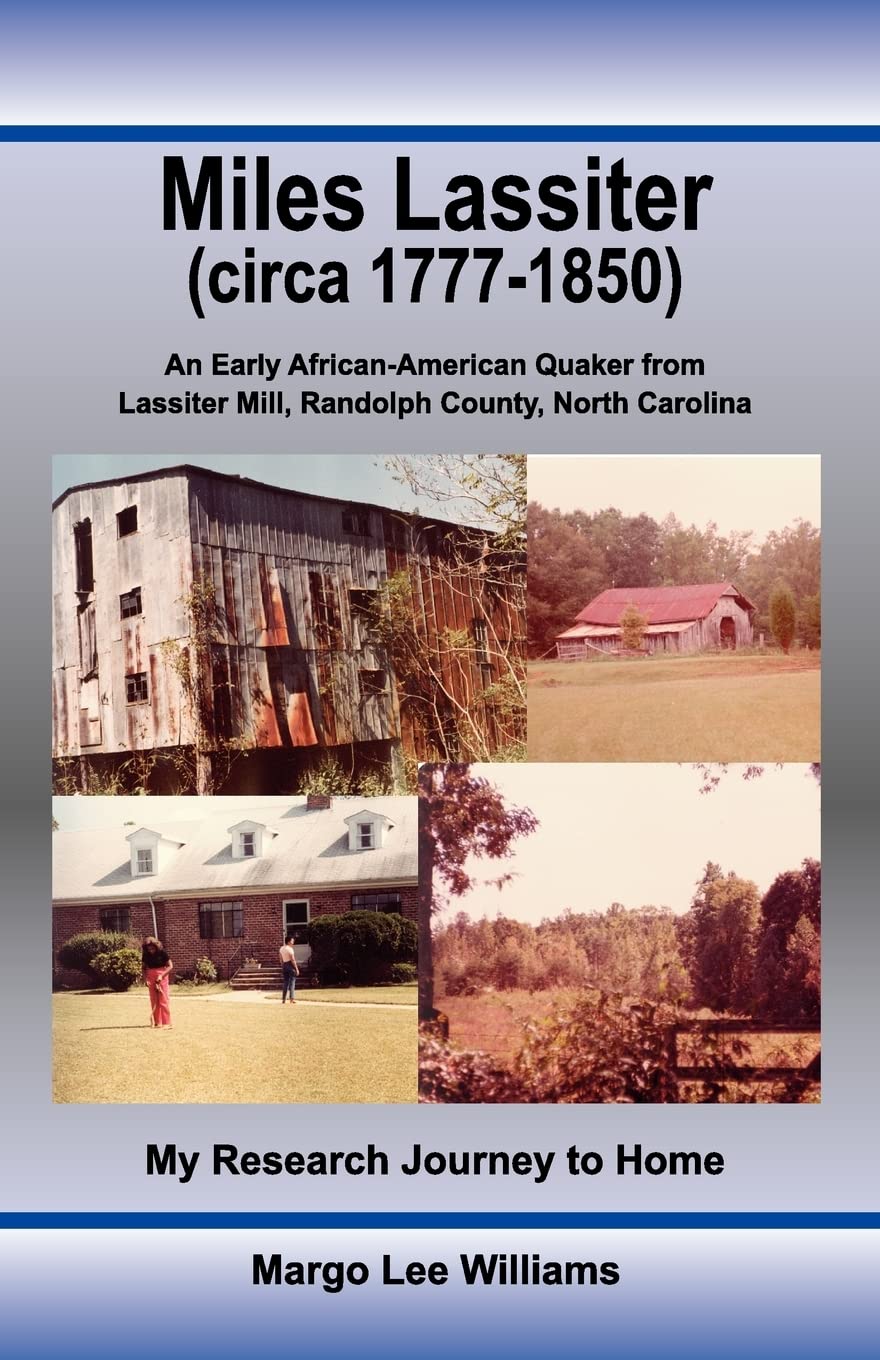

This book is part history, part memoir, and part detective story. Author Margo Lee Williams traces the remarkable journey of her ancestor, Miles Lassiter, a free African-American Quaker living in North Carolina before the Civil War. Through genealogical records, dusty courthouse files, and oral histories, she reconstructs the life of a man whose quiet defiance of the times stands as a beacon of dignity and faith. The narrative also follows her own search for identity and belonging, from vague family memories to a rediscovered home in the Carolina countryside. It’s as much about the process of finding history as it is about the man himself, a story of persistence, connection, and the hidden layers of American life.
I was struck by the warmth of Williams’s writing. She doesn’t just present facts; she brings people to life. The scenes of her research trips, pouring over records, meeting cousins she never knew she had, walking the land her ancestors once farmed, made me feel like I was there beside her. Her tone is tender but firm, respectful yet real. There’s a sense of wonder in her words, the kind of awe that comes from holding pieces of the past in your hands. At times, her attention to genealogical detail can slow the pace, but that same care is what makes the story believable and human. I admired her honesty when she admitted confusion or surprise. It reminded me that history isn’t neat, it’s messy, layered, and full of contradictions.
As someone who loves history, this book hit me deep. It’s rare to find a work that balances emotion with scholarship so gracefully. The story of Miles, a Black Quaker in the antebellum South, is extraordinary. His life defied the boundaries of race, religion, and law. Williams’s discovery that her ancestor was both enslaved and later a respected Quaker moved me profoundly. It challenged what I thought I knew about early African-American history. There were moments I had to pause, just to take in the weight of it all, the perseverance, the quiet resistance, the unspoken courage.
Miles Lassiter is a love letter to ancestors who endured, to forgotten stories waiting to be told, and to the act of remembering itself. I’d recommend this book to anyone who loves history that feels personal and alive, to readers who crave stories of ordinary people doing extraordinary things without fanfare. It’s perfect for genealogists, students of African-American history, or anyone who has ever wondered where they came from.
Pages: 150 | ASIN : B0064FITWQ




 LITERARY TITAN