Blog Archives
Fairness Is Not Charity

Seeking Fairness at Work is a sharp, compassionate, and thoughtful exploration of what fairness really means in today’s workplace and provides leaders a five-part strategy to embed fairness deeply into workplace culture. Why was this an important book for you to write?
As a business strategist and attorney, frustrated employees have shared their feelings of helplessness and anger with me many times over the years. They were upset about the organization’s willful blindness to management behaviors that torched their dignity, confidence, and psychological safety.
When raising a serious issue about the behavior of a senior vice president with the head of human resources at a large manufacturing company, for example, an employee was essentially shooed away. “It’s worse in other departments,” they were told. In desperation, they consulted a lawyer.
That is but one example of misguided leadership behaviors I’ve witnessed over the years that damage trust and result in unintended negative consequences. No, they didn’t always trigger lawsuits. Although, many could have. But they were always costly in terms of diminished employee engagement, retention, and definitely satisfaction.
We embrace new jobs with excitement about fresh opportunities, but our enthusiasm wanes when it’s met by a workplace climate that raises our defenses instead of our game.
It’s a standoff that won’t improve until managers understand why employees respond negatively to their workplace culture and appreciate how low employee engagement, satisfaction, and retention are symptoms of a suboptimal culture, one that management controls, influences, and can change.
As a result, I wanted to write a book that challenged employer “truths” by examining those unwritten workplace norms – the invisible lines that when crossed, create organizational dysfunction.
This new perspective on employee engagement explains employees’ legitimate frustration and offers management a roadmap to previously missed opportunities that can improve their workplace culture.
How much research did you undertake for this book, and how much time did it take to put it all together?
Seeking Fairness at Work relies on evidence-based science, academic research, interviews, and real-life stories that took five years to assemble and more than forty years of living it.
What were some ideas that were important for you to share in this book?
Too often people think of fairness as a soft, lofty ideal, that can be an Alice in Wonderland whatever someone wants it to be – an entitlement. The fact that fairness is commonly thought of as “unfair” speaks volumes about how positional power is regularly misused in relationships. And that’s the point of Seeking Fairness at Work.
Relationships are implied social contracts where fairness is reflected by acting in good faith and with fair dealing. Seeking Fairness at Work takes a granular look at those objective standards, what they mean for the employees and employers, and how certain unwritten workplace norms betray those expectations, contributing to low employee engagement, retention, and satisfaction.
What is one thing that you hope readers take away from Seeking Fairness at Work?
I’d like employees to know their expectations of fairness at work are reasonable and for managers to appreciate how fairness is not charity, it’s smart business.
Author Links: GoodReads | X | Website
WINNER: 2025 Book Excellence Award (Business)
WINNER: 2025 Axiom Business Book Gold Medal Book Award (Digital Media)
WINNER: 2024 Independent Press Book Award (Distinguished Favorite)
3x WINNER: 2024 Dan Poyner’s Global eBook Awards (Business, Communications, Leadership)
2x WINNER: 2024 Goody Business Book Awards (Business – Management, Leadership – Think Differently)
WINNER: 2024 NYC Big Book Award (Distinguished Favorite)
Seeking Fairness at Work challenges employer “truths” by examining unwritten workplace norms – the invisible lines that when crossed, create organizational dysfunction. This new perspective on employee engagement explains employees’ legitimate frustration and identifies missed management opportunities to improve workplace culture.
Recognized business strategist and Journal of Business Ethics Education editorial board member Hanna Hasl-Kelchner, MBA, JD identifies the five most common workplace norms that betray fairness, leaving employees feeling dispirited, disengaged, and headed for the door by examining the social psychology of how our basic human motivations intersect with the implied workplace social contract.
Clarion Foreward Reviews calls her recent book Seeking Fairness at Work: Cracking the New Code of Greater Employee Engagement, Retention & Satisfaction “pithy and persuasive,” while BookLife Review compares it to Kim Scott’s Radical Respect and Kim Dabb’s You Belong Here.
Using evidence-based science, academic research, interviews, and real-life stories, Hasl-Kelchner merges organizational psychology with the practical aspects of workplace dynamics to offer ethical leadership an actionable five-part framework filled with practical tips to empower more employee engagement and retention, including chapters on how to:Rebuild Trust with More Self-Awareness
Improve Relationship Chemistry with More Empathy
Make Genuine Accountability a Cornerstone
Maintain a Cultural Safety Net
Mend the Structural Safety Net
Seeking Fairness at Work is ideal for executives, managers, and entrepreneurs who want to raise their employees’ game instead of their defenses; the human resource professionals, consultants, and employment attorneys who advise them; and employees wanting a reality check of their own workplace experiences.
Seeking Fairness at Work: Cracking the New Code of Greater Employee Engagement, Retention & Satisfaction
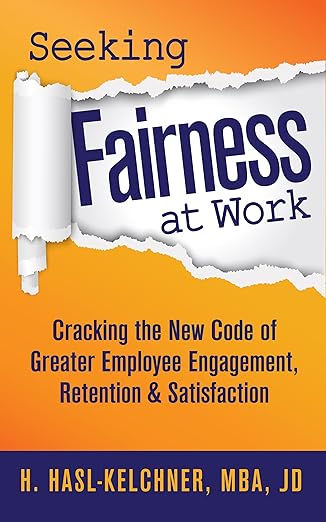

Seeking Fairness at Work by Hanna Hasl-Kelchner is a sharp, compassionate, and thoughtful exploration of what fairness really means in today’s workplace. The book opens with candid, real-life stories of people pushed to their limits by unfair treatment and builds a powerful case for why fairness isn’t just a “nice-to-have” but essential for high performance, trust, and retention. Hasl-Kelchner breaks the topic down in two parts: first, by giving voice to what employees wish they could say out loud, and then by offering leaders a five-part strategy to embed fairness deeply into workplace culture. It’s a mix of research, practical advice, and a wake-up call.
This book resonated with me, as I have worked for a corporation for a decade. I’ve been both an employee and a leader, and I saw myself on both sides of the page. The stories were so real, the writing down-to-earth and smart without being preachy. Hasl-Kelchner doesn’t mince words. She gets to the heart of the matter, like how people are treated, and how easy it is for leaders to become blind to the damage their silence or inaction causes. I especially appreciated how she tied fairness to things like health, motivation, and even workplace violence. It’s not just about equity, it’s about safety and dignity. She makes you feel the stakes. And she does it with empathy, never pointing fingers, just opening your eyes.
What I loved most is how actionable this book is. Each of the five steps: trust, empathy, accountability, cultural safety, and structure, is explained clearly and with examples. The “Fairness Factors” sprinkled throughout make you stop and reflect. This book doesn’t ask you to become a superhero. It just asks you to care, to be aware, and to do better. The book challenged me. I caught myself thinking things like “But we don’t have time for that,” or “That’s just how things are.” Hasl-Kelchner anticipates those reactions and gently calls them out.
I found this book to be one of the most honest and grounded management books I’ve read in a long time. I’d recommend Seeking Fairness at Work to anyone in a leadership role, especially those who think they don’t need it. It’s for HR professionals, team leads, executives, and entrepreneurs who want more than surface-level employee engagement. If you’ve ever felt the tension between doing what’s efficient and doing what’s right, this book is for you.
Pages: 226 | ASIN : B0D1GXVKP1

Feel and Hear the Music

See Listen Play: How to play your life music by playing it together presents to readers a path to rediscover passion and purpose in working together. Why was this an important book for you to write?
I was never a musician who enjoyed playing solo. My goal was to play music together. The time has come when I want to share my experience, observations, and notes that I made on the music margins during rehearsals with the greatest conductors and orchestras. I feel a strong need to reactivate our natural abilities to cooperate, listen, and be involved. In this post-pandemic time, we have a lot of frustration in this area. When writing my book, my main goal was to make each of us want to change from a passive follower to an active participant. Both in the context of life and the work environment. Not only by accepting this thought on an intellectual level but also on an emotional level, when you start to feel and hear the music flowing within you.
What were some ideas that were important for you to share in this book?
The chapters in which I talk about overcoming established stereotypes or paradoxes are very important to me. I like to change the reader’s perspective. The very fact that our actions and values create a certain type of music and looking at teamwork or leadership in this context is mind-changing. Also in the context of creating a brand image. Which melodies do we play as a team and do we treat our audience as an extension of our music?
Another very important message for me is to show that in the goal-oriented world, we underrate the stage of “rehearsals,” when we start to see and listen to each other by exploring our roles and impact rather than pure tasks. What kind of music do we want to create together? I want to show that everyone needs to feel visible, regardless of the exposure of their tasks, because you have an impact on the shape of the “concert.”
Music has long been known to evoke emotional responses. What led to the idea of using music to enhance teamwork and leadership?
I have always seen a very strong analogy between music and life. I have notebooks full of notes from rehearsals and music workshops, and at almost each of them, I wrote down something that related to my self-development as a person, not only in the context of music. This attitude clarified the idea and life motto in my head: everyone plays music without knowing it. Then I met several people in my life who showed that drawing inspiration from other areas of life, especially from music (which combines the structural with the abstract), is possible and necessary. Years of experience playing in various orchestras, from different parts of the world, have assured me that regardless of the cultural canon or language, the dynamics that make us play together not only notes but music, function in every corner and also in non-musical contexts.
What experience in your life has had the biggest impact on your writing?
My main literary base is poetry, which is where I started and where I continue my work. I honed my skills under the supervision of the best poet from my region, I started winning competitions, and thanks to that I gained more courage. Now, I no longer have to look for confirmation of the value of my writing capacity in competitions. I’m sure that the creative freedom that poetry unleashes is what gave me wings for years to come.
Author Links: Goodreads | Facebook | Website | Amazon
Through the lens of orchestral wisdom and rich metaphors, Kuk reveals how the change we seek in society begins within us and echoes through our interactions with others. Immerse yourself in this melody of insights and reignite the symphony of your life and work.



 LITERARY TITAN