Blog Archives
Freedom Highway

Priscilla Speaks follows a young girl living in poverty who is cast out of her home at sixteen, leaving her to set out on the Appalachian Trail, where she meets diverse people who help her learn about life and relationships along the way. What was the inspiration for the setup of your story?
The answer is broader than you might have anticipated. I have thru-hiked the Appalachian Trail four times, and have found each journey to be life-changing or life-affirming. As a consequence, it is an element in much (although not all) of my fiction. I find the trail to be regenerative. Most who successfully thru-hike it or even hike long sections of it feel the same. It is the total immersion that does it, having one’s ego worn down by sweat and hunger and bugs until the real you is exposed. A long weekend on the trail won’t quite get one there.
Relating to the Speaks Saga as a whole, and Priscilla in particular for the moment, during Hike 3 in 2018 I hiked into a town for resupply, a town brought closer by a trail relocation and a town I’d never been to before, in an area where rednecks were known to harass hikers, and where I’ve personally witnessed hillbillies doing some pretty bizarre things. I was struck by the despair of the place before I’d even entered the town, considering the drug paraphernalia I spotted littering the curb. Once in the town, I encountered people almost unintelligible in their speech who volunteered the most offensive racist comments to a total stranger, and many of whom sported the missing teeth and cleft lips of heavy meth addiction. I couldn’t hike out of that town quickly enough.
I pondered as I continued my hike, wondering how one could wrest oneself out of that environment, then realized that the Appalachian Trail, an actual freedom highway, lay right at their doorstep. I conceived the first novel, Timewall Speaks, within the next hundred miles, and have used the Appalachian Trail as a means of escape for every character since.
Priscilla is born into a world of poverty, addiction, and abuse, but refuses to let that define who she is or who she will become. What was your process to bring her character to life?
I knew from the beginning that Priscilla might be the most complicated character in the Saga, and I had to reimagine her a few times before I felt I’d gotten her right. The epiphany came as I was writing Chapter Two, the fight scene, her brother injured, and I knew right then who I wanted Priscilla to be. I raced back, did a lot of re-writing, made Pris autistic and fearless, had her cut off her braid (probably spoilers in this), and evolved her into an outsider in her own family. Unknown to Pris, she is more like her mother at that age than she would ever want to accept, strong, unyielding, fierce, and in her own emotionally-numbed way, proud.
What were some themes that were important for you to explore in this book?
As always, that transformation from dysfunctional to emotional health, and that people are not defined by their circumstances, but defined by themselves. I wanted to demonstrate that it is possible to escape, despite the burdens that Pris carried. I have known people in similar circumstances who have rescued themselves, so Priscilla’s journey is not a stretch.
Will this series continue in another book, or are you working on a different story?
There will be one more novel in the Saga, The Family Speaks, in which a story arc covering fifty years will be brought full circle. I intended to end it there, although I have been encouraged by many to expand the Saga to incorporate some of the secondary characters. That might happen in the future, novels in a Speaks Universe if you will, but immediately after The Family Speaks (and a fifth Appalachian Trail thru-hike), I will begin work on some unrelated novels that have been nagging me for a few years now.
Author Links: Goodreads | Website | Amazon
In Book Four of The Speaks Saga, Blaize’s second daughter, Priscilla, born during the worst of her mother’s addiction, begins at an early age to count the years until she can escape the drudgery and boredom of her dismal, impoverished life, all the while watching as her older siblings leave one by one.
Cast out on her own at the age of sixteen, Priscilla ventures forth in search of an uncertain future while grappling with her sexuality and the phenomenal capacity of her mind. Using the Appalachian Trail as a means of escape, distracted from her obsessive nature by the day-to-day trials of the wilderness, her journey thrusts her into the company of diverse people who steer her toward a fuller understanding of the complexities of life and relationships. Through confounding emotions, heartache, and moments of grace, she is forced to confront mortality, love, and loss, all pointing her toward a staggering awareness of space and time.
With deliberate cunning, Priscilla does battle on her own terms, calling forth the hardened legacy of her family as she fights against the abuses she encounters in society.
Priscilla Speaks
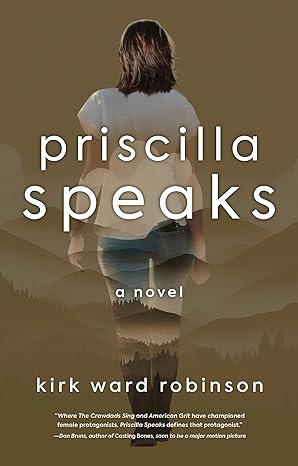

Priscilla Speaks is a raw and moving novel about a young girl born into the harshest corners of Appalachian poverty. The story begins before Priscilla’s birth, with her mother, Blaize, a fierce and wounded woman, doing whatever she can to care for her children and survive in a world that gives her nothing. We follow Priscilla as she grows up in the town of Bilbo, navigating her family’s deep dysfunction, community violence, and the emotional scars passed down from one generation to the next. Robinson crafts a brutal yet intimate look into this young girl’s life as she slowly begins to understand who she is, who her family really is, and how to carve her own place in a world that keeps trying to swallow her whole.
The writing is bold and fearless, with a rhythm that swings between lyrical and gritty. The dialogue feels authentic. The world is murky and tough. The people are full of contradictions. Blaize, for instance, is both the villain and the savior in her children’s lives. Her pain is palpable, but she also passes that pain along. It made me uncomfortable more than once, and that’s a compliment. As a reader, I felt like I was sitting on the edge of a splintered porch with these characters, watching lives unravel and harden, sometimes all in the same breath.
What really stayed with me, though, was Priscilla’s voice. She doesn’t say much, but her silence is louder than everyone else’s shouting. Her mind is sharp. She sees through people. She aches to be seen herself. And when she finally acts, whether it’s to cut off her hair or confront someone who’s hurt her brother, it never feels like a big triumph. It just feels necessary. The author never turns her into a cartoon hero. She’s messy and guarded and real. And the book respects that. The pacing slows in a few places, and some characters feel like they pop in just to fill a theme. But it doesn’t matter much because the emotions land hard.
I’d recommend Priscilla Speaks to anyone who’s tired of polished stories and wants something jagged and honest. It’s not a light read. But it tells the truth in a way that sticks. If you grew up poor, or close to someone who did, you’ll recognize the ache in these pages. And if you didn’t, it’ll open your eyes to what strength and survival really look like.
Pages: 332 | ASIN : B0FB43QHG1




 LITERARY TITAN