Blog Archives
Science and Faith

The Pilgrim follows a man who wakes up to discover his life was all part of an advanced civilization experiment and that he also holds a rare spiritual ability. What was the inspiration for the setup of your story?
Because of my love of family, I have seen my fervor for history, as well as my passion for wondering about the future, deepen dramatically.
The Immortality Wars series was created from several questions I asked myself. For example, given the history of humanity’s conflict between good and evil, what will we be like 540 years from now in 2562? If we continue the exponential increase in our rate of knowledge, where will this rapid development take us? Will we be at peace, or will we be at war? What power will science hold over us? Will faith fall away?
When I was a boy my parents let me go to the movie theater to see Ben‒Hur (1959). I was completely in awe of this film. I was completely immersed in watching a powerful human drama set within the time of Christ. I never experienced anything like it. From that moment on, I wanted to see if I could ever write something similar. When I was older I read J. R. R. Tolkien’s The Hobbit (1937) and The Lord of the Rings (1954 – 1955). The same powerful response to Tolkien’s work that I had to Lew Wallace’s (1880) work of Ben‒Hur, as translated by director William Wallace onto the “big screen,” occurred.
In 2014, I felt I was ready to write, even attempt, such a story. I recalled the quote by Arthur C. Clarke, “Any sufficiently advanced technology is indistinguishable from magic.” It is Clarke’s third law about the future.
I wondered what it would be like if I could somehow bring people from the 18th century, like George Washington, Thomas Jefferson, Benjamin Franklin, and John and Abigail Adams, into the 21st century. These folks are people from a fire and horse culture. What would they think of our present-day world if they were taken to New York City, Paris, London, Tokyo, Abu Dhabi, Beijing, and Shanghai? Would they think of me as a mighty conjuror or wizard?
Then I thought, What would I think and believe if someone from the 26th century brought me into their world? What would such a world look like? What would civilization become? What would happen to faith? To science? To people?
That scenario became the basis for the beginning idea of the series.
I find the world you created in this novel brimming with possibilities. Where did the inspiration for the setting come from and how did it change as you were writing?
The setting in this novel was created based on my wondering about the future and fate of humanity. What will our world look like? Five hundred years ago, 16th-century Europe was ruled by three great powers, those of Henry VIII of England, Holy Roman Emperor Charles V, and Francis I of France. The divine rights of kings became accepted dogma and it led to an absolutism of corrupt power being placed in the hands of a powerful minority of people. It was a world of the horse, the sword, and wooden sailing ships. It was lit by fire and fire alone.
In looking at this world, the world of the 18th century, as well as in our time at the beginning of the 21st century, I wondered if we would have the same conditions in the use of power, fueled by greed, dominance over nature, and an overall corruption of the human spirit. I projected this timeline into the 26th century. I looked at our timeline on the Earth from the Stone Age to the middle of the 26th century.
I then thought about the Earth being polluted so badly, as well as other conditions becoming critically and alarming chaotic that they degrade our planet so badly that a major migration off the planet occurs. Global war, called “The First Armageddon” occurs from 2100 (Old Earth Time, oet) to 2075 oet. Eventually, the Earth is mostly abandoned. The various former world governments and powers seek nearby solace in terraforming and settling on 12 exoplanets that are located in the Orion Spur of the Milky Way Galaxy, which is in the same location as our solar system. They are called The Five Alliances.
The exoplanets were selected from what astronomers are finding from recent cosmological and data. I renamed them, such as Ouroboros where the main action of the Pilgrim ‒ Part I is set. It is located in the constellation of Scorpius and it is 23.6 light years, or 7.232 parsecs from our sun.
The setting of this story evolved with my exposure to the worlds that were unfolding. Each planet has its own individuality, which is based on current astronomical evidence of these exoplanets. As my knowledge of this world increased and it became populated by the beings inhabiting it, the setting became more detailed and real to me.
What were some themes that were important for you to explore in this book?
I wanted to write a story that has intense human drama in it and set it alongside of a background wherein science and faith interact with one another. I wanted it to be a crucible, a severe trial of human, machine, and cyborg endeavors in which rational and spiritual understandings respond and react to one another. I thought I would try to carry on the visions of J. R. R. Tolkien and C. S. Lewis in a 21st century sensibility and see what happens to them. I hope it will be a modern allegory in the manner of John Bunyan’s (1678 oet) The Pilgrim’s Progress. As a Christian, I wanted to see how faith plays itself out in such technologically superior cultures at this point in civilization’s development.
Can you tell us a little about where the story goes in book two and when the novel will be available?
Great question! It puts me on my literary toes.
Without giving a spoiler answer, I plan on returning to Evangel in the Pilgrim ‒ Part II. She is the main character in book two, the Penitent ‒ Part II, of my series. She and Pall Warren are soul mates, yet the story narrative seems to show them meeting one another only through their respective visions and dreams. Evangel, in part, is based on the character of Joan of Arc (c. 1412 – 30 May 1431 oet). She is a young woman with a powerful presence and charismatic personality. She is deeply connected to the Christian faith, which is forbidden in the culture in which she lives. Forces of good and evil gravitate around her more and more. Her high king’s champion advocates for her and brings Evangel under his protection.
I am currently researching and story boarding the next book. Several chapters have been composed but I’m not sure that they are what I want to employ for the completed story in this fifth book.
I used the AI–imager Midjourney v4 to generate a picture of her and I am stunned at the result. It’s a beautiful and captivating photo of Evangel. I plan on using it on the front cover of my next book.
Author Links: GoodReads | Twitter | Facebook | Website
After thinking he dies in combat, a young warrior learns he was in a world created as a human experiment by a ruthless society over 500 years in the future. He must draw upon his combat skills and spiritual power to fight amidst a galactic war whose twelve bases are in a deadly quest for immortality.
It is 2562 Old Earth Time. One reality, created by scientists, technicians, and a corrupt ruling council on a distant exoplanet seeking immortality, erupts into their own. He brings with him all the mortal capacity, knowledge, and prowess in combat he has gained through their experimentation on him.
A sergeant in an elite company of warriors, Pall Warren brings these acquired powers of a medieval time to this realm of sophistication. He also brings with him a rare spiritual ability not seen in 540 years.
Pall is sought by human greed, the morbid manipulation of scientific curiosity, the hunger for religious truth, and the might of cyborg masters. He must fight his way through a theater of war far beyond anything he has ever before witnessed or imagined.
Yet through his perilous journey in two dominions, he is sustained by the love and prayer of a mysterious and beautiful woman from his former life.
The Pilgrim Part 1
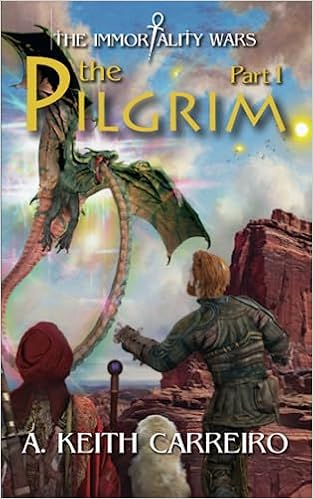

Pall Warren awakens disoriented in an alien world, only to stumble upon a revelation that jolts his understanding of reality: he now resides in a society 500 years advanced from his own, one that conceived his original world merely as an experiment. As a unique byproduct of this experiment, Pall’s characteristics captivate this futuristic society, and he soon realizes his potential role in their ultimate quest: the pursuit of eternal life. Thrust into a war among the twelve factions of this advanced civilization, Pall, the young warrior, grapples with navigating an intricately scientific and technological landscape.
The Pilgrim is a refreshing entry into the sci-fi genre and marks the first book in Keith Carreiro’s second trilogy.
Set against the backdrop of the 26th Century, The Pilgrim gracefully melds traditional thematic undertones with avant-garde characters and concepts, crafting an irresistibly gripping narrative. The book commences with an enigmatic allure, potentially invoking curiosity or perplexity in the reader. Personally, I found it captivating.
Carreiro’s prowess in world-building is noteworthy. He meticulously crafts vivid tapestries of his universe, enhancing the mesmerizing quality of the setting. His writing style can be likened to a masterfully curated art gallery, where each descriptive element coalesces to transport readers into the depths of his imagined universe, the psyche of his characters, and the core essence of the narrative. One can’t help but resonate with the protagonist’s tumultuous emotions, oscillating between multiple realities.
The Pilgrim delves into age-old themes such as the race for dominance through technological prowess, human innovation juxtaposed with greed, and more. Yet, Carreiro’s brilliance lies in weaving these threads in a world unfamiliar to us. Despite its length, the book remains a page-turner and is hard to put down.
Pages: 298 | ASIN : B0C2JML8VF




 LITERARY TITAN