Blog Archives
The Weight of Our Choices

Vendetta: Legend of the Iron Warrior, Vol. 3 follows a fallen hero who is pulled back into a war between heaven and hell, forcing him to confront his past, his faith, and his failures as he decides whether redemption is earned through power or sacrifice. How does Vol. 3 deepen or challenge Travis’s sense of identity compared to earlier books?
Volume 3 peels back the layers of The Iron Warrior like an onion. Volume 1 is the introduction, where we get introduced to him and gain an understanding of who he is. Volume 2 takes it another step up, where he must confront the darkness in him. As challenging as those obstacles were, there was still very much left in the man underneath the armor. Candace attacks him at the levels that no one is supposed to know about. His darkest secrets are exposed. So that leads to the question he has to face throughout the book. What happens when every bit of you is exposed? There is truly nowhere for him to run. It’s one thing to be a public figure, but it’s another when every part of your being is displayed for the world to see. Now he must choose if he should try to be the man he is expected to be or be the broken man he is without worrying about what everyone thinks. We all face that challenge in life. If we are truly aware of ourselves, can we choose the higher choice all the time. And at what point do we break down from the weight of our choices?
Candace Loveless is driven by something deeply personal. What makes her more than just an antagonist?
Candace was introduced in Volume 1: Slaying Paradise. Every scene with her became so much more. It sounds weird, but her voice was so easy to hear. There is so much life in who she is. She felt powerful. Candace is a fully realized person. Because there is so much to her, she can’t fall simply into one category. She is a well-rounded woman with so much more story to tell.
The novel reframes greatness as service rather than glory. When did that idea become central?
That was born in the moments when service is spoken about. Many of us chase greatness and the glory that comes with it. We’ll do things in hopes of attaining that attention, but when you truly look at what makes those who are great, you see service. Unapologetic service to someone or something else. They are unmoved by what they do, and their works capture our attention. It’s their service to others and what they give that we are drawn to. Those who serve the most, who give the most, are the greatest because it shows us what is possible. They become the ones whom we can strive to be. They become the example. Greatness for the sake of glory is worthless. Service is greatness. That is what’s remembered.
What does this volume reveal about the long-term journey of The Iron Warrior?
The Iron Warrior has been tested inside and out. Volume 3 was originally meant to be the end of the story, but Candace changed that. She brought so much to the table that the story with her deserved to stand on its own. The second half of this story literally takes us to hell, Brimstone, where it will end. We’re going to follow The Iron Warrior, who is almost a completely different man from whom we met in Slaying Paradise. It’s taking a man who is potentially at his most reckless and throwing him into a place where his nature will be right at home. A volatile man in a place where there are no limits. What’s the worst that can happen?
Author Links: GoodReads | Amazon
A new enemy, Candace Loveless, knows every secret Travis buried and is determined to destroy him from the inside out. His reputation is destroyed. His allies begin to question him. His faith is pushed to the breaking point.
Now, Travis must face an enemy who knows his past, exploits his weaknesses, and forces him to confront the man beneath the armor.
Vendetta: Legend of the Iron Warrior Vol. 3 delivers cinematic action, emotional conflict, and supernatural warfare in a dark superhero noir fantasy readers have compared to The Batman and City of Bones.
T.V. Holiday’s Vendetta: Legend of The Iron Warrior Vol. 3
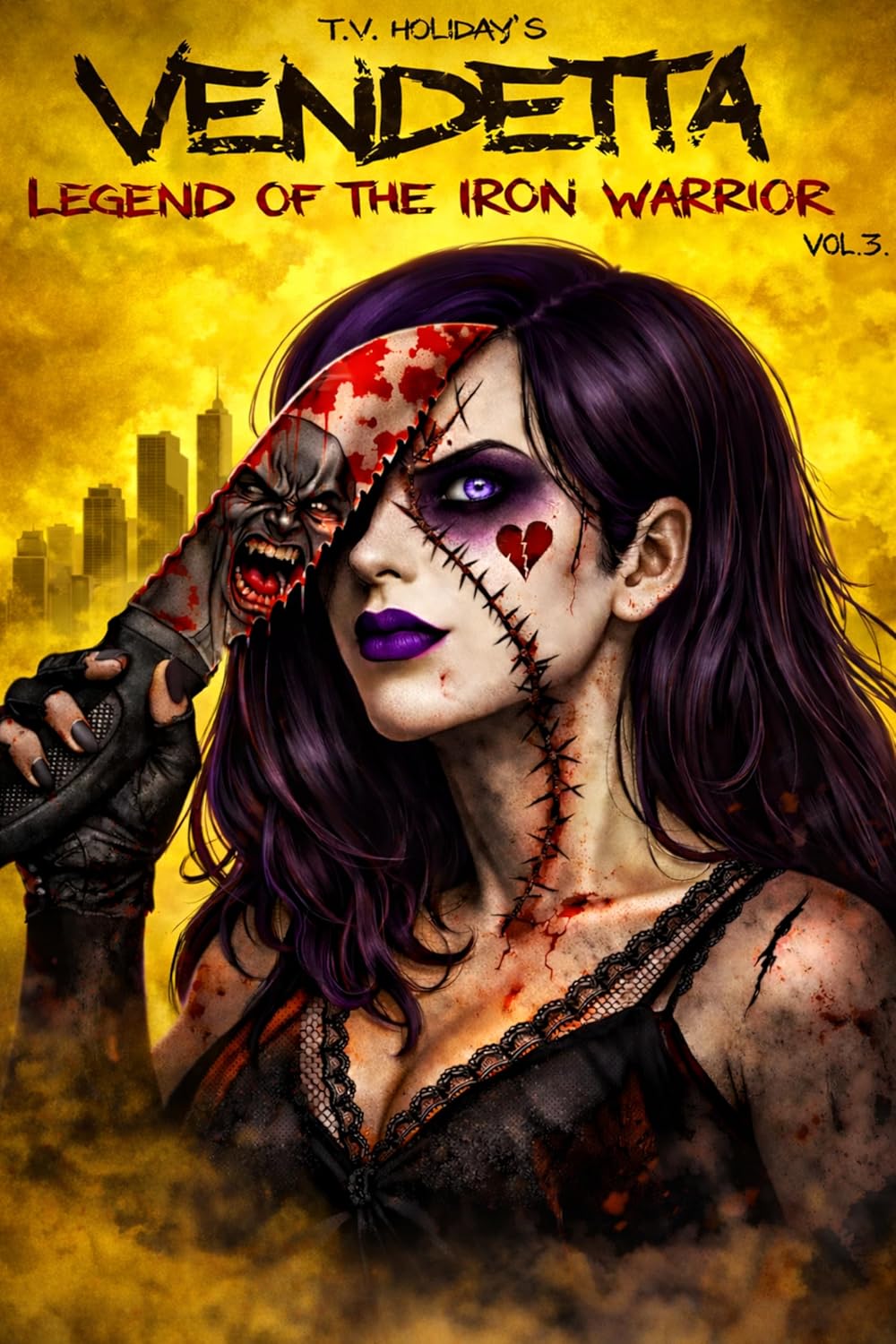

Vendetta: Legend of the Iron Warrior, Vol. 3 is a melodramatic and unexpectedly tender superhero novel about a man trying to outrun destiny and discovering that duty, grief, and faith won’t let him go so easily. Travis Holiday begins the book trying to leave Carnage Coast behind with Crystal and Ashley, only to be pulled back into its holy war, its conspiracies, and its emotional wreckage. What follows is part urban-fantasy action saga, part spiritual crisis, part intimate family drama. The novel moves from bank sieges and villainous set pieces involving Diversion, Hypnotion, and Candace Loveless to a far more inward struggle, as Travis’s identity is exposed, his moral legitimacy is shredded, and he is forced to reckon with what it means to be chosen at all. The strongest thread, for me, was not the mythology on its own, but the way the book keeps yoking cosmic warfare to personal longing, especially Travis’s ache for his son, his bond with Crystal and Ashley, and the late, quietly moving conversation with Mark in jail that reframes greatness as service rather than glory.
T.V. Holiday writes as someone utterly unafraid of intensity, and that conviction gives the novel an entertaining pulse. I was struck by how often the story pauses amid the violence to make room for vulnerability: Leslie’s fear of motherhood in a war zone, Crystal’s private unraveling when doubt creeps into her trust, Ashley’s simple, devastating declaration of love, the strange sweetness of a family barbecue trying to hold itself together while everything around it frays. Those scenes give the book a lived-in heart. Even when the dialogue leans broad or the sentiment comes in hot, I never doubted the feeling behind it. The novel’s deepest interest isn’t spectacle for its own sake. It’s in wounded people trying, sometimes clumsily and sometimes beautifully, to remain worthy of one another.
The prose is maximalist, earnest, and unapologetically larger than life. At its best, that gives the book a comic-book grandeur that suits Carnage Coast perfectly. The opening image of Travis racing the White Ghost across a desert he can’t quite escape is vivid and genuinely memorable, and the action sequences have a propulsive, pulpy swagger. The novel often prefers excess to restraint. Even those rougher edges became part of the experience for me. The book is never coy, never slick, never interested in cool detachment. It wants redemption, love, faith, corruption, sex, betrayal, and apocalypse all on the same canvas, and there’s something oddly winning about how fully it commits to that ambition. The ideas are most compelling when they move away from simple chosenness and toward the harder question the book keeps circling: whether a flawed man can still become meaningful through sacrifice, service, and endurance.
Vendetta: Legend of the Iron Warrior, Vol. 3 is a novel with a fierce emotional engine, a taste for chaos, and a sincere belief that spiritual struggle and human intimacy belong in the same story. The book has conviction, and conviction carries it a long way. I’d recommend it most to readers who enjoy dark superhero fiction, religiously inflected urban fantasy, and stories where the battles in the soul matter just as much as the battles in the street.
Pages: 400 | ASIN : B0GRSZV3YF

Battle Beyond the Veil

Battle Beyond the Veil is an urban fantasy romance that follows Kyden, a battle-weary angel who hunts demons, and Zahra, a museum curator in Boston whose life is built around ancient artifacts, a sick mother, and a pile of color-coded to-do lists. When Zahra’s famous archaeologist father disappears during a dig in Iraq, and a legendary halo called the Atar’zul goes missing, their worlds collide. The missing relic draws demons, angels, and humans into the same storm, and Zahra learns she is Vaelatori, one of the rare humans who can see beyond the veil and is tied to a prophecy about the halo. The book moves between dusty ruins in Babylon, the polished glass cases of a museum, and the unseen spiritual war that rages around them.
What pulled me in first was Zahra herself. She is capable and driven, but she is also tired, snappy in all the right ways, and constantly chewing on Dum-Dums to keep from slipping back into cigarettes. Her stress about the gala, her rage when a coworker quietly takes credit for her work, and the raw ache around her mom’s dementia feel very human. At the same time, you have Kyden on the other side, an immortal who kills demons for a living and drinks way too much coffee, rolling his eyes at humans while still crossing continents to protect them. I liked how the author lets their paths intersect in messy, awkward ways. Zahra literally slams into him at the museum, spills champagne down his front, and then later has to deal with the fact that the hot donor is actually her angelic bodyguard. The romantic beats are there, but the story does not rush into some instant, swoony bond. Instead, it leans into trust, annoyance, and slow respect, which works well for this genre.
On the worldbuilding side, the book feels like a blend of action fantasy and spiritual warfare, with some clear Christian influence but more focus on story than sermon. Angels and demons are not vague forces; they have ranks, rules, and politics. Apollyon leads seven princes of hell tied to the classic deadly sins, each with their own territories. We see grunts whispering in human ears at traffic jams and fancy galas, shifting moods and nudging bad choices rather than throwing fireballs. That small detail, the quiet influence, made the unseen war feel more grounded. I also appreciated the author’s choice to complicate the love angle. The obvious route in an urban fantasy romance would be “girl falls in love with broody angel.” Here, Zahra has a very real, painful history with her ex Jake, and her arc is less about “picking the hottest supernatural guy” and more about figuring out what kind of love and life she actually wants while carrying grief, betrayal, and responsibility. By the end, her connection to Kyden looks more like a sacred partnership born out of the prophecy and shared battles, while her romantic future with Jake feels surprisingly gentle and earned.
By the time I reached the last pages, I felt like the book had threaded its main promise: big supernatural stakes wrapped around a very personal story. The halo is found and fought over, secrets about Zahra’s father and mother click into place, and Zahra steps fully into her role as Vaelatori without losing sight of her normal life as a curator who still has to show up for work. Battle Beyond the Veil will land best with readers who enjoy urban fantasy romance that mixes angels, demons, and prophecies with real-world problems like caregiving, career pressure, and complicated family ties. If you like a story where the spiritual and the everyday sit at the same table, where the action has heart, and the romance is threaded with responsibility and faith, this one is worth picking up.
Pages: 411 | ASIN : B0G67HC9BC
Moral Perspectives

A Haunting Connection is a multi-point-of-view paranormal fantasy centered around a woman with a unique gift struggling to trust those around her and a man who questions his own powers. What was the inspiration for the setup of your story?
In the third grade, I was electrocuted. The hair dyer fell into the tub, and my mom had to revive me. Ever since, I’ve been fascinated by the paranormal and stories about life, death, and the energy that lingers. I love visiting old or historic places, and sometimes I get visions or ideas about what actually happened there. After I read the history, I’m often chilled by how similar my ideas and vision were to actual events.
The inspiration for The Ascension Series came after I delivered a package to a mysterious house on Cougar Mountain in Bellevue, WA. My scanner kept glitching when I went there, and my imagination created a story as to why. The house seemed to push me to start writing.
The other thing that inspired this book was Korean dramas. I watch them with my daughter and found myself sketching one out about an American in Korea caught in a complicated emotional situation. That concept worked perfectly for Brandon’s storyline.
Brandon acts as a kind of moral counterweight to Leah. How did you develop the contrast between their paths?
Brandon and Leah’s contrast really came from my travels. When I lived in Japan, I saw how people orient themselves around family, community, and the greater good. In Thailand, life seemed to be more about survival. People were more willing to take risks. In the U.S., our values create tension around personal desire and social expectations. We see these differences not only in cultures, but in age groups.
Leah is young and discovering her powers. She wants to help people, but that help comes in the form of manipulation. Over time, she finds herself justifying her actions for the greater good.
Brandon is a detective. He’s seen addiction and the misuse of power. So when he’s introduced to Yoona and given the chance to learn, he questions everything.
That contrast allowed me to explore the temptation of power and the discipline required to resist it. Their paths highlight perspective, life experience, and emotional maturity.
The multi-POV structure gives readers access to very different moral perspectives. What challenges did you face in balancing those viewpoints?
The biggest challenge was fully inhabiting each character—history, motivations, personal goals, and moral perspectives. I needed their actions to feel authentic to who they were, not a device to move the plot forward.
Another challenge was working with powerful characters. Yoona had to take actions that at times could be judged as morally wrong. But she sees the full picture and knows that in order to achieve necessary outcomes, she must bend her morality. That’s tricky when she is supposed to hold the moral high ground. But it works because Brandon, being skeptical, questions her, and in doing so, we explore the gray areas of morality.
When I traveled overseas, I saw knockoff brands everywhere, sold openly. In the U.S., doing the same thing could get you sued. But in Thailand, selling these items is a way to put food on the table. That raises questions: how do we judge what’s right or wrong when necessity forces choices we might otherwise reject? That tension is at the heart of A Haunting Connection.
Another major challenge I had was the cost. What is the cost for each character? For Leah, it’s her father’s trust, her best friend’s loyalty, and her own ability to choose. Power pulls, and each time she uses it, she loses the ability to resist.
Can you give us a glimpse inside Book 3 of The Ascension Series? Where will it take readers?
A Haunting Redemption opens with the same 1945 Nagasaki scene that started the first two books, but this time from Yoona’s perspective. Readers finally see the full story behind the pivotal moment that shaped the present.
From there, the story picks up where book two left off, with the long-anticipated disturbance Choi and Yoona have been talking about since book one. This event affects every character, altering lives and the world around them.
Then we race toward the confrontation between Ruth and Yoona. Who ends up redeeming themselves along the way, and how does that redemption change the world forever?
Leah Davenport survived the supernatural nightmare of A Haunting Deception,
but her struggles have only begun.
From Washington to Seoul, leaders and manipulators see her as the key to
shaping the world’s future. For Leah carries a rare gift: the ability to step inside
minds, to bend thoughts and feelings as if they were her own. And with every
use of her gift, she walks the path that destroyed those before her.
Caught between rivals, Leah must decide who to trust and how far she’s willing
to go to keep her freedom.
Meanwhile, Brandon Spencer trains with a shaman in Korea who promises similar
power, yet he begins to question whether such power is a gift, or a curse that
corrupts everyone who wields it.
Power has a price, and that price devours everything you love.
From Misfit to Mastery

Shamaness: The Silent Seer follows a young girl born mute but also psychic, who, despite a childhood filled with cruelty, grows into a powerful shamaness. What was the first image or moment that sparked this story for you?
I literally dreamed the story of Kreya, the psychic but mute girl whose destiny takes her on a journey from misfit to mastery. Start to finish, including the main characters and events! It’s the only time that’s happened to me, and it took years after that dream to craft the story.
The shamanic teachings unfold slowly, almost as if the reader is being trained alongside Kreya. Was that intentional?
Yes. In high school when my classmates were exploring psychedelics, I was hunkered down on the floor of the dusty stacks at the local library, reading about ancient cultures and healing traditions. I wanted to share those traditions and beliefs in a way that makes sense for today’s readers. As a corollary, I also teach yoga:).
Kreya’s grandmother’s “rainbow voice” is a striking image. How do symbols like that function in your storytelling?
As a clinician working with individuals of all ages and brain-based conditions, I came to appreciate the role of multisensory experience and understanding. I perceive people in five senses! For me, sounds can inspire colors, just as sights can inspire physiological responses smells inspire memories. Amma’s presence seemed to me like a rainbow, so her speech carries that aspect.
You frame the novel between Kreya’s childhood and her sixtieth summer. Why was it important to tell the story from both ends of her life?
I rewrote the story three times, experimenting with different beginnings/endings and timelines. My wonderful critique partner read the second one and told me to “shred this and start over.” It was the best advice! I realized that the reader needed to know from the beginning that Kreya would not be defeated, that her future was solid.
Author Links: Facebook | Website
SHAMANESS – The Silent Seer


Shamaness: The Silent Seer is a spiritual coming-of-age fantasy that follows Kreya, a gifted but marginalized girl who grows into a powerful shamaness. The story moves between her sixtieth summer, when she is grieving her husband and preparing for a final journey, and her childhood at Sky Lake, where she faces cruelty, discovers her abilities, and learns the foundations of healing and mysticism. It feels part myth, part memoir, part adventure, all held together by a steady emotional core.
I found myself drawn in by Kreya’s honesty. Her voice is reflective and calm, even when she is recounting childhood humiliation or danger, like the moment she can’t warn a boy about the bobcat in clear speech or the time she senses Sholana’s peril before anyone else understands what is happening. Nothing feels rushed. I liked that she didn’t try to make Kreya flawless. Her frustration, her longing to communicate, and her flashes of humor make her feel real. The writing leans into sensory details in ways that feel earned; when Kreya describes Sky Lake or her grandmother’s “rainbow voice,” the images land gently instead of feeling decorative.
The deeper ideas of the book stayed with me. The fantasy elements feel rooted in emotional truth rather than spectacle. The shamanic teachings are presented slowly, almost like the author wants the reader to learn them alongside Kreya. I found myself curious and occasionally moved, especially by the repeated lesson that healing involves choice, not force. The scenes connecting past and present add a wistful tone. Watching Kreya train her great-grandson while carrying the weight of her promise to scatter her husband’s ashes, I kept thinking about how wisdom is passed forward and what it costs the person who carries it.
The tone of the book never turns grandiose; it stays grounded even when touching on visions, spirit companions, or the mysteries between worlds. This blend of accessibility and quiet wonder is what makes the fantasy genre work so well here. If you enjoy character-driven fantasy, spiritual journeys, or stories that move at the pace of memory rather than battle drums, this book will speak to you. Readers who like reflective narratives with a strong emotional core will probably appreciate it most.
Pages: 265 | ASIN : B0FZDB3RM9
Elf Stone of the Neyna

Elf Stone of the Neyna is a character-driven fantasy adventure that follows Yanda Selkeden, a surgeon from the planet Alland who is wrenched away from her life and her young daughter when a mysterious psychic call drags her onto a ship and into captivity. The novel moves from claustrophobic imprisonment on a barren moon to the toxic, war-scarred world of Terlond, where Yanda and a diverse group of other abducted women, each with unusual abilities, must survive the schemes of the mind-controlling mage Kridenit. As Yanda forms bonds, grows her own powers, and eventually encounters the ancient Elves whose fractured Great Stone summoned her, the story blends science fiction settings with classic fantasy motifs, creating a hybrid genre that feels both familiar and new.
Reading this in Yanda’s corner of the universe pulled me in quicker than I expected. The writing has a clean, direct style that makes even the stranger pieces of worldbuilding, mind-speak, stasis flights, toxic moons with domed prisons, easy to settle into. I found myself warming to the rhythm of scenes where the women talk in their cells late at night, learning to trust each other despite trauma and fear. Those chapters felt grounded and human. At the same time, the book isn’t shy about darkness. Kridenit’s manipulation and violation of Yanda is handled with a starkness that made me pause. It’s uncomfortable because it’s meant to be. The author doesn’t sensationalize it, but she doesn’t soften it either, and that honesty shapes the emotional arc of the whole story.
What surprised me most was how the story shifts tone once the Elves enter more fully. When Zamani reveals the true nature of the Stone and Yanda’s connection to it, the narrative opens up. The fantasy elements step forward, the ancient magic, the living forests, the sense of destiny pulling at her life. Those scenes have a gentler color to them, almost like stepping from a metal corridor into filtered green light. I liked that the book didn’t rush to resolve Yanda’s sense of guilt over leaving her daughter or the unease she feels about how her powers are growing. The author gives her space to make mistakes, to wonder, to push back. It makes her feel real in a story full of mind magic and star travel.
I walked away feeling like I’d been given a part of a much larger journey. The book’s blend of science fiction and fantasy, its hybrid genre, will appeal to readers who like character-centered stories with both technology and ancient magic intertwined. If you like your fantasy worlds with a hint of sci-fi grit and emotional stakes that don’t let up, Elf Stone of the Neyna is worth your time.
Pages: 308 | ASIN : B0C1629PRX

We Have Agency
Time and Space follows a woman on the verge of turning forty who, on the way to work, is kidnapped by three university-aged young men from the future and is taken forward in time to a society built on patriarchal dominance. What was the inspiration for the setup of your story?
I remember becoming angrier and angrier at the objectification of women and the failed promise of equality.
Women’s Liberation hit the news when I was in school. I also grew up with a Zoroastrian father who taught us, in accordance with his religion, that men and women are equal. I didn’t understand the need for Women’s Lib until my later university/early working years, when I saw how women were treated in the workplace. Decades on, and except for Federal and provincial Canadian laws, nothing had changed. Women who felt they were liberated because of issues around sex having been loosened were wrong. It seemed like only the older generation understood that changing laws and mores didn’t translate to women being treated and perceived as equal to men. Whether women were virtually unclothed in one culture or covered up to the eyeballs in another, they were still being treated as objects for men to control. They still had less value.
I was also getting fed up with how Toronto and Ontario treat Toronto’s public transit and the commodification of every aspect of life.
On a personal note, I had little control over any part of my life because of my brain injury. I guess I was telling myself through Time’s story that we may not see it, but we have agency.
What are some things that you find interesting about the human condition that you think make for great fiction?
Our weaknesses. And the forces that both exploit them and force us to grow. That often surprises us when they lead us to fulfilling our own potential.
What were some themes that were important for you to explore in this book?
Sexism:
- The objectification of women and how they’re perceived as either baby bearers or sex fulfillers for men.
- What equality truly looks like when men and women perceive women as having inherent worth.
- Women recognizing their own intelligence, both to receive help and to problem-solve their own challenges.
Classism:
- Through the neglect of public transit.
- In the commercial arena or public spaces.
Racism:
- I’ll leave this to the reader to ponder the way I presented it and its meaning.
Ageism:
- I made Time an older woman.
- Since then, I began writing a trilogy (The Q’Zam’Ta Trilogy) featuring a woman in her 60s. Book one, The Soul’s Awakening, is out now.
- With such an emphasis on stories with younger people and the whole mindset that the youth will “save us,” we need to hear stories about older people also able to “save us,” especially older women in nondescript jobs.
What is the next book that you are working on, and when can your fans expect it to be out?
I’ll be publishing The Soul’s Reckoning, book 2 of The Q’Zam’Ta Trilogy, in December 2025 and am currently writing book 3, The Soul’s Turning, which I hope will come out at the end of 2026.
I’m particularly excited about The Soul’s Turning because it’s set in far, far future Toronto, London, and Mumbai, and expands on some of the technology and themes I first explored in Time and Space. However, I’ll be making climate change an essential background to the character development and plot settings. And unlike Time and Space, it delves into the latter aspects of Revelation — what would a world without Satan and the beasts of “the elite” actually look like?
Author Links: GoodReads | Bluesky | Website | Amazon
Time is turning forty, but her ordinary morning walk to work shatters when three university-aged boys from the future snatch her into a shimmering white cube. Their destination: a technologically advanced, male-dominated future where girls are tightly controlled, kept cosmetically perfect, and denied knowledge and autonomy.
When their professor discovers the abduction, he’s furious. The boys had promised never to interfere with the past again. Now he orders them to dump Time in a desolate era few dare visit, The Nasty Time. It’s 2411. The world is stripped of equality, connection, and choice. Time is abandoned and left stranded.
But someone unexpected intervenes, offering Time a sliver of hope—and knowledge she never asked for. Now, survival may depend on learning more than she ever imagined.
Smart, satirical, and deeply unsettling, Time and Space is a genre-defying journey across centuries and systems of control. Shireen Jeejeebhoy blends speculative science, biting social commentary, and sharp humour in a story that asks: “What happens when the powerless are forced to reclaim their life—or be erased from their future?”
Time is waiting. Don’t delay.


