Blog Archives
The Moment I Stopped Disappearing

The Quiet Calendar follows a woman day by day as she leaves a damaging entanglement and rebuilds herself through small, tender moments of clarity, grief, and hard-won peace. Why was this an important book for you to write?
The Quiet Calendar was important for me to write because it marks the moment I stopped disappearing inside someone else’s narrative. I didn’t write it to explain what happened or to assign blame. I wrote it to reclaim myself. At the time, I was moving through grief quietly, functioning outwardly while unraveling inwardly. Writing gave me a place to be honest without performing strength.
This book documents the shift from survival to clarity. It captures how healing actually happens, not in grand gestures, but in small, private recognitions: a day without checking a phone, a breath that doesn’t hurt, a morning that belongs to you again. Writing it helped me turn silence into something useful. It became proof that I could leave, endure, and rebuild, one day at a time.
Why did you choose a day-by-day structure, and how did time shape the emotional arc of the book?
The day-by-day structure mirrors how grief behaves. When you’re in it, time becomes both oppressive and necessary, you count days because surviving them feels like an accomplishment. I needed the structure to ground me, to make the intangible measurable. I was writing in real time to replace texts I no longer sent.
Time shapes the emotional arc by revealing patterns. Early days are raw, repetitive, desperate. Later days are quieter, less dramatic, but more honest. The absence of intensity becomes its own kind of progress. By the end, the act of counting is no longer needed. That’s the real arc: not closure, but release. The calendar eventually dissolves because the life underneath it returns.
How did you decide when simplicity was enough, especially when writing about manipulation and pain?
Simplicity became a boundary. When you’ve lived through manipulation, language can become tangled, over-explained, defensive, performative. I stripped the poems down because clarity is an act of self-respect.
I trusted that naming a truth plainly was more powerful than dramatizing it. Pain doesn’t always need elaboration; often it needs space. Short lines, lowercase, and restraint allowed the reader to feel without being told how. When the words felt quiet but steady, when they no longer asked for validation. That’s how I knew simplicity was enough.
I’ve spent decades in an operating room, where time matters and conversations are often brief, interrupted, or unfinished. That environment teaches you to speak clearly and only when it counts.
My writing carries that discipline. I trust simplicity because it gets to the truth faster. When words are chosen carefully, they don’t need to be loud.
What role did the drawings play in your own healing process while creating the book?
The drawings were a parallel language. When words felt too loaded, drawing allowed me to process without narrative or justification. They slowed me down. They asked for presence, not explanation.
Visually, they echo the themes of the book—keys, time, absence, return—but emotionally, they served as anchors. They reminded me that creation doesn’t always require articulation. Sometimes healing happens through the hands before it reaches the voice. The drawings helped me stay connected to myself while the poems helped me name what I was leaving behind.
The sketches invite the reader into my internal landscape. They aren’t explanations, they’re presence. I wanted the reader to feel immersed, to experience the emotional weight of the book not just through words, but through what is seen and held in silence.
Author Links: X | Facebook | Website
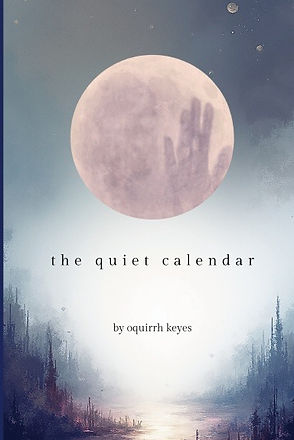
What do you do when the person you loved disappears into silence?
You count. You write. You learn to breathe again.
the quiet calendar is a day-by-day descent into heartbreak—and the unexpected rise that follows. With stark honesty and gentle restraint, these poems illuminate the stillness after loss and the strength found within it.
For anyone who has ever held on too long or had to let go without closure, this collection offers recognition, release, and the quiet beginning of renewal.
the quiet calendar
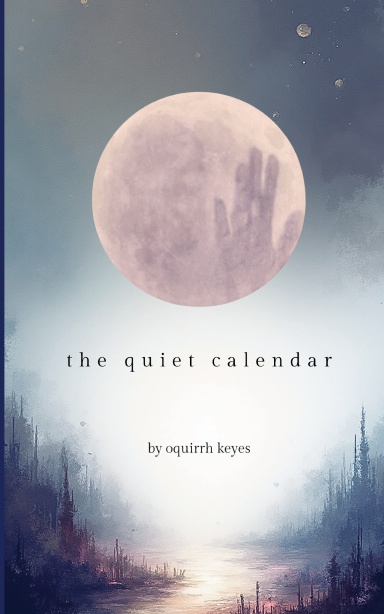

The Quiet Calendar feels like a month of someone’s inner world laid bare. It traces day by day how a woman crawls out of a long, damaging entanglement and slowly learns to hear her own voice again. The book moves through grief, shock, anger, clarity, and finally something like peace. Each poem marks a moment in time. Some are sharp. Others feel like exhaling after holding your breath. The drawings scattered through the book soften the blows a bit. They echo the mood of the poems and give everything a floating, ghostly feel. The whole collection reads like a journal.
As I moved through the pages, I felt myself pulled into her emotional rhythm. The writing is simple on the surface, but it hits hard because of that simplicity. Some lines shocked me with how plainly they revealed the manipulation she endured. Other lines made me root for her like a friend who keeps getting stronger each day without realizing it. The pacing is tight. The shift from longing to clarity feels natural. It never rushes.
I also loved the way the book explores self-return. Many poems break open the idea that healing is not one big moment. It is a series of tiny decisions that build you back up. I felt myself smiling at her small victories. A cup of coffee alone. A morning without checking the phone. A song that once hurt now simply playing in the background. These little moments felt huge and real and made me weirdly proud of her. The writing carries a lot of tenderness, even when it stings, and I kept thinking about how many people will see bits of their own story in hers. The art deepened that feeling. The cracked hourglass. The key with wings. The feather.
The book is honest about the messy parts of leaving someone who should never have been held so tightly. It is gentle about the slow return to a life that was waiting the whole time. I would recommend The Quiet Calendar to anyone who is coming out of a breakup that left them confused, guilty, or hollow. It is soft, real, and full of small truths.
Pages: 112 | ISBN: 9798218838591




 LITERARY TITAN