Blog Archives
The Face of Expression 3: Fall of A King
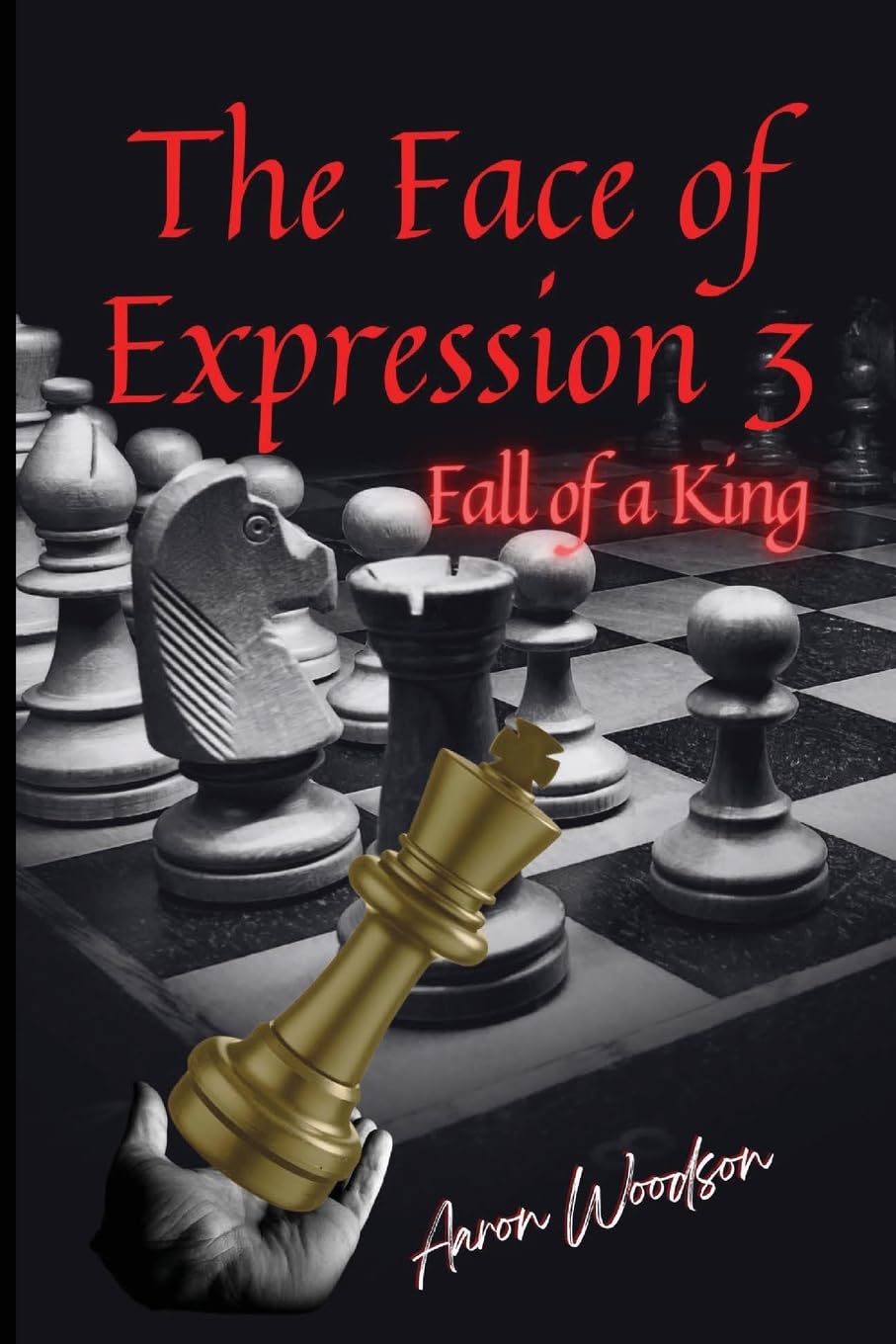

The Face of Expression 3: Fall of a King by Aaron Woodson is a sprawling, deeply personal poetry collection about faith, masculinity, love, Black identity, heartbreak, endurance, and spiritual repair. It moves like a long testimony, beginning with surrender in “Chess With God,” swelling into declarations like “Leading With Love,” “Black By Popular Demand,” and “Heart of A Lion,” then circling through romance, loneliness, self-worth, social pain, fatherhood, exhaustion, and legacy before arriving at the title poem, “Fallen Kings,” and the quieter ache of “Swan Song.” The book feels less like a neat, curated volume and more like a life poured straight onto the page, sometimes polished, sometimes raw, but almost always emotionally direct.
I felt the force of that in poems like “Still on My Feet,” where the speaker is bruised but refuses to retreat, and in “Quitting,” where the honesty turns darker, wearier, and more vulnerable. Woodson writes often from the posture of a king, a soldier, a lover, a believer, but the most moving moments come when the crown slips a little and I can see the tired man underneath it. In “Anchor,” the prayer isn’t ornamental. It sounds like someone genuinely close to breaking, asking God to hold him in place before the storm takes him. That kind of naked need gives the collection its heartbeat.
Woodson’s style is conversational, repetitive, sometimes sermon-like, and he often leans into big declarations rather than subtle turns. I admired the sheer openness of the voice. Poems like “Waves” and “Pilot” stretch an idea almost playfully until it becomes metaphor, memory, flirtation, joke, and testimony all at once. “Black By Popular Demand” has a proud, pulsing confidence that feels communal rather than merely personal, while “Hello Handsome” turns self-affirmation into something funny, sensual, and strangely tender. The ideas in the book are not shy ones. Love heals. God rescues. Blackness is beautiful. Men hurt. People fail each other. Grace remains.
By the end, I felt like I’d spent time with someone determined to bless the wounds that shaped him, not deny them. The Face of Expression 3 isn’t a delicate book, and it isn’t trying to be. It’s loud, searching, romantic, wounded, faithful, proud, and full of hard-earned hope. This collection works best when read as a testimony in motion, not as a pristine literary object. I’d recommend it to readers who enjoy confessional, faith-centered poetry with a strong spoken-word current, especially those drawn to reflections on Black manhood, resilience, love, and spiritual recovery.
Pages: 414 | ISBN : 1953526322

The Magical World of Poetry

The Magical World of Poetry by Sandy Whiting is a warm, classroom-friendly collection that introduces young readers to acrostics, cinquains, concrete poems, free verse, haiku, and rhyme before sending them into poems about animals, sports, food, weather, holidays, and fantasy. It feels both like a poetry anthology and a gentle workbook, with prompts, definitions, playful illustrations, and an answer key that invite children not only to read poems, but to notice how poems are made.
I found the book at its best when it lets silliness and tenderness sit beside each other. A karate-kicking cat, a clownfish that refuses to act like a clown, and a snake enjoying the swing set all have that childlike “what if?” sparkle, but then a poem like “Secret Ingredient” quietly changes the air, turning baking with grandma into memory, flour, love, and ache. The book doesn’t treat children as though they can only handle jokes or only handle lessons. It trusts them with wonder, grief, goofiness, pride, and imagination.
The writing is approachable, sometimes simple, and that’s its strength. Some rhymes land with an easy bounce that would be lovely aloud, especially in pieces like “Who’s There?” and “Fun Without Sun,” where repetition gives the poems a bright, chant-like energy. Other poems feel more instructional than surprising, as though the form is carrying the piece more than the image or music. Still, I admired the clarity of the book’s purpose. The poems open doors. The concrete poems, the haiku, and the free verse pieces such as “Keep Swimming” and “Cyclone” show young writers that poetry can be funny, shaped, breathy, anxious, brave, or quiet.
The book’s real magic wasn’t in any single poem, but in its invitation to participate. It’s a book for children who are curious about writing, for teachers building a poetry unit, for families who like reading aloud, and for young readers who need permission to play with words before worrying about perfection. I’d recommend it especially to elementary and middle-grade writers who are just discovering that a poem can be a joke, a memory, a spell, or a small hand reaching toward the world.
Pages: 138 | ASIN : B0GL9QNGY5
Literary Titan Gold Book Award: Poetry

The Literary Titan Book Award recognizes poets who demonstrate exceptional artistry and proficiency and push the boundaries of language and expression. The recipients are poets who excel in their technical skills and evoke deep emotional responses, challenge thoughts, and illuminate new perspectives through their work. The award honors those who contribute to the literary landscape with their unique voices and powerful words.
Award Recipients




Visit the Literary Titan Book Awards page to see award information.
Unleashing The Power Within: A Journey of Self-Discovery Through Poetry
Unleashing the Power Within is a short, heartfelt collection of inspirational poems that moves through self-worth, recovery, faith, gratitude, nature, and personal renewal. Lisa McCarthy writes as someone who has suffered, endured, and come out the other side determined to speak encouragement over both herself and her reader. The book’s emotional arc gathers force as recurring ideas echo across the collection: breaking free from harm, setting boundaries, trusting intuition, reclaiming one’s voice, and finally rooting identity in God. What gives it shape beyond affirmation is the sense that these poems arise from lived experience, especially when the book turns personal in pieces like “My Freedom Day” and “From Silence to Self-Acceptance,” where liberation stops being an abstract slogan and starts to feel earned.
McCarthy isn’t trying to be sly or ironic, and that lack of distance gives the collection a disarming openness. When she writes about blooming “beneath the ashes and dirt,” or compares healing to pushing toward light, the imagery is simple, but it lands because she means it. I felt that again in the poems about the natural world, especially the red cedar trees, the Gulf of Mexico beach, the lavender fields, and those bright little “Golden Finches in the Rain.” Those poems briefly loosen the book’s grip on exhortation and let it breathe. They offer a quieter kind of restoration, and I found myself wishing there were even more of them, because McCarthy’s voice is often at its most vivid when she pauses long enough to really look.
McCarthy returns to the language of empowerment, destiny, courage, and self-belief. I respected the clarity of the ideas. This is a book deeply invested in healthy boundaries, in refusing negativity, in choosing gratitude, and in seeing survival not just as escape but as transformation. Even when the phrasing is familiar, the conviction behind it feels real, and that reality matters.
I read Unleashing the Power Within less as a formally ambitious poetry collection than as a personal testament shaped into verse, and on those terms it has genuine warmth and purpose. It’s a book about speaking kindly to the bruised parts of the self until they begin to believe they deserve light. I would recommend it to readers who want accessible, faith-tinged, emotionally direct poetry about healing, resilience, and beginning again. For someone coming through loss, self-doubt, or a hard season of change, this book could feel like a companionable hand on the shoulder.
Pages: 96 | ASIN : B0DBVC33S5
More Other Such Matters
Fella Cederbaum’s More Other Such Matters is a book of spiritually searching poems that circle around identity, love, mortality, truth, and the terrible persistence of the thinking mind. The collection moves less like a narrative than like a sustained act of inquiry, each poem worrying at the same great questions from a different angle until they start to glow. Again and again, Cederbaum turns to direct address and cascading questions, asking what remains when profession, doctrine, self-image, fear, and even opinion fall away. Poems like “Before You Were You,” “Faith,” “The Knower And The Known,” and “The Mirror” make the book feel like both a meditation manual and a private reckoning, though its strongest moments are more intimate and embodied than abstract.
What struck me most was the book’s unusual combination of severity and tenderness. Cederbaum can sound almost admonishing, as if she’s trying to shake the reader awake, but there’s warmth under that urgency, and often a real ache. I felt that most sharply in poems where the philosophical pressure gives way to something bruised and personal, like the old tears in “Love Broke Through,” the lonely vastness of “One Single Tear,” or the quietly devastating recognition in “What I Thought I Wanted,” where imagined identities keep turning bland in the hand. Even the more playful poems, especially “My Universe of Cheese,” have that same undercurrent: delight laced with metaphysical impatience. I admired the refusal to settle for easy consolation. This isn’t poetry interested in decorating experience. It wants to strip experience bare.
The book is most effective when its style becomes genuinely musical. Cederbaum has a real instinct for repetition, for the pressure of a recurring phrase, for the way a question can become its own rhythm. Her best lines have lift and clarity, and her images can be surprisingly memorable, as with the orchid and the daisy, the cat as a silent teacher in “Medical Journeys,” or the mirror that keeps changing with praise, desire, and self-doubt until the poem lands on a wiser, steadier truth. The poems return often to oneness, surrender, and the unreliability of thought. But even then, the voice is unmistakably authentic.
I found More Other Such Matters earnest, searching, and often deeply affecting. It’s a book less interested in polish than in penetration, less interested in literary coyness than in saying the largest things as plainly as possible. I think readers drawn to spiritual poetry, contemplative writing, and emotionally candid meditations on selfhood, love, and impermanence will find a great deal here.
Pages: 156 | ASIN : B0FR37DNSZ
Inspiring Others Through Your Work

Poetic Mind 2 is a raw and emotionally direct collection of poetry that transforms pain, memory, and inner conflict into language that comforts, challenges, and urges others to keep going. Do you see this book more as self-expression, communication, or a form of support for readers?
All of the above. I believe the biggest purpose of writing to be inspiring others through your work. That’s what is big to me. I do have a lot of fans, but to me, writing is a platform that I can use to inspire. I’m not in this for the money. I do this because I love writing. I can express myself and communicate through it. Take someone who is going through rough times and motivate them by picking up a book and reading about the things that come from my imagination. We all need reminders, at times, to keep pushing forward. Through pain and mistakes…that is how we learn. I love touching the lives of others in a positive way through my poetry.
How do you approach writing about difficult experiences like grief, trauma, or war without losing authenticity?
By being 100% genuine at all times. I only write about what I have lived through and I do not judge others. There is always someone out there in a more difficult situation than us, regardless of what we go through. I write raw and uncut because I am not ashamed of who I was, and nobody else should ever be either. We are all human, and we cannot dwell on the past.
The collection often feels like it’s reaching directly toward the reader. Do you write with a specific reader in mind who might need these messages?
Absolutely. I want everyone to know that regardless of how you grew up, whether you are white, black, or brown, rich or poor, young or old, gay or straight, and especially those who feel they don’t fit in and have been bullied…we are all somebody. I have posted many poems on social media, and my favorite days are when people comment that they have also been in that situation, and my words helped them. It moves me beyond words and is proof that deep down inside, we are all somewhat alike.
What did you want Poetic Mind 2 to do that your earlier work didn’t, and are there themes you feel you’re still trying to fully capture?
I decided that I wasn’t finished yet. Poetic Mind is going to be a trilogy, with Poetic Mind-Lyrical Storm, the final installment coming in 2027. Poetic Mind 2 is a storm within the mind. Some funny, some serious, some explosive. Like the journey we all go through with our emotions each day. It gets more intense with each book. Poetic Mind 2 has set the stage for a lyric storm, where all of my emotions will hit at once, and that will come to fruition in the final Poetic Mind installment.
Author Links: Facebook | Website
At once reflective and piercing, Poetic Mind 2 invites readers into the restless landscape of the mind, where ordinary moments open into something enduring, and where language becomes a way of understanding the world, and ourselves.
Release & Be Free: An Enlightening Erotic Anthology


Release & Be Free is an erotic anthology, but it isn’t interested in eroticism as spectacle alone. I think what the author is really writing about, again and again, is liberation: sexual, emotional, spiritual, generational. The book moves through poems and stories that treat desire as revelation, whether that’s the surreal, shape-shifting mythology of “Mow Me Down,” where a supernatural sexual curse becomes a story about tenderness breaking inheritance, or the more intimate pieces that turn toward self-worth, patience, motherhood, and the ache of becoming someone freer than you were taught to be. Even when the book is at its most explicit, it keeps reaching for something deeper, and that tension gives the collection its identity.
Angelica Stevenson writes with almost no ironic shield at all, and I found that disarming. In “Mow Me Down,” the wildness of cursed women, levitating lawnmowers, and men who only prove worthy when they slow down long enough to ask, to listen, to please, could have tipped into pure camp, but there’s real feeling underneath it. The emotional logic is clear even when the plot is gloriously excessive. I felt that same pulse in the poems too. “Patience’s Patient” and “A Soul Kiss” shift the mood completely, but in a way that makes the anthology feel fuller rather than scattered. They bring in healing, motherhood, self-regard, and the painful work of learning how to receive love without losing yourself. That emotional openness gave the book its strongest moments for me.
Stevenson has a bold voice. She likes intensity, repetition, declaration, and heat. Sometimes, the prose can be rough or more direct than elegant. But there’s also a raw immediacy to that style that suits the material. The book’s best scenes aren’t polished into cool perfection. They’re vivid, impulsive, strange, and emotionally exposed. I especially liked how often the ideas beneath the sex were about agency rather than conquest. Rebel’s refusal to be pulled in too easily, the sisterly ache between Zaphena and Ragina, the self-recognition in “The Art of Roses,” even the charged chaos of stories like “Murderous Intimacy,” all of it suggests a writer trying to fuse body and spirit instead of pretending they live in separate rooms.
I found Release & Be Free: An Enlightening Erotic Anthology sincere, imaginative, and unexpectedly heartfelt. What it offers is emotional candor, erotic fantasy with a spiritual undertow, and a voice that feels genuinely personal. I’d recommend it to readers who enjoy erotica with mythic flair, emotional directness, and a strong interest in healing, transformation, and feminine power. It left me feeling that Stevenson’s real subject isn’t sex by itself, but what sex can uncover when a person is finally ready to be honest.
Pages: 235 | ISBN: 9798233384141
Private Survival

To Say Goodbye Again is an emotionally candid poetry collection that turns grief, memory, love, labor, and trauma into language strong enough to bear what silence could not. What inspired you to write and publish this collection?
Writing To Say Goodbye Again wasn’t something I planned—it was something I needed. After years on the road as a truck driver, hauling freight across the continent, I carried a lot more than cargo. Grief, memories of family, lost love, the weight of hard work, and old wounds that never quite healed—they all rode shotgun with me. When I finally retired and had time to sit still, those things started demanding to be spoken. Poetry became the way, I could carry what silence couldn’t hold anymore.
I also wanted to prove to myself that I could start a project like this and finish it. I needed to leave behind something for my children to remember me by—something more than just the constant reminders to be responsible, the harping on obligations and discipline. I wanted them to know they had a father who was a dreamer, a goal setter, and who lived for humanity rather than just himself.
Publishing it was about turning private survival into something shared. If one person reads it and feels less alone in their own mess of love, loss, or regret, then it was worth laying it all bare. It’s my way of saying: here’s what the road, the years, and the heart taught me. Take what you need.
How did the structure of the book evolve as you moved from grief and family memory toward “Princess”?
It started as fragments—short pieces about saying goodbye to people and dogs and old versions of myself. The early poems circle grief and family the way you circle a wound that won’t close. I didn’t force an order at first; I just let the memories come out as they needed to.
The strange thing about the final chapter is that I was sidestepping around the idea of adding “Princess” at all. I was more focused on creating a poetry collection that was uniquely universal. I wanted the book to find readers who needed the roller coaster of emotions—that way I was certain to provide something for everyone. “Springtime,” which is a popular piece, was going to be the last chapter.
Ironically, it was during that same week I first started seriously entertaining the thought of publishing the work that the trauma of my childhood came to a head. It was a serious week of hell. I felt that at this point in my life, if I didn’t face all the toxic emotions I carried with intelligence and in a reasonable way, I would rot and die with it inside me—and my family would continue to wonder why I was so sad and withdrawn.
After a week of dealing with it head-on, I finally made the decision to incorporate “Princess.” What I felt, however, was that if I was going to write that piece, I wanted to convey a message to the reader without vitriol and without sounding like a victim seeking sympathy. It needed to be written with wisdom and to lead the reader calmly through the storm. Nothing is learned if we shock the reader and force them to close the book. My desire was to meet people where they were, and that doesn’t work if we chase them away.
Once “Princess” was in there, the whole collection felt heavier, truer. The structure evolved naturally from protection to reckoning. It had to end where the deepest silence had lived, because only then could the goodbye feel complete.
In what ways do work, masculinity, and self-acceptance connect for you across these poems?
For a guy who spent decades behind the wheel, work wasn’t just a job—it was how I proved I could carry weight, provide, and keep moving no matter what. Masculinity, in my experience, often meant swallowing the pain, staying steady for the people counting on you, and finding dignity in dirty hands and long hours. A lot of these poems wrestle with that: the pride in the labor, the loneliness of the cab at 3 a.m., the way it shapes a man.
Though we write for others, the truth is we are often writing for ourselves first. Reflecting on the years as a father, husband, and coworker—all of that was so deeply stitched into me that there was no way my poetry was going to be anything but lived truths. I was always known over the years as a straight shooter. It wasn’t always favorable, but those who knew me understood that they were getting someone who wears his heart on his sleeve and will never be anything but me.
So, my writing reflects all those incredible and heartbreaking experiences.
Self-acceptance came later, after the miles and the losses. It meant admitting I didn’t have to be unbreakable. That it’s okay to feel the grief, the regret, the softness I used to hide. The poems connect those threads—work as both armor and teacher, masculinity as both strength and limitation, and finally, the hard-won peace of letting myself be human. Vulnerable but still standing. That’s the real haul.
What do you hope readers carry with them after finishing To Say Goodbye Again?
I hope they carry the permission to feel it all—the grief, the love, the anger, the tenderness—without shame. Life breaks us in places, but those cracks are where the light gets in and where we learn to speak truthfully.
More than anything, I want readers to walk away knowing they’re not alone in their goodbyes, whether to people, to old selves, or to the versions of life that didn’t work out. There’s resilience in naming the hurt, and there’s renewal on the other side of it.
I also want those who seek my work to trust that I am not self-serving. I may not know exactly what they are going through, but I will be there for them if they need me. Whatever they read, they will know that I had them in mind and not just myself.
If this book leaves them with a little more courage to say what needs saying—or to finally say goodbye again—then I’ve done what I set out to do.
Shadows, Roads and Redemption the Memoir and full story scheduled for a 2026 mid-summer release.
Author Links: GoodReads | Jac Winters | X (Twitter) | Facebook | Website | Amazon
“In the ache of saying goodbye, grief arrives as our uninvited guest. We
can let it consume us, or we can let it forge us—carrying us forward,
transformed, into whatever comes next.” —Jac Winters.
Jac Winters shares his deeply personal journey through childhood trauma, 48
years of enforced silence that held the pain in check, and the long-overdue road to healing that finally began in 2017 with a single, powerful poem that cracked open the past.
In To Say Goodbye Again, retired truck driver and poet Jac Winters lays bare his life through vivid, heartfelt verses born from the shadows of loss, grief, abuse, and hard-won resilience.
What began as a private act of turning endured evil into something good has grown into a quiet lifeline for other survivors burdened by silence, violence, or marginalization. These poems speak straight to the heart of anyone who’s carried their story alone for too long—offering connection, validation, and the gentle reminder that healing is possible, one brave, determined step at a time.
This book of poetry is a hand reaching out from one survivor’s road to yours, saying you’re not alone, your voice matters, and it’s never too late to say goodbye to the weight you’ve carried.


