Blog Archives
Extraordinary Childhoods

The Summer of ’71 follows four military kids in West Germany whose search for a hidden World War II bunker turns into a life-shaping journey through friendship, grief, history, and the mysteries people leave behind. What was the inspiration for the setup of your story?
The story is based on true events. I am a military brat and brats are different. We lived extraordinary childhoods. Overall, we have seen more of the world than a lot of people. We typically speak more than one language, and we have an innate ability to read a room instantly. Living in Germany during the early 1970’s gave many brats exposure to the relics of WWII. We played in what were war zones of heavily mechanized military forces. That coupled with the fact that friendships were fleeting, and learning to trust each other quickly, gave me the vision of making this fascinating demographic of our American melding pot visible. The book is inspired by experiences. I like to term my experiences as the scaffolding and creative license as my paint.
How did your own understanding of military-brat life shape the friendships and sense of instability in the novel?
It is what it is. Military brat life is by nature transient. We moved every 2-3 years. New schools, new housing, new commissary, new gym and swimming pool, new Officers Club, new Scout Troop-you get the idea. The kids came to understand at an early age that friendships were short-term for the most part. Our paths sometimes crossed more than once. That was cool if it happened. The instability was a stability in its own way if that makes sense.
Bobby carries much of the story’s emotional weight without saying too much. How did you approach writing his grief and quiet loyalty?
The characters Bobby, Galen, Rusty, and Pascal are composites of kids I knew. The names have not been changed to protect the innocent but rather the characters have been changed to protect the guilty. So, there was a kid I knew named Bobby. We were scouts together. His dad was enlisted, but that did not matter because in short order we became best friends. Then his dad got orders to Nuremburg and he was gone. He was kind of the first kid I missed as a good friend, and I was always sad about that. The character of Bobby is an expression of that grief and quiet loyalty that friends have for each other. Bobby died in his mid-40’s due to Lime Disease. I was able to visit with him and his family a few years before he died. I miss him.
What do you hope readers take away from the boys’ adventure once they reach the end of the story?
A sense of appreciation, and understanding for this almost invisible military brat demographic hidden in plain sight, in our American society. The story is personal. The adventure is universal.
Author Links: GoodReads | X | Facebook | Website
Four American military kids slip through a base fence before dawn and walk eight kilometers into the German countryside – past dragon’s teeth, past a farmer’s dog, past the edge of everything they’re supposed to know. What they find is a sealed WWII bunker on the old Siegfried Line. What’s inside has been waiting twenty-six years: four gold coins, a soldier’s Bible, a photograph of a woman whose name no one knows, and scratched deep into the west wall – I was here. I loved her. Written by a man who died in that room the same day he wrote it. On the east wall of the bunker “KILROY WAS HERE” is inscribed with an arrow points down. Galen Rodriguez has been trying to write this story for fifty years. He’s tried and stopped, tried and stopped, because every time he starts, Bobby’s face comes back – the way it looked that summer, twelve years old and carrying something no twelve-year-old should have to carry. The way it looked when he smiled, just once, in a limestone shelter during a thunderstorm, talking about his dead brother. Some secrets aren’t meant to be kept. Only carried for a while. The Summer of ’71 is a story about four boys, a promise made in the dark, a one-armed German farmer who asked only one question in return for everything he gave, and the fifty years it took one man to finally write it all down.
The Summer of ’71
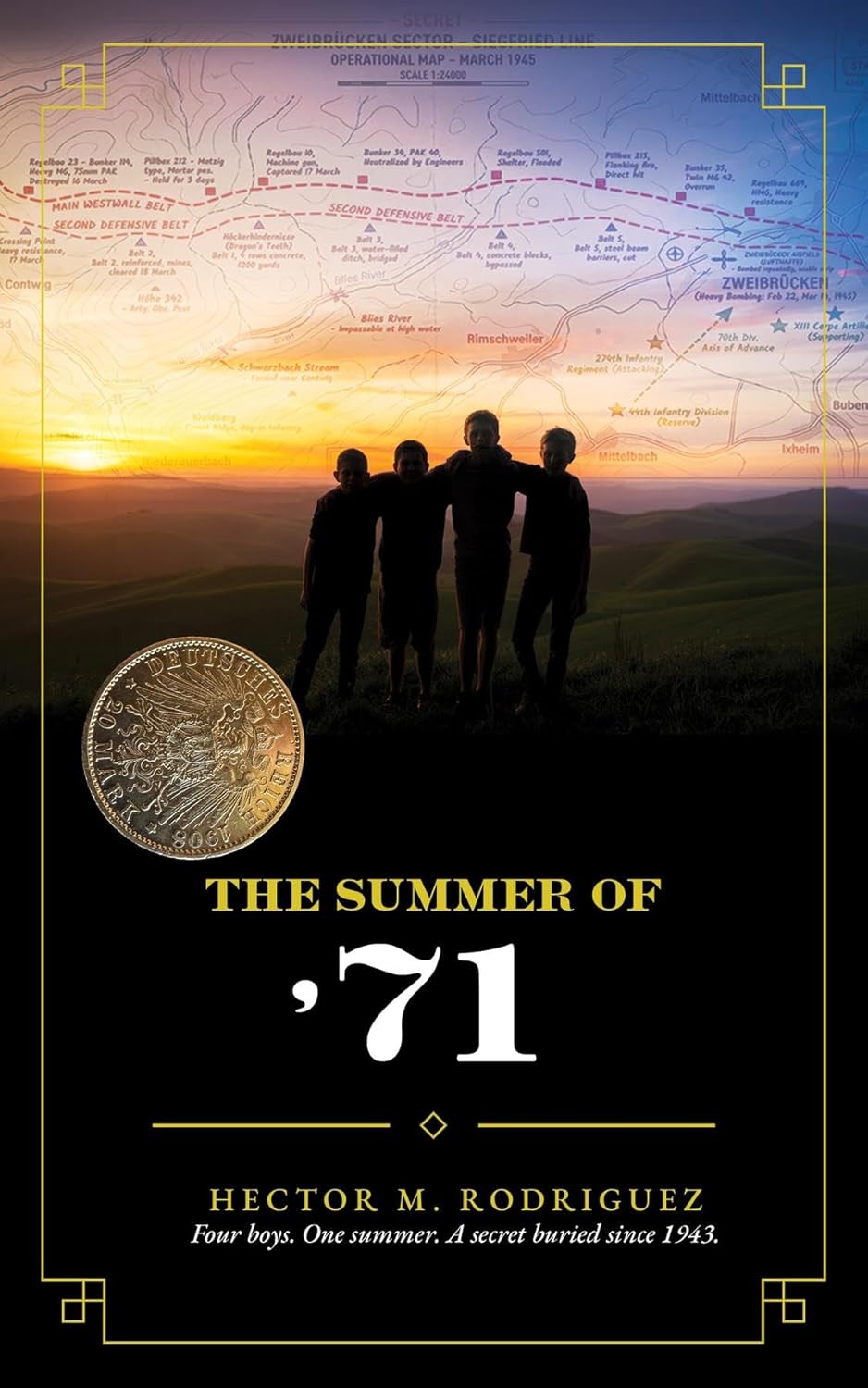

Hector M. Rodriguez’s The Summer of ’71 is a boyhood adventure told through the steady, reflective voice of a man who has spent most of his life trying to understand one summer in West Germany. Four military kids slip away from base, chase a rumor about a sealed World War II bunker, and find themselves carrying more than gold coins by the time they come home. It’s a story about friendship, military-brat life, old war wounds, and the strange way childhood can turn serious before anyone’s ready for it.
The book works because the boys feel specific. Galen watches and records, Bobby carries grief with quiet dignity, Rusty talks big but keeps going on a bad ankle, and Pascal moves through history like someone who already knows it has a pulse. Their banter feels natural, and their loyalty builds in small gestures rather than speeches. Bobby, especially, gives the story its emotional center. He’s the kind of kid who doesn’t announce that he cares. He just moves closer so he can catch someone if they fall.
Rodriguez gives the bunker scenes a strong, almost tactile atmosphere. The cold concrete, old tobacco smell, stopped clock, scratched walls, and buried ammo can make the past feel close enough to touch. The inscription “I was here. I loved her.” becomes one of the book’s quiet anchors, turning a wartime relic into something human and intimate. The gold coins matter, but the deeper treasure is the way the boys begin to understand that history is made of people who were scared, loyal, lonely, brave, and unfinished.
The novel also has a tender understanding of military families. It captures the odd mix of freedom and instability that comes with growing up on bases, where friendships form quickly because everyone knows time is limited. The boys’ secret becomes a bond they carry into adulthood, and the later chapters give that bond real weight. When the narrator looks back and says, “I wouldn’t change a single step,” it works because the story has earned that feeling.
The Summer of ’71 is warm, suspenseful, and deeply personal. It reads like a memory that’s been protected for decades before finally being set down on the page. Rodriguez turns a childhood expedition into a meditation on grief, duty, friendship, and the things people leave behind for others to find. It’s a heartfelt book with a strong sense of place and a sincere respect for the past.
Pages: 130 | ASIN: B0GX2X8NNZ



