Blog Archives
A Fresh Start For Humanity

Tim Rees’ Original Earth: Book One follows the last survivors of humanity who have, for generations, drifted through space and now, after their ship is sabotaged, are forced to land on what they now call Earth 2. What was the inspiration for the setup of your story?
What a great question! Thank you for asking it.
I live very near a beach in Wales called Freshwater West. It’s a beautiful beach and I walk on it pretty much every day. Whilst walking on this one beach in Wales, I will see the debris of humankind. Our rubbish. Manmade items that have no place in the natural world. I am constantly being shocked by what I see in this very small corner of the world and this is just one beach. I’m sure you could walk on every beach in the world and experience shock and horror at what we’ve done. And what I see is of little consequence to the bigger picture. What is the rubbish made of and where do we get the materials to make the rubbish in the first place, that’s the bigger picture. And, of course, I’m only scratching the surface here… So, to keep this short, I find myself gasping on the same question every day: imagine how beautiful this planet would be without humans?
I’m a novelist and my tools are words, so the story evolved upon the question: imagine if we were offered a new, uncontaminated planet and a fresh start, how would I, as an author, wish to see humanity move forward…?
And I wanted the main character to be an individual in perfect harmony with the natural world, so through that character I could play with scenarios and ideas about what it must feel like to be truly in harmony with nature and with all my fellow natural beings.
One of the things that stands out in your novel is the complex relationships of the survivors as they try to rebuild a life on this new planet. What aspects of the human condition do you find particularly interesting that could make for great fiction?
I like your use of the term ‘human condition’, because we live in societies where we are conditioned to live in particular patterns and aspire to particular goals. I could go on, but let’s keep this simple. On the spaceship, everyone was forced to live together in a sterile, confined space. They knew no different, so it wasn’t really a problem, that is, until they were exposed to the hope or the opportunity to explore their own dreams and aspirations. They land on a planet without any experience of how to live in the ‘real’ world. They are completely innocent, except for information and data they have with regard Original Earth. So I asked myself the question: where do these people begin to build a community into a free-thinking society? To begin to answer that question, I reflected on a passage in a previous novel I’d written called Delphian. In the novel there is this relevant passage:
For some reason his thoughts always ended up at the same questions: society and establishment; two words describing the maze of structure created to protect and enable the vast variety of people to live in apparent harmony. His mother had put it perfectly when she’d said: ‘People are different shades of colour, darling, and too often the colours clash.’ She was so right. Different shades of colour. Beautiful. Different shades of personality in a rainbow of dreams, aspirations, hopes and desires… It is we, collectively, who accept terms like human resources, for instance. It is we who put up fences labelled ideology and either stand on one side or the other and proclaim this is right and that wrong…
As an author, I’m hugely excited to explore this landscape. No spoilers, but in books two and three you see those colours naturally coming together and blending, whilst other colours clash and pull apart. I leave that very much to the characters to play out. I’m in discussion with a film producer at the moment, not for Original Earth, but another story, but he complimented me on the fact my scenes breathe. I know what he means, but I don’t create that, the characters do.
What themes were particularly important for you to explore in this book?
That’s an easy question. The damage we have done to planet Earth. The damage we have and are continuing to do to ourselves, because, whilst we poison the planet, we also poison ourselves. And the damage we have done and continue to do to the planet and all other life forms with whom we share this space has to stop, because we only have this one planet. I write fiction so can imagine exploring different worlds, but will humanity survive our collective suicide in order to really explore other worlds?
Where does the story go in the next book, and where do you see it going in the future?
Anu grows closer to Sonri and together they will explore the universe. You already see that in books two and three and in all the planets Anu visits you’ll see a reflection of humans on Earth. For instance, in book three Anu visits a planet run by a humanoid species governed by a repressive, authoritarian ideology similar to Afghanistan and the Taliban – Anu, of course, liberates the women in that society. In book four, the novel I’m currently writing, Anu returns to Original Earth about 150 years in our future. Planet Earth is unrecognisable.
I think in the back of my mind, I always had the idea I’d like Original Earth to evolve in a similar way the stories of Star Trek must have for Gene Roddenberry.
Author Links: Facebook | Instagram | Threads | TikTok
Now, armed with some knowledge of the complex relationships that exist between both fauna and flora – all life with whom we share this incredible planet – what lessons have we learned?
This is a story about a new beginning…
Anu has a gift: her personal vibration is in perfect harmony with the natural world.
Tim Rees’ Original Earth: Book One
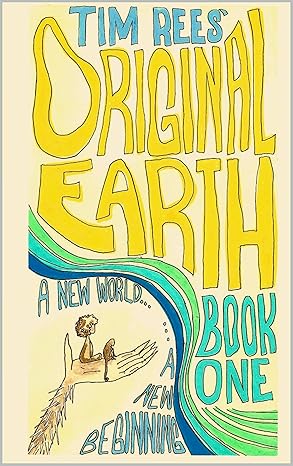

When I opened Tim Rees’ Original Earth: Book One, I expected a familiar survival tale. Instead, I found an emotional journey that runs from the claustrophobic passages of a crippled starship to the harsh beauty of an alien planet. Humanity’s last thousand survivors drift in space for generations before sabotage forces an emergency landing on a world they call Earth 2. Tim Rees explores not just survival, but whether people can truly change when given a second chance. At the heart of it all is Anu, an eight-year-old girl whose honesty and quiet courage cut deeper than the words of most adults.
The opening chapters carried a warmth that drew me in. Anu’s algae-block “strawberry” breakfast was both sweet and heartbreaking, and it showed me how well Rees balances innocence with underlying loss. That sense of comfort didn’t last. The sabotage of the algae vats shattered it in an instant. The frantic scramble to abandon ship, paired with Juno’s ruthless grab for power, made me feel just how fragile their world had always been.
The landing on Earth 2 was one of the most striking sections for me. Rees describes grass beneath bare feet, birds overhead, and the shock of real air with such vividness that I felt the settlers’ exhilaration. Yet he cuts that wonder short with the sudden appearance of a dinosaur-like creature, a jarring reminder that this new world is as dangerous as it is beautiful. Survival becomes grueling, and the endless cycle of hunting, gathering, and securing water presses heavily on every page. Rees captures that grind with a stark honesty that left me uneasy but deeply invested.
For me, Juno’s tightening grip was one of the most unsettling parts of the book. His obsession with water control felt alarmingly real, and it made me think about how fragile any society can be when power rests on basic needs. At the same time, I found myself drawn to Emrys and Onua’s struggle to hold their family together, even as Onua’s injuries dragged them down. What struck me most was Anu’s quiet strength in these chapters. Watching her comfort her brother with a maturity far beyond her years was both moving and painful.
The latter portion of the narrative resonated with me. The pages carried betrayals, losses, and a sliver of hope that felt almost too fragile to hold. Anu’s reflection near the end on what survival truly costs stunned me. It wasn’t neat, and it wasn’t reassuring. Rees doesn’t hand out easy answers. Instead, he leaves us with the harsh truth that humanity has to keep trying, even when the odds feel impossible.
Tender and tense, Tim Rees’ Original Earth: Book One blends discovery, danger, and humanity’s flaws with remarkable honesty. For readers who love survival stories with heart and grit, this book delivers.
Pages: 338 | ASIN : B0DLPGDKQF

A Hug and an Open Hand
Origin Earth: Book One follows humanity’s last survivors as they land on a new planet, where a curious young girl, her scientist mother, and a divided crew must decide who will lead and whether history will repeat itself. How did you approach balancing the science and environmental ethics with the human drama?
First and foremost, a novel has to entertain. That is its primary function. Without entertaining the reader, the story will not be read. So, introducing science and environmental ethics into a story at the beginning was something I considered at length. It is the main reason Anu is eight years old – innocent, yet old enough to understand, and her innate curiosity would ask questions. My thinking was, if I can get the reader to embrace Anu, she can explain the science with simple clarity. For me, it all rested upon Anu’s shoulders right from the first line. Every novel I have written, I have placed complete trust in the main character(s). In the first novel I wrote, Raw Nerve, I learned quickly that, as the author, I needed to sit back, shut up, and let the characters get on with telling their story.
As an author, I’ve learned to set the stage, people that stage with characters and trust in the creative process. Put a bunch of people together and you’ll end up with drama.
For me, every aspect of a novel has to be believable, regardless of genre. If a reader can believe, then the writer can capture the imagination, and through the imagination, the characters can tell the reader anything, literally – excuse the pun, couldn’t resist.
Juno’s distrust of authority feels timely. Were you consciously drawing from modern political tensions?
Absolutely, and also historical leadership, or rather, lack of. I recall a line in another novel I wrote, where the character stated, “There’s no such thing as good and evil, there’s just people.” Juno is clearly a bully, and, not wanting to spoil book two for the readers, but that stems from a bullying father. His ego blinds him. In my life, I’ve met many very interesting individuals, and the few who have left the most powerful imprint on me are the people, men and women, who don’t have anything to prove to anyone. These are individuals who can sit in the midst of chaos and smile and offer a helping hand where needed. I call them powerful, because they are people who have no desire to impose their perspective or opinion on anyone else, unless asked, and then they’ll offer it with a hug and an open hand without attempting to influence or control any particular outcome. These people are powerful because they are comfortable in their own skin. On the other hand, there have been dangerous individuals I’ve met who feel they have everything to prove to everybody and use their own ego to batter others over the head with their opinion, their hate, and their neurosis in whatever form that neurosis takes.
The human community on Earth 2 faces huge challenges, and when we confront challenges, bonds are forged. I personally fought in a war, and the bonds that were forged with the men I stood shoulder to shoulder with are unbreakable; the strongest relationships I have yet experienced. Regardless of faith, political ideology, or race, the bonds are forged upon respect. In the First and Second World Wars, men and women forged bonds on the battlefields and at home in the communities. Immediately after the conflict had ended, the people helped each other (I’m considering community/society in the UK). They pulled each other up, often by the scruff of the neck, and the whole family/community would benefit. In large part, I would argue, that was due to the bonds forged during serious hardship. Communities and society as a whole grew stronger due to those brutal times. Back to the community on Earth 2, or The Sanctuary, as the phen call the planet. They have a blank canvas, a new page, if you like. These people really do begin a new life and have the freedom to write their own future. And as I write, the conflict within the community grows – how do they set up this new society so they can all live together in freedom? One individual wants to pull in one direction and another in the opposite direction… I don’t want to spoil the story for the readers, but I’ll explain one very simple scenario to clarify:
A couple of people are killed by alligators or crocodiles. Individuals stand up and demand weapons. These are people who stand up with good in their hearts because they consider it their duty to protect the community. Anu is their only contact with the phen people, who have very advanced technology, and they have seen that the phen people have shared some of their technology with Anu. So, it is through Anu that they demand the phen people help them with weapons. Anu simply asks how many other individual life forms do they want to kill…?
Just as an aside: only the other day, I was reading an article about Gaza. I imagined Anu asking me what it was about. I scratched my head and tried to explain as best I could about hate about what causes hate, and how it drives people to do awful things. I began to explain the word genocide, but she stopped me. She had tears in her eyes and just looked at me in the inimitable way she does and said: “Humans. I don’t like humans.” Then she leapt up into the trees to be with the mantou. Anu has the gift of telling me in very few words what the problem is.
Phoos, the phen president in the novel, says, “With knowledge comes understanding…” Is that true? I think in a future novel, she’ll need to revisit that statement.
What is the next book that you are working on, and when will it be available?
I’ve been redrafting a novel I wrote over ten years ago. It’s a thriller set in Wales. Actually, it’s more about preparing a second edition rather than a redraft. I used terms like smartphone, which is very dated now, so it’s been about cleaning up little things like that. I’ll publish the second edition within the next week or so, and then it’s onto book four of Original Earth. I’m hugely excited about where Anu is taking the story in book four, because, spoiler alert! We’re returning to Original Earth around about one hundred and fifty years in the future. What will she discover? Is Earth a cinder? Have humans survived? If so, how have they survived? What sort of societies are there? Are humans still at war? Is there any habitat left for other life forms (beings)? … So many questions, and it’s going to be great fun to spend time on, what I can only imagine will be a very different planet Earth than the one we exist in today. And, of course, I get to spend a lot of valuable time with Anu and Sonri … My plan is to publish early next year. Possibly January.
And, yes, there will be a book five, six, seven, eight, etc.
Author Links: Goodreads | Facebook | Instagram | TikTok | Amazon
Now, armed with some knowledge of the complex relationships that exist between both fauna and flora – all life with whom we share this incredible planet – what lessons have we learned?
This is a story about a new beginning…
Anu has a gift: her personal vibration is in perfect harmony with the natural world.



 LITERARY TITAN