Blog Archives
A Product of Creative Storytelling

Voyagers: Homeland to Heartland follows a Norwegian immigrant family’s journey from the rugged valleys of Norway to the windswept prairies of Nebraska. What first drew you to transform your family history into fiction rather than memoir or nonfiction?
Though Voyagers: Homeland to Heartland is based on a true account with actual events taken from historical records, family journals, diaries, letters, and various personal collections, much of the dialogue and sensory detail is a product of creative storytelling.
I believe this blend of fiction and nonfiction became a more honest vessel for ancestral memory than the half-stories that are often passed down through generations. The split between fact and fiction wasn’t a chasm; it was a braid, the strands made stronger when entwined.
Faith steadies many characters, but it doesn’t spare them grief or moral difficulty. How did you approach writing spirituality without turning it into easy reassurance?
It was important to show how faith shaped the characters’ lives while also shining a tender light on their struggles, vulnerabilities, and gradual acceptance of their circumstances. This was never a story about an easy existence, but more about perseverance and resilience in the face of hardship.
The vignette structure richly details episodes across generations and suits the material but creates its own challenges. How did you decide what each vignette needed to do for the larger story?
I structured the vignettes to carry readers through the family’s joys, sorrows, struggles, and hardships. My hope was that these detailed scenes would draw readers more deeply into the story.
The temptation was always to linger, circle back and revise, but I forced myself to move chronologically, as if pacing out a timeline on some empty stretch of prairie. The result was a quilt of moments, each square stitched with its own sorrow and hope, but together forming a collective resilience.
Omer’s loss and the family’s final reckoning with love, silence, and truth give the book its closing weight. What did you want that ending to feel like — resolved, aching, or something harder to name?
For the ending, I intentionally avoided a neat, predictable closure. The true family story was marked by tragedy, and Omer’s death brought long-buried conflict to the surface. I wanted the ending to hold both the raw pain of loss and the quiet resignation that followed. There was no real resolution—only acceptance, or perhaps the illusion of it.
On a deeper, more personal level, my grandmother and father were never given the chance to be heard. She was judged harshly for betrayal and yielding to a forbidden love. My father, marked by this scandal and set apart from his siblings by the color of his eyes and the curl of his hair, endured his own exile. The family’s solution was silence: no confession, no forgiveness, just an unspoken pact to let the wounds heal over time.
I spent my childhood observing the subtle choreography at family gatherings, the practiced dance that ensued whenever painful topics entered the conversation. I learned early that stories had the power to heal, but also that the wrong story, or an incomplete one, could wound the very soul. In writing Voyagers, I was not only giving voice to my ancestors but also breaking the pact of silence that had defined my family for a century. Every word became a kind of restitution.
My goal was never to rewrite history, but rather to restore it: to take the faint, wavering outlines of my family and thicken them until they could be seen in all their flawed fullness. The book’s conclusion, though unresolved, felt honest. There was no final reckoning, only the hard-won acceptance that sometimes comes after loss.
What I desired most was for my grandmother and father to finally be heard—to have their true selves, in all their complication and contradiction, stand tall and unashamed. In the name of propriety, their stories had long been silenced—until now. I wanted to give them a voice; they waited nearly 100 years for the truth to be told.
Author Links: Website | Amazon
Rooted in the author’s own heritage, the story follows Kittil and Marte Dyrebu as they leave behind everything familiar-family, language, and homeland-to chase the promise of opportunity in America. Their passage across the Atlantic is only the beginning. What follows is a lifetime of perseverance: carving a home from raw prairie, enduring devastating storms, profound loss, quiet joys, and the relentless demands of frontier life.
Told through richly detailed vignettes, Voyagers weaves together the lives of parents and children, siblings and spouses, revealing how love, faith, and tradition are carried forward even as circumstances change. From intimate moments around a family table to life altering crossroads shaped by duty, sacrifice, and longing, each generation faces its own tests-yet remains bound by shared memory and resilience.
At its core, Voyagers is a tribute to storytelling itself: the way stories preserve identity, heal grief, and connect past to present. It is a novel for anyone drawn to historical fiction, immigrant journeys, and the enduring power of family legacy.
Both tender and unflinching, Voyagers honors the courage of those who came before-and the stories that continue to shape who we are.
Voyagers: Homeland to Heartland
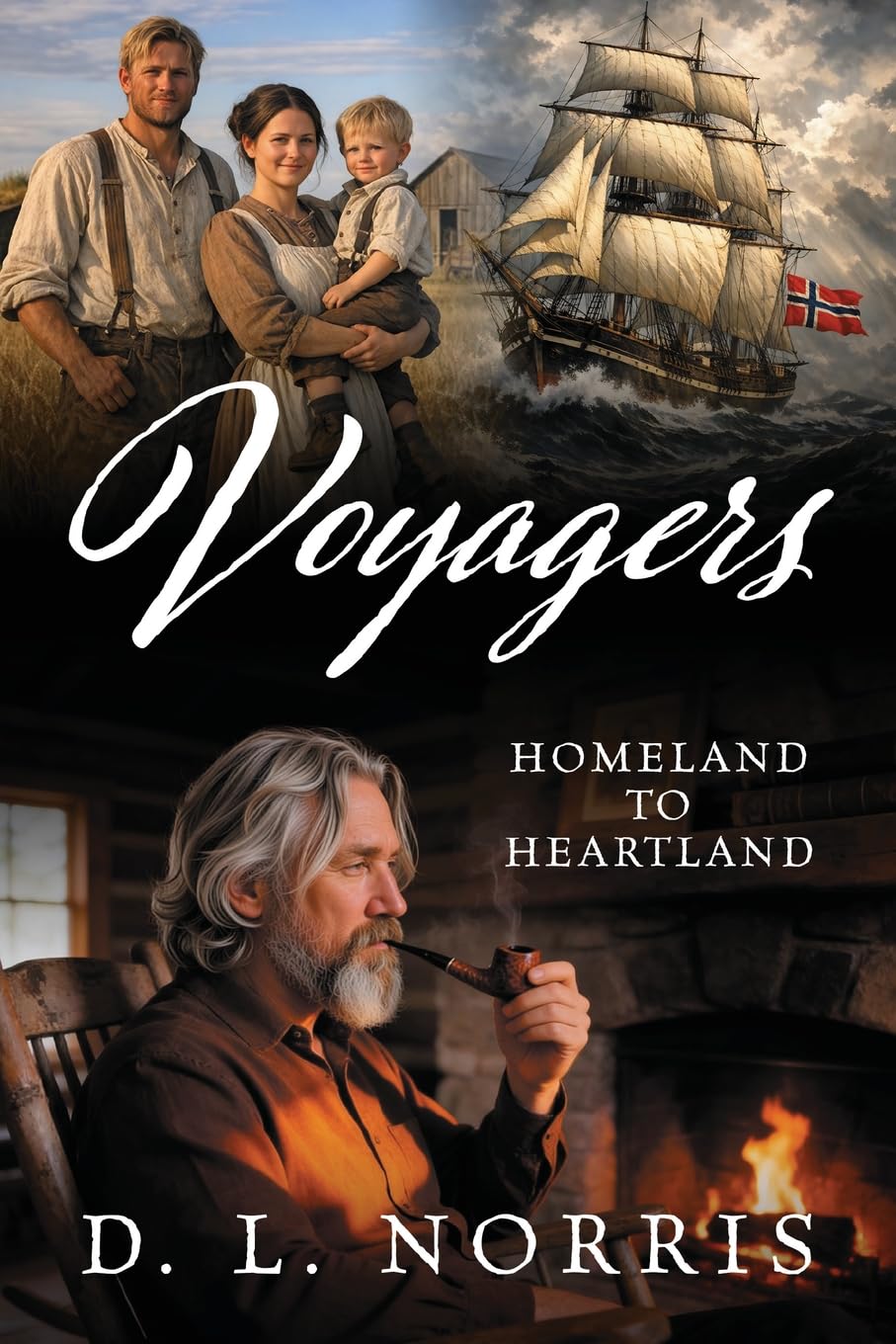

Voyagers: Homeland to Heartland is a tender family saga about Norwegian immigrants carrying memory, faith, and stubborn hope from the old country into the American Midwest. Author D. L. Norris follows Kittil, Marte, and their descendants through prairie hardship, household rituals, courtship, grief, weather, work, and inheritance, moving from the dream of America to the complicated reality of building a life there. The book lingers on objects and moments that become emotional anchors: Marte’s rocking chair, Otto’s care for the calf and Porker, Mathea’s rare smile, Snip’s arrival, the Schoolhouse Blizzard, Sophia’s difficult marriage, Omer’s heartbreaking loss, and the family’s final reckoning with love, silence, and truth.
I liked the book’s sincerity. It has the feeling of someone opening a family trunk and taking out each folded memory with both hands. The early chapters especially worked on me: Marte sitting in the old chair, half in Nebraska and half in Norway, made the immigrant ache feel physical rather than abstract. I also found Otto’s gentleness genuinely moving. His devotion to Porker could’ve been sentimental, but the scene carries a hard little lesson about farm life, love, and necessity. The book understands that tenderness doesn’t protect anyone from loss. Sometimes it only teaches them how deeply they can feel it.
The writing is at its best when it slows down and trusts domestic detail: bread cooling on the counter, a child watching from a window, a train pulling into the station, a yellow telegram darkening the kitchen. Some chapters lean into summary or moral reflection. Still, there’s a steadiness to the voice that suits the material. The ideas are plainspoken but not shallow: heritage is a blessing and a burden, faith can steady a person without saving them from pain, and family loyalty can become either shelter or silence. Sophia’s storyline, especially, gives the book a darker grain. Her struggle to honor her heart, then later to protect her children, complicates the warmer immigrant-family portrait in ways I appreciated.
By the end, I felt less like I’d read a plotted novel than like I’d spent time inside a family’s remembered weather, its storms, hymns, kitchens, funerals, and stubborn acts of love. Voyagers is heartfelt in a way that feels earned, and its best passages carry the quiet ache of people trying to keep the past alive without being trapped by it. I’d recommend it to readers who enjoy multigenerational family stories, immigrant history, Norwegian American heritage, faith-inflected historical fiction, and books that value emotional inheritance as much as outward adventure.
Pages: 196 | ISBN : 1977290469



