The Cycle of the Serpent
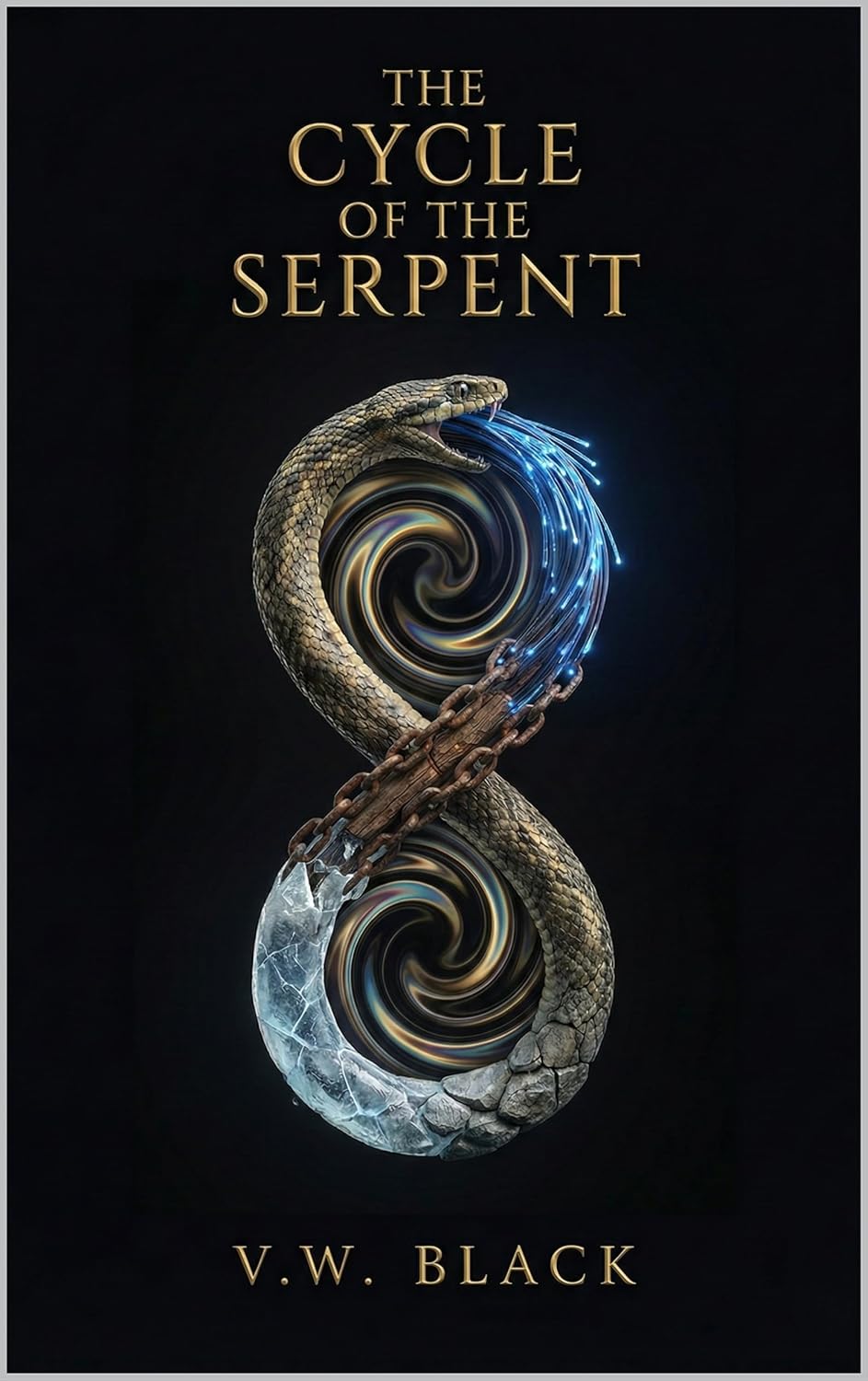

V.W. Black’s The Cycle of the Serpent is a dark speculative anthology built around eight historical collapses, from the Ice Age steppes to Ur, Pompeii, Viking fjordlands, plague-era France, the Dust Bowl, wartime Europe, and a near-future AI tower. In each era, humanity’s cruelty, greed, or complacency summons, or releases, a corrective force through a marked “vessel,” asking whether civilization needs a monster to keep it from becoming one. The book frames its recurring infinity-loop scar as both curse and indictment, a serpent eating its tail across time.
I was impressed by how bluntly moral the book is without feeling simple. Its premise could have turned into a procession of punishments, but the stronger sections complicate the judgment: the “correction” is terrifying, often excessive, and yet the societies it visits have already made ordinary mercy feel endangered. Author V.W. Black writes catastrophe with a tactile nastiness; the cold has weight, dust has teeth, and heat becomes almost juridical. I liked that the book’s horror often arrives through systems before it arrives through spectacle: ledgers, hierarchies, raids, feasts, algorithms. The monster is only the final grammar of a sentence humanity has already been writing.
I enjoyed how fully the book commits to its intensity. The moral architecture is clear, purposeful, and severe, giving each chapter the force of a parable without flattening it into a lesson. The anthology structure turns repetition into ritual: the same scar, the same failure, the same awful question returns in different costumes, and by the final book, where the cycle mutates into technological apocalypse, the pattern feels less like a device and more like a diagnosis. I admired the book most when it let small human gestures resist the grand machinery: someone sheltering a child, preserving a tool, keeping a hearth alive. Those moments give the darkness its necessary filament of light.
I’d recommend this to readers of historical fiction, horror, apocalyptic fiction, dark fantasy, science fiction, and dystopian fiction, especially anyone drawn to stories about collapse, punishment, and the dangerous romance of judgment. It has the historical sweep and doom-laden recursion of Max Brooks by way of Clive Barker, with a harsher, more elemental appetite.
Pages: 412 | ASIN: B0GKFKKB4Q


Posted on May 1, 2026, in Book Reviews, Five Stars and tagged anthology, author, book, book recommendations, book review, book reviews, book shelf, bookblogger, books, books to read, ebook, fantasy, fiction, goodreads, horror, indie author, kindle, kobo, literature, nook, novel, read, reader, reading, story, The Cycle of the Serpent, V.W. Black, writer, writing. Bookmark the permalink. Leave a comment.



Leave a comment
Comments 0