Blog Archives
The Voice of Cuba

The Voice of Cuba by Amarilys Gacio Rassler is a collection of fiction, drama, poetry, and nonfiction centered on Cuba, political oppression, exile, faith, and the difficult work of building a life in a new country. Rather than treating Cuban history as something distant or abstract, Rassler brings it into family homes, prison cells, airports, classrooms, and makeshift rafts. The book moves across decades and points of view, but its emotional center stays consistent: ordinary people are trying to protect the people they love while forces larger than themselves reshape their lives.
The fiction contains some of the anthology’s most intense moments. “Seis Dedos, Six Toes” follows a young girl whose courage takes a shocking physical form, while “The Tree of Hope” portrays political prisoners struggling to preserve their dignity and faith under brutal conditions. “The Rafters” turns a family’s escape by sea into a painful story about sacrifice, and the play “From Worms to Butterflies” captures the confusion and heartbreak of a child leaving Cuba. Rassler often blends English and Spanish within the same conversation, so the language feels rooted in Cuban family life. Food, songs, religious expressions, nicknames, and familiar objects give the stories warmth even when the events become frightening.
The book reminded me of Cristina García’s Dreaming in Cuban, especially in the way both writers connect political history to intimate family relationships. García’s novel is more layered and stylistically experimental, moving among generations whose feelings about Cuba often conflict. Rassler’s anthology is more direct and testimonial. Her characters tend to speak clearly about freedom, faith, and the damage caused by the Castro regime. That directness gives the book the feeling of oral history passed from parents and grandparents to younger generations. It’s less interested in creating distance between the reader and the subject than in making sure these experiences are remembered.
What stayed with me most was the anthology’s movement from terror and separation toward memory, love, and cultural continuity. The nonfiction pieces near the end, including the funny and affectionate courtship story “Romance in the U.S.A.” and the tender “The Shoe,” show that exile contains awkwardness, humor, romance, and ordinary family negotiations alongside grief. Rassler’s writing is at its strongest when a small object or gesture carries a much larger history: a shoe touched by a mother, a guava-filled cookie, a pearl necklace, a song, or a shared phrase in Spanish. The Voice of Cuba feels personal because it is personal. It gathers stories that might otherwise remain inside individual families and turns them into a record of endurance, faith, and Cuban-American identity.
Pages: 129
Tales From the Texas Timberlands, Volume 2


Tales from the Texas Timberlands Volume 2, by J. Andrew Rice, is a fiction anthology rooted in East Texas life, family memory, faith, work, and community. Across five stories, Rice moves from a postwar sawmill and a woman’s unexpected wrestling career to city management, football coaching, and church ministry. The book has the feel of stories passed down on a porch, where personal history, local color, and moral reflection all sit side by side.
What stood out to me most was the book’s steady affection for ordinary people doing hard things. Rice writes with a clear respect for builders, teachers, coaches, public servants, church members, and family elders. The stories are often direct, sometimes almost plainspoken, but that plainness works with the material. It gives the book an unvarnished quality. I felt like I was listening to someone who knows these towns, these arguments, these little rituals, and these long memories. The writing doesn’t rush to impress. It takes its time.
I also appreciated the way Rice lets each story carry a lesson without making the whole book feel like a lecture. That balance isn’t always easy. At times, the themes are stated openly, especially around faith, leadership, character, and perseverance, but the best moments come when those ideas rise naturally from the characters’ choices. Mattie’s strength in “Red Hammer Body Slammer,” Guy’s principles in “Sawmill,” Kent’s public service in “The City Manager,” Gary’s mentorship in “Coach,” and the narrator’s church life in “When We All Get To Heaven” all point toward the same belief: people are shaped by work, place, faith, and the stories they inherit. That idea really resonated with me.
As Southern historical fiction and a regional short story collection, Tales from the Texas Timberlands Volume 2 will appeal most to readers who enjoy character-driven stories with a strong sense of place. I would recommend it to anyone who likes reflective small-town fiction, family-centered storytelling, faith-inflected narratives, and books that treat local history as something alive rather than dusty. It’s warm, sincere, and grounded. Readers who enjoy stories about legacy, grit, and community will find a lot to appreciate here.
Pages: 171 | ASIN : B0H2DKDV3Y

Shadows of the Archipelago: An Anthology of Philippine Mythological Creatures


Shadows of the Archipelago, by E. R. Escober, is a dark anthology that reimagines Philippine mythological creatures through tragic, emotionally heightened stories of love, terror, betrayal, and vengeance. Across tales centered on the Nuno sa Punso, Tikbalang, Manananggal, Diwata, Multo, mermaid, Batibat, and Aswang, the book treats folklore not as decorative mythology but as a living force: something old, wounded, and still watching from the edges of human life. These are monster stories, yes, but the deeper concern is often what people do to the misunderstood, the lonely, the beautiful, and the cursed.
I was struck by how insistently the book asks me to reconsider the word “monster.” Escober’s creatures are frightening, but they are rarely simple villains. The Nuno becomes a protector whose love is misread as horror; the Tikbalang’s violence grows from persecution and grief; the Batibat becomes less a random nightmare than a moral reckoning. The book’s strongest moments come when folklore and human cruelty collide, creating a kind of gothic pressure in which the supernatural is not the scariest thing in the room. I appreciated that the stories don’t merely parade legendary beings across the page. They give them sorrow, appetite, dignity, and doom.
The style is dramatic, sometimes operatic, and it leans into excess: curses crackle, grief burns, bodies transform, and love tends to arrive already shadowed by catastrophe. That intensity won’t be for every reader. But the book’s fervor also gives it its peculiar magnetism. It reads like folklore retold around a fire by someone who refuses to whisper, someone who wants each legend to feel less like an artifact and more like a warning pressed into your palm.
I would recommend Shadows of the Archipelago to readers who enjoy folklore, mythology, dark fantasy, supernatural horror, gothic tragedy, creature horror, and mythic retellings with a strong emotional core. Readers who admire the folkloric menace of Neil Gaiman or the culturally rooted darkness of Silvia Moreno-Garcia may find a similar pleasure here, though Escober’s work is more fevered and melodramatic in its delivery. This is a book for those who like their legends blood-warm, grief-soaked, and morally thorny.
Pages: 210 | ASIN : B0GP2QB14K
Generational Curses

Release & Be Free is an erotic anthology where desire becomes a gateway to healing, self-discovery, and freedom. Did you set out to write erotica with a spiritual dimension, or did that emerge naturally?
Great question. The answer is both. I was introduced to erotica writing by WAPUnleashed Publishing’s Facebook group years ago. I remember reading people’s stories and a comment, a woman said that they were just about sex, nothing else. And I was like, hmm. So I prayed on it and allowed God to work through me so we could create an erotic story with meaning, depth, and purpose. Which was very natural to me because all my writings have that spiritual element in them, no matter the genre I’m writing in. It’s intentional. Release & Be Free: An Enlightening Erotic Anthology was no different, the way it came out though, each story or scene was different, though, and inspired by my imagination, my life, personal experiences, and observation, all with divine assistance of course. For instance, “Mow Me Down,” I enjoy mowing lawns, and I started to connect with how lawn mowers cut grass that continuously needs to be cut, and that reminded me of generational curses, because I was going through learning and breaking some of my own at the time.
What did “liberation” mean to you when you began writing this collection?
Since Release & Be Free: An Enlightening Erotic Anthology is a collection of works written over numerous years, they all stem from my journey of wanting to be free to be me, like I was when I was in middle school before the noise, distractions, choices, and changes that growing up brought. Freeing myself from old habits, mindsets, and choices so that I could be the best Mother to my children, a good wife, focused on fulfilling my purpose without getting distracted, and loving myself in the way of support and encouragement that I’ve done for others for decades. Liberation also meant healing and forgiving, too. Ultimately, liberation meant I already have divine permission to be. Who I was. Who I am now. And who I am becoming. Daily.
The collection often treats body and spirit as inseparable. Were there specific experiences or influences that shaped that perspective?
I love this question. From my studying of the definition and etymology of spirit, along with years of living my life, helping others, and most importantly being open to higher learning from God. I’ve been shown that they are not separate. Spirit is inside of us, it is us, and one of the things that I was shown and that I teach is that the spirit is just one of our human functions, so to speak, that the body listens to, or follows, or chooses from. Our body follows the direction of our brain with our thoughts, our “heart” with our emotions (feelings), and our soul or spirit. The two need to be aligned, like one in thought, feeling, words, and spirit. When you are, your body follows, and that means less confusion, internal battles, or wars within yourself. More purposeful, intentional, and balanced living, from the head to the feet. We have our own spirit, or I should say the Creator’s spirit in us, which is why we can connect, sense, or see the spirit of others.
How has this book changed you as a writer, or what did you learn about yourself through writing it?
Release & Be Free: An Enlightening Erotic Anthology has joined the journey of me owning myself, being proud, and authentic about who I am and the work God has given me to do when it comes to intimacy. To help people remember and understand that sex is more than just sex. It is an exchange of energy; it has purpose, value, and importance. Therefore, it should be respected and talked about as such more, so that it won’t be abused anymore and used to hurt others.
Author Links: GoodReads | Facebook | Website

The Cycle of the Serpent
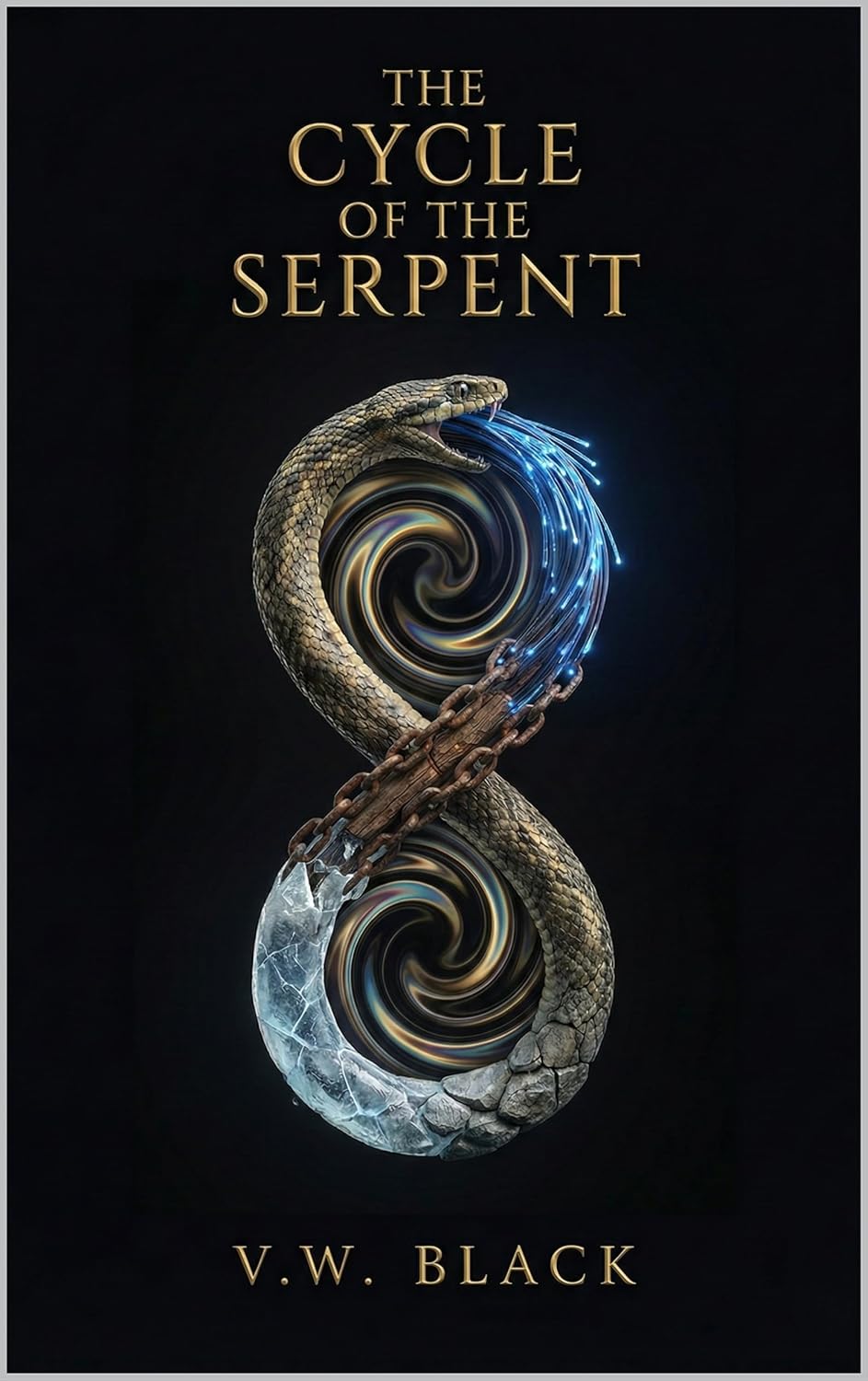
V.W. Black’s The Cycle of the Serpent is a dark speculative anthology built around eight historical collapses, from the Ice Age steppes to Ur, Pompeii, Viking fjordlands, plague-era France, the Dust Bowl, wartime Europe, and a near-future AI tower. In each era, humanity’s cruelty, greed, or complacency summons, or releases, a corrective force through a marked “vessel,” asking whether civilization needs a monster to keep it from becoming one. The book frames its recurring infinity-loop scar as both curse and indictment, a serpent eating its tail across time.
I was impressed by how bluntly moral the book is without feeling simple. Its premise could have turned into a procession of punishments, but the stronger sections complicate the judgment: the “correction” is terrifying, often excessive, and yet the societies it visits have already made ordinary mercy feel endangered. Author V.W. Black writes catastrophe with a tactile nastiness; the cold has weight, dust has teeth, and heat becomes almost juridical. I liked that the book’s horror often arrives through systems before it arrives through spectacle: ledgers, hierarchies, raids, feasts, algorithms. The monster is only the final grammar of a sentence humanity has already been writing.
I enjoyed how fully the book commits to its intensity. The moral architecture is clear, purposeful, and severe, giving each chapter the force of a parable without flattening it into a lesson. The anthology structure turns repetition into ritual: the same scar, the same failure, the same awful question returns in different costumes, and by the final book, where the cycle mutates into technological apocalypse, the pattern feels less like a device and more like a diagnosis. I admired the book most when it let small human gestures resist the grand machinery: someone sheltering a child, preserving a tool, keeping a hearth alive. Those moments give the darkness its necessary filament of light.
I’d recommend this to readers of historical fiction, horror, apocalyptic fiction, dark fantasy, science fiction, and dystopian fiction, especially anyone drawn to stories about collapse, punishment, and the dangerous romance of judgment. It has the historical sweep and doom-laden recursion of Max Brooks by way of Clive Barker, with a harsher, more elemental appetite.
Pages: 412 | ASIN: B0GKFKKB4Q
Unleashing The Power Within: A Journey of Self-Discovery Through Poetry

Unleashing the Power Within is a short, heartfelt collection of inspirational poems that moves through self-worth, recovery, faith, gratitude, nature, and personal renewal. Lisa McCarthy writes as someone who has suffered, endured, and come out the other side determined to speak encouragement over both herself and her reader. The book’s emotional arc gathers force as recurring ideas echo across the collection: breaking free from harm, setting boundaries, trusting intuition, reclaiming one’s voice, and finally rooting identity in God. What gives it shape beyond affirmation is the sense that these poems arise from lived experience, especially when the book turns personal in pieces like “My Freedom Day” and “From Silence to Self-Acceptance,” where liberation stops being an abstract slogan and starts to feel earned.
McCarthy isn’t trying to be sly or ironic, and that lack of distance gives the collection a disarming openness. When she writes about blooming “beneath the ashes and dirt,” or compares healing to pushing toward light, the imagery is simple, but it lands because she means it. I felt that again in the poems about the natural world, especially the red cedar trees, the Gulf of Mexico beach, the lavender fields, and those bright little “Golden Finches in the Rain.” Those poems briefly loosen the book’s grip on exhortation and let it breathe. They offer a quieter kind of restoration, and I found myself wishing there were even more of them, because McCarthy’s voice is often at its most vivid when she pauses long enough to really look.
McCarthy returns to the language of empowerment, destiny, courage, and self-belief. I respected the clarity of the ideas. This is a book deeply invested in healthy boundaries, in refusing negativity, in choosing gratitude, and in seeing survival not just as escape but as transformation. Even when the phrasing is familiar, the conviction behind it feels real, and that reality matters.
I read Unleashing the Power Within less as a formally ambitious poetry collection than as a personal testament shaped into verse, and on those terms it has genuine warmth and purpose. It’s a book about speaking kindly to the bruised parts of the self until they begin to believe they deserve light. I would recommend it to readers who want accessible, faith-tinged, emotionally direct poetry about healing, resilience, and beginning again. For someone coming through loss, self-doubt, or a hard season of change, this book could feel like a companionable hand on the shoulder.
Pages: 96 | ASIN : B0DBVC33S5

Be Wary of Wishes Gone Awry : Tales of Horror and Dark Fantasy

Be Wary of Wishes Gone Awry is a horror and dark fantasy collection that gathers six shorter pieces and a longer three-part novella, moving from sea-haunted myth and biotech dread to grief-soaked domestic horror. Across stories like “Sailor’s Warning,” “The Aberration,” “Dearest Diary,” and “The Enhancement,” author M. Ainihi keeps circling the same uneasy question: what happens when people reach for relief, certainty, progress, or love and get something warped in return. The book’s structure, split into “One-Shot Shorts,” “Slightly Bigger Bites,” and the closing “Miracle Baby,” gives it a steady build, with the final section carrying the heaviest emotional weight.
The book understands one of horror’s oldest pleasures: dread lands harder when it grows out of something ordinary. A sailor wants to finish a voyage and go home. A woman makes a greedy decision she cannot morally outrun. Someone wants the pain to stop. Someone wants to be more productive. Those setups are simple on purpose, and that works. The writing is often most effective when it stays close to a character’s physical unease, the heat of a fever, the sting of a wound, the metallic shock of blood, the hush before something awful fully shows itself. “Sailor’s Warning” especially caught me with its mix of folklore and fatalism, while “The Aberration” and “The Enhancement” feel like sharp modern horror, interested in guilt, ambition, and the cost of trying to correct what should maybe be left alone.
I also found myself noticing the author’s choices around control. That feels like the live wire running through the whole collection. These stories keep putting people in situations where they think they are making a practical choice, a smart choice, maybe even a loving one, and then the ground shifts under them. Sometimes that works brilliantly. It gives the book a clear identity and makes the horror feel grounded rather than random. I stayed interested because Ainihi is good at building atmosphere and at letting shame, grief, superstition, and obsession do part of the frightening work. The collection isn’t just creepy for the sake of being creepy. It wants to poke at human weakness.
I’d recommend Wishes Gone Awry most to readers who enjoy horror and dark fantasy that lean more toward mood, moral consequence, and unsettling imagery than nonstop shock. It should work well for people who like short fiction with a gothic pulse, creature horror with a human center, and novellas that sit in the uncomfortable space between sorrow and nightmare. I would especially recommend it to someone who enjoys horror that feels reflective after the scare.
Pages: 173 | ASIN : B0GN3KCB59
More Other Such Matters

Fella Cederbaum’s More Other Such Matters is a book of spiritually searching poems that circle around identity, love, mortality, truth, and the terrible persistence of the thinking mind. The collection moves less like a narrative than like a sustained act of inquiry, each poem worrying at the same great questions from a different angle until they start to glow. Again and again, Cederbaum turns to direct address and cascading questions, asking what remains when profession, doctrine, self-image, fear, and even opinion fall away. Poems like “Before You Were You,” “Faith,” “The Knower And The Known,” and “The Mirror” make the book feel like both a meditation manual and a private reckoning, though its strongest moments are more intimate and embodied than abstract.
What struck me most was the book’s unusual combination of severity and tenderness. Cederbaum can sound almost admonishing, as if she’s trying to shake the reader awake, but there’s warmth under that urgency, and often a real ache. I felt that most sharply in poems where the philosophical pressure gives way to something bruised and personal, like the old tears in “Love Broke Through,” the lonely vastness of “One Single Tear,” or the quietly devastating recognition in “What I Thought I Wanted,” where imagined identities keep turning bland in the hand. Even the more playful poems, especially “My Universe of Cheese,” have that same undercurrent: delight laced with metaphysical impatience. I admired the refusal to settle for easy consolation. This isn’t poetry interested in decorating experience. It wants to strip experience bare.
The book is most effective when its style becomes genuinely musical. Cederbaum has a real instinct for repetition, for the pressure of a recurring phrase, for the way a question can become its own rhythm. Her best lines have lift and clarity, and her images can be surprisingly memorable, as with the orchid and the daisy, the cat as a silent teacher in “Medical Journeys,” or the mirror that keeps changing with praise, desire, and self-doubt until the poem lands on a wiser, steadier truth. The poems return often to oneness, surrender, and the unreliability of thought. But even then, the voice is unmistakably authentic.
I found More Other Such Matters earnest, searching, and often deeply affecting. It’s a book less interested in polish than in penetration, less interested in literary coyness than in saying the largest things as plainly as possible. I think readers drawn to spiritual poetry, contemplative writing, and emotionally candid meditations on selfhood, love, and impermanence will find a great deal here.
Pages: 156 | ASIN : B0FR37DNSZ


