Blog Archives
A Planetary Immune Response

The Cycle of the Serpent follows a cursed mark across eight eras of human collapse, as each civilization’s greed, violence, and complacency awakens a monstrous force that asks whether judgment can save humanity or doom it. What drew you to the idea of linking historical collapses through a recurring supernatural “correction”?
My background is in systems engineering and biological sciences, so I tend to view history not as a linear progression of dates, but as a complex system of feedback loops. In biology, when a system becomes unstable or toxic, an immune response is triggered to preserve the whole. I wanted to apply that ‘systems thinking’ to human civilization. What if our recurring collapses aren’t just bad luck or political failure, but a planetary immune response? Linking these eras through the ‘Entity’ allowed me to explore the terrifying idea that humanity isn’t the master of the world, but a component that is subject to reset whenever our collective greed threatens the planetary baseline.
How did you choose the eight eras featured in the anthology, and were there any collapses you considered but left out?
I chose the eras based on the ‘Peak and Precipice’ rule. I wanted moments where a society felt it was at its absolute zenith, whether that was the survivalist triumph of an Ice Age tribe, the decadent peak of the Roman era, or the high-tech hubris of 2026. Each era represents a specific flavor of human failure: complacency, greed, or the blind pursuit of power. I did consider including the fall of the Khmer Empire at Angkor, as their water management systems are a fascination for an engineer like me, but I ultimately left it out to ensure the narrative felt geographically global and spanned a full 12,000-year arc without becoming repetitive.
How did you balance the moral clarity of the premise with the ambiguity of whether the corrective force is justified?
This was the most challenging part of the ‘Hard Science’ edge of the book. To the ‘vessels’, the individuals caught in the reset, the Entity is an unspeakable monster. It is violent, final, and seemingly cruel. However, from a systems and biological perspective, a forest fire is a catastrophe for the individual tree but a necessity for the health and future of the forest. I wanted readers to wrestle with that discomfort: Can you call a force ‘evil’ if it is the only thing preventing a species from completely destroying its own habitat? The ‘moral clarity’ comes from the recognition of our own flaws; the ‘ambiguity’ lies in whether we believe we deserve the survival we’ve been given.
What is the next book that you are working on, and when will it be available?
I am currently finalizing a project that feels like the natural, much darker, evolution of the themes explored in The Cycle of the Serpent. It is a work of autofictional cosmic horror, a narrative that bridges the gap between the grounded, high-stakes reality of the industrial engineering world and the existential dread of ancient, unknowable forces.
While The Cycle examined the macro-system of historical resets, this new work turns the lens inward. It’s an intimate, visceral look at what happens when a person who understands how the world is built begins to see the cracks in the reality behind it. I am still wrestling with the final title. While The Shadow of the Dragon has served as the working name, the story is demanding something that better captures its specific brand of suffocating intimacy. I am aiming for a Fall release in October 2026, a timeframe that feels appropriate for a story meant to be read as the days grow shorter.
Closing thought/statement:
I write for the reader who suspects that history is a series of resets, existence is a reincarnation trap, and that true freedom only begins when we stop being components of the system and find the hand on the control wheel.
Author Links: GoodReads | Instagram | Amazon
From the frozen steppes of 10,000 BCE to the glass towers of 2026, humanity has always faced the same test: When the resources run low, do we share, or do we hoard?
And eight times, we have failed.
In The Cycle of the Serpent, V.W. Black weaves a terrifying and beautiful tapestry of human history, revealing the secret mechanism that governs our rise and fall. In every age, when greed and cruelty reach a breaking point, an Entity awakes. It is not a god. It is not a demon. It is the immune system of the planet.
It chooses a vessel—a shaman in the Ice Age, a slave in Pompeii, a soldier in Stalingrad, a CEO in the future —and marks them with a scar in the shape of an Infinity Loop.
Through their eyes, we witness the moments when civilization breaks:
The Great Sleep: A shaman freezes the world to stop a tribe from eating its future.
The Obsidian Heart: A slave girl in Pompeii triggers Vesuvius to end the gluttony of the Empire.
The Plague Bearer: A peasant in Feudal France becomes the vector of the Black Death to balance the ledger of the rich.
The Legion Protocol: A tech CEO in 2026 uploads her rage to the cloud to break the digital wheel.
Spanning 12,000 years, this anthology is a dark, gripping exploration of the thin line between survival and extinction.
The library is closed.
The Cycle is ending.
Are you the Ninth Vessel?
The Cycle of the Serpent
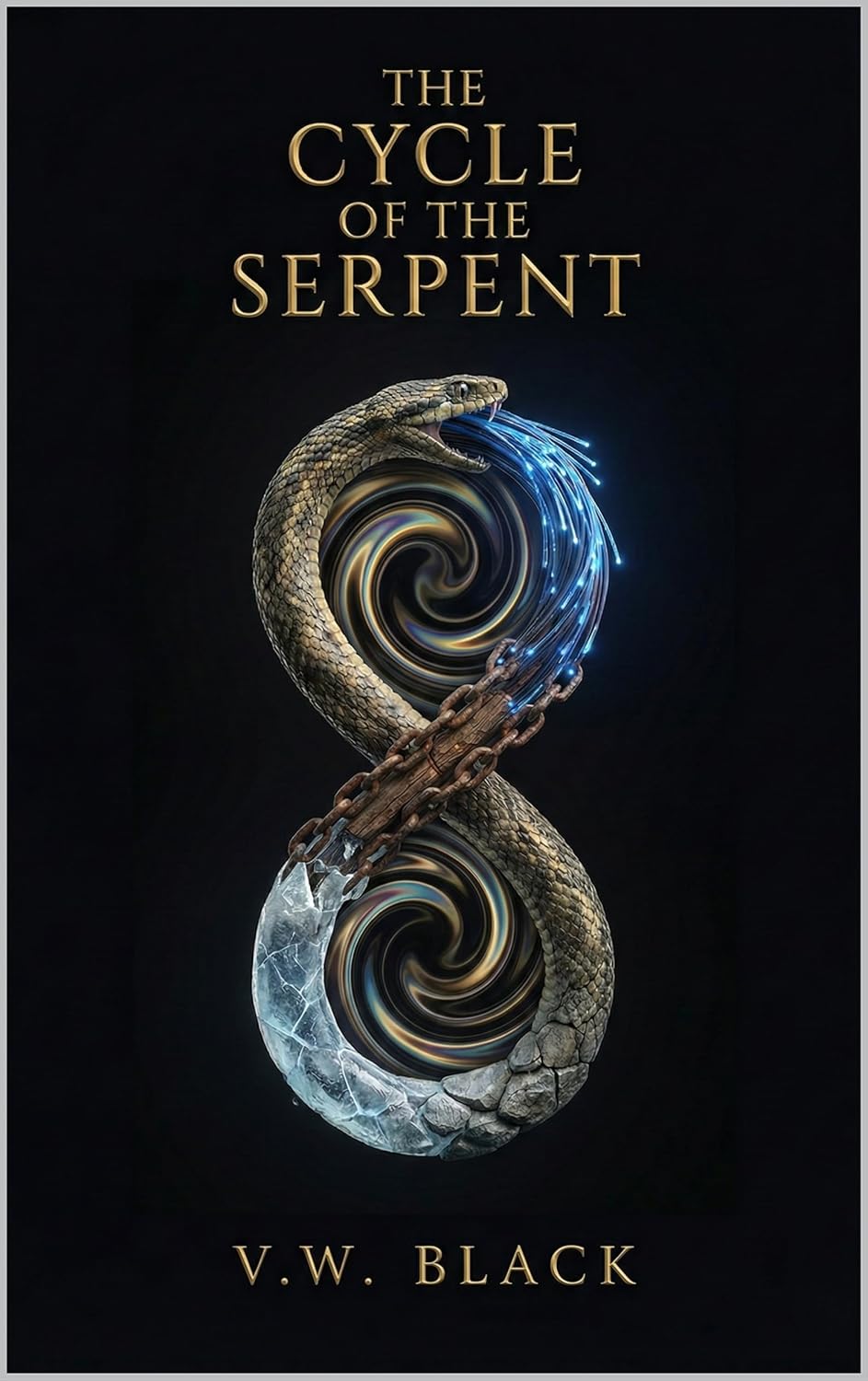

V.W. Black’s The Cycle of the Serpent is a dark speculative anthology built around eight historical collapses, from the Ice Age steppes to Ur, Pompeii, Viking fjordlands, plague-era France, the Dust Bowl, wartime Europe, and a near-future AI tower. In each era, humanity’s cruelty, greed, or complacency summons, or releases, a corrective force through a marked “vessel,” asking whether civilization needs a monster to keep it from becoming one. The book frames its recurring infinity-loop scar as both curse and indictment, a serpent eating its tail across time.
I was impressed by how bluntly moral the book is without feeling simple. Its premise could have turned into a procession of punishments, but the stronger sections complicate the judgment: the “correction” is terrifying, often excessive, and yet the societies it visits have already made ordinary mercy feel endangered. Author V.W. Black writes catastrophe with a tactile nastiness; the cold has weight, dust has teeth, and heat becomes almost juridical. I liked that the book’s horror often arrives through systems before it arrives through spectacle: ledgers, hierarchies, raids, feasts, algorithms. The monster is only the final grammar of a sentence humanity has already been writing.
I enjoyed how fully the book commits to its intensity. The moral architecture is clear, purposeful, and severe, giving each chapter the force of a parable without flattening it into a lesson. The anthology structure turns repetition into ritual: the same scar, the same failure, the same awful question returns in different costumes, and by the final book, where the cycle mutates into technological apocalypse, the pattern feels less like a device and more like a diagnosis. I admired the book most when it let small human gestures resist the grand machinery: someone sheltering a child, preserving a tool, keeping a hearth alive. Those moments give the darkness its necessary filament of light.
I’d recommend this to readers of historical fiction, horror, apocalyptic fiction, dark fantasy, science fiction, and dystopian fiction, especially anyone drawn to stories about collapse, punishment, and the dangerous romance of judgment. It has the historical sweep and doom-laden recursion of Max Brooks by way of Clive Barker, with a harsher, more elemental appetite.
Pages: 412 | ASIN: B0GKFKKB4Q



