The Happy High-Performing Lawyer: The Science and Practice of Well-Being and Sustainable High Performance
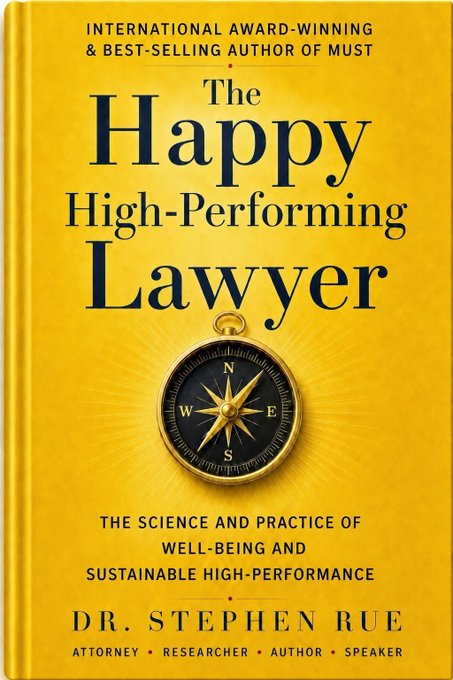

The Happy High-Performing Lawyer is built around a deceptively simple idea: professional success should be measured by more than visible achievement. Stephen Rue asks readers to look at the full record, including excellent work, client service, ethics, leadership, relationships, health, meaning, and the capacity to keep performing well over time. That idea gives the book its structure. It begins with the pressures that shape lawyers, from law school and billing models to workplace culture and personal habits, then develops a broader definition of flourishing before turning to the practical design of a sustainable career. The book’s central question is consistent from beginning to end: can a lawyer produce excellent work without steadily consuming the human capacities that make that work possible?
Rue makes that argument through an unusually broad mix of material. He draws on positive psychology, motivation and performance research, lawyer well-being studies, his own qualitative research with supervising and subordinate lawyers, decades of legal experience, personal stories, and recurring composite characters. Mary, Jonathan, Ana, Evan, and the others keep the research connected to recognizable moments: checking email before dawn, redoing an assignment because instructions were vague, watching an annual review collapse into a billable-hours number, trying to listen to a child while mentally revising an argument, or wondering whether a successful career still fits. The book also keeps moving responsibility to the level where it belongs. Sometimes the useful change is personal, such as sleep, boundaries, attention, recovery, or a better-aligned goal. Sometimes it’s relational, particularly in supervision and communication. And sometimes the workload, incentives, culture, or business system itself needs to change. Rue is careful about that distinction, which helps the book avoid reducing serious professional problems to a collection of self-care tips. His research is also presented with appropriate limits: he explains that his study is qualitative and that its findings aren’t meant to establish universal prevalence or simple causal claims.
I liked the book’s ability to preserve ambition while examining its costs. Rue clearly likes lawyers, respects difficult legal work, and takes competence seriously. That matters because his discussion of well-being is inseparable from judgment, ethics, service, development, and accountability. The later chapters are especially strong in showing how the ideas become concrete. Sleep and energy affect legal judgment. Boundaries are part of professional design. Strengths can become liabilities when overused. Goals need some definition of “enough.” Time affluence depends on usable, not merely empty, time. Career dissatisfaction should be diagnosed before someone assumes the whole profession is the problem. And supervisors shape performance through ordinary acts such as clarifying expectations, allocating opportunity, giving specific feedback, making it safe to surface uncertainty, and teaching toward independence. By the final chapters, the concept of sustainable performance has widened naturally into a question of legacy: not simply what a lawyer accomplished, but what that lawyer’s way of working strengthened or depleted in colleagues, clients, family members, institutions, and the lawyer.
I’d recommend this most strongly to lawyers who are outwardly doing well but have started wondering what their success is requiring from the rest of their lives. It should also be especially useful for partners, managing attorneys, general counsel, practice-group leaders, and anyone who supervises younger lawyers, because a substantial portion of Rue’s argument concerns the conditions leaders create for other people. Law students and newer lawyers could benefit from it too, particularly the sections on professional identity, career fit, motivation, and the hidden lessons embedded in legal training. The book is substantial and reflective, so it’s probably best read by someone willing to examine patterns. Its most useful contribution is a richer vocabulary for questions many lawyers already sense but may not have framed clearly: what is this career producing, what is it costing, what should be protected, what needs to change, and what kind of professional life is worth sustaining?

Posted on September 28, 2026, in Book Reviews, Five Stars and tagged author, book, book recommendations, book review, book reviews, book shelf, bookblogger, books, books to read, Dr. Stephen Rue, ebook, goodreads, indie author, kindle, kobo, literature, nonfiction, nook, novel, read, reader, reading, self help, story, The Happy High-Performing Lawyer, writer, writing. Bookmark the permalink. Leave a comment.



Leave a comment
Comments 0